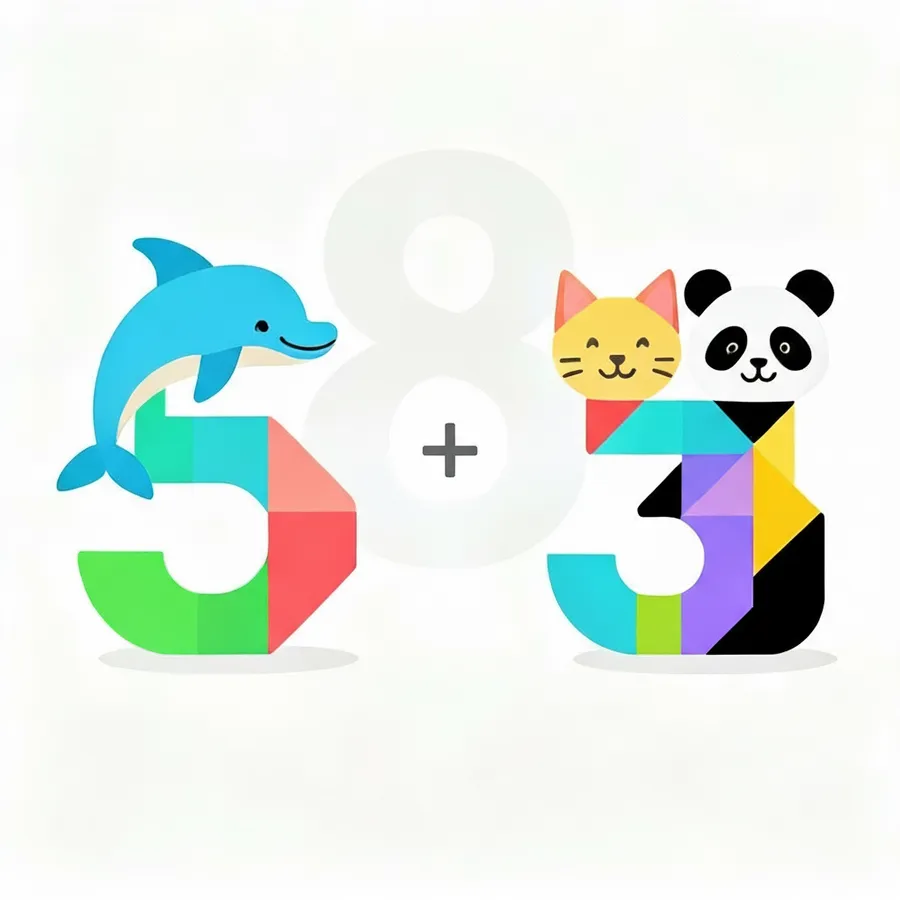
When children learn that 8 = 5 + 3 or 8 = 6 + 2, it may sound trivial at first. But this knowledge is not a nice extra – it is a central switchboard in their mathematical thinking: it connects counting strategies with flexible mental strategies, supports access to more complex operations, and can prevent later difficulties.
In the following, I will explain (1) recent scientific findings, (2) didactic principles and approaches, and (3) a Practice Box for parents and teachers – with concrete games and exercises.
1. Scientific Findings on Number Decomposition
1.1 Decomposition and Early Mathematical Competence
Number decompositions (also called part-whole relationships) are cornerstones of number sense and are strongly linked to the transition from counting to mental calculation strategies (Beutler, 2013).
In Grade 1, the part-whole concept is a central conceptual milestone: lack of understanding here is identified as one of the main reasons for math difficulties (Springer, 2023).
Wartha et al. (2023) show that children who master all decompositions up to 10 are much more secure in addition and subtraction. Number decomposition is not optional but essential.
1.2 Teaching Decomposition Strategies
Cheng et al. (2012): Teaching 5–6-year-olds decomposition strategies reduced reliance on counting and improved mental calculation.
Baroody & Dowker: Strategies such as “Make Ten” or doubles (e.g., 6+6) are core mental tools that replace counting.
The IES Practice Guide on Teaching Math to Young Children stresses that early math learning (ages 3–6) should actively promote decomposition and recombination of numbers.
1.3 Number Sense and Cognitive Foundations
Jordan et al. (2010): Number sense in preschool is a strong predictor of later math success, and part-whole relationships are central to it.
ANS studies show that approximate number skills strongly correlate with later precise arithmetic skills.
Anderson et al. (2021) developed a diagnostic tool for number decomposition in the range 1–20, proving its role as a measurable key competence.
2. Didactic Principles and Approaches
It is not enough to present “5 + 3 = 8” and let children memorize it. Good teaching combines understanding, structure, and automatization.
| Principle | Meaning / Implementation |
|---|---|
| Diversity of Access | Use dice patterns, dot fields, finger patterns, or abacus to make decompositions visible (Beutler 2013). |
| Explicit Strategy Instruction | Introduce strategies such as “Make Ten”, doubles, or decomposition + recombination explicitly (Baroody & Dowker). |
| Step-by-Step Abstraction | First use visual aids, then move towards mental strategies until automatized. |
| Short, Regular Practice | Frequent short exercises are more effective for automatization than rare long sessions. |
| Diagnosis & Differentiation | Use diagnostic tools to identify missing decompositions and target them (Anderson et al. 2021). |
| Error Culture | Treat mistakes as learning opportunities, provide immediate feedback, and reinforce correct decomposition. |
| Contextualization | Integrate decompositions into real tasks (“How can I make 10 out of 7+3?”). |
For example, the “power of five” approach uses decompositions like 8 = 5 + 3 to anchor numbers in familiar structures.
3. Practice Box: Games and Exercises for Parents and Teachers
3.1 At Home with Parents
Finger Decomposition to Ten: Hold out both hands (10 fingers). Place a pen between two fingers. Ask: “How many left / right?” (e.g., 6 + 4, 7 + 3). Later, do it mentally.
Dot Cards: Show cards with dots (e.g., 8 as two groups). Ask: “How can we decompose this?” Encourage multiple decompositions (8 = 1+7, 2+6, 3+5…).
Number Friends Memory: Pairs of cards: one shows “5+3”, another shows “8”. The child must find matching pairs.
Everyday Math Talk: In daily life (“We have 8 candies, I give you 3, how many left?”), encourage children to verbalize strategies (“8 = 5+3, minus 3 leaves 5”).
3.2 In the Classroom
Decomposition Circles: Visual charts showing how each number can be decomposed.
Decomposition Domino: Cards matching sums and decompositions (e.g., “5+3” matches “8”).
Calculation Paths: Tasks that guide children to strategically decompose numbers (e.g., 7+8 → 7+3+5).
Digital Apps: Use apps that provide feedback and adaptive practice.
Partner Work: Children discuss: “Which decomposition should I use to make 10 first?“
3.3 Diagnostics & Differentiation
- Use tools like Anderson et al. (2021) for targeted support.
- Differentiated exercises can range from simple decompositions to flexible recombination strategies (Schulze, 2022).
4. Conclusion
Number decomposition is not an extra step, but a crucial bridge between counting and secure, flexible mental strategies.
Children who can automatically recall decompositions like 8 = 5 + 3 are faster, make fewer errors, and build a stronger number sense. Research clearly shows: targeted teaching and playful practice make a lasting difference.