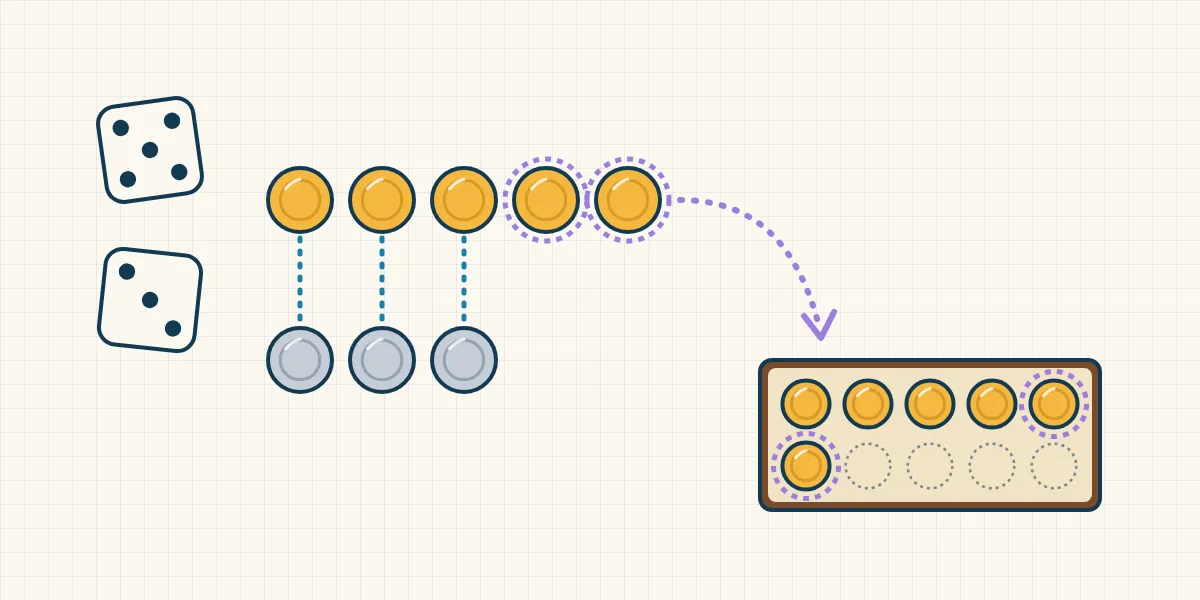
In short: We are working on a game in which children roll a die, place coins, compare the two amounts and finally capture exactly the difference. The idea builds on research into simple number games: about an hour with a suitable board game improved preschoolers’ number comparison (Siegler & Ramani, 2009). What matters is that the game moves demand exactly the thinking that is meant to be learned.
An invented but familiar scene: two children are rolling dice at the kitchen table. Each takes as many buttons as their die shows. “I’ve got more!” – “How many more?” They line the buttons up side by side, one opposite one. Two are left over. “Those two are mine.” That is all it takes for the game idea we are working on.
Why a game at all?
Because well-designed games demonstrably make a difference when they practise the right thing. In one study, preschoolers from low-income families played a number board game in several short sessions, about an hour in total. Children who played on a straight, numbered board compared numbers better afterwards and placed numbers on a number line more accurately than children who played on a circular board or did other number activities. These children also learned more from later arithmetic practice (Siegler & Ramani, 2009).
A follow-up study shows what makes the difference. Kindergarten children played a board game numbered 0 to 100. When they counted on from their current square as they moved (“34, 35, 36”), they learned considerably more than when they started again from 1 on every turn (Laski & Siegler, 2014). The researchers’ summary: you learn what you encode.
And a meta-analysis of 17 studies with children aged 1 to 8 found that guided play, in which adults keep a learning goal in view, had a somewhat larger effect on early maths skills than direct instruction (g = 0.24). However, the studies meant quite different things by “guided play” (Skene et al., 2022).
For us this means: a game only helps if the moves themselves are the learning steps. Points, stars or animations wrapped around a sum are not enough.
What should a child do in our game?
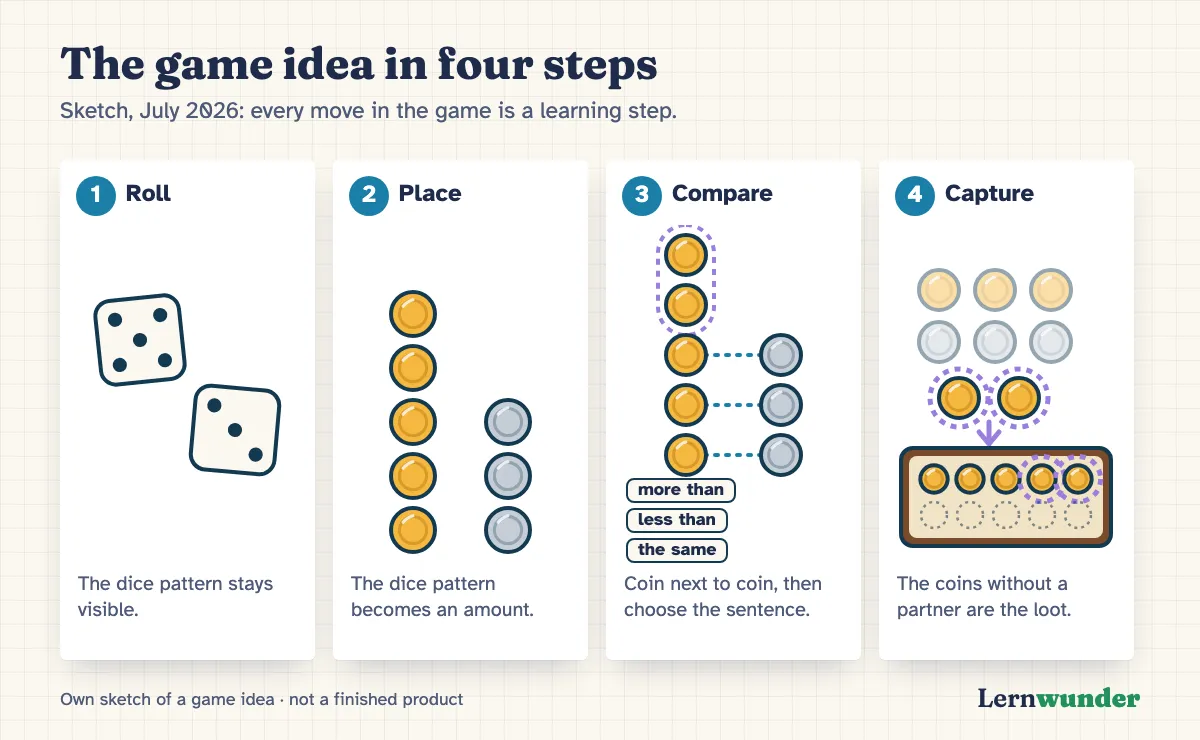
Our plan has four steps, each standing for a learning step:
- Roll. Both players roll in turn. The dice pattern stays visible.
- Place. Each child places as many coins on their deck as the die shows. The dice pattern becomes an amount.
- Compare. The two decks lie side by side, coin next to coin. The child chooses the true sentence: “I have more than you”, “I have less than you” or “We have the same amount”.
- Capture the difference. Whoever has more takes exactly the coins without a partner and puts them in their treasure chest.
We picture the chest as a ten-frame: two rows of five, so you can see at a glance how many are already inside and how many are missing. How this structure of five helps is explained in our post on the power of five.
Why capture the difference?
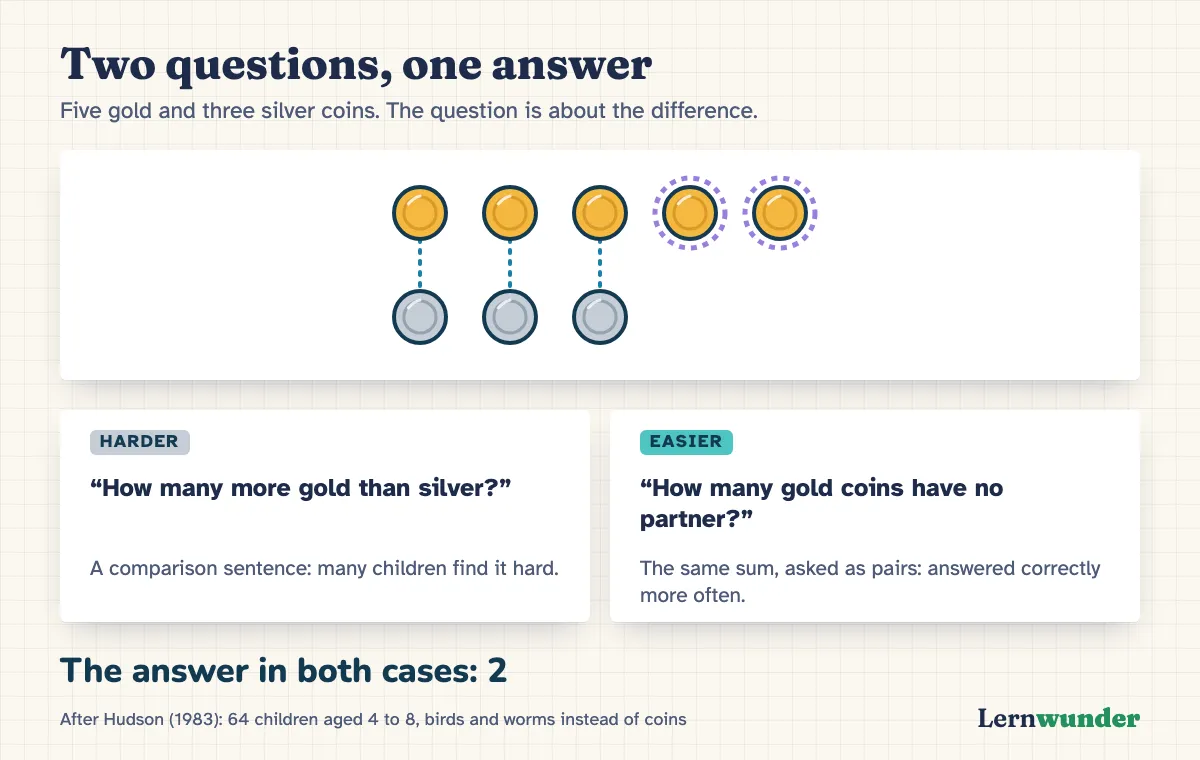
Because “How many more?” is a surprisingly hard question for children. In a classic study, 64 children aged 4 to 8 were shown birds and worms. Asked “How many more birds than worms are there?”, many answered wrongly. Asked “How many birds won’t get a worm?”, they found the answer much more often (Hudson, 1983). The children could work out the difference. What they lacked was access through the “more … than” sentence.
Later experiments also found that comparison word problems depend mainly on language, less on calculation (Stern, 1993).
This is exactly where our idea comes in. The question “Which coins have no partner?” becomes an action: those coins are the loot. The loot is the difference. And because the child has chosen the comparison sentence just before, the language is tied directly to the action. That way we want to connect the two routes that appear separate in the research: pairing, which children can often already do, and the comparison sentence, which they find hard.
Why pirates?
Because the story explains the rule. Pirates take from the other side exactly what it has more of. No child needs to remember to “find the difference”; they simply capture the leftover coins. The world should stay friendly: islands, coins, a chest, no weapons and no skulls.
What the game should not have
Just as important as the idea are the things we deliberately want to leave out:
- No time pressure. Comparing needs calm, especially at the start.
- No red for mistakes. Why we avoid it is explained in Why mistakes should not be red in our apps.
- No lives, no leaderboards. A child who slips up should be able to look again, not lose something.
- No reading required. Children of this age often cannot read confidently yet. More in Maths without reading.
What you can do
You don’t need a device to try the game idea. The table version:
- Materials: one or two dice, buttons or coins in two colours, and an empty ten-cup egg carton per child as a chest.
- Roll and place: each child rolls and lays that many buttons in a row.
- Compare: put the rows side by side, button opposite button. The child says the whole sentence: “I have more than you.”
- Capture: whoever has more puts the buttons without a partner into their egg carton. With the same amount, nobody gets anything; new round.
- End: the first to have ten buttons in the carton wins.
- Harder: use two dice, cover the rows briefly and compare from memory, or ask for the size of the loot before it is taken.
How to practise “more”, “less” and “the same amount” without a game is covered in More, less or the same?. And how the signs > and < come in later is explained in Does the alligator eat the bigger number?.
What we are working on
The idea is now turning into a game. We are testing how the four steps feel on a tablet, how big coins and spaces need to be, and how much help a child needs after miscounting. We are not giving a name, a date or a feature list yet. Only the core is settled: roll, place, compare, capture the difference.
Frequently asked questions
From what age does the dice game work? The table version with one die often works from preschool age. In the birds and worms study, many four- to eight-year-olds could already find differences by pairing (Hudson, 1983).
What if my child miscounts? Lay the rows side by side together and make pairs. The difference becomes visible without anyone having to say “wrong”.
When will the game be released? We cannot say yet. We will report here when it is ready.
Sources
- Hudson, T. (1983). Correspondences and numerical differences between disjoint sets. Child Development, 54(1), 84–90. https://doi.org/10.2307/1129864
- Laski, E. V. & Siegler, R. S. (2014). Learning from number board games: You learn what you encode. Developmental Psychology, 50(3), 853–864. https://doi.org/10.1037/a0034321
- Siegler, R. S. & Ramani, G. B. (2009). Playing linear number board games—but not circular ones—improves low-income preschoolers’ numerical understanding. Journal of Educational Psychology, 101(3), 545–560. https://doi.org/10.1037/a0014239
- Skene, K., O’Farrelly, C. M., Byrne, E. M., Kirby, N., Stevens, E. C. & Ramchandani, P. G. (2022). Can guidance during play enhance children’s learning and development in educational contexts? A systematic review and meta-analysis. Child Development, 93(4), 1162–1180. https://doi.org/10.1111/cdev.13730
- Stern, E. (1993). What makes certain arithmetic word problems involving the comparison of sets so difficult for children? Journal of Educational Psychology, 85(1), 7–23. https://doi.org/10.1037/0022-0663.85.1.7
Lernwunder editorial team · Chaolan Lu