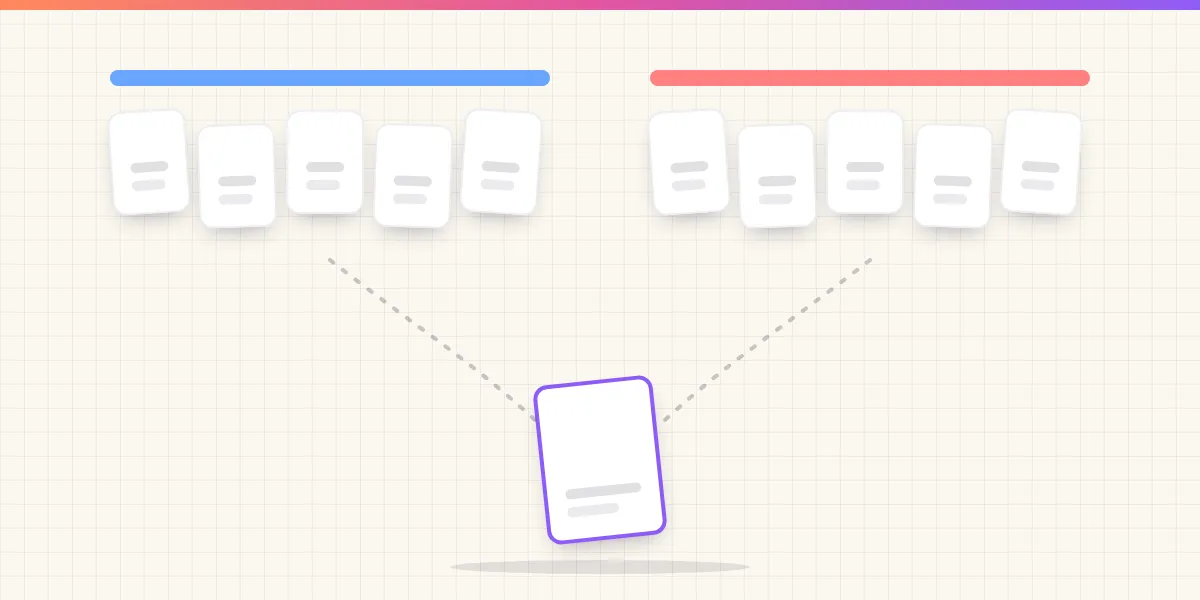
In short: When two captains take turns picking teams, the whole class watches a ranking being made, and someone always ends up standing alone. In surveys, adults who were picked last as children report less physical activity later in life. Random draws, counting off or teams set by the teacher in advance are fairer, and usually faster.
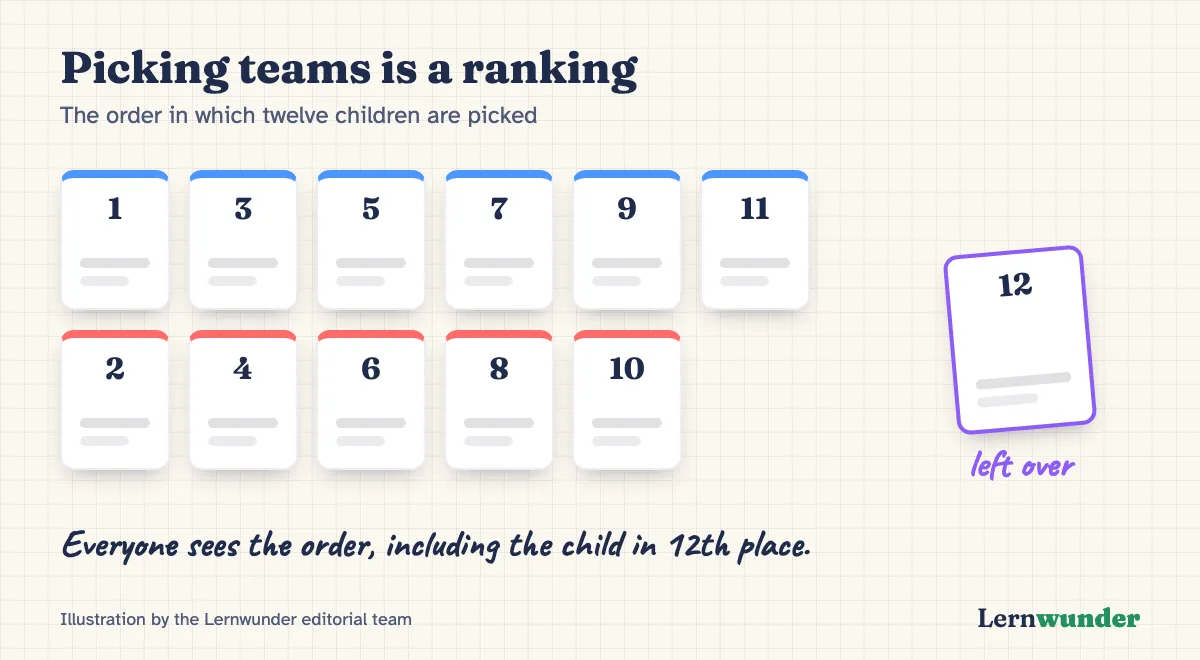
A scene many of us know (made up here, but not far-fetched): the school gym, third period. Two children get to be captains. The first names come quickly: the best players, the best friends. Then it goes quiet. In the end, two children are left by the wall, and one of them is not chosen at all, just “the one who’s left”. They walk over to their team, and everyone has seen the order.
Team picking survives because it is easy: no preparation, no discussion, the game starts within two minutes. The price is usually paid by the same children every time.
What actually happens when children pick teams?
Captains choose by skill, friendship or popularity, and they do it in public. For a few minutes a group of children turns into a ranking that everyone can read. The children at the bottom usually know before it starts.
That is exactly what young people describe in a study from physical education. Barney and colleagues (2016) compared two methods with 233 junior high boys: public picking by captains, and a confidential draft in which nobody sees the order. The motivation questionnaires showed no measurable difference. The interviews, however, revealed why students picked whom, how they think about ability, and that many felt empathy for the classmates who are exposed by public picking. The researchers recommend against the practice.
What does research say about being picked last?
Most of the direct evidence comes from adults looking back. The findings point the same way:
- Less activity later. In a survey of 293 students about their childhood experiences in PE and sport, those who had been picked last for a team reported significantly less physical activity later in life. The authors point out that professional bodies have long classed captains picking teams as an inappropriate teaching practice (Cardinal et al., 2013).
- In Germany, too. Among 692 adults, remembering being chosen last was linked to less physical activity in adulthood. Remembered enjoyment of PE turned out to be the connecting factor: people with good memories of PE were more active and sat less today (Limmeroth et al., 2026).
- What sticks. In a survey of 1,028 adults in the US, about a third of the worst PE memories were about embarrassment in front of others, and 17 percent about bullying. People who remembered enjoying PE also had more positive attitudes to exercise today (Ladwig et al., 2018).
To be honest about the limits: these studies show associations, not causes. The effects are small, and memories are not the same as what actually happened. Perhaps children who were less active anyway were more likely to be picked last. Still, these numbers make it hard to justify a method that reliably exposes one child when there is no need for it.
Why does it hurt so much?
Because it is a form of exclusion, and people are sensitive to that. A review of research on ostracism describes how even brief episodes of being ignored or left out cause sadness and anger and threaten basic needs such as belonging and self-esteem. People who experience it again and again gradually run out of ways to cope (Williams, 2007).
In a well-known experiment, adults played a simple ball-tossing game on a screen in which, at some point, nobody passed to them any more. A brain region also involved in physical pain became more active, and more so the more distress people reported (Eisenberger et al., 2003). A computer game is not a gym. But it shows that “just not being included” is not harmless.
Isn’t picking teams a way of giving children a say?
A common argument: children should learn to make decisions. True, but this decision is a poor place to practise. The captains are under pressure too, because every pick is public. Picking a weaker child early invites teasing; picking them late hurts them.
Children can have a real say where nobody is being rated: in choosing the game, the rules, or who goes first. Research on cooperative learning, with more than 1,200 studies one of the most thoroughly researched teaching approaches, explicitly describes structuring group work as part of the teacher’s role (Johnson & Johnson, 2009).
What you can do at school, at practice or at home
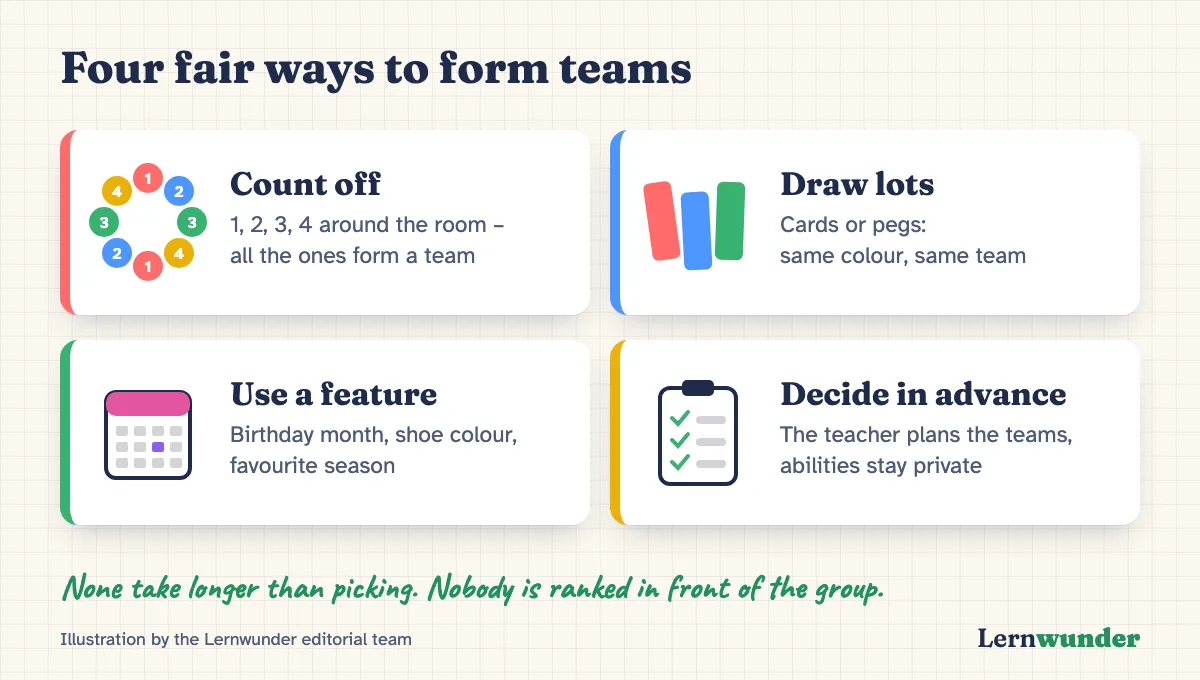
None of these take longer than picking; most are quicker.
- Count off. “One, two, three, four” around the room; all the ones form a team. Tip: have children mingle first, or neighbours will always end up together.
- Draw lots. Playing cards, coloured clothes pegs or lolly sticks with names. Same colour, same team. It is visibly random, and nobody can complain.
- Use a feature. Birthday month, shoe colour, favourite season. It mixes children who rarely play together.
- Decide in advance. For games where balanced teams matter, set the teams yourself before the lesson. What you know about children’s abilities stays with you instead of being negotiated in front of the class.
- Pick in private. If children must have a say, take the audience away: captains pick on the side and the teams are announced together afterwards (like the confidential draft in Barney et al., 2016).
- Reshuffle after each game. Whoever lost today is on a different team tomorrow. That takes the weight off the result.
And if it doesn’t work out, quietly swap two children. The method is there to serve you, not the other way round.
Why this matters to us
We are working on a small tool for teachers, coaches and parents that is meant to help with exactly this moment: forming teams quickly, in a way that never ranks anyone in front of the group. More when it is ready. Until then, everything above works with a deck of cards.
Frequently asked questions
At what age does team picking become a problem? Research does not give a clear age limit. The surveys ask about memories of the whole school career. We would avoid it at any age when other methods are just as quick.
Aren’t random teams often unbalanced? Sometimes. For games where it matters, set the teams in advance or swap two children after the draw. Balancing is your job, not the children’s.
What if children want to play with their friends? That is understandable, and at break time it can be that way. In lessons it pays to reshuffle groups regularly so children work with different classmates.
Does this only apply to PE? No. Children also pick groups for projects, presentations or club training. The studies come from sport, but the principle that public picking makes a ranking visible applies everywhere.
Sources
- Barney, D., Prusak, K. A., Beddoes, Z. & Eggett, D. (2016). Picking teams: Motivational effects of team selection strategies in physical education. The Physical Educator, 73(2). https://doi.org/10.18666/TPE-2016-V73-I2-6212
- Cardinal, B. J., Yan, Z. & Cardinal, M. K. (2013). Negative experiences in physical education and sport: How much do they affect physical activity participation later in life? Journal of Physical Education, Recreation & Dance, 84(3), 49–53. https://doi.org/10.1080/07303084.2013.767736
- Eisenberger, N. I., Lieberman, M. D. & Williams, K. D. (2003). Does rejection hurt? An fMRI study of social exclusion. Science, 302(5643), 290–292. https://doi.org/10.1126/science.1089134
- Johnson, D. W. & Johnson, R. T. (2009). An educational psychology success story: Social interdependence theory and cooperative learning. Educational Researcher, 38(5), 365–379. https://doi.org/10.3102/0013189X09339057
- Ladwig, M. A., Vazou, S. & Ekkekakis, P. (2018). “My best memory is when I was done with it”: PE memories are associated with adult sedentary behavior. Translational Journal of the American College of Sports Medicine, 3(16), 119–129. https://doi.org/10.1249/TJX.0000000000000067
- Limmeroth, J., Leisterer-Härtig, S., Hagemann, N. & Ladwig, M. A. (2026). Last in line, lasting in mind? A retrospective investigation of the relationship between physical education experiences and adult physical activity. Journal of Sport & Exercise Psychology, 48(1), 46–54. https://doi.org/10.1123/jsep.2025-0008
- Williams, K. D. (2007). Ostracism. Annual Review of Psychology, 58, 425–452. https://doi.org/10.1146/annurev.psych.58.110405.085641
Lernwunder editorial team · Chaolan Lu