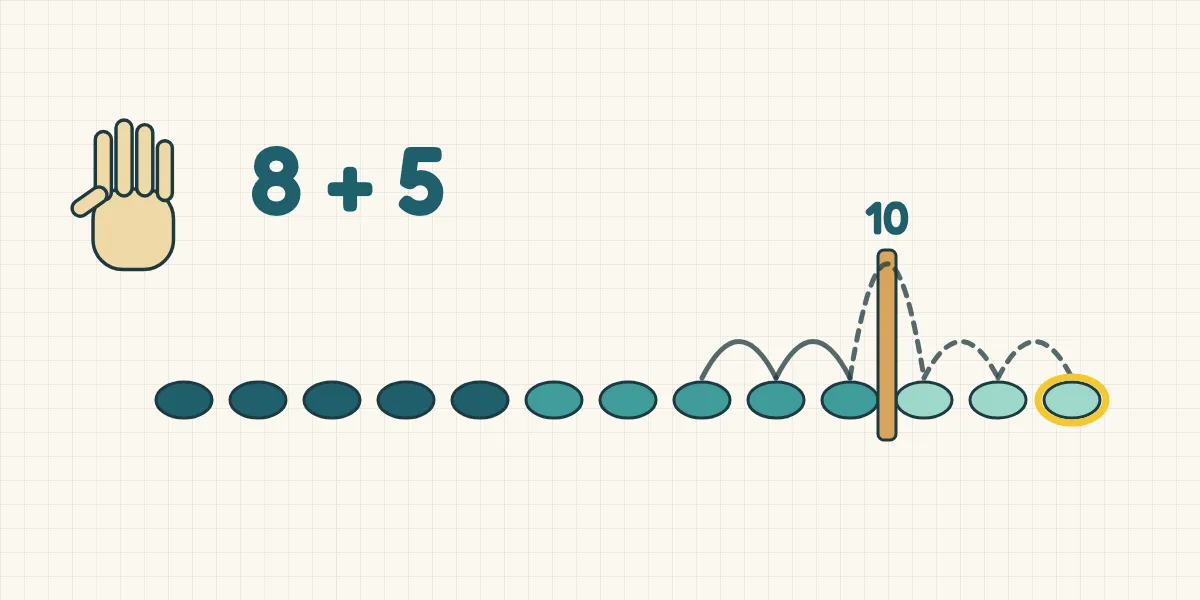
In short: Bridging ten means a calculation crosses ten, as in 8 + 5. Ten fingers are no longer enough, and children who still count have to keep track of their steps in their heads. That is slow and error-prone. In an Austrian study, children at the end of Year 1 still counted their way through about half of these problems (Gaidoschik & Fellmann, 2015). What helps is not faster counting but secure knowledge around ten.
An invented but familiar scene at the kitchen table: the worksheet says 7 + 6. The child holds up seven fingers and then goes quiet. There are no fingers left for the six. They nod along, whisper “eight, nine, ten …”, lose track and write 12. The next problem, 10 + 3, is done in a flash. The hurdle this article is about lies between those two problems.
What is bridging ten?
Bridging ten (also called “crossing ten” or “bridging through ten”) means a calculation goes past ten. In addition problems such as 8 + 5 or 7 + 6 the answer is greater than ten; in subtraction problems such as 13 − 5 you have to go back below ten. In many German-speaking schools these problems come in the last third of the first school year (Gaidoschik & Fellmann, 2015, citing a widely used intervention handbook).
Mathematically, it is a small step beyond numbers to 10. For children it is often the first point where a trusted method stops working.
Why is this step so hard?
Because several things come together.
Fingers run out. Up to ten, a child can show every problem on their hands. With 8 + 5 that is impossible. A child who counts now has to follow two things at once: the number sequence (9, 10, 11, 12, 13) and how many steps they have taken (1, 2, 3, 4, 5).
It takes several steps. Without counting, 8 + 5 can be solved as 8 + 2 = 10 and then 10 + 3 = 13. For that, a child needs to know that 8 and 2 make 10, that 5 can be split into 2 and 3, and that “ten and three” is thirteen. If one piece is missing, counting is all that is left. Why these number bonds matter so much is explained in our article on number decomposition.
Number words do not help. In English, “eleven” and “twelve” do not mention ten at all, and “thirteen” names the three before the ten. You cannot hear that 13 means “ten and three”. In Korean, the numbers after ten are literally “ten one”, “ten two” and so on. For Korean first graders, these number words, together with finger methods, supported calculation methods built around ten (Fuson & Kwon, 1992).
What is the counting trap?
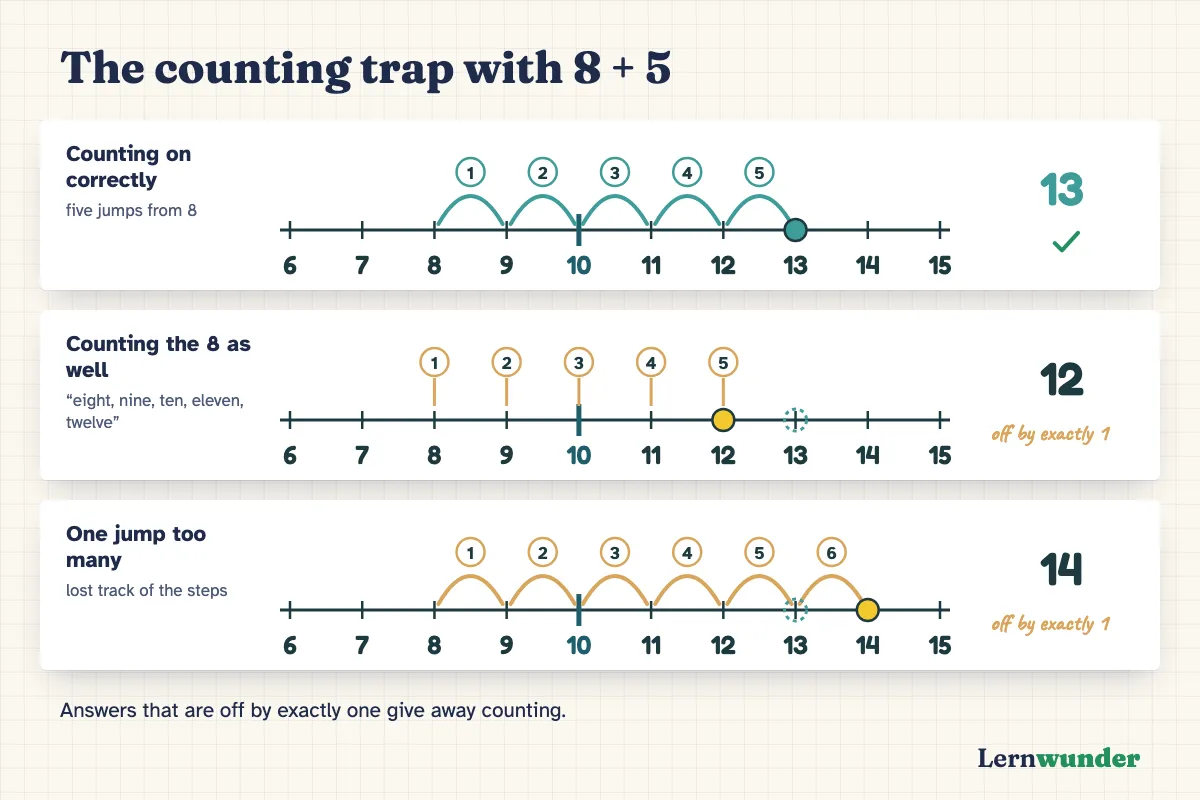
Counting often produces correct answers. That is exactly what makes it tricky. A child who reliably counts on from 8 to solve 8 + 5 seems to have mastered the problem. But counting takes up all their attention. Gaidoschik and Fellmann (2015) describe it like this: children who count often do not notice how a problem relates to its answer, for example that 8 + 5 is just one more than 8 + 4. Even solving the same problem correctly many times does not necessarily make it stick. Counting is more likely to turn into a habit.
Then there are typical counting errors. A child who counts the 8 as well (“eight, nine, ten, eleven, twelve”) ends up at 12. A child who loses track of the steps and makes one jump too many ends up at 14. Answers that are off by exactly one are therefore a clear sign that a child is counting.
What does the research say?
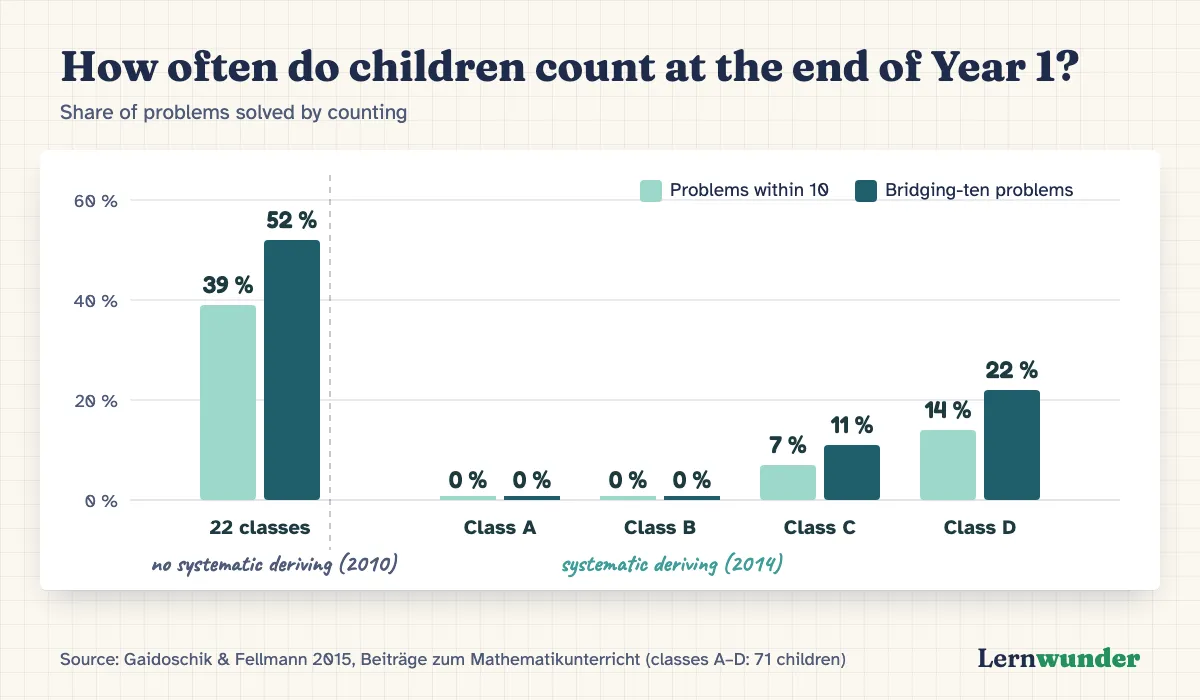
Counting peaks at the ten. In a longitudinal study with children from 22 classes, children at the end of Year 1 counted to solve about 39% of problems within 10 and 52% of problems that bridge ten. In these classes, deriving strategies had not been taught systematically (Gaidoschik & Fellmann, 2015, reporting data from Gaidoschik, 2010).
It can be different. In a small follow-up study with 71 children from four classes in Carinthia, Austria, teachers worked from the start on number bonds, on a few firmly known core facts and on deriving new facts from known ones. At the end of Year 1, children in two classes no longer counted at all on bridging-ten problems; in the other two they counted on 11% and 22% of these problems (Gaidoschik & Fellmann, 2015). The study is small and the classes were not randomly assigned. But it shows that high rates of counting are not a law of nature.
Slower starters need more time. Torbeyns, Verschaffel and Ghesquière (2004) compared strong and weaker second graders, plus third graders who calculated as well as the strong second graders, on problems that bridge ten. The weaker second graders used their strategies differently from the strong ones. Between the strong second graders and the equally strong third graders, however, there were no differences. The researchers interpret this as a delay in strategy development. For us that means: the path is probably the same, it just takes more time and support.
Counting can last a long time. In a study with 200 seventh graders, 35% still mostly solved simple additions by counting on from the larger number, and another 16% often made errors doing so. Students who counted a lot tended to have lower maths achievement (Hopkins & Bayliss, 2017).
Ten as a unit grows step by step. Murata (2004) followed Japanese first graders over a school year. They started with very different prior knowledge and took different paths. Gradually they adopted the method valued in Japan: splitting a number so that ten is completed. Counting and seeing groups supported them along the way. Calculating across ten without counting develops gradually, and structure helps.
So are fingers banned?
No. Fingers are an important tool at the start, and many children need them for a while. What matters is how they are used: showing five fingers at once and seeing a hand as five is different from counting each finger one by one. When finger counting helps and when it becomes a problem is covered in our article on counting-based calculation.
What you can do
- Secure the number bonds to ten. 1 and 9, 2 and 8, 3 and 7 … Knowing these pairs without thinking is the most important building block. Ideas in our article on number bonds to ten.
- Make “ten and …” visible. Put down a full egg carton with ten cups and three buttons next to it. “How many are there?” The goal is an instant “thirteen” without counting. Say it out loud: “Ten and three is thirteen.”
- See fives instead of counting. Two rows of five, one above the other (a ten-frame), make every number up to ten recognisable at a glance. More in The Power of Five.
- Ask about the method. “How did you work that out?” is worth more than “Is that right?”. Praise a clever method, not speed.
- Watch for signs of counting. Long pauses on 8 + 7 but not on 8 + 2, quiet muttering, nodding, answers off by exactly one. This is no reason to worry, but it tells you where your child is right now.
- Seek advice if counting persists. If a child is still counting out almost every problem well into Year 2, talk to the teacher. How to recognise maths difficulties is covered in Recognising maths difficulties.
Why this matters to us
In our learning path, bridging ten is the third station, after recognising quantities and splitting numbers. It is the point where it becomes clear whether the foundations hold. We are currently working on a new app for exactly this hurdle. We will share what we are taking from the research once the idea takes shape.
Frequently asked questions
My child gets 8 + 5 right, but slowly. Is that a problem? Not necessarily. Ask how they worked it out. If they count on every time, it is worth working on number bonds to ten. If they go via ten and simply need time, speed will come with practice.
Should my child memorise the bridging-ten facts? In the end, many facts should be quick to recall. But the way there leads through understanding and deriving. The data from Gaidoschik and Fellmann (2015) support practising deriving early and deliberately.
When is persistent counting a warning sign? Many children count at the start of Year 1. A sign to look closer is when a child in Year 2 still solves almost all problems up to 20 by counting. A blog post cannot replace an assessment, so talk to the teacher.
Does this apply to subtraction too? Yes. With 13 − 5, counting back is even more error-prone than counting on. Going via ten helps here as well: first 13 − 3 = 10, then take away 2 more.
Sources
- Fuson, K. C. & Kwon, Y. (1992). Korean children’s single-digit addition and subtraction: Numbers structured by ten. Journal for Research in Mathematics Education, 23(2), 148–165. https://doi.org/10.5951/jresematheduc.23.2.0148
- Gaidoschik, M. & Fellmann, A. (2015). Zählendes Rechnen im 1. Schuljahr: (Vermutlich) weder notwendig noch förderlich [Counting-based calculation in Year 1: (probably) neither necessary nor helpful]. In F. Caluori, H. Linneweber-Lammerskitten & C. Streit (Eds.), Beiträge zum Mathematikunterricht 2015 (pp. 296–299). WTM. https://doi.org/10.17877/DE290R-16634
- Hopkins, S. & Bayliss, D. (2017). The prevalence and disadvantage of min-counting in seventh grade: Problems with confidence as well as accuracy? Mathematical Thinking and Learning, 19(1), 19–32. https://doi.org/10.1080/10986065.2017.1258613
- Murata, A. (2004). Paths to learning ten-structured understandings of teen sums: Addition solution methods of Japanese Grade 1 students. Cognition and Instruction, 22(2), 185–218. https://doi.org/10.1207/s1532690xci2202_2
- Torbeyns, J., Verschaffel, L. & Ghesquière, P. (2004). Strategic aspects of simple addition and subtraction: The influence of mathematical ability. Learning and Instruction, 14(2), 177–195. https://doi.org/10.1016/j.learninstruc.2004.01.003
Lernwunder editorial team · Chaolan Lu