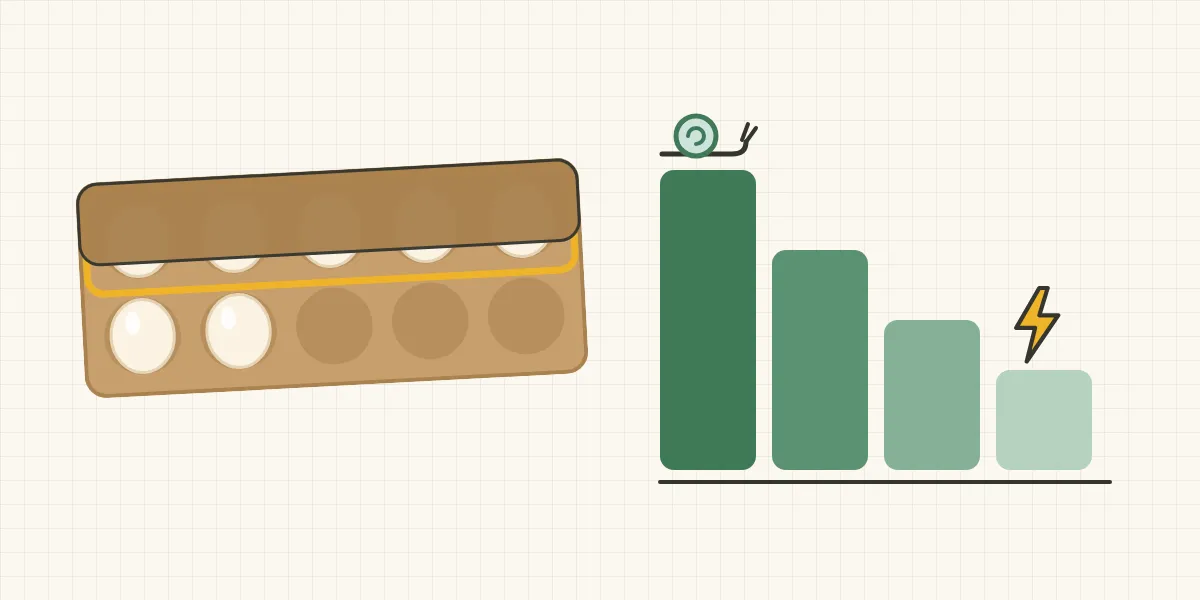
In short: If children see an amount only briefly, they cannot count it and have to look at its structure. That is why quick looks are useful in practice. Time pressure on the answer, however, measurably makes children more anxious. Our approach for a new app: the viewing time gets shorter step by step, but there is no clock on the answer, and the pace is set by each child’s own progress.
A scene from a first-grade classroom (made up, but typical): the teacher holds up a dot card, just for a moment. “Seven!” one child calls out immediately. Another hesitates, is almost sure, but says nothing because the next card is already up. Both saw the dots. Only one had enough time to answer.
Quick-look activities and dot flash cards are part of daily routine in many classrooms. They work well if you keep two things apart: time to look and time to answer.
Why show amounts only briefly?
Because otherwise children count. When an amount stays visible, many children touch every object one by one, even if they could actually see how many there are. A quick look prevents that and draws attention to the structure: five on top, two below.
Research shows that seeing and counting are two different processes. Schleifer and Landerl (2011) asked children of different age groups to name the number of dots while recording response times and eye movements. For small amounts that can be taken in at a glance, the age groups differed little; for counting larger amounts, much more. Children with dyscalculia showed a steeper rise in response time even for small amounts. How the eye for small amounts develops in the preschool years is described in How Many Things Can Children See at a Glance?.
For amounts up to 20, children also need structure. That is why good flash activities show amounts in order, as in the egg box as a ten frame, and never as a random pile.
Does speed make children anxious?
It depends on where the speed sits. A recent study with 311 third and fourth graders gave maths and reading tests once with and once without a time limit. Under time pressure, children’s momentary anxiety rose in both subjects (Orbach et al., 2026).
In Recall, not counting we explained why time pressure can harm unsure children in particular. For flash activities, we take this to mean a clear separation: the amount may be visible only briefly; that is the exercise. The answer, however, needs calm. A countdown, a ticking clock or a race against others puts the pressure in exactly the wrong place.
How fast should it get, and who sets the pace?
Ideally the child, through their own performance. A well-known example of this approach is “The Number Race”, a learning game developed for children with maths difficulties. It continuously adjusts difficulty so that the child gets about three in four problems right. One of its settings is a response deadline that shortens as skill grows (Wilson et al., 2006a). In a first, small trial with nine children, they became several hundred milliseconds faster at subitizing (Wilson et al., 2006b). Nine children without a control group, however, are only a first hint.
Order matters too. Five-year-olds compared amounts more precisely when they started with easy comparisons and worked their way up to hard ones than the other way round (Odic, Hock & Halberda, 2014). The researchers explain this with confidence: children who experience many sure decisions also decide better on hard ones. A follow-up experiment found that after an easy-to-hard sequence, children even did better on a maths task afterwards (Wang et al., 2016).
What you can do
- Show briefly, wait patiently. Show an amount in an egg box for two or three seconds and cover it. Then wait, without hurrying, for the answer.
- Start easy. Begin with amounts your child recognises reliably, and only step up when it works several times in a row.
- Shorten the look, not your patience. When things go well, the glance gets shorter. Thinking time stays the same.
- After a mistake: show, don’t judge. Uncover the amount again and say how to see it: “Five … and two. Seven.” Then try again straight away, with a little more time.
- Stepping back is normal. If it does not work twice, make it easier again. Say so calmly.
- Against yourself, never against others. “Last week you needed three seconds for this card, today one is enough.” No races with siblings.
- Stop while it’s still fun. Five minutes is plenty.
What we are working on
We are working on a new app in which children take in amounts up to 20 at a glance. For the quick look we have decided on the following:
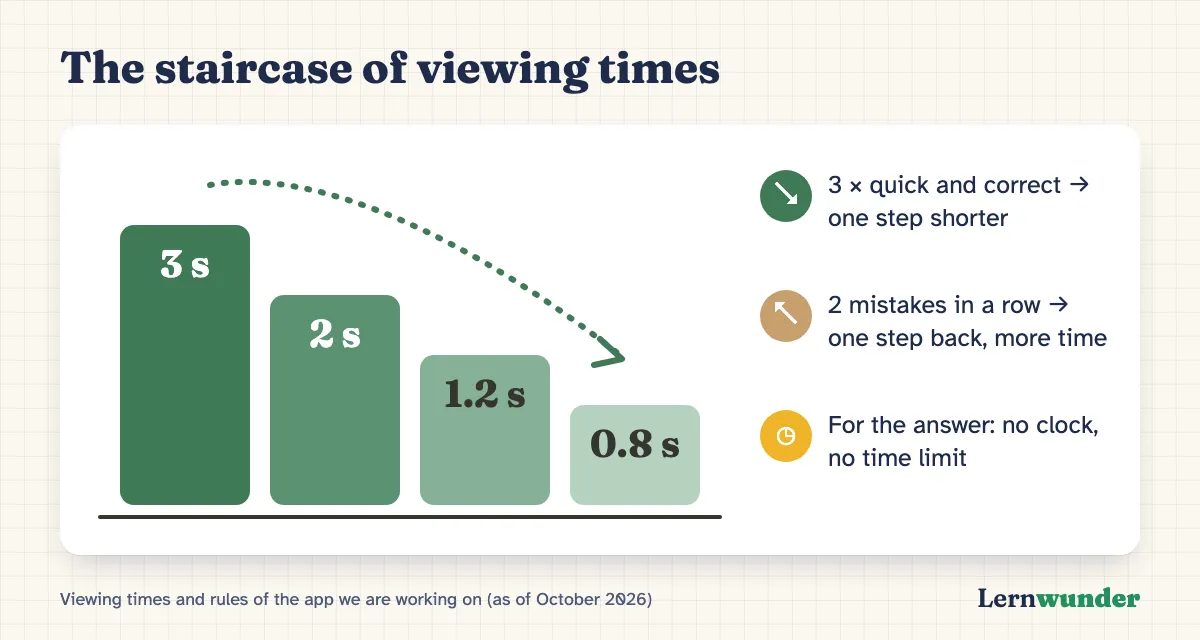
- Viewing time has four steps: 3 seconds, 2 seconds, 1.2 seconds and 0.8 seconds. It only gets shorter once a child has answered three problems in a row quickly and correctly. After two mistakes in a row it goes back one step, which usually means: more time.
- There is no clock on the answer. Unlike a response deadline, only the viewing time shrinks. The answer options appear once the amount is covered. From then on response time is measured, but nothing is shown, nothing ticks, nothing runs out. While the amount is visible, nothing else moves on screen.
- “Quick” is measured against each child. In the first ten problems the app works out how fast a child answers correctly, separately for each way of answering (tapping one of three cards or typing the number). Anything up to a quarter slower than that child’s typical time counts as quick, within limits of 1.8 to 4 seconds. The value grows with the child. That way a child who taps slowly is not mistaken for one who is counting.
- After a mistake the app shows the structure. The amount reappears, the row of five lights up in yellow, and a voice says, for example: “Five … and two. Seven!” Then the same problem comes again, with more time. There is no red, no error sound and no score.
- Progress compared with yourself. Children see their speed as an animal, from snail to lightning. Adults see the curve of viewing times. If you prefer, you can switch the flash off for a child: then the amount stays visible.

We will write more about the app once it is finished.
Frequently asked questions
Is time pressure in practice always bad? Not every kind. A short viewing time is part of the exercise because it prevents counting. The problem is pressure on the answer, such as countdowns or competitions (Orbach et al., 2026).
How short should the glance be? Start with two to three seconds. Only go shorter when your child gets it right several times in a row.
My child still counts as soon as the amount appears. What can I do? Show the amount more briefly and in a clearer structure, in an egg box or as a row of five, and ask afterwards: “How did you see it?”
Can an app tell whether my child has dyscalculia? No. Slow answers can be a reason to look more closely, but an app or a game is no substitute for a proper assessment.
Sources
- Odic, D., Hock, H. & Halberda, J. (2014). Hysteresis affects approximate number discrimination in young children. Journal of Experimental Psychology: General, 143(1), 255–265. https://doi.org/10.1037/a0030825
- Orbach, L., Schmitz, F., Fritz, A. & Willmes, K. (2026). Reading and math anxiety in children: Differential roles of state and trait components in academic performance, and the moderating effects of intelligence and time pressure. Frontiers in Child and Adolescent Psychiatry, 5, 1778068. https://doi.org/10.3389/frcha.2026.1778068
- Schleifer, P. & Landerl, K. (2011). Subitizing and counting in typical and atypical development. Developmental Science, 14(2), 280–291. https://doi.org/10.1111/j.1467-7687.2010.00976.x
- Wang, J. J., Odic, D., Halberda, J. & Feigenson, L. (2016). Changing the precision of preschoolers’ approximate number system representations changes their symbolic math performance. Journal of Experimental Child Psychology, 147, 82–99. https://doi.org/10.1016/j.jecp.2016.03.002
- Wilson, A. J., Dehaene, S., Pinel, P., Revkin, S. K., Cohen, L. & Cohen, D. (2006a). Principles underlying the design of “The Number Race”, an adaptive computer game for remediation of dyscalculia. Behavioral and Brain Functions, 2, 19. https://doi.org/10.1186/1744-9081-2-19
- Wilson, A. J., Revkin, S. K., Cohen, D., Cohen, L. & Dehaene, S. (2006b). An open trial assessment of “The Number Race”, an adaptive computer game for remediation of dyscalculia. Behavioral and Brain Functions, 2, 20. https://doi.org/10.1186/1744-9081-2-20
Lernwunder editorial team · Chaolan Lu