In short: Maths anxiety is a feeling of tension and fear that blocks thinking when working with numbers. It shows up as early as first and second grade and is by no means limited to children who struggle with maths. Anxiety and achievement feed each other, and adults often pass on their own unease without noticing. What helps: experiences of success through targeted practice, relaxed maths moments at home, and adults who talk about maths calmly and positively.
A scene many parents will recognise (made up, but typical): it is Monday evening and tomorrow there is a timed times-tables quiz at school. The daughter who used to count the stairs with delight in nursery sits in front of her exercise book and says: “I can’t do it. I’m bad at maths.” She is seven.
Young children in many countries like maths; over the years their attitude often gets worse (Dowker et al., 2016). How does that happen, and what can adults do?
What is maths anxiety?
A classic definition describes maths anxiety as “a feeling of tension and anxiety that interferes with the manipulation of numbers and the solving of mathematical problems” in everyday life and at school (Richardson & Suinn, 1972, cited in Dowker et al., 2016). The second half matters: anxiety is not only unpleasant, it gets in the way of thinking itself.
A study of 154 first and second graders shows how. Even at this age, maths anxiety was linked to lower achievement, mainly in children with good working memory (Ramirez et al., 2013). The researchers’ explanation: these children like to solve problems in their heads using strategies that need a lot of working memory, and worry takes up exactly that space. So maths anxiety can hold back the very children with the most potential.
Does maths anxiety only affect children who are weak at maths?
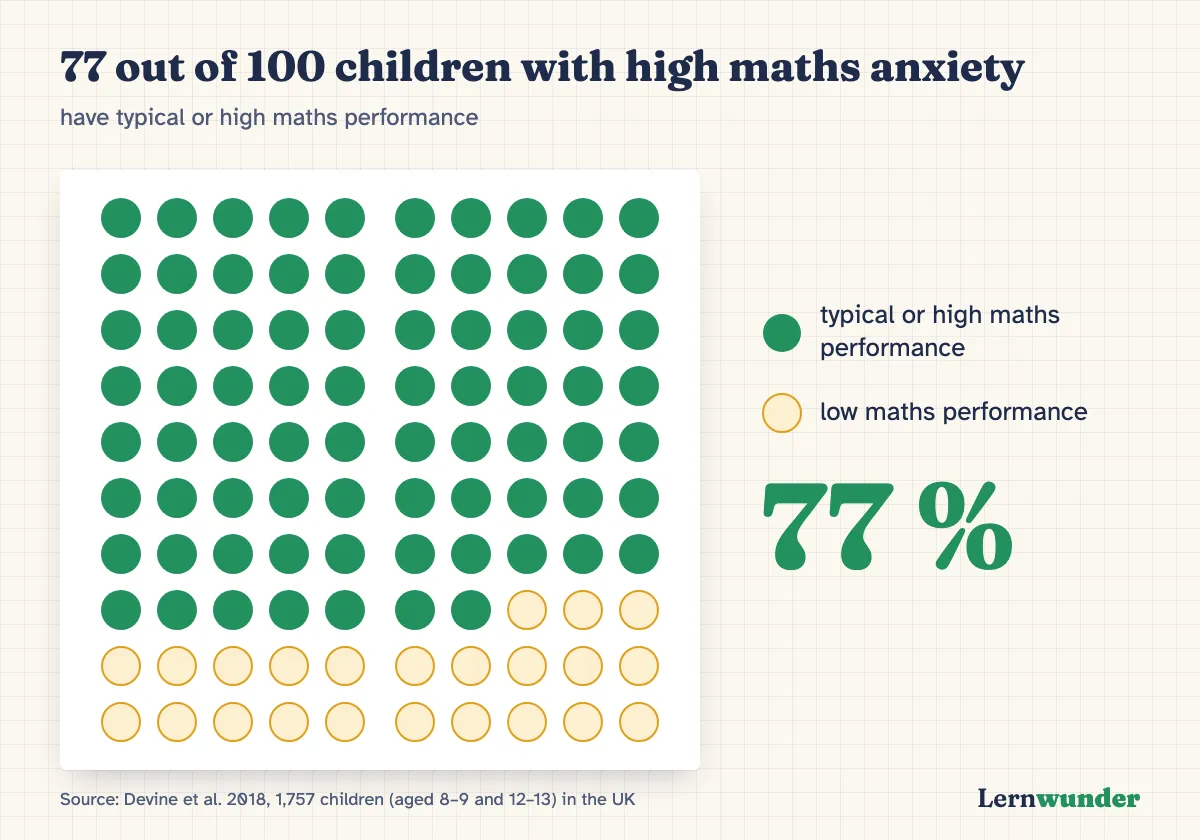
No. In a British study of 1,757 children aged eight to nine and twelve to thirteen, children with dyscalculia were twice as likely as others to have high maths anxiety. But 77 percent of children with high maths anxiety had typical or even high maths performance (Devine et al., 2018).
How many children are affected overall is hard to say. There is no agreed cut-off for “high” anxiety, and studies report very different rates depending on how it is measured (Dowker et al., 2016).
Which comes first: the anxiety or the poor marks?
Both, and that is what makes it tricky. A large meta-analysis of 747 effect sizes found a clear, small-to-moderate negative link between maths anxiety and maths achievement. It starts in childhood and lasts into adulthood (Barroso et al., 2021).
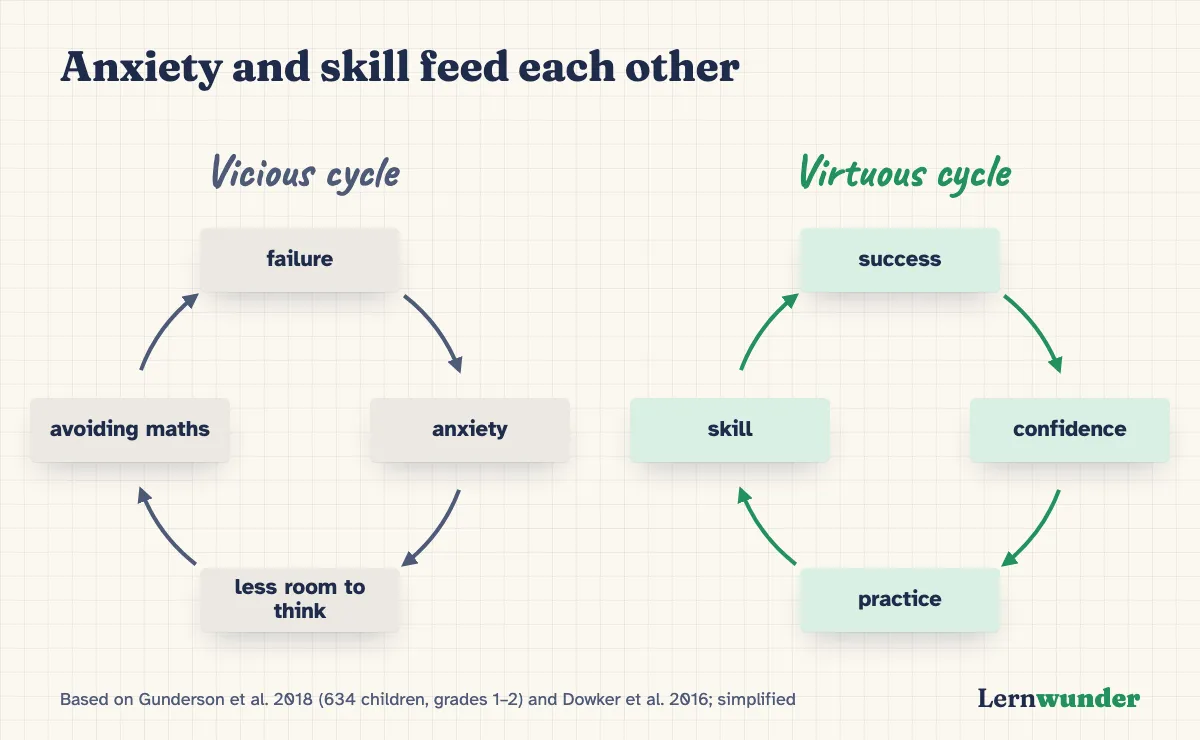
A study of 634 first and second graders, tested twice six months apart, shows the direction: anxiety and achievement influenced each other. Children who believed maths ability is fixed and innate were more anxious. And strong achievement was a particularly good protection against later anxiety. The researchers describe a vicious or a virtuous cycle that is already at work in the first two years of school (Gunderson et al., 2018).
What role do parents and teachers play?
A bigger one than many realise.
Teachers: In a US study of female first and second grade teachers, their own maths anxiety was unrelated to pupils’ achievement at the start of the school year. By the end it was: the more anxious the teacher, the more likely girls were to believe that “boys are good at maths, girls are good at reading”, and the lower these girls’ maths achievement (Beilock et al., 2010).
Parents: Children of maths-anxious parents learned less maths over a school year and ended it more anxious, but only when those parents often helped with maths homework. When they rarely helped, there was no link (Maloney et al., 2015). Well-meant help can pass on unease, probably through tone, impatience or explanations that are unsure themselves.
What actually helps children?
There is less research on solutions than on causes, but some findings are encouraging:
- Relaxed maths moments at home. In an experiment with 587 first graders, families regularly solved short maths story problems together, delivered through a tablet app. The children learned more maths over the school year than a comparison group with reading stories, especially children of maths-anxious parents (Berkowitz et al., 2015).
- Building skill. After eight weeks of one-to-one maths tutoring, anxiety dropped significantly in highly maths-anxious third graders (Supekar et al., 2015). Success is one of the best remedies for fear.
- Adults’ attitudes. Parents and teachers can model a positive attitude towards maths and avoid negative remarks. That is hard when they are anxious themselves, and how well individual strategies work is still under-researched (Dowker et al., 2016).
What you can do
- Talk about maths calmly. Instead of “I was always bad at maths too”, try: “That’s a tricky one. Let’s see how we can picture it.”
- Take the pressure out of homework help. If you feel unsure yourself, it is fine to step back or swap with another adult. Ask “How did you think about it?” rather than “Why can’t you do this?”
- Everyday maths, no testing. Dice games, counting stairs, laying the table, the shopping list: short moments where numbers are fun and nobody is judging.
- Praise effort and strategies, not talent. “You found a clever way” rather than “You’re a maths genius”. Children who see ability as fixed tend to be more anxious (Gunderson et al., 2018).
- Make success possible. Better to solve an easier problem confidently than to fail at one that is too hard. Skill grows, anxiety shrinks.
- Take it seriously. If a child has stomach aches before maths for weeks or avoids it entirely, talk to the teacher. Strong anxiety can also point to maths difficulties that deserve a professional assessment.
Why this matters to us
Maths should feel like discovery to children, not like a test. If anxiety and failure reinforce each other, the opportunity lies in the opposite: small, safe experiences of success. We keep that in mind with every decision about our first maths app, which is currently in the making. Our next article looks at maths difficulties: how to recognise them in the first two years of school and what helps.
Frequently asked questions
At what age can maths anxiety appear? It can be measured in first and second grade and is already linked to achievement at that age (Ramirez et al., 2013; Gunderson et al., 2018).
Is my child bad at maths if they are anxious about it? Not necessarily. Most children with high maths anxiety perform at a typical or high level (Devine et al., 2018). But the anxiety can stop them from showing what they can do.
Should I stop helping with homework? Helping is not wrong. In studies, what was unhelpful was frequent help from parents who are very maths-anxious themselves (Maloney et al., 2015). Calm, short support and shared maths games without pressure are a good path.
Is maths anxiety the same as dyscalculia? No. They can occur together but are not the same (Devine et al., 2018). If difficulties persist, a professional assessment helps.
Sources
- Barroso, C., Ganley, C. M., McGraw, A. L., Geer, E. A., Hart, S. A. & Daucourt, M. C. (2021). A meta-analysis of the relation between math anxiety and math achievement. Psychological Bulletin, 147(2), 134–168. https://doi.org/10.1037/bul0000307
- Beilock, S. L., Gunderson, E. A., Ramirez, G. & Levine, S. C. (2010). Female teachers’ math anxiety affects girls’ math achievement. Proceedings of the National Academy of Sciences, 107(5), 1860–1863. https://doi.org/10.1073/pnas.0910967107
- Berkowitz, T., Schaeffer, M. W., Maloney, E. A., Peterson, L., Gregor, C., Levine, S. C. & Beilock, S. L. (2015). Math at home adds up to achievement in school. Science, 350(6257), 196–198. https://doi.org/10.1126/science.aac7427
- Devine, A., Hill, F., Carey, E. & Szűcs, D. (2018). Cognitive and emotional math problems largely dissociate: Prevalence of developmental dyscalculia and mathematics anxiety. Journal of Educational Psychology, 110(3), 431–444. https://doi.org/10.1037/edu0000222
- Dowker, A., Sarkar, A. & Looi, C. Y. (2016). Mathematics Anxiety: What Have We Learned in 60 Years? Frontiers in Psychology, 7, 508. https://doi.org/10.3389/fpsyg.2016.00508
- Gunderson, E. A., Park, D., Maloney, E. A., Beilock, S. L. & Levine, S. C. (2018). Reciprocal relations among motivational frameworks, math anxiety, and math achievement in early elementary school. Journal of Cognition and Development, 19(1), 21–46. https://doi.org/10.1080/15248372.2017.1421538
- Maloney, E. A., Ramirez, G., Gunderson, E. A., Levine, S. C. & Beilock, S. L. (2015). Intergenerational effects of parents’ math anxiety on children’s math achievement and anxiety. Psychological Science, 26(9), 1480–1488. https://doi.org/10.1177/0956797615592630
- Ramirez, G., Gunderson, E. A., Levine, S. C. & Beilock, S. L. (2013). Math anxiety, working memory, and math achievement in early elementary school. Journal of Cognition and Development, 14(2), 187–202. https://doi.org/10.1080/15248372.2012.664593
- Supekar, K., Iuculano, T., Chen, L. & Menon, V. (2015). Remediation of childhood math anxiety and associated neural circuits through cognitive tutoring. Journal of Neuroscience, 35(36), 12574–12583. https://doi.org/10.1523/JNEUROSCI.0786-15.2015
Lernwunder editorial team · Chaolan Lu