Short answer: Early number knowledge is closely linked to later maths learning. What matters, though, is not school content but number sense: linking number words to quantities and discovering that a quantity can be split into parts and put back together. In the year before school this works best with objects, games and conversation. Worksheets, writing digits and timed sums can wait.
It is the middle of July. In Germany, where children usually start school at six, many families are only weeks away from the first day. Friends are passing round “preschool workbooks”, and sooner or later someone asks: “Shouldn’t she be able to do some sums by now?”
The good news first: no child has to be able to calculate before school. School starts with the basics. Still, it is worth knowing which early experiences with numbers really matter.
What can children do with numbers before school?
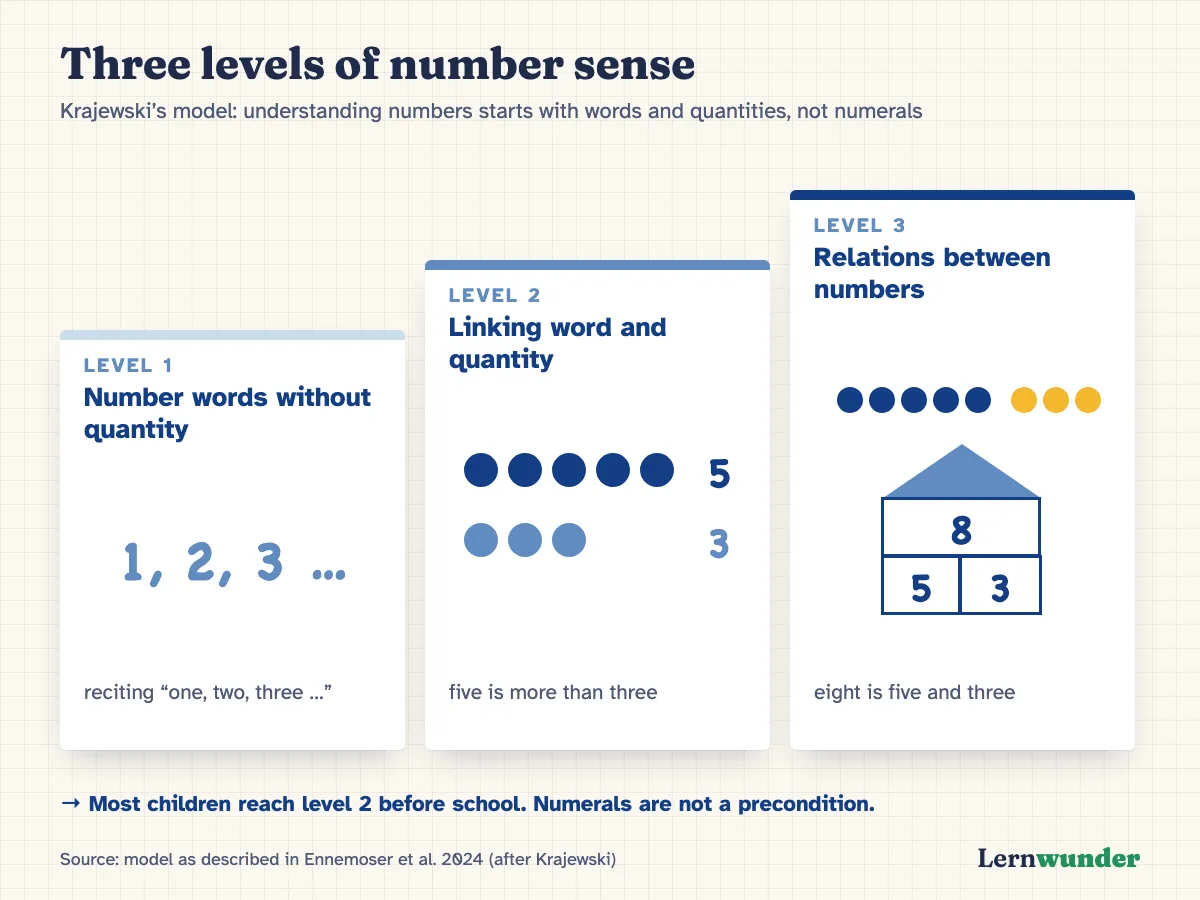
More than you might think, and something different from what you might think. A well-researched model describes three levels of how children come to understand numbers (Krajewski, as described in Ennemoser et al., 2024):
- Number words without quantity. A child can recite “one, two, three …” without the words standing for an amount yet.
- Linking number words to quantities. The child knows that “five” is a particular amount and more than “three”. According to the model, most children reach this level before formal school instruction begins.
- Relations between numbers. The child understands that eight can be split into five and three, and that five is exactly two more than three. These are number bonds.
What stands out: these insights first develop through language and objects. The numerals 8, 5 and 3 can help, but they are not a precondition (Ennemoser et al., 2024). A child can split numbers long before being able to write them.
How important is maths before school?
Important, but not in the way workbooks suggest. Duncan and colleagues (2007) analysed six large longitudinal studies together. Of all the skills children bring to school entry, early maths skills were the strongest predictor of later achievement, ahead of reading and attention.
A four-year longitudinal study from Germany fits this picture: how well preschoolers linked quantities and number words predicted their maths achievement in primary school (Krajewski & Schneider, 2009). Children who struggled most in grade 4 had already performed less well on these tasks before school.
Two caveats belong here. First, these studies show associations, not simple causes. Second, head starts often fade. A major review of educational interventions found that the effects of early support often shrink or disappear over time. Whether they last depends on which skills are targeted and whether later learning builds on them (Bailey et al., 2020). A child who knows sums by heart before school does not automatically keep an advantage.
Do number bonds belong in the preschool year?
They can, but they don’t have to. In a study with five- and six-year-olds, children were successfully taught to use decomposition as a strategy, so they relied less on counting when adding. How well they did was related to how securely they knew the part-whole relations of the numbers to 10 (Cheng, 2012). Why these relations matter so much is explained in Number decomposition: why 8 = 5 + 3 is the key to calculating.
The reverse matters just as much: it is not too late once school starts. In a study of 119 first-graders at risk for maths difficulties, a training of twelve sessions on quantities and number relations improved their skills. The effect on school maths appeared after six months and was still there 15 months after the training (Ennemoser et al., 2024).
For the preschool year this means: splitting numbers is a lovely theme for play if a child enjoys it. It is not compulsory.
What makes sense, and what can wait?
From the findings above we draw a simple rule of thumb: quantities, language and play before numerals, sums and speed.
| Worth doing before school | Can wait |
|---|---|
| recognising small amounts without counting (dice, fingers) | practising neat digits |
| counting to find out how many | sums on worksheets |
| comparing amounts: more, fewer, the same | timed tests, quizzing |
| splitting a set and putting it back together | numbers up to 100 |
| dice and board games | workbooks as an obligation |
Home matters, too. A meta-analysis of 64 studies found a small but reliable association between what families do and say with numbers and children’s maths achievement (Daucourt et al., 2021). Small means: it is not about a big programme, but about numbers being part of everyday life.
What you can do
None of these ideas need anything you would have to buy. More games are in Number bonds at home: seven games without an app.
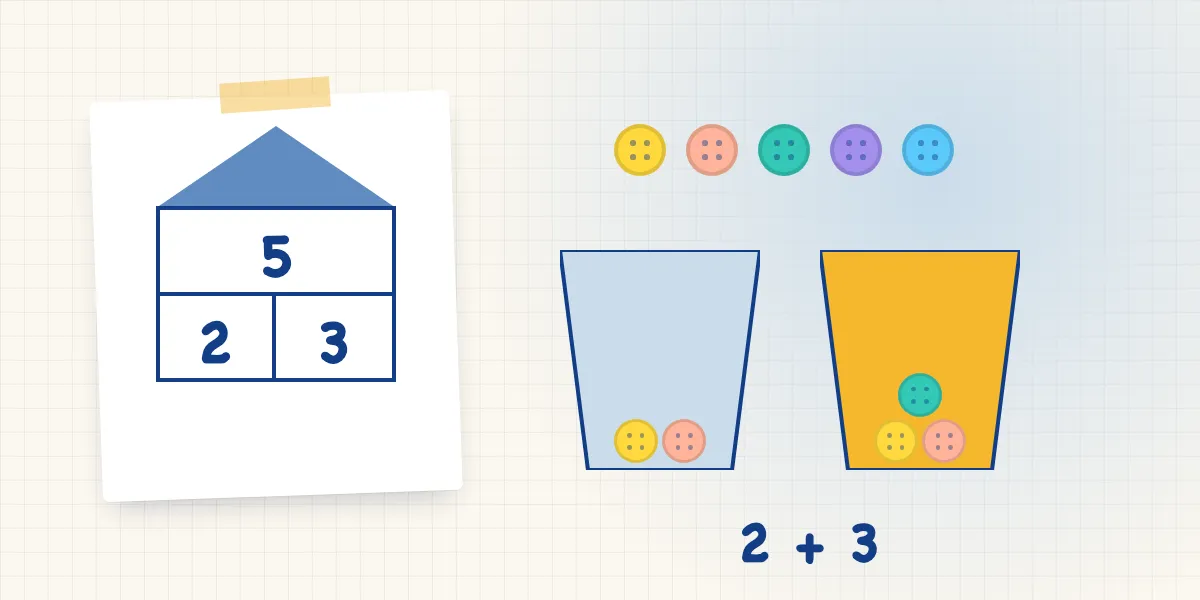
- Five in two cups. Five buttons, two cups. Your child shares the buttons out, you guess: “How many are in your cup?” Then swap roles. How many different ways are there?
- Sharing fruit. “Six strawberries for the two of us. How could we share them?” Fair is one way, but not the only one.
- How many steps left? On a staircase with eight steps: “We have climbed three. How many are left?”
- Two colours, one tower. Your child builds a tower of seven blocks in two colours. How many red, how many blue? Is there another tower of seven?
- Reading dice. In every board game, ask briefly: “Do you need to count the dots, or can you see it?” Why structured patterns help is explained in The power of five.
- Stop while it’s fun. Five happy minutes do more than twenty reluctant ones.

How our app Zahlzerlegung can help
Our app Zahlzerlegung (German for “number decomposition”) is designed for children aged about five to seven, so it includes the year before school. It practises the number bonds up to 10 in the shape of a number house: the whole at the top, the two parts below, one part missing. The child drags the right number into place.
Three things matter for preschoolers. Every number also appears as a picture of the quantity, as dice, fingers, tally marks or dots, so the amount stays visible even if a child does not yet know the numeral well. Reading is not needed, as the app uses almost no text. And the ring around the tangram animal runs for five seconds but never ends a task: a child who still counts may finish counting.
To be honest: at this age the app is an option, not a must. Children who split buttons, cups and dice do not need it. If you use it, sit with your child now and then and ask: “How did you know?” Zahlzerlegung is available in German only, for iPhone and iPad, with no sounds. It does not replace assessment or specialist support. More on the Zahlzerlegung page.
Frequently asked questions
Does my child need to add up to 10 before school? No. School starts with the basics. It helps if a child can link number words to quantities, and most children can do this before school (Ennemoser et al., 2024).
Should my child be able to write numbers? It is not a precondition. Understanding number relations first develops through language and objects; numerals can come later (Ennemoser et al., 2024).
My child isn’t interested in number games. What now? Don’t push. Numbers are part of almost every game, of laying the table and of sharing. Casual questions often achieve more than a planned programme.
Sources
- Bailey, D. H., Duncan, G. J., Cunha, F., Foorman, B. R. & Yeager, D. S. (2020). Persistence and fade-out of educational-intervention effects: Mechanisms and potential solutions. Psychological Science in the Public Interest, 21(2), 55–97. https://doi.org/10.1177/1529100620915848
- Cheng, Z.-J. (2012). Teaching young children decomposition strategies to solve addition problems: An experimental study. The Journal of Mathematical Behavior, 31(1), 29–47. https://doi.org/10.1016/j.jmathb.2011.09.002
- Daucourt, M. C., Napoli, A. R., Quinn, J. M., Wood, S. G. & Hart, S. A. (2021). The home math environment and math achievement: A meta-analysis. Psychological Bulletin, 147(6), 565–596. https://doi.org/10.1037/bul0000330
- Duncan, G. J., Dowsett, C. J., Claessens, A., Magnuson, K., Huston, A. C., Klebanov, P., Pagani, L. S., Feinstein, L., Engel, M., Brooks-Gunn, J., Sexton, H., Duckworth, K. & Japel, C. (2007). School readiness and later achievement. Developmental Psychology, 43(6), 1428–1446. https://doi.org/10.1037/0012-1649.43.6.1428
- Ennemoser, M., Sinner, D., Nguyen, L. & Krajewski, K. (2024). From developmental theory to effective training: Long-term and transfer effects of promoting the quantity–to–number word linkage in first-graders at risk for mathematical difficulties. Frontiers in Psychology, 15, 1380036. https://doi.org/10.3389/fpsyg.2024.1380036
- Krajewski, K. & Schneider, W. (2009). Early development of quantity to number-word linkage as a precursor of mathematical school achievement and mathematical difficulties: Findings from a four-year longitudinal study. Learning and Instruction, 19(6), 513–526. https://doi.org/10.1016/j.learninstruc.2008.10.002
Lernwunder editorial team · Chaolan Lu