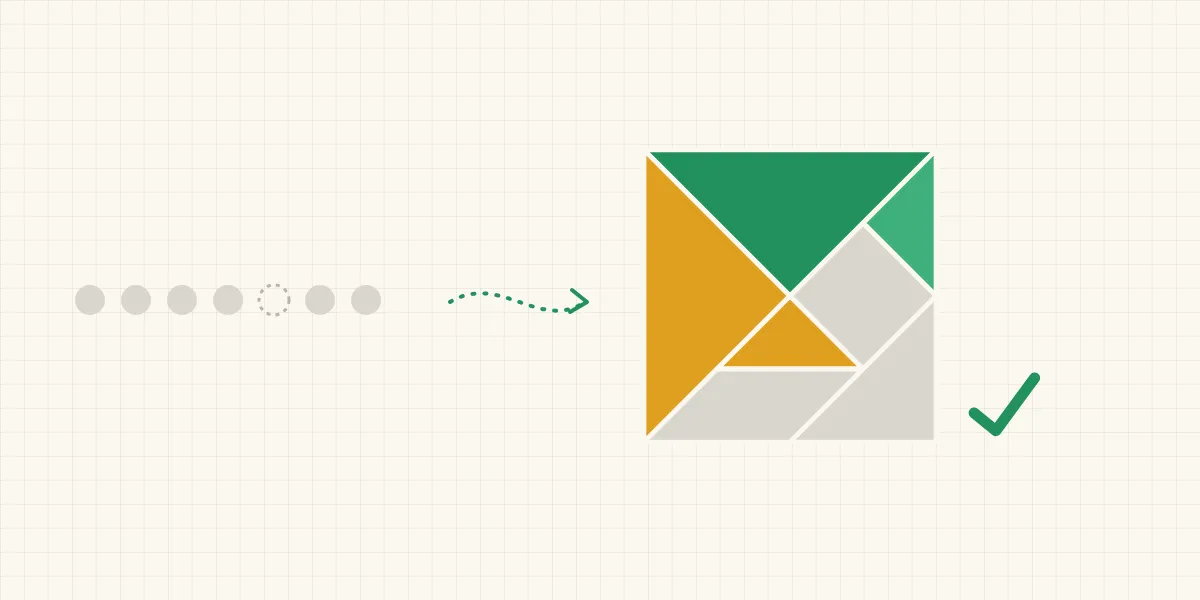
In short: Rewards do not harm learning across the board. The risky kind is a tangible reward that a child knows about in advance and gets simply for taking part: it can reduce the wish to come back to the activity freely later on. Praise and feedback that say something about what was learned tend to work in the other direction. Daily streaks are proven to keep people going, but often because the streak itself becomes the goal.
A made-up but familiar scene: the Christmas holidays are just over. In the evening a child sits in front of the tablet and taps through three problems in a learning app without really looking. Why the hurry? “Or my flame goes out. I’m on 41 days!” Over the holidays the family remembered every evening. Today it was close.
Points, stars, badges, levels and daily streaks are part of almost every learning app. They are meant to motivate. But what do they actually do? And when does a reward tip over and start to pull attention away from learning?
Do rewards kill the joy of learning?
Psychologists have argued about this for more than 40 years, and the honest answer is: it depends on which reward is given for what.
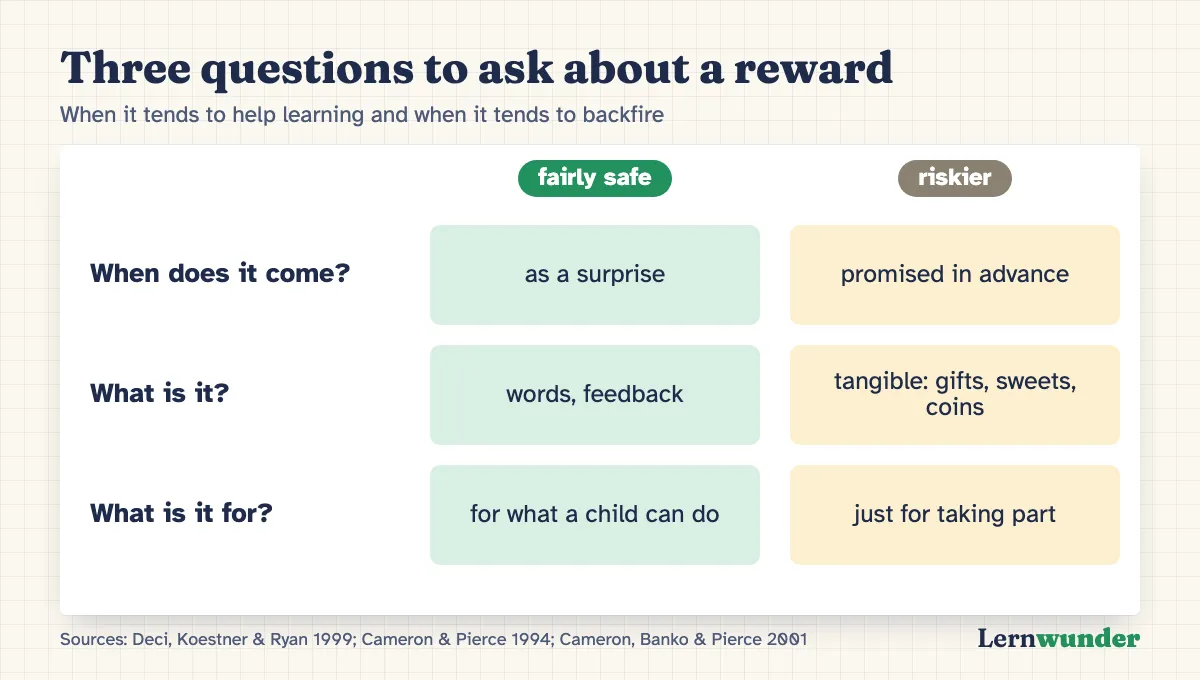
The largest review, a meta-analysis of 128 experiments, found that people who expect a reward and get it for taking part, for finishing or for a particular level of performance afterwards return to the task less often of their own accord. Tangible rewards had a more negative effect on children than on university students. Positive feedback, in contrast, increased both free-choice persistence and interest (Deci, Koestner & Ryan, 1999).
Other researchers reached a milder verdict. Their meta-analysis of 96 studies found no overall drop in intrinsic motivation from rewards, and verbal praise actually increased it. Only expected tangible rewards for simply doing a task had a small negative effect (Cameron & Pierce, 1994). A later analysis by the same group adds detail: the downside appeared for tasks that were already enjoyable, when the reward was tangible, announced in advance and only loosely tied to performance. When the reward was tied to the level of performance, motivation stayed the same or went up (Cameron, Banko & Pierce, 2001).
However far apart the two camps are, they agree on two points: praise and informative feedback tend to help, and “promised in advance, tangible, just for taking part” is the riskiest pattern.
Do points, badges and levels help children learn?
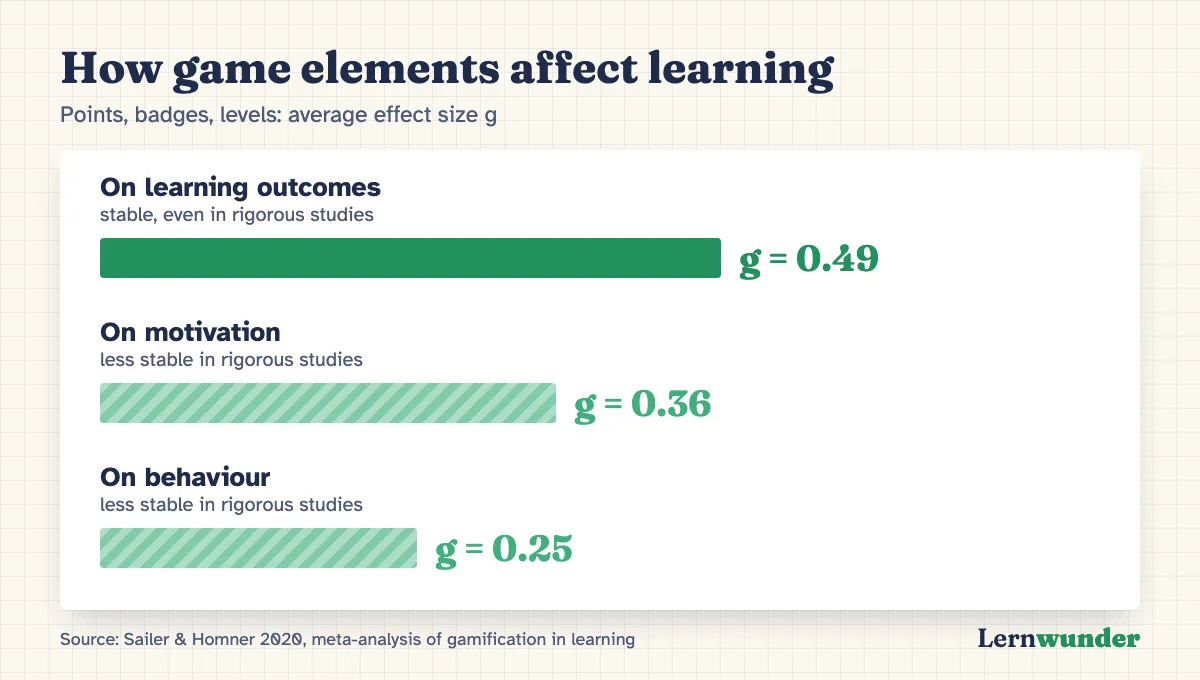
Adding game elements to learning is called gamification. A meta-analysis found small positive effects on learning outcomes (g = 0.49), motivation (g = 0.36) and behaviour (g = 0.25) (Sailer & Homner, 2020). The effect on learning held up in methodologically rigorous studies. The effects on motivation and behaviour, however, became uncertain once only careful studies were counted.
A second large review covering 40 years of research in school, work and sport helps to put this in context. Incentives mainly predicted the quantity of performance, intrinsic motivation more its quality. And the more directly an incentive was tied to performance, the less intrinsic motivation mattered (Cerasoli, Nicklin & Ford, 2014). Applied to a learning app: points get children to tap through more questions. Whether they understand more is a different matter.
What is the problem with streaks?
A daily streak counts how many days in a row you have practised. Seven studies show how strong the pull is: people who were shown an intact streak were more likely to keep going than people shown a broken streak, regardless of how much they had actually done before. The reason: the streak becomes a goal in its own right that people want to protect. The effect was especially strong when people blamed themselves for a break (Silverman & Barasch, 2023).
For adults who exercise or learn a language, that can be useful. With children we are more sceptical, and this is our own view: a child has no control over day trips, sick days or an evening at their grandparents’. When the streak breaks, they experience a loss although they did nothing wrong. And a child who only practises to keep the flame alive is practising for the flame.
What does this look like in children’s apps?
A research team examined the apps that 160 children aged three to five used most. Design tricks that push children to keep playing or to buy were common: around 45 per cent of the apps contained attractive lures to prolong play, 17 per cent used time pressure, and about a quarter of apps with characters used social pressure through the character (Radesky et al., 2022).
A second study rated 124 popular “educational” apps for young children on whether they support active, engaged, meaningful and social learning. Scores were low overall. Free apps scored lower than paid apps on engagement in learning, mainly because of distracting add-ons (Meyer et al., 2021).
What you can do
- Praise the strategy, not the child. “You went up to ten first and then on from there, clever” says more than “Great job!”.
- Don’t promise a reward for practising. “If you do ten minutes of maths, you can watch TV afterwards” turns maths into a chore to get through.
- Ask about the content. Instead of “How many points did you get?”, try “What was tricky today?” or “Show me one you can do now.”
- Make progress visible. A sheet on the wall where your child ticks off the number bonds they now know by heart is a reward that says something about learning.
- Switch off streak reminders if an app has them. A break is not a failure.
- Watch what your child reacts to. Are they pleased about the solved problem, or only about the sound that follows?
How we approached it in Zahlzerlegung
Our app Zahlzerlegung (currently in German only) has no points, no coins, no daily streak, no leaderboard and no sounds. A child who does not practise for three days loses nothing.
It does have rewards, though, and we want to be open about them:
- One tangram animal per child. A piece of the animal only takes on its colour once all number bonds for that number are secure. This reward is tied to mastery and shows what a child has learned, which research suggests is the most favourable kind (Cameron, Banko & Pierce, 2001). When all pieces are coloured, there is a certificate, and the goal has been reached.
- The occasional sticker. After a correct answer, a sticker of the child’s own animal sometimes appears for three seconds, at random. It is unexpected and is not collected or counted. To be honest, though, randomness is also the mechanism many games use to keep players hooked. That is why we keep the sticker deliberately small and brief, and we are watching whether it earns its place.
- A star level for each number bond. The flashcard system uses stars to show how secure a number bond already is. That is feedback about learning, not a score.
Why the animals are made of tangram pieces and how they work in detail is a story for a separate article.
Frequently asked questions
Should I avoid rewards altogether? No. Praise and feedback that show what a child can do tend to help (Deci, Koestner & Ryan, 1999). Be careful with promised, tangible rewards for simply taking part.
Are learning apps with points bad? Not automatically. Game elements can slightly improve learning (Sailer & Homner, 2020). What matters is whether points say something about skill or just count taps.
My child loves their streak. Is that a problem? Not necessarily. But keep an eye on whether it is still about the problems. If a child is upset because the streak broke, that is a sign the streak has become the goal (Silverman & Barasch, 2023).
How can I spot distracting rewards? They pop up while the child is working, flash constantly or push them to keep playing. Design patterns like these are common in children’s apps (Radesky et al., 2022).
Sources
- Cameron, J., Banko, K. M. & Pierce, W. D. (2001). Pervasive negative effects of rewards on intrinsic motivation: The myth continues. The Behavior Analyst, 24(1), 1–44. https://doi.org/10.1007/BF03392017
- Cameron, J. & Pierce, W. D. (1994). Reinforcement, reward, and intrinsic motivation: A meta-analysis. Review of Educational Research, 64(3), 363–423. https://doi.org/10.3102/00346543064003363
- Cerasoli, C. P., Nicklin, J. M. & Ford, M. T. (2014). Intrinsic motivation and extrinsic incentives jointly predict performance: A 40-year meta-analysis. Psychological Bulletin, 140(4), 980–1008. https://doi.org/10.1037/a0035661
- Deci, E. L., Koestner, R. & Ryan, R. M. (1999). A meta-analytic review of experiments examining the effects of extrinsic rewards on intrinsic motivation. Psychological Bulletin, 125(6), 627–668. https://doi.org/10.1037/0033-2909.125.6.627
- Meyer, M., Zosh, J. M., McLaren, C., Robb, M., McCafferty, H., Golinkoff, R. M., Hirsh-Pasek, K. & Radesky, J. (2021). How educational are “educational” apps for young children? App store content analysis using the Four Pillars of Learning framework. Journal of Children and Media, 15(4), 526–548. https://doi.org/10.1080/17482798.2021.1882516
- Radesky, J., Hiniker, A., McLaren, C., Akgun, E., Schaller, A., Weeks, H. M., Campbell, S. & Gearhardt, A. N. (2022). Prevalence and characteristics of manipulative design in mobile applications used by children. JAMA Network Open, 5(6), e2217641. https://doi.org/10.1001/jamanetworkopen.2022.17641
- Sailer, M. & Homner, L. (2020). The gamification of learning: A meta-analysis. Educational Psychology Review, 32(1), 77–112. https://doi.org/10.1007/s10648-019-09498-w
- Silverman, J. & Barasch, A. (2023). On or off track: How (broken) streaks affect consumer decisions. Journal of Consumer Research, 49(6), 1095–1117. https://doi.org/10.1093/jcr/ucac029
Lernwunder editorial team · Chaolan Lu