
In short: A length is the distance between the start and the end. On a ruler, what counts are the spaces between the marks, not the number at the end. Many children measure correctly as long as the object starts at zero, and fail as soon as it starts somewhere else. What helps most is an experience that contradicts their own prediction: guess first, then count the spaces.
A made-up but typical scene: a seven-year-old measures her pencil. She lines up the ruler, reads “12”, all correct. Then the pencil slides a little to the right. Now it runs from 3 to 15. “Fifteen centimetres!” she says. The pencil has not grown. But she never measured. She read off a number.
What does measuring length actually mean?
Measuring means laying a unit down again and again and counting how many times it fits. The German national education standards call this the basic principle of measuring: choose units, use them repeatedly and, where needed, split them into smaller units. Children should measure lengths with suitable units and tools and estimate sizes using familiar reference objects, such as the height of a door (KMK, 2022).
A ruler is nothing more than many equal units lined up in a row. The number at a mark tells you how many units lie between zero and here. Children who understand this can measure with any piece of a ruler. Children who don’t often go unnoticed, as long as the object sits at zero.
Which mistakes do children make with a ruler?
Two in particular, and both only show up when the object does not start at zero. Researchers call this the “broken ruler” or “shifted ruler” task (Kwon et al., 2024):
- Reading off the end number. The child names the number where the object ends. At zero this works perfectly; shifted, it does not.
- Counting the marks. The child counts the hatch marks under the object instead of the spaces and ends up one too many. They are already thinking about units, but mistake the marks for the units.
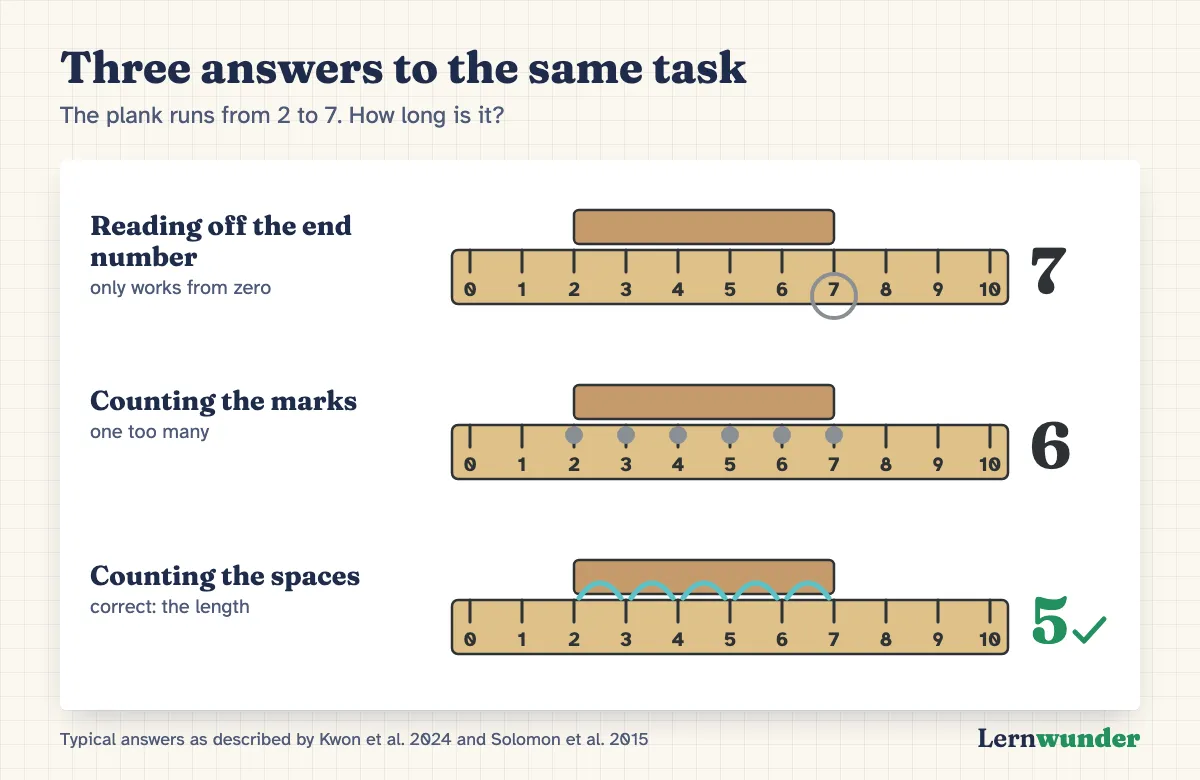
How common this is shows up in older US test data summarised by Kwon and colleagues: on such problems, 86% of third graders answered incorrectly, and 37% were still wrong in eighth grade. Internationally, only 29% of fourth graders on average solved a challenging shifted ruler problem (Kwon et al., 2024). We could not check comparable figures for the UK or Germany. Given the international figure, we think it unlikely that this is a purely American problem.
Why is it so hard?
A research team led by Tracy Solomon asked kindergarteners and second graders to measure crayons, once with a ruler and once with a row of separate blocks. When the crayon was aligned with the start, both age groups did well with both. When it was shifted, they could still count the blocks under the crayon correctly. With the ruler, however, they were at chance level. The difficulty remained even when the numbers were removed from the ruler (Solomon et al., 2015).
The authors’ conclusion: the real hurdle is seeing the ruler as a row of countable spaces. Separate blocks are visible. The units on a ruler have to be imagined between the marks.
Constance Kamii and Faye Clark had already pointed out that children build up the idea of a repeated unit only gradually. In interviews with 383 children in grades 1 to 5, most had grasped unit iteration only by grade 4 (76%). They used this to explain why traditional teaching leads to poor test results, and argued for problems that challenge children to rethink (Kamii & Clark, 1997).
What helps children understand the ruler?
An experience that does not match their own prediction. In three experiments with 120 second graders, Kwon and colleagues compared different kinds of training. Typical classroom tasks, where the object sits at zero, did not improve measuring with a shifted ruler. Children improved clearly when they first gave an answer and then counted the spaces under the shifted object themselves and realised: that doesn’t fit. They learned fastest and retained most when they also placed transparent unit chips exactly on the spaces of the ruler (Kwon et al., 2024). The authors base this last finding on an additional exploratory analysis, so it is preliminary.
One detail from the same study: children who initially read off the end number did clearly worse overall than children who counted marks. Mark counters are at least already looking for something to count.
What you can do
- Make a broken ruler. Cut a paper ruler at the 3. “How long is this pencil?” Let your child guess first, then count.
- Walk the spaces with a finger. “How many jumps does your finger make from here to here?” Not: “Which number is there?”
- Lay units on top. Place small one-centimetre paper squares exactly in the spaces under the object and count them.
- Measure with body parts. The table in hand spans, the hallway in feet. Then an adult measures with their hands: why is the result different?
- Spot gaps and overlaps. Lay out paper clips with gaps and ask: “Is that still right?”
- Turn the question around. “A pencil is 4 centimetres long. Where could it lie on the ruler?” Children who find many positions have understood that length does not depend on zero.
And a sentence you can give your child: “The number tells you how far it is from zero. The length is how far it is from the start.”
What we are working on
We are currently developing Noa Learn Math, a new app for primary school. It takes place on NOA, a small island that travels from coast to coast. The first unit is measuring length, and it starts with exactly this misconception.
The idea: a piece of the island’s jetty is missing. Kofi the shipwright is to saw a plank, and the child measures the gap. Kofi’s old measuring tape is torn at the front; it only starts at 2. Children who read off the end number order a plank that is too long, and see it at once: the plank sticks out over the post. If it is too short, water glitters in the gap.
This is how we want to put Kwon and colleagues’ finding into practice: the app does not say “wrong”; the material contradicts. Kofi saws what is ordered and never points to the solution. And the Strandling, a small companion made of driftwood and shells, makes the typical mistake himself and asks the child whether he is right.
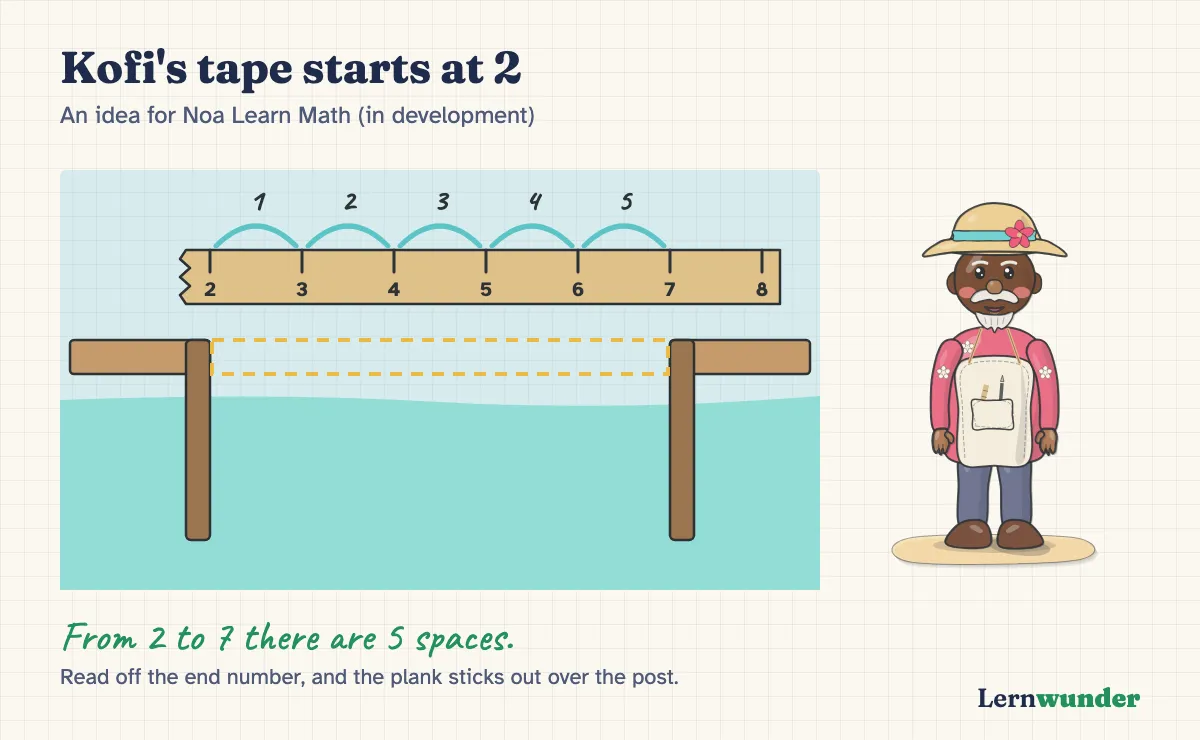
Noa is still being built. We cannot yet say when or in what form the app will appear. How the individual apps fit together is described in our post on the maths learning path. One thing is already clear: real lengths come from real objects. Hand spans and a ruler on the kitchen table remain irreplaceable, as described in our post on enactive, iconic and symbolic learning.
Frequently asked questions
When do children learn to measure length? Usually in the first two school years, first with body measures and everyday objects, then with centimetres and metres on a ruler and tape measure (KMK, 2022).
My child measures correctly. Should I still check? Try it once with a shifted object. A child who measures correctly from zero may still only be reading off (Kwon et al., 2024).
Why does my child always count one too many? They are probably counting the marks instead of the spaces. In one study, children using this strategy did better than children who simply read off the end number (Kwon et al., 2024). Show them the jumps between the marks.
Should I just correct my child? An experience works better: let them guess and then count the spaces themselves. The contradiction is more convincing than an explanation.
Sources
- Kamii, C. & Clark, F. B. (1997). Measurement of length: The need for a better approach to teaching. School Science and Mathematics, 97(3), 116–121. https://doi.org/10.1111/j.1949-8594.1997.tb17354.x
- Kultusministerkonferenz (2022). Bildungsstandards für das Fach Mathematik, Primarbereich [German national education standards for primary mathematics]. Decision of 15.10.2004 as amended on 23.06.2022, p. 15. https://www.kmk.org/fileadmin/Dateien/veroeffentlichungen_beschluesse/2022/2022_06_23-Bista-Primarbereich-Mathe.pdf
- Kwon, M. K., Congdon, E. L., Ping, R. M. & Levine, S. C. (2024). Overturning children’s misconceptions about ruler measurement: The power of disconfirming evidence. Journal of Intelligence, 12(7), 62. https://doi.org/10.3390/jintelligence12070062
- Solomon, T. L., Vasilyeva, M., Huttenlocher, J. & Levine, S. C. (2015). Minding the gap: Children’s difficulty conceptualizing spatial intervals as linear measurement units. Developmental Psychology, 51(11), 1564–1573. https://doi.org/10.1037/a0039707
Lernwunder editorial team · Chaolan Lu