In short: In German you usually cannot tell from a noun whether it takes der, die or das. Research shows that even very advanced learners make gender errors, not because they don’t know the grammar, but because the gender is not firmly stored with the word. The best approach is to learn every noun together with its article from the start, as a single unit. That is exactly how we want words to be spoken in our learning aid.
“Kannst du mir den Infusion bringen?” The colleague smiles and brings die Infusion, the IV bag. No one on the ward is in danger because of it, and yet moments like this stick. If you have spoken good German for months and still trip over the article, you start to wonder: why can’t I finally learn this?
The honest answer from research: because German articles really are hard for adult learners. And because how you learn words makes a difference.
In our post One word, three sentences we looked at learning medical terms in sentences. Today is about the smallest piece of that, and the one that wobbles most often: the article.
Why are German articles so hard?
German has three grammatical genders: masculine, feminine and neuter. Gender shows not only on the article but also on other determiners, on pronouns and on adjectives (Szagun et al., 2007). Once you’ve learned “der Zugang” (the IV line), you also have to say “er ist verstopft” (it’s blocked) and “ein neuer Zugang” (a new line). A wrong gender runs through the whole sentence.
On top of that, gender is intertwined with case and number. “Der” is masculine in the nominative but feminine in the dative (“mit der Kanüle”, with the cannula). In the plural, gender disappears altogether (Szagun et al., 2007). For learners, the signals are ambiguous. This very mix of gender, case and number is what makes errors in German especially likely (Spinner & Juffs, 2008).
Are there rules that reveal a noun’s gender?
Yes, but they are tendencies, not laws. Linguists describe rules based on meaning, word form and sound, and most of them only hold with a certain probability (Szagun et al., 2007). Some are very useful on the ward:
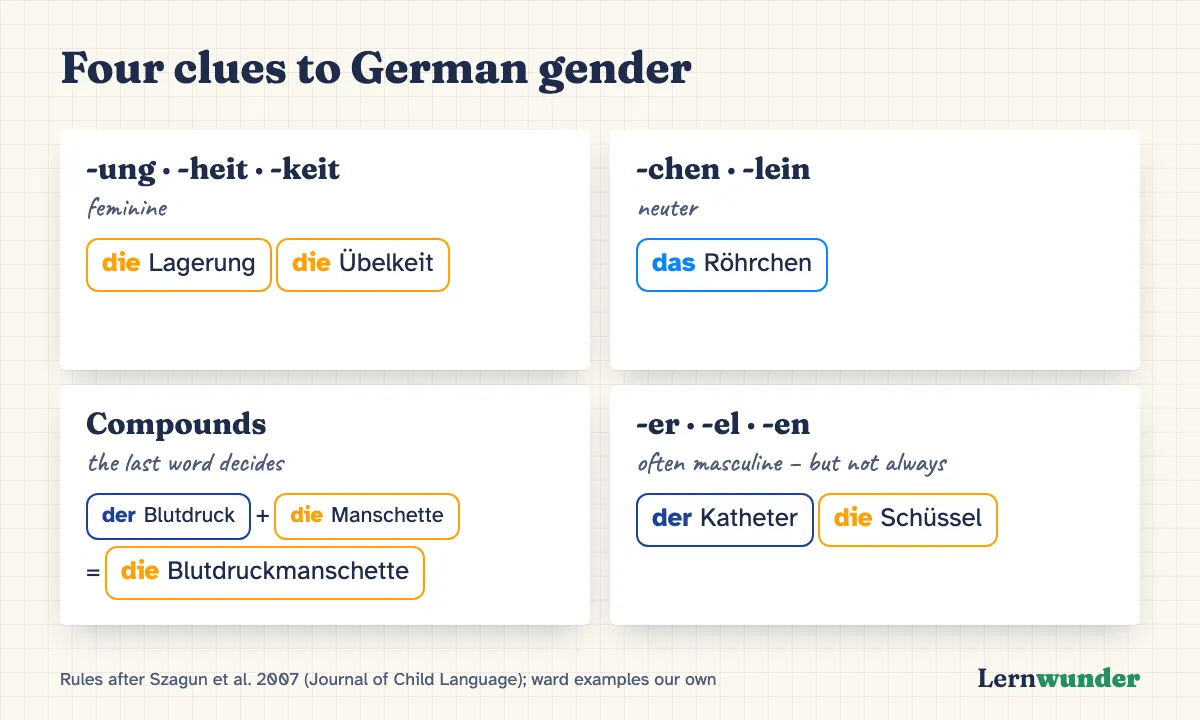
- Words ending in -ung, -heit, -keit, -schaft are feminine: die Lagerung (positioning), die Übelkeit (nausea).
- Diminutives ending in -chen and -lein are neuter: das Röhrchen (the sample tube).
- In compound words, the last part decides: der Blutdruck + die Manschette = die Blutdruckmanschette (the blood pressure cuff).
- Words ending in -en, -er, -el are often masculine, but only often: der Katheter, but die Schüssel (the bowl).
Native speakers and learners use these clues very differently. In experiments, native German speakers named pictures equally fast whether or not the noun’s ending matched its gender. English-speaking learners of German were fastest with typical endings and slowest with atypical ones (Bordag et al., 2006). Native speakers simply “know” a word’s gender; learners work it out. Later experiments suggest that in learners, gender is not stored as a fixed feature but computed anew each time it is needed (Bordag & Pechmann, 2007).
What does research show about learners’ gender errors?
One particularly revealing study comes from Spanish, which has two genders. Highly proficient learners whose first language was English understood gender-marked sentences as reliably as native speakers. Speaking was a different story: 17 percent of their answers contained a wrongly assigned gender. Errors in agreement, the grammar rule itself, made up only 1.5 percent (Grüter et al., 2012).

So the learners knew the rule. What they lacked was the gender of the individual word. A study with advanced English-speaking learners of German reached a similar conclusion: those who assigned gender more accurately when speaking were also the ones who used articles while listening to predict the next word. The author interprets the problem as one of vocabulary, not of grammar (Hopp, 2013).
The first language matters too. In a study on Dutch, learners with German as their first language did best, speakers of a Romance language came in the middle, and English speakers performed at chance on one of the tasks. What counted was less whether the first language has gender than how similar the systems are (Sabourin et al., 2006). For nurses from Turkey, the Philippines or China, whose languages have no grammatical gender, German articles are entirely new ground. But speakers of Polish or Arabic cannot rely on their instinct either.
Why does it help to learn the word and its article together?
This is where it gets practical. Researchers taught adults an invented language with articles. One group first heard the nouns with their articles in context and only later on their own. The other group heard the nouns on their own first. The first group learned both the nouns and the articles better (Arnon & Ramscar, 2012).
The authors’ explanation: meeting the small units first, nouns without articles, makes it harder to learn the link between article and noun. Children, by contrast, hear words with their articles from the very start, and sometimes even treat article and noun as one undivided unit at first (Grüter et al., 2012).
One caveat belongs here: the Arnon and Ramscar study used an artificial language, not German. We know of no study that compares learning German medical terms with and without the article. But the findings fit together: gender is a property of the individual word, and it sticks best when it belongs to the word from day one.
What you can do
- Never write down a noun without its article. Not even in your ward notebook. Not “Infusion” but “die Infusion”.
- Learn out loud. Say article and noun as one unit, like a single word: “dieInfusion”, “derZugang”.
- Use colours if they help you: one colour per gender on flashcards.
- Start with the reliable rules: -ung, -heit, -keit, -chen and the last part of compounds. They cover many ward words.
- In compounds, look for the last word: if you know die Manschette, you know die Blutdruckmanschette.
- Take mistakes calmly. Even very good learners make them (Grüter et al., 2012). You will almost always be understood.
What we are working on
In PflegeMate, the learning aid for nursing German that we are working on, we have made a decision: every noun appears with its article, and it is also spoken with its article. Tap a word and you should not hear “Rufanlage” but “die Rufanlage” (the call system).
The reason is in this post: gender belongs to the word, you cannot hear it in the word, and learners benefit from hearing word and article together from the start. Words without gender get no article. Activities such as “Blutdruck messen” (taking blood pressure) or descriptions such as “blass” (pale) are spoken as they are. That way nothing wrong is learned along the way.
PflegeMate is a language learning aid only. It does not replace onboarding or professional training.
Frequently asked questions
Can you tell a German noun’s article from its ending? Sometimes. -ung, -heit, -keit and -schaft are feminine, -chen and -lein neuter. Many other rules only hold most of the time (Szagun et al., 2007). The only safe way is to learn the word with its article.
Why do I still get articles wrong although my German is good? That is normal. Even very advanced learners sometimes assign the wrong gender when speaking, although they know the rules (Grüter et al., 2012; Hopp, 2013).
Is my first language an advantage or a disadvantage? It plays a role, especially if its gender system resembles German (Sabourin et al., 2006). But everyone has to learn gender word by word.
Do people notice article mistakes on the ward? They hear them, but they rarely get in the way of understanding. It matters more that you speak up and ask.
Sources
- Arnon, I. & Ramscar, M. (2012). Granularity and the acquisition of grammatical gender: How order-of-acquisition affects what gets learned. Cognition, 122(3), 292–305. https://doi.org/10.1016/j.cognition.2011.10.009
- Bordag, D., Opitz, A. & Pechmann, T. (2006). Gender processing in first and second languages: The role of noun termination. Journal of Experimental Psychology: Learning, Memory, and Cognition, 32(5), 1090–1101. https://doi.org/10.1037/0278-7393.32.5.1090
- Bordag, D. & Pechmann, T. (2007). Factors influencing L2 gender processing. Bilingualism: Language and Cognition, 10(3), 299–314. https://doi.org/10.1017/S1366728907003082
- Grüter, T., Lew-Williams, C. & Fernald, A. (2012). Grammatical gender in L2: A production or a real-time processing problem? Second Language Research, 28(2), 191–215. https://doi.org/10.1177/0267658312437990
- Hopp, H. (2013). Grammatical gender in adult L2 acquisition: Relations between lexical and syntactic variability. Second Language Research, 29(1), 33–56. https://doi.org/10.1177/0267658312461803
- Sabourin, L., Stowe, L. A. & de Haan, G. J. (2006). Transfer effects in learning a second language grammatical gender system. Second Language Research, 22(1), 1–29. https://doi.org/10.1191/0267658306sr259oa
- Spinner, P. & Juffs, A. (2008). L2 grammatical gender in a complex morphological system: The case of German. IRAL – International Review of Applied Linguistics in Language Teaching, 46(4). https://doi.org/10.1515/iral.2008.014
- Szagun, G., Stumper, B., Sondag, N. & Franik, M. (2007). The acquisition of gender marking by young German-speaking children: Evidence for learning guided by phonological regularities. Journal of Child Language, 34(3), 445–471. https://doi.org/10.1017/S0305000906007951
Lernwunder editorial team · Chaolan Lu