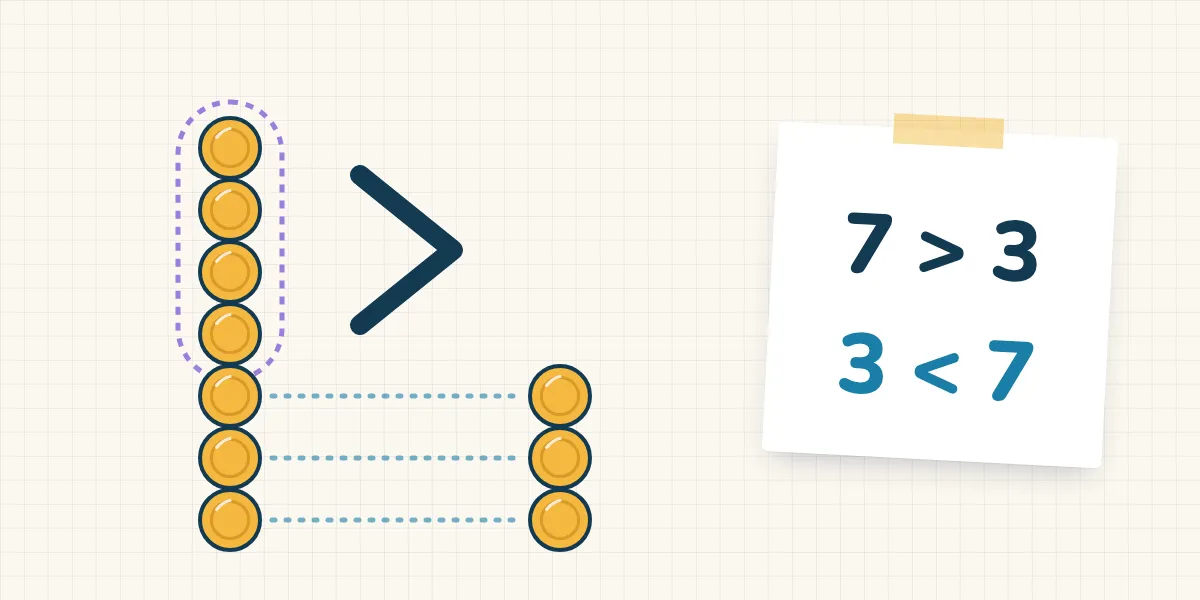
In short: The signs > and < are shorthand for a sentence: “8 > 5” means “8 is greater than 5”. Children learn them most securely when they compare quantities first and then always read the signs as a full sentence, together with the equal sign. In one study, children understood the equal sign better after comparing it with > and < (Hattikudur & Alibali, 2010). The alligator trick can help at the start, but it does not replace that sentence.
An invented but familiar scene: the homework sheet says 3 □ 7. The child draws an alligator with its mouth wide open towards the 7 and writes the sign correctly. Asked “How do you read that?”, the answer is: “The alligator eats the 7.” The task is done. Whether the child knows that 3 is less than 7 is another question.
What do > and < actually mean?
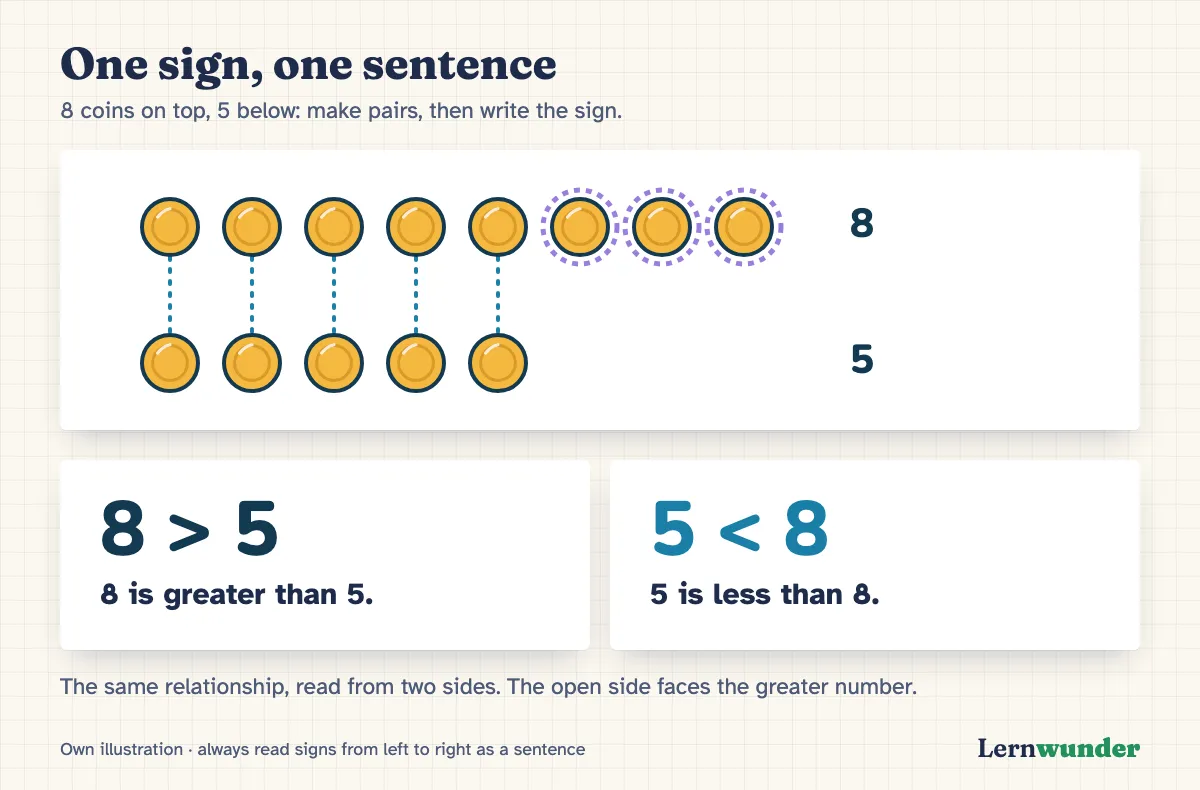
The signs > and < are inequality symbols or relation signs: they describe a relationship between two numbers. You read them from left to right, like a sentence.
- 8 > 5 means “8 is greater than 5”.
- 5 < 8 means “5 is less than 8”.
- 5 = 5 means “5 is equal to 5”.
The open side faces the greater number, the point faces the smaller one. And 8 > 5 and 5 < 8 describe the same relationship, seen from two sides. Switching between those two points of view is the hard part for many children.
Why does it all depend on the equal sign?
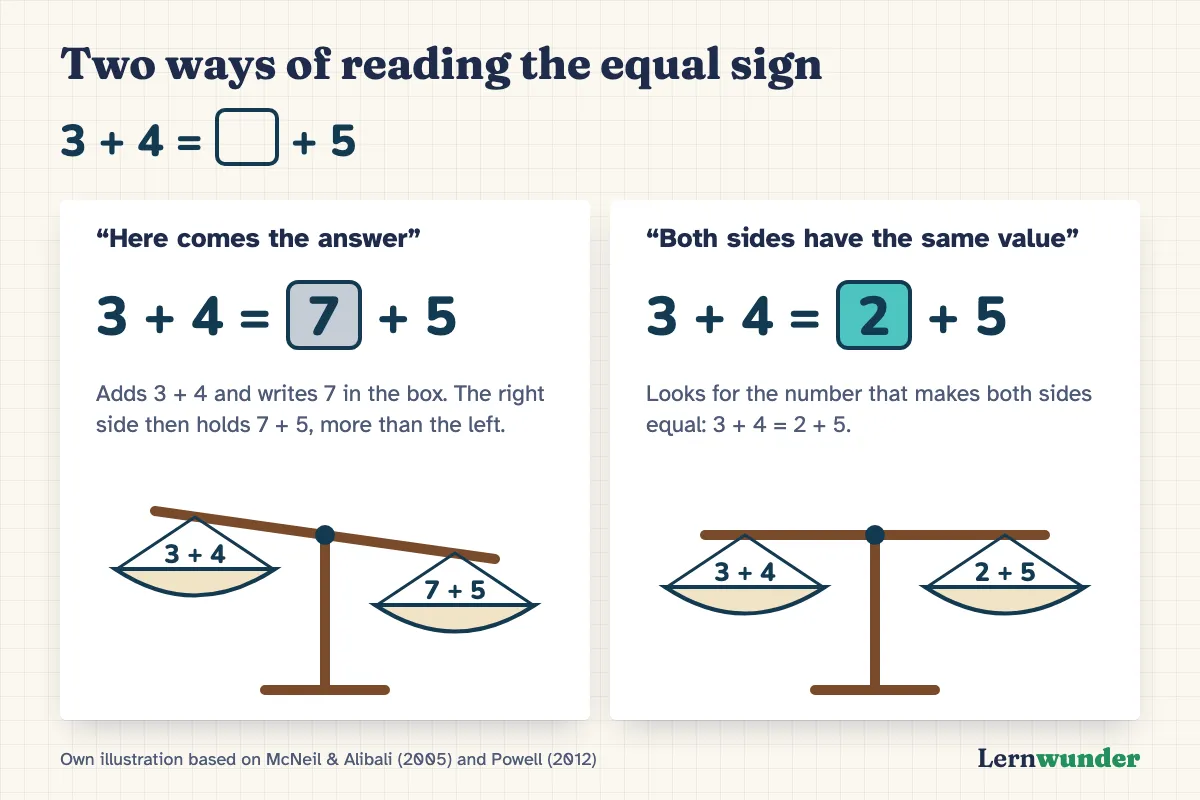
Because children often understand the equal sign differently from how adults expect. Many read “=” as “here comes the answer”. What it actually means is “both sides have the same value”. With 3 + 4 = 7 the difference goes unnoticed. With 3 + 4 = □ + 5 it doesn’t: a child who thinks “answer” writes 7 in the box, a child who thinks “same value” writes 2.
Research shows how persistent the “answer” view is:
- Children aged 7 to 11 who held strongly to this pattern learned less from a lesson on equations than others did (McNeil & Alibali, 2005). Patterns learned early can hold back later learning.
- In seven of eight US elementary maths textbook series, equations such as 3 = 8 − 5 or 2 + 3 = 1 + 4, which make “same value” visible, hardly appeared (Powell, 2012).
- In a study of 175 children in grades 2 to 6, most had only developed a basic view of “both sides have the same value” by grade 5 (Rittle-Johnson et al., 2011).
The German curriculum standards, too, expect children by the end of primary school to recognise and represent the equality of expressions and to compare terms (KMK, 2022). The equal sign is not a side issue.
Does it help to learn all three signs together?
One study suggests so. Third and fourth graders either learned about the equal sign alone or compared the three signs >, < and = with each other. The comparison group afterwards understood the equal sign better, and it could also handle > and <, in the same amount of teaching time (Hattikudur & Alibali, 2010).
The explanation is plausible: when children see that all three signs answer the same question, “How do the two sides relate?”, they understand the equal sign as a relationship rather than a command to calculate.
What is the problem with the alligator trick?
We have not found a study that tests the alligator mnemonic itself. What follows are our own considerations, not research findings.
- It replaces the sentence with a story. “The alligator eats the 7” doesn’t say that 3 is less than 7. The child practises a picture, not the relationship.
- It helps with writing, hardly with reading. Where the mouth points is quickly remembered. That 3 < 7 is read from the left, “3 is less than 7”, is not part of the picture.
- It doesn’t explain the equal sign. An alligator that eats nothing is a weak bridge to “the same value”.
- It is a pattern that has to be dropped again. The equal-sign findings show that early patterns are stubborn (McNeil & Alibali, 2005). Whether that applies to the alligator has not been studied.
Our view: as a starting aid, the alligator is fine. What matters is that the sentence comes next and the picture slowly fades away.
Why are “more than” and “less than” so hard to say?
Because comparison sentences have their own difficulty. In a classic study, 64 children aged 4 to 8 were shown birds and worms. Many answered “How many more birds than worms are there?” wrongly. The same problem phrased as “How many birds won’t get a worm?” went much better (Hudson, 1983). The children could work out the difference. What tripped them up was the “more … than” construction.
A series of experiments with kindergarten and first-grade children reached a similar conclusion: comparison word problems become especially hard when the sentence has to be turned around, as in “John has 7 eggs. He has 4 fewer than Peter. How many does Peter have?”. The deciding factor was not the arithmetic but flexible use of language (Stern, 1993).
There are also fine points of wording. “Greater than” fits numbers, “more than” fits quantities, and in everyday speech children also hear “bigger than” for both. It pays to use the maths phrases deliberately and consistently.
What you can do
- Quantities first, signs second. Lay out two rows of counters or coins, make pairs, and only then write the sign. How pairing works is explained in More, less or the same?.
- Read every sign aloud as a sentence. Always from left to right: “5 is less than 8”. Don’t let your child name the sign (“point”, “alligator”); ask for the sentence.
- Say both directions. Every 8 > 5 comes with a 5 < 8. Ask: “And what is the sentence from the other side?”
- Show the equal sign in unusual forms. Write 7 = 7, 8 = 5 + 3 or 3 + 4 = 2 + 5. A kitchen scale or a coat-hanger balance with pegs makes “the same value” tangible. More on number bonds like 8 = 5 + 3 in our post on number decomposition.
- Sign card game. Turn over two number cards; your child places >, < or = between them and reads the sentence aloud. If unsure, lay the quantities next to them.
- Rephrase questions. Besides “How many more?”, ask “How many don’t get a partner?”. Then build the comparison sentence together: “So Peter has 3 more than John.”
- Let the alligator go. Once your child reads the signs confidently as sentences, the picture is no longer needed.
Why this matters to us
Our last post looked at why comparing comes before calculating. The signs are the next step: they turn a comparison of quantities into a comparison of numbers. We are still thinking about what a game could look like in which children compare quantities. One principle is already settled for us: signs never appear on their own, always together with the sentence they stand for.
Frequently asked questions
Should I stop my child from using the alligator rule? Not abruptly. Add the sentence: “Yes, and how do we read it? 3 is less than 7.” Over time, the sentence will carry on its own.
My child keeps mixing up > and <. Is that a concern? Usually not. The signs look alike, and switching the point of view is demanding in language terms (Stern, 1993). It helps to lay out the quantities and say the sentence aloud.
What is the difference between “greater than” and “more than”? “More than” describes quantities (“I have more marbles than you”), “greater than” describes numbers (“8 is greater than 5”). Both express the same comparison.
Why does my child write 7 in 3 + 4 = □ + 5? Because they read the equal sign as “the answer comes next”. This is very common and can be practised well with balance examples and unusual equations (Powell, 2012; McNeil & Alibali, 2005).
Sources
- Hattikudur, S. & Alibali, M. W. (2010). Learning about the equal sign: Does comparing with inequality symbols help? Journal of Experimental Child Psychology, 107(1), 15–30. https://doi.org/10.1016/j.jecp.2010.03.004
- Hudson, T. (1983). Correspondences and numerical differences between disjoint sets. Child Development, 54(1), 84–90. https://doi.org/10.2307/1129864
- Kultusministerkonferenz (2022). Bildungsstandards für das Fach Mathematik. Primarbereich (German national education standards for primary mathematics). https://www.kmk.org/fileadmin/Dateien/veroeffentlichungen_beschluesse/2022/2022_06_23-Bista-Primarbereich-Mathe.pdf
- McNeil, N. M. & Alibali, M. W. (2005). Why won’t you change your mind? Knowledge of operational patterns hinders learning and performance on equations. Child Development, 76(4), 883–899. https://doi.org/10.1111/j.1467-8624.2005.00884.x
- Powell, S. R. (2012). Equations and the equal sign in elementary mathematics textbooks. The Elementary School Journal, 112(4), 627–648. https://doi.org/10.1086/665009
- Rittle-Johnson, B., Matthews, P. G., Taylor, R. S. & McEldoon, K. L. (2011). Assessing knowledge of mathematical equivalence: A construct-modeling approach. Journal of Educational Psychology, 103(1), 85–104. https://doi.org/10.1037/a0021334
- Stern, E. (1993). What makes certain arithmetic word problems involving the comparison of sets so difficult for children? Journal of Educational Psychology, 85(1), 7–23. https://doi.org/10.1037/0022-0663.85.1.7
Lernwunder editorial team · Chaolan Lu