In short: Many individual learning plans are written because they are required and then hardly used. Studies keep finding the same weaknesses: goals that cannot be observed, no statement of how progress will be measured, and reviews that are missing or end without a decision. A plan gets read when it is short (few goals), specific (observable behaviour) and measurable (criterion, date, method), and when every review leads to a next decision.
A Friday afternoon in the staff room, a scene we made up but many teachers will recognise: the folder with the learning plans is on the table, the deadline is Monday. Six pages per child, boxes for strengths, current level, goals, interventions, responsibilities. Last term’s goals are still there: “should improve reading”, “should concentrate better”. Did it work? Hard to say. So the plan gets copied, tweaked and filed.
If that sounds familiar, you are not alone, and it rarely comes down to a lack of effort.
What is an individual learning plan for?
An individual learning plan (called an IEP in the US, a Förderplan in Germany) describes for a child with additional support needs where they are, what they should learn next, what will be done and how you will know whether it worked. In Germany, every federal state requires such plans for pupils with an identified special educational need (Neumann et al., 2026); the details are set by each state.
The literature names several functions at once: planning teaching, structuring learning, enabling agreements between teachers and with parents, but also documenting and justifying (Moser Opitz et al., 2019). The trouble starts when that last function crowds out the others.
What does research show about learning plans in practice?
Written, yes; used, rarely. In a Swiss survey of 226 teachers, plans were usually written where they were required. But their main role was documentation and justification, not support itself, and teachers did not use them to plan lessons (Moser Opitz et al., 2019).
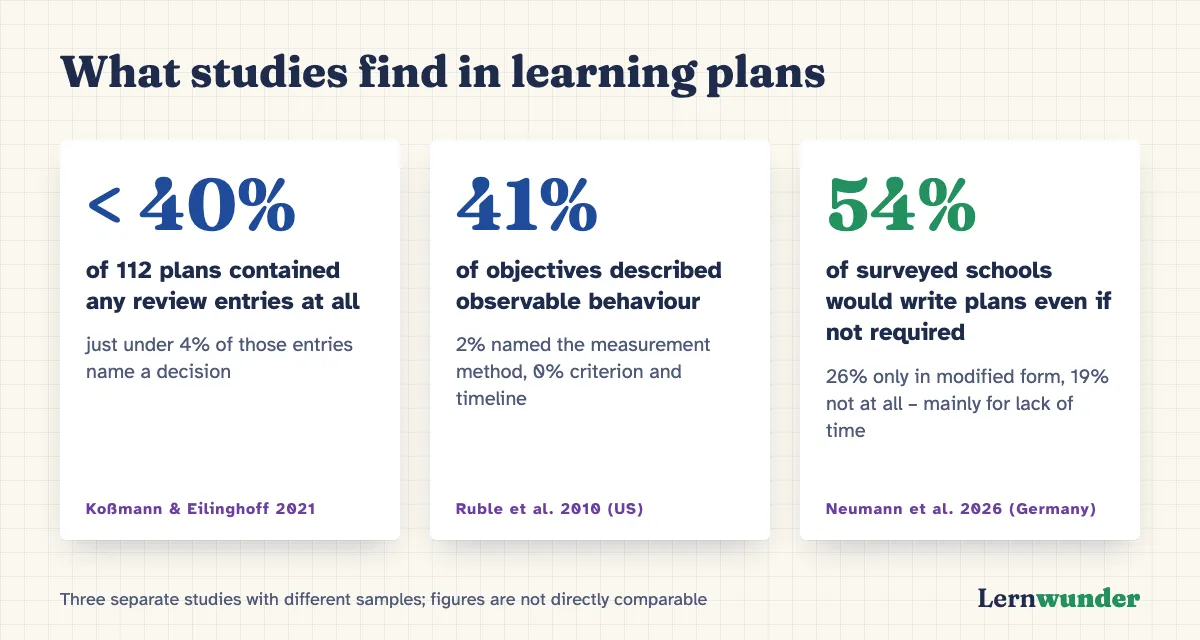
Valued, but too much work. A random sample of schools in North Rhine-Westphalia, Germany, was asked in 2024 whether they would write learning plans even if they were not required. 54 per cent said yes, 26 per cent “only in a modified form”, and 19 per cent no. The reasons were mainly lack of time, formal requirements and plans not being used in everyday teaching, rarely a rejection of planning itself (Neumann et al., 2026).
Reviews are often missing. An analysis of 112 real learning plans from one German state found entries evaluating the support in fewer than 40 per cent of them. Where there were such entries, on average only every second intervention was reviewed. And only a very small share of entries, just under 4 per cent, combined an observation with a decision about what to do next (Koßmann & Eilinghoff, 2021).
Goals you cannot measure. A US study analysed 35 IEPs for young children with autism. Only 41 per cent of the objectives described observable behaviour. Just under 2 per cent said how progress would be measured, and none gave a specific criterion together with a timeline (Ruble et al., 2010). The study is older and comes from a different school system, but the patterns match what the German studies describe.
Why does the review matter so much?
Because it turns a document into a tool. A research review on regular progress monitoring found that teachers who measured progress regularly achieved better student outcomes, especially when they used clear data-based decision rules for when to change their teaching (Stecker et al., 2005). Measuring alone is not enough. What counts is the step after: continue, adjust, or set a new goal.
For a learning plan, this means a goal is only as good as your ability to say, after six or eight weeks, whether it has been met.
What makes a goal useful?
A common memory aid is SMART: specific, measurable, achievable, relevant, time-bound. In everyday teaching it boils down to three questions:
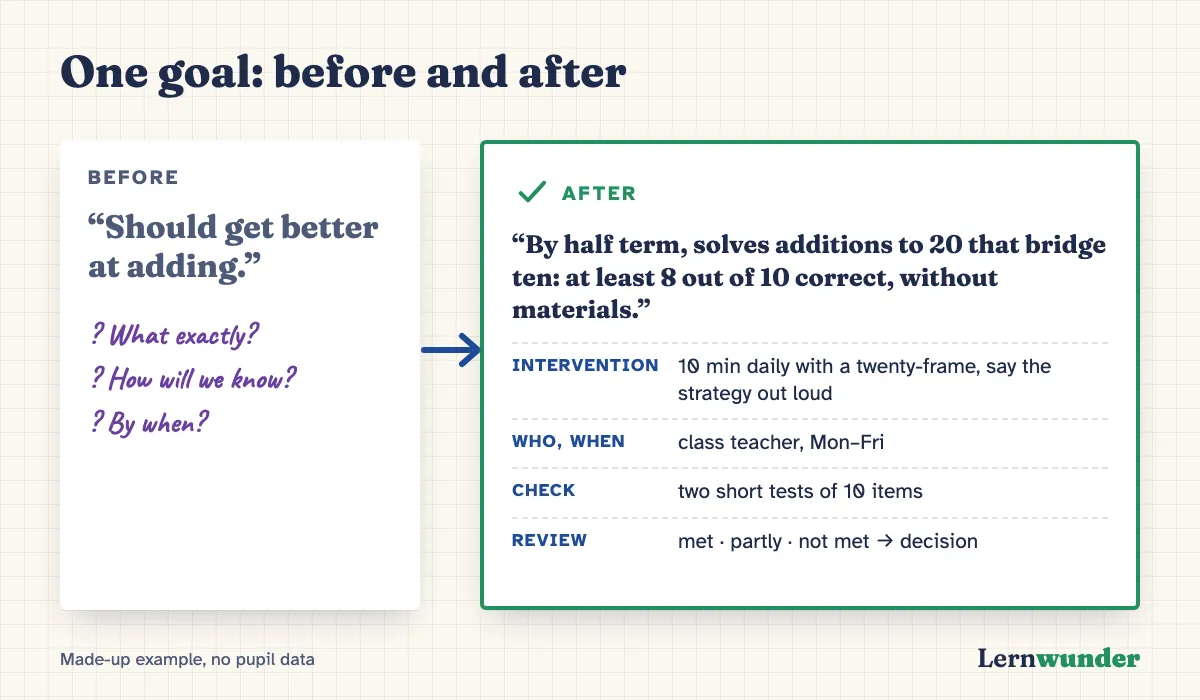
- What exactly will the child do? Observable behaviour, not a trait. Not “concentrate better” but “works on an independent task for 10 minutes before asking for help”.
- Under what conditions? With or without materials, alone or with support, in which situation.
- How will we know, and by when? A criterion (“8 out of 10”), a date and a method (“checked twice briefly”).
What you can do
- No more than three goals. Three goals that actually come up in lessons beat eight that nobody keeps track of. Other topics can go into the next plan.
- Every goal as a sentence with a verb. “Reads …”, “writes …”, “asks for …”. If you cannot find an observable verb, the goal is still too vague.
- Write criterion and date straight away. Whoever writes the goal also decides when and how it will be checked, and puts the date in the calendar.
- Interventions: specific but short. “10 minutes daily with a twenty-frame, saying the strategy out loud” rather than “individual support in class”. If you describe an intervention that precisely, you can review it later.
- Review in three words. Met, partly met, not met. Add one sentence of observation and one decision: continue, adjust, new goal.
- Don’t forget strengths. They are often the lever for the intervention and make conversations with parents easier.
- Keep the plan where you teach. A plan in a folder in a cupboard does not get read. A short plan with your lesson materials does.
What we are working on
We keep asking how a learning plan can be short enough that teachers use it and specific enough to teach from. That is why we are working on a tool for teachers that puts exactly this cycle of planning, a quick review and updating the plan at the centre. It is not finished, and we are not promising a date. When it is ready, we will write about it here.
Frequently asked questions
Does a learning plan have to follow SMART? Usually no rule says so; requirements differ between states, countries and schools. SMART is a memory aid, not a standard. What matters is that you can say at the end whether a goal has been met.
How often should a plan be reviewed? That is set locally, often once per term or half-year. For individual goals, shorter intervals of a few weeks help you adjust in time. Research does not prescribe a fixed number.
What if a goal was not met? Then the plan has not failed; it has given you information. Note what you observed and decide: more time, a different intervention or a smaller goal. According to Koßmann and Eilinghoff (2021), exactly this decision is missing from most reviews.
Does a good plan replace assessment? No. A learning plan builds on an assessment of where the child is; it does not replace it. If in doubt, special educators, school psychologists or advisory services can help.
Sources
- Koßmann, R. & Eilinghoff, P. M. (2021). Was sich aus evaluativen Eintragungen in Förderplänen lernen lässt [What review entries in learning plans can teach us]. Hildesheimer Beiträge zur Schul- und Unterrichtsforschung, 3. Universitätsverlag Hildesheim. https://doi.org/10.18442/190
- Moser Opitz, E., Pool Maag, S. & Labhart, D. (2019). Förderpläne: Instrument zur Förderung oder „bürokratisches Mittel“? [Learning plans: a support tool or a bureaucratic instrument?]. Empirische Sonderpädagogik, 11(3), 210–224. https://doi.org/10.25656/01:17780
- Neumann, P., Bunte, C. & Melzer, C. (2026). Zwischen Förderkonzept und Vorschrift [Between support concept and regulation: an empirical study of learning plan practice in schools in North Rhine-Westphalia]. Zeitschrift für Heilpädagogik, 77(2), 61–74. https://ris.uni-paderborn.de/download/64189/64190/zfh_02.2026_neumann.pdf
- Ruble, L. A., McGrew, J., Dalrymple, N. & Jung, L. A. (2010). Examining the quality of IEPs for young children with autism. Journal of Autism and Developmental Disorders, 40(12), 1459–1470. https://doi.org/10.1007/s10803-010-1003-1
- Stecker, P. M., Fuchs, L. S. & Fuchs, D. (2005). Using curriculum-based measurement to improve student achievement: Review of research. Psychology in the Schools, 42(8), 795–819. https://doi.org/10.1002/pits.20113
Lernwunder editorial team · Chaolan Lu