
In short: Addition and subtraction are two sides of the same relationship: 3 + 5 = 8 means 8 − 5 = 3. Even five- and six-year-olds understand that adding and taking away the same amount cancel each other out. But children do not automatically use this knowledge when they calculate. It works best when the connection is explained and shown, not when fact families are simply copied out.
A scene at the kitchen table (made up, but typical): a child works out 3 + 5 and writes 8 without hesitating. The next line says 8 − 5. Now the fingers come out and the child counts back: “seven, six, five, four, three.” The answer is right. But the child has not noticed that the answer was sitting one line above.
That connection is what this article is about: how children learn to see addition and subtraction as belonging together, and why this saves so much calculating.
What are inverse relations and fact families?
The inverse of a calculation undoes it. 3 + 5 = 8 goes with 8 − 5 = 3: what was added is taken away again.
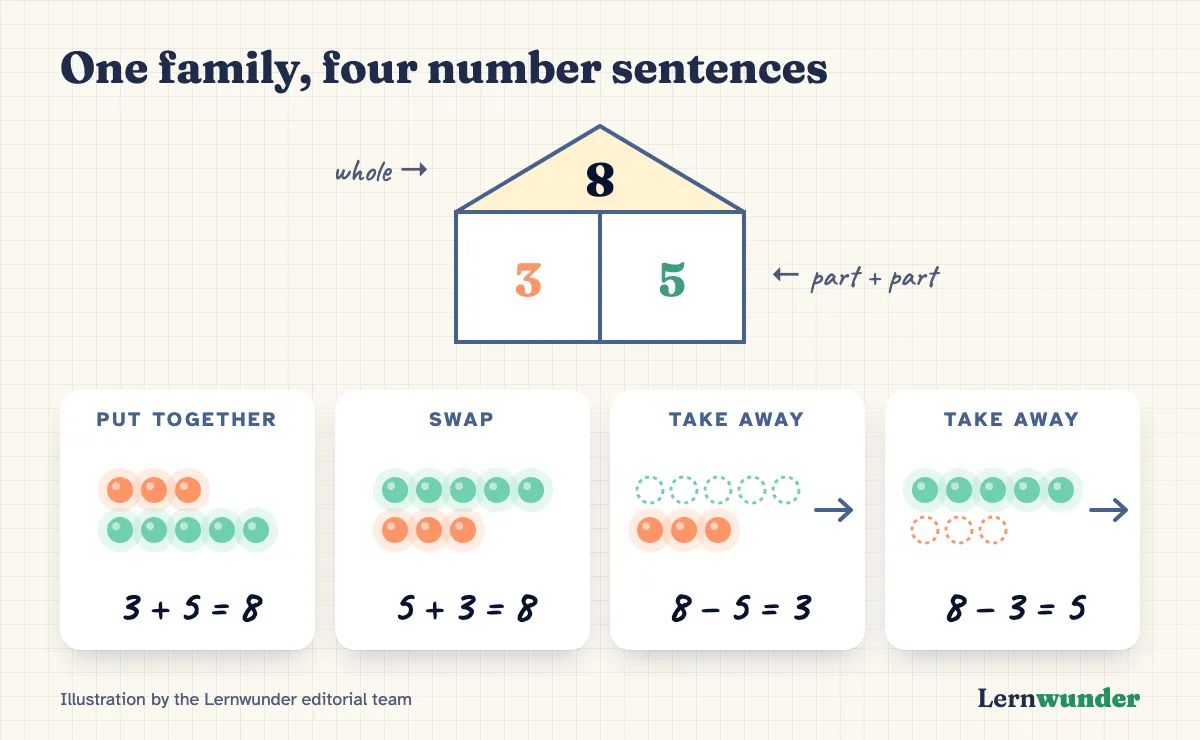
A fact family is a set of three numbers that belong together, for example 3, 5 and 8. They give four number sentences: 3 + 5 = 8, 5 + 3 = 8, 8 − 5 = 3 and 8 − 3 = 5. Eight is the whole, three and five are the parts. If you know the part-whole model from our article on number bonds, you will recognise the idea.
Researchers distinguish two ideas here. The inversion principle says that adding and subtracting the same amount cancel out (8 + 5 − 5 is 8 again). The complement principle says that if two parts make a whole, taking one part away from the whole leaves the other part (from 3 + 5 = 8 it follows that 8 − 5 = 3).
Do young children understand this at all?
Surprisingly early. Bryant, Christie and Rendu (1999) gave five- and six-year-olds problems in which objects were added and then taken away. The children recognised that the two cancel out, even when the objects taken away were a different material from those added. Six- to eight-year-olds even used the principle on problems such as a + b − (b + 1). The researchers conclude that this understanding does not simply follow from being able to calculate.
Children do differ a lot here, though. A meta-analysis of 14 studies on understanding inversion found stable patterns of individual differences (Gilmore & Papadatou-Pastou, 2009). Understanding and calculation skill do not grow in step for every child. Some calculate confidently without using the relationship; others understand it before they calculate fluently.
Can it be taught?
Yes, and deliberately so. Nunes, Bryant and colleagues (2009) taught children about the inverse relation in two studies. With eight-year-olds it clearly worked: afterwards they did better not only on problems like a + b − b, but also on problems where they had to transfer what they had learnt (a + b = c, so c − b = ?). With five-year-olds the effect was limited.
A randomised study with 81 children from kindergarten to third grade is particularly revealing (Paliwal & Baroody, 2020). For twelve weeks, one group practised subtraction with an explicit link to addition; other groups practised subtraction facts without that structure, or a different strategy. The test was a “shortcut” task: first 7 + 7 = 14 was shown, then 14 − 7. Significantly more children from the structured group used the addition fact instead of working it out again. A large majority of that group used the “think addition” strategy reliably; the comparison groups did not.
Even older children sometimes need a nudge. In a study with 67 third and fourth graders, children were told that the previous problem might sometimes help. On about 40 percent of the matching problems they then looked back, and they answered faster and more accurately (Torbeyns et al., 2016).
Why isn’t writing out fact families enough?
Many workbooks treat fact families as a writing exercise: three numbers, four number sentences. Baroody (2016) examined six widely used US first-grade curricula. None of them adequately covered the three prerequisites children need to solve subtraction through addition:
- Adding can be undone by subtracting.
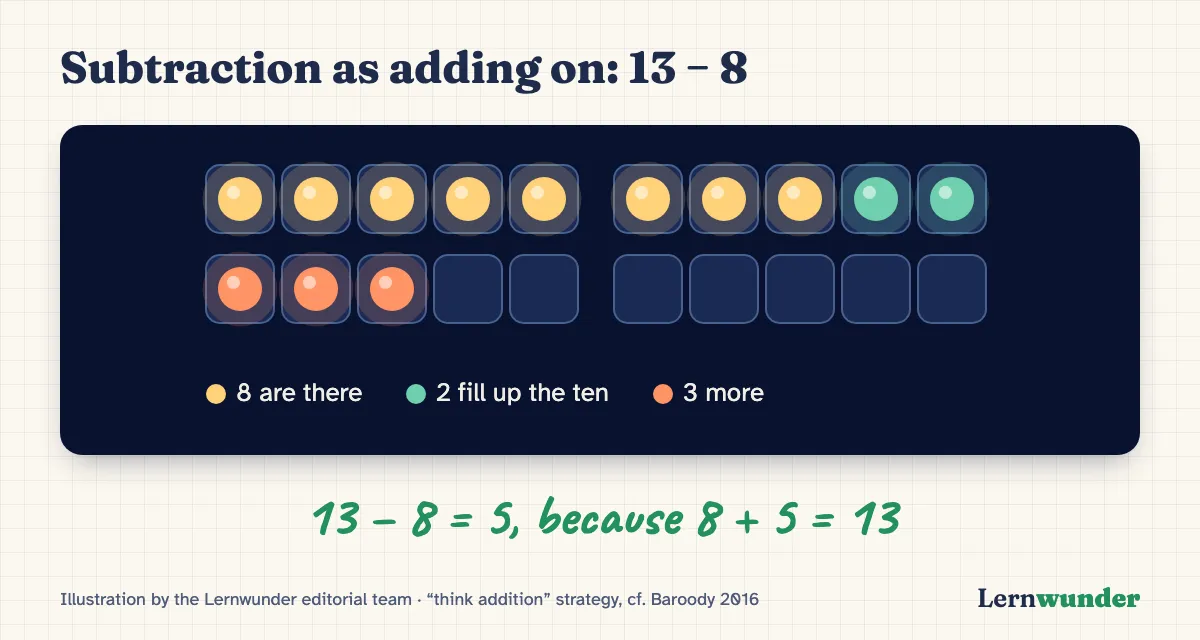
- 5 + 8 and 13 − 8 share the same whole (13) and the same parts (5 and 8).
- If 5 and 8 make 13, taking 8 away from 13 leaves 5.
In our view, this is the heart of the matter: a fact family is a thinking tool, not a form to fill in. A child who copies four number sentences from a pattern can write them correctly without ever using the relationship behind them, and may still count when in doubt.
What you can do
- Under the cup. Put out eight counters, hide five under a cup and ask how many are still visible. Then bring the five back: “How many now?” Undoing becomes something the child sees happen.
- Shortcut pairs. Ask 7 + 4 first, then straight away 11 − 4. Afterwards ask: “Did the first one help?” Praise your child for noticing the link on their own.
- Part-whole first. Draw a part-whole diagram (or number bond) with the whole and two parts before any number sentences appear. Let your child tell you what happens when one part is taken away.
- Add on when the gap is small. For 12 − 9, “How many from 9 to 12?” is much easier than counting back nine steps.
- Stories in both directions. “Three birds sit on a branch, five more arrive.” Then: “Eight birds sit there, five fly away.” Ask what the two stories have in common.
- Explain, don’t copy. Instead of writing four number sentences: “Why does 8 − 3 = 5 belong to this family too?”
- Spot the impostor. Deliberately add 3 − 8 = 5 to the family. Can your child explain why you cannot take eight things away from three?
Why this matters to us
Seeing addition and subtraction as connected is the step after number bonds and before bridging through ten. In our learning path these steps build on each other. What we take from the research: children should experience and explain the relationship, not just copy it down. And adding on is a perfectly good way to subtract.
Frequently asked questions
What is the difference between the commutative property and the inverse? Commutativity swaps the order: 3 + 5 and 5 + 3. The inverse undoes the calculation: 3 + 5 = 8 becomes 8 − 5 = 3.
At what age can children do this? The basic understanding appears at five or six (Bryant et al., 1999). Using it while calculating is a topic for the first school years and works better with explicit teaching (Nunes et al., 2009; Paliwal & Baroody, 2020).
My child writes fact families correctly but still counts for subtraction. What should I do? That is common. Use shortcut pairs and ask about the connection. If a child in second grade (Year 2) still solves almost everything by counting, talk to the teacher. Practice at home is no substitute for a proper assessment.
Should subtraction always be done through addition? No. If the amount taken away is small (13 − 2), taking away is quick. If the gap is small (13 − 9), adding on is usually easier. It helps to know both.
Sources
- Baroody, A. J. (2016). Curricular approaches to connecting subtraction to addition and fostering fluency with basic differences in grade 1. PNA, 10(3), 161–190. https://doi.org/10.30827/pna.v10i3.6087
- Bryant, P., Christie, C. & Rendu, A. (1999). Children’s understanding of the relation between addition and subtraction: Inversion, identity, and decomposition. Journal of Experimental Child Psychology, 74(3), 194–212. https://doi.org/10.1006/jecp.1999.2517
- Gilmore, C. K. & Papadatou-Pastou, M. (2009). Patterns of individual differences in conceptual understanding and arithmetical skill: A meta-analysis. Mathematical Thinking and Learning, 11(1–2), 25–40. https://doi.org/10.1080/10986060802583923
- Nunes, T., Bryant, P., Hallett, D., Bell, D. & Evans, D. (2009). Teaching children about the inverse relation between addition and subtraction. Mathematical Thinking and Learning, 11(1–2), 61–78. https://doi.org/10.1080/10986060802583980
- Paliwal, V. & Baroody, A. J. (2020). Fostering the learning of subtraction concepts and the subtraction-as-addition reasoning strategy. Early Childhood Research Quarterly, 51, 403–415. https://doi.org/10.1016/j.ecresq.2019.05.008
- Torbeyns, J., Peters, G., De Smedt, B., Ghesquière, P. & Verschaffel, L. (2016). Children’s understanding of the addition/subtraction complement principle. British Journal of Educational Psychology, 86(3), 382–396. https://doi.org/10.1111/bjep.12113
Lernwunder editorial team · Chaolan Lu