In short: Experts advise almost no screen time for children under two and at most one hour a day for two- to five-year-olds. German guidance suggests a maximum of 45 to 60 minutes of screen media in total for six- to ten-year-olds, ideally not every day. These numbers rest on fairly weak evidence. For learning apps, what a child does on screen matters as much as how long. Short, regular sessions beat long ones.
A made-up but typical question at a parents’ evening: “My son is allowed half an hour of TV in the afternoon. Now his teacher has recommended a maths app. Does that count as screen time too? And is that then too much?”
The honest answer has two parts. Yes, the learning app counts. And no, ten minutes of a maths app and ten minutes of cartoons are not the same.
What do experts recommend?
The key recommendations at a glance:
- World Health Organization (WHO, 2019) for children under five: no screen time under the age of two; for two- to four-year-olds no more than one hour of sedentary screen time a day, “less is better”. Reading and storytelling with a caregiver are recommended instead.
- American Academy of Pediatrics (AAP, 2016): under 18 months no screens except video-chatting; from 18 to 24 months, if at all, high-quality content and only together with an adult; for two- to five-year-olds at most one hour of high-quality programming, ideally watched together. No screens during meals or in the hour before bed.
- German Federal Centre for Health Education (BZgA, 2020; now the Federal Institute for Public Health): up to age three, ideally none; three to six years at most 30 minutes in total; six to ten years at most 45 to 60 minutes of TV, computer, console, tablet and smartphone combined. And: ideally not every day.
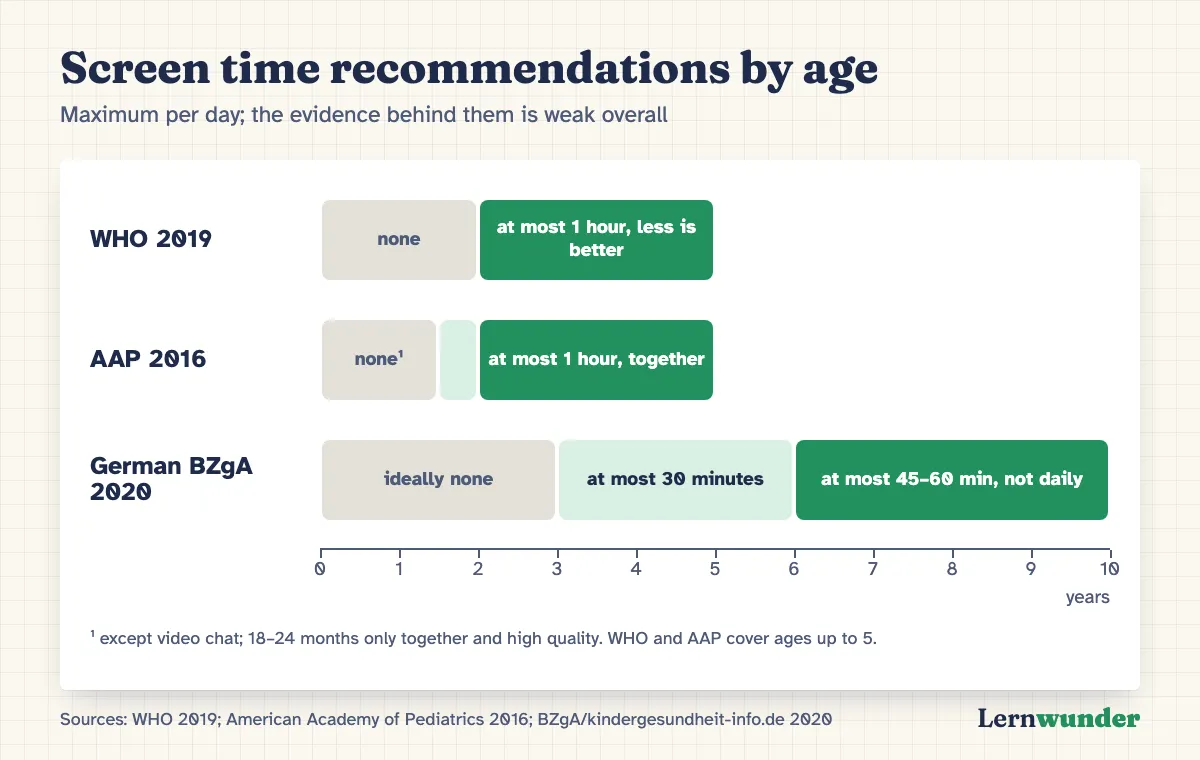
The BZgA explicitly calls these values “approximate guidelines”, since every child is different. Its main reason for a limit is that movement, family time and “classic” games should not miss out (BZgA, 2020).
How solid are these numbers?
Less solid than the round figures suggest. The WHO describes its recommendations as “strong”, but rates the underlying evidence as of very low quality overall. For screen time and cognitive development it found mostly unfavourable or no associations (WHO, 2019).
One example of stronger research is a Canadian longitudinal study of 2,441 children. More screen time at ages two and three preceded slightly poorer results on developmental screening tests later, not the other way round. But the effects were small (Madigan et al., 2019). And the study measured total screen time, not the type of content.
What follows from this: limits make sense, mainly because screen time can crowd out other important things. Research does not provide an exact “healthy number of minutes”.
Is a learning app the same as a video?
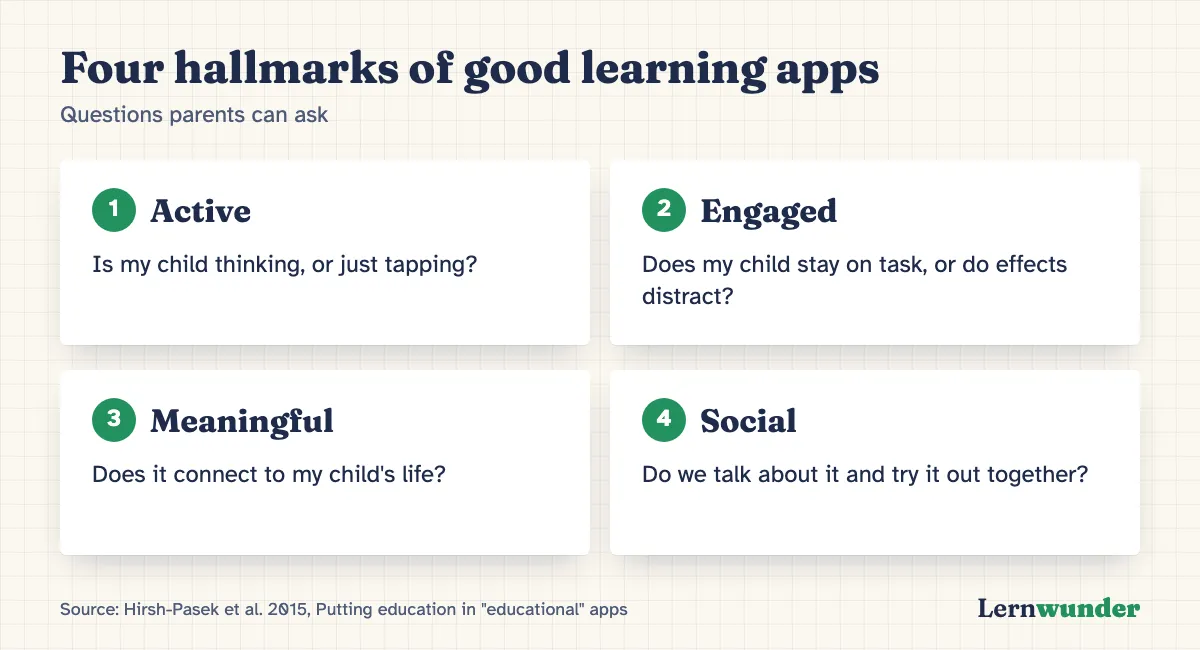
No. A research team led by Kathy Hirsh-Pasek derived four hallmarks of good learning apps from the science of learning. Children learn when they are actively thinking rather than just tapping, when they stay engaged with the task instead of being distracted by effects, when the learning is meaningful and connects to their lives, and when it happens socially, for example in conversation with adults (Hirsh-Pasek et al., 2015).
A review of 35 controlled studies with young children shows that well-made apps can support learning: there was evidence of a learning benefit for early academic skills, particularly in early mathematics. The authors note, however, that the studies were very varied and often poorly reported (Griffith et al., 2020).
Paediatricians make the same distinction: they advise against fast-paced programmes and apps with lots of distracting content, and recommend helping children apply what they see to the world around them (AAP, 2016).
Why do short sessions make sense?
Because spaced practice sticks better than massed practice. A large meta-analysis of 317 experiments found that spreading learning across several separate sessions leads to better retention than practising for the same total time in one go (Cepeda et al., 2006). Most of these studies tested remembering words and facts, not maths in primary school children. For recalling number facts such as 8 = 5 + 3, we consider the transfer plausible.
In practice: ten minutes on four days achieve more than forty minutes on one afternoon. And they fit more easily within any recommendation.
What you can do
- Count learning apps too. Plan learning time into the overall budget instead of adding it on top.
- Short and regular. Ten minutes on several days rather than one long session at the weekend.
- Start together. Be there for the first few times and ask: “How did you work that out?” That turns screen time into a conversation.
- From the screen into the world. After the app, carry on with real objects: share eight spoons between two plates, count stairs in fives.
- Fixed screen-free times. During meals and in the hour before bed (AAP, 2016).
- Check the app yourself. Are there ads, distractions or pressure to keep playing? Then choose a different one.
How we approached it in Zahlzerlegung
Our app Zahlzerlegung (currently in German only) is built so that nothing pulls a child back to the screen: no ads, no notifications, no daily streaks, no sounds. While a child is working out a number bond, the screen only shows what belongs to the task. Why we do without points and streaks is explained in our article on rewards in learning.
The flashcard system spreads practice over time: new number bonds and ones answered wrongly come up often, while secure ones only reappear in every fifth practice round as a check.
We are just as open about what the app does not have: there is no built-in timer and no automatic end to a practice round. How long your child practises is up to you. Our recommendation is a few minutes, but regularly, alongside real counters on the table, as described in our article on number bonds to ten.
Frequently asked questions
Does a learning app count as screen time? Yes. The BZgA recommendations cover all screen media together (BZgA, 2020). Within that time, though, a good learning app is a better choice than many alternatives.
How much is fine for a child in Year 1? German guidance gives six- to ten-year-olds a maximum of 45 to 60 minutes of screen media a day, ideally not daily. That is a rough guide, not an exact limit.
Does screen time damage the brain? There is no solid evidence for that. Studies tend to find small associations, and the quality of the evidence is low (WHO, 2019; Madigan et al., 2019).
How can I tell a good learning app? Your child thinks actively, is not distracted, learns something meaningful, and you end up talking about it (Hirsh-Pasek et al., 2015).
Sources
- American Academy of Pediatrics, Council on Communications and Media (2016). Media and young minds. Pediatrics, 138(5), e20162591. https://doi.org/10.1542/peds.2016-2591
- Bundeszentrale für gesundheitliche Aufklärung (2020). Wie oft und wie lange dürfen Kinder Medien nutzen? [How often and how long may children use media?] kindergesundheit-info.de, as of October 2020. https://familienportal.nrw/sites/default/files/2022-12/Empfehlungen-der-Dauer-Mediennutzung_BZgA_kindergesundheit-info.pdf
- Cepeda, N. J., Pashler, H., Vul, E., Wixted, J. T. & Rohrer, D. (2006). Distributed practice in verbal recall tasks: A review and quantitative synthesis. Psychological Bulletin, 132(3), 354–380. https://doi.org/10.1037/0033-2909.132.3.354
- Griffith, S. F., Hagan, M. B., Heymann, P., Heflin, B. H. & Bagner, D. M. (2020). Apps as learning tools: A systematic review. Pediatrics, 145(1), e20191579. https://doi.org/10.1542/peds.2019-1579
- Hirsh-Pasek, K., Zosh, J. M., Golinkoff, R. M., Gray, J. H., Robb, M. B. & Kaufman, J. (2015). Putting education in “educational” apps: Lessons from the science of learning. Psychological Science in the Public Interest, 16(1), 3–34. https://doi.org/10.1177/1529100615569721
- Madigan, S., Browne, D., Racine, N., Mori, C. & Tough, S. (2019). Association between screen time and children’s performance on a developmental screening test. JAMA Pediatrics, 173(3), 244. https://doi.org/10.1001/jamapediatrics.2018.5056
- World Health Organization (2019). Guidelines on physical activity, sedentary behaviour and sleep for children under 5 years of age. https://www.who.int/publications/i/item/9789241550536
Lernwunder editorial team · Chaolan Lu