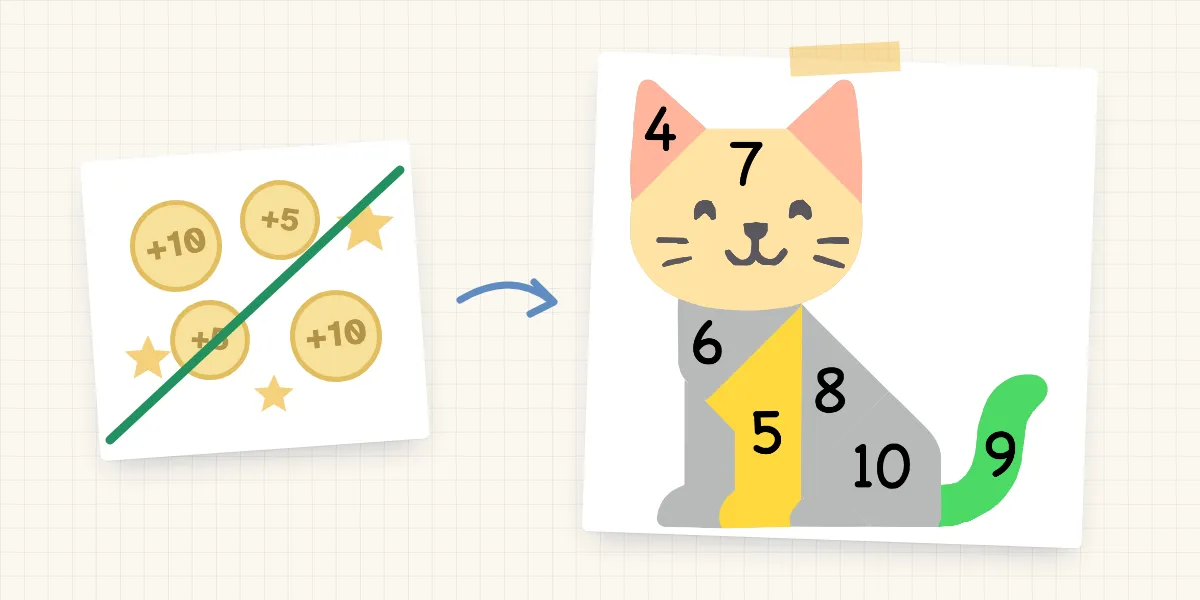
In short: Rewards in learning apps help when they show what a child has learned, and tend to backfire when they become the goal or pull attention away from the maths. That is why Zahlzerlegung has no points, coins or daily streaks. Each child has a tangram animal, and a piece only fills with colour once all number bonds of one number are secure.
A made-up but familiar scene: a child is playing a maths app. After every answer coins rain down, a counter jumps up, a fanfare plays. Ten minutes later you ask, “What were you practising?” The answer: “I’ve got 340 coins!”
Last week we looked at what points, stars and streaks do to learning. Today we turn to the question that followed for us: what does a reward look like that supports number bonds to 10 instead of competing with them? Our answer in Zahlzerlegung is four tangram animals.
What does research say about rewards and learning?
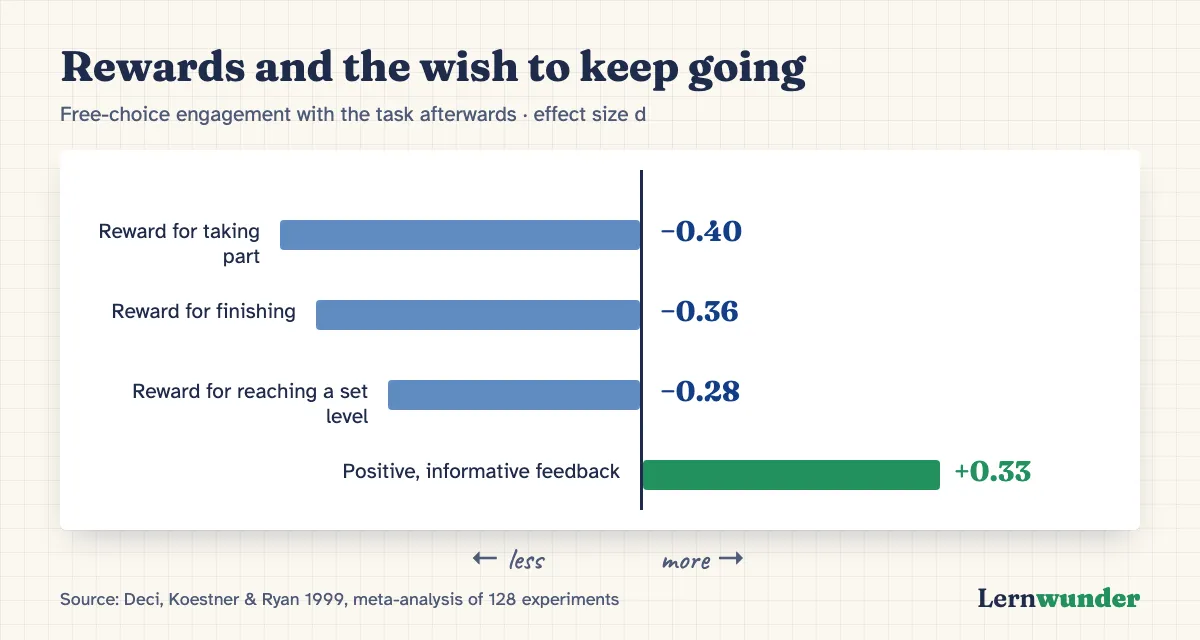
The most thorough review comes from Deci, Koestner and Ryan (1999), who pooled 128 experiments. Rewards that children expect, and that are given for simply taking part, finishing or reaching a set level, on average reduced how much people later chose to engage with the task on their own. Positive, informative feedback worked the other way: it increased both free-choice engagement and interest. For children, the downside of tangible rewards was somewhat larger than for university students.
Does that mean game elements are bad? No. A more recent meta-analysis of gamification found small positive effects on learning outcomes, motivation and behaviour (Sailer & Homner, 2020). The effects on motivation and behaviour were less stable, however, once only methodologically rigorous studies were counted. So it matters a lot which game element is used for what.
When does a reward distract from learning?
Children aged five to seven cannot yet shield their attention well from colourful stimuli. In one experiment, kindergarten children in a heavily decorated classroom were more distracted, spent more time off task and learned less than in the same room with the decorations removed (Fisher et al., 2014).
For digital media, a meta-analysis of e-books for young children shows a similar pattern: animated pictures and music that supported the story helped comprehension, while built-in games, hotspots and extra features distracted – especially for children from less stimulating home environments (Takacs et al., 2015).
From this we took a simple rule: everything that happens on screen while a child is thinking should be about the maths. A reward may come once the task is done, and it should say something about what was learned.
What does tangram have to do with maths?
Tangram is an old puzzle made of seven geometric shapes that can be arranged into animals, people and objects. Puzzles and construction play like this call on spatial thinking. The link between spatial skills and early maths is well established: even in three-year-olds, the ability to copy block constructions predicted part of their maths performance (Verdine et al., 2014).
Can spatial thinking be trained to help maths? A meta-analysis of 29 studies found that spatial training improved maths performance by a small amount on average (Hawes et al., 2022). Training with physical materials worked better than computer-based training.
To be honest about it: the tangram animals in our app are not spatial training. The child doesn’t arrange the pieces; they watch them fill with colour. We chose tangram because it fits the topic: a whole made of parts, just like 8 is made of 5 and 3. If you want to build spatial skills, real tangram pieces in your child’s hands are the better choice (see below).
How we solved it in Zahlzerlegung
One animal per child. Each child chooses a tangram animal: panda, dolphin, dog or cat. Up to four children can practise on one device this way. At the start the animal is grey.
One piece per number. The animal has seven pieces, one for each number from 4 to 10. A piece only fills with colour once all number bonds of that number are secure, meaning each has been answered correctly several times with no mistake in between. One lucky guess isn’t enough. So the animal doesn’t show how much a child has tapped – it shows what they can do.
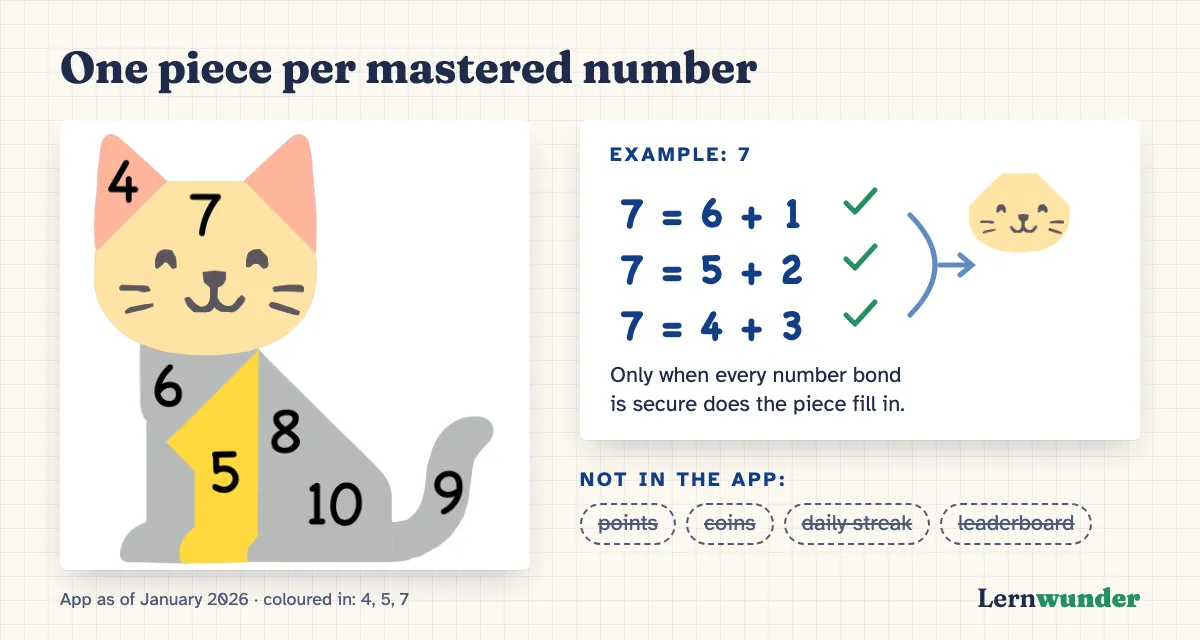
Rewards after the task, not during it. While the child is thinking, the only thing that moves is the ring that measures but doesn’t rush. After a correct answer, the colour of the matching piece sometimes lights up briefly as a preview. Now and then a sticker of the child’s own animal appears for three seconds. It isn’t collected or counted, so there’s nothing to grind towards.
No counter, no streak, no leaderboard. There are no points, no coins, no daily streak that can break, and no comparison between children. A child who skips three days loses nothing. The app also has no sounds.
A visible finish line. When all seven pieces are coloured in, there is a certificate. At that point the app has done its job, and there is no reason to keep tapping forever.
The animal always shows the current state. If a number bond is later answered wrongly, it comes up more often, and its piece waits until the bond is secure again. There’s no point deduction and no telling-off. We explained why mistakes shouldn’t be punished in an earlier post.
What you can do
- Ask about the piece, not the animal. “Which number is new in colour? Show me how you can split 7.” That turns the reward into a conversation about maths.
- Praise the strategy. “You knew 6 + 4 because 5 + 5 is also 10” says more than “Great job!”. Informative feedback is the kind of reward that, according to Deci et al. (1999), tends to strengthen the wish to keep going.
- Don’t promise rewards for practising. “If you do ten minutes of maths, you can watch TV” turns maths into a chore to get through.
- Play real tangram. Seven pieces cut from card are enough. Start with outlines your child fills in, then move to free designs. Name shapes and positions as you go: “The triangle is at the top right.”
- Decompose with tangram, too. Two small triangles make a square, two large ones make a bigger triangle. Again: a whole made of parts.
Frequently asked questions
Are rewards in learning apps always bad? No. Small game elements can help (Sailer & Homner, 2020). Problems start when the reward becomes the goal or draws attention away during the maths itself.
Why are there stickers, then? Children enjoy small surprises. We kept them deliberately short: three seconds, after the task, with no album and no counter.
What happens after the certificate? Your child can keep practising, but there’s nothing new to earn. Once all number bonds to 10 are secure, the goal has been reached.
Does the app train spatial thinking? No, and we don’t claim it does. Hands-on materials are much better suited for that (Hawes et al., 2022).
Zahlzerlegung is available in German only. Find out more on the Zahlzerlegung page.
Sources
- Deci, E. L., Koestner, R. & Ryan, R. M. (1999). A meta-analytic review of experiments examining the effects of extrinsic rewards on intrinsic motivation. Psychological Bulletin, 125(6), 627–668. https://doi.org/10.1037/0033-2909.125.6.627
- Fisher, A. V., Godwin, K. E. & Seltman, H. (2014). Visual environment, attention allocation, and learning in young children: When too much of a good thing may be bad. Psychological Science, 25(7), 1362–1370. https://doi.org/10.1177/0956797614533801
- Hawes, Z. C. K., Gilligan-Lee, K. A. & Mix, K. S. (2022). Effects of spatial training on mathematics performance: A meta-analysis. Developmental Psychology, 58(1), 112–137. https://doi.org/10.1037/dev0001281
- Sailer, M. & Homner, L. (2020). The gamification of learning: A meta-analysis. Educational Psychology Review, 32(1), 77–112. https://doi.org/10.1007/s10648-019-09498-w
- Takacs, Z. K., Swart, E. K. & Bus, A. G. (2015). Benefits and pitfalls of multimedia and interactive features in technology-enhanced storybooks: A meta-analysis. Review of Educational Research, 85(4), 698–739. https://doi.org/10.3102/0034654314566989
- Verdine, B. N., Golinkoff, R. M., Hirsh-Pasek, K., Newcombe, N. S., Filipowicz, A. T. & Chang, A. (2014). Deconstructing building blocks: Preschoolers’ spatial assembly performance relates to early mathematical skills. Child Development, 85(3), 1062–1076. https://doi.org/10.1111/cdev.12165
Lernwunder editorial team · Chaolan Lu