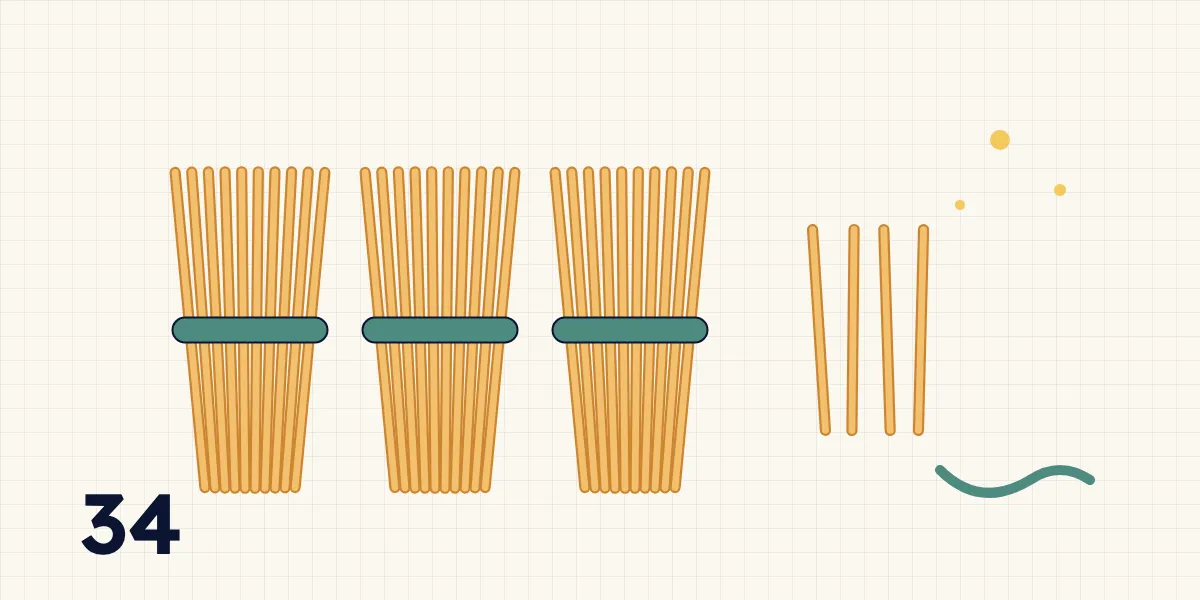
In short: In our place value system, a digit means something different depending on its position: the 3 in 34 stands for three tens, or thirty. Many children can name tens and ones without understanding this. In one interview study, none of 15 second graders reliably showed what the tens digit means (Ross, 1986). Understanding grows when children group ten objects into a bundle themselves and can also undo a bundle, not simply because base-ten blocks are on the table.
An invented but typical scene: a child in Year 2 counts out 26 sticks, writes “26” and says proudly: “The 2 is the tens, the 6 is the ones.” Then the question: “Show me with the sticks what the 2 means.” The child pushes two sticks aside. They have learned the words, but not what the words stand for.
What does place value actually mean?
Our number system rests on two ideas. First, things are grouped: ten ones make a ten, ten tens make a hundred. Second, the position of a digit decides its value: in 34 the 3 means three tens, in 43 it means three ones. On top of that, zero acts as a placeholder; without it, 305 and 35 would look the same.
For adults this is so obvious that the hurdle is easy to miss. A ten is two things at once: one thing and ten things. Children have to build this double view for themselves.
Isn’t it enough to name tens and ones?
No, and this is one of the most robust findings on the topic. Researcher Sharon Ross interviewed 60 children from grades 2 to 5, 15 per grade, one by one, on tasks like the one with the sticks. In six tasks, the children had to show how many objects each digit of a two-digit number represents. Seven fifth graders, seven fourth graders, two third graders and no second graders solved all six. 28 of the 60 children showed no convincing understanding of the tens digit at all (Ross, 1986).
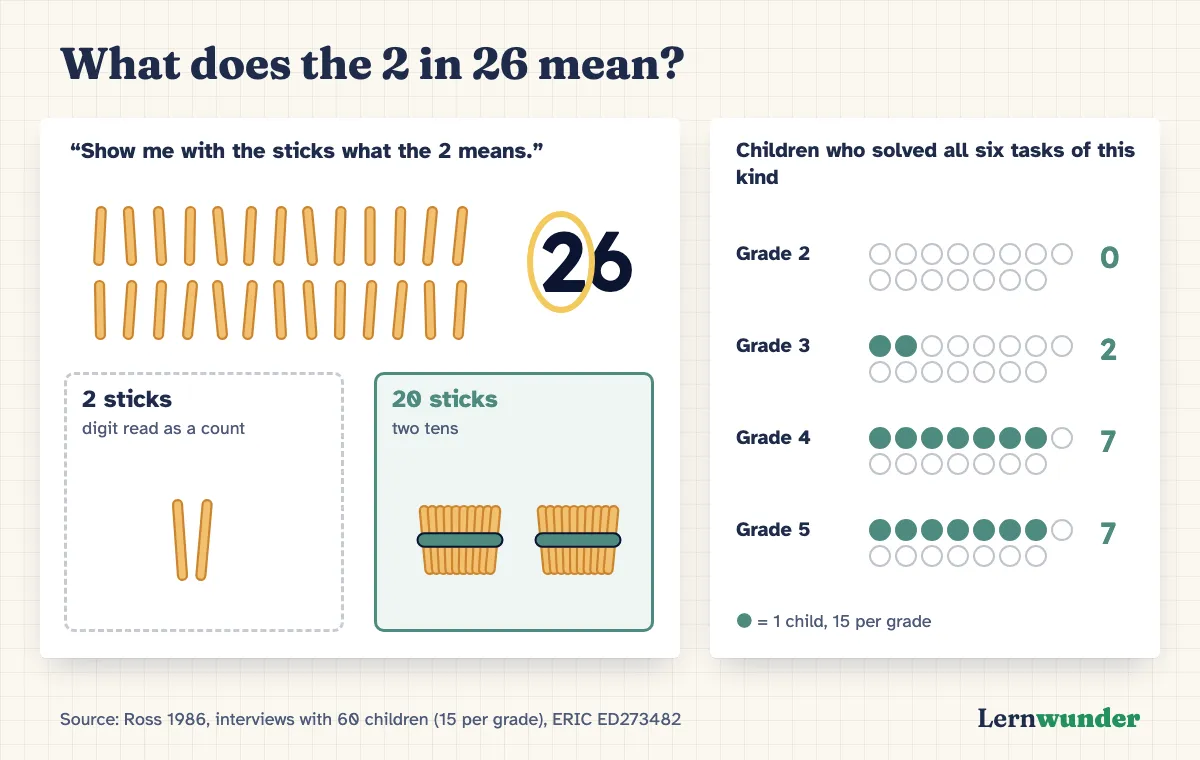
What mattered was what the successful children had in common. They could count in tens, split a collection into a tens part and a ones part, and recognised that a grouped collection stays the same size however it is arranged. Being able to name the places was not enough (Ross, 1986). From these interviews Ross developed a five-stage model of how children interpret two-digit numbers, with suggestions for teaching (Ross, 1989).
How does understanding develop?
A major paper drawing on four research projects describes how children gradually come to think about two-digit numbers (Fuson et al., 1997). At first, 34 means 34 single things. Later children hear “thirty and four”, then they count “ten, twenty, thirty” in tens and carry on in ones. Only after that do they see “three tens and four ones” as separate units and can switch between all these views.
This development starts early. In a study with 207 children aged three to seven, even three-year-olds showed some competence, for example when comparing two multidigit numbers. With targeted practice the children made clear progress (Mix et al., 2014). Children bring prior knowledge that can be built on.
And it pays off. In a longitudinal study, place value understanding in Year 1 reliably predicted certain aspects of addition performance in Year 3 (Moeller et al., 2011). Children who understand tens and ones later calculate more securely with larger numbers.
Why bundle themselves instead of using ready-made tens?
Many classrooms use base-ten rods with ten cubes fixed together. They are practical. But to a child, a ready-made rod is at first just a longer piece of material. You cannot see that it was made from ten ones and can fall apart into ten ones again.
We have not found studies that directly compare children making their own bundles with ready-made materials. But two findings suggest that materials alone are not enough:
- Manipulatives work, but not automatically. A meta-analysis of 55 studies found small to moderate benefits for teaching with manipulatives. How large depended clearly on how they were used in teaching (Carbonneau et al., 2013). More in our article Enactive, iconic, symbolic.
- Lots of material is not the same as lots of understanding. Laski and colleagues (2016) studied 150 children from Montessori schools, where base-ten materials play a big role, and from other schools. An advantage in showing numbers with tens and ones appeared only in kindergarten, no longer in first grade. In grades 2 and 3 there were no differences in place value understanding.
What does help is thinking and talking about meaning. In a classroom study, only 18% of children in grades 3 to 5 initially solved such a digit task. After lessons in which they worked on the meaning of digits in groups and exchanged their views, 71% of the previously unsuccessful children succeeded (Ross & Sunflower, 1995).
Our conclusion: grouping should be the child’s own action, not a result handed to them. A child who ties ten straws together with a rubber band experiences that a bundle is exactly ten ones. A child who unties it again experiences that nothing gets lost.
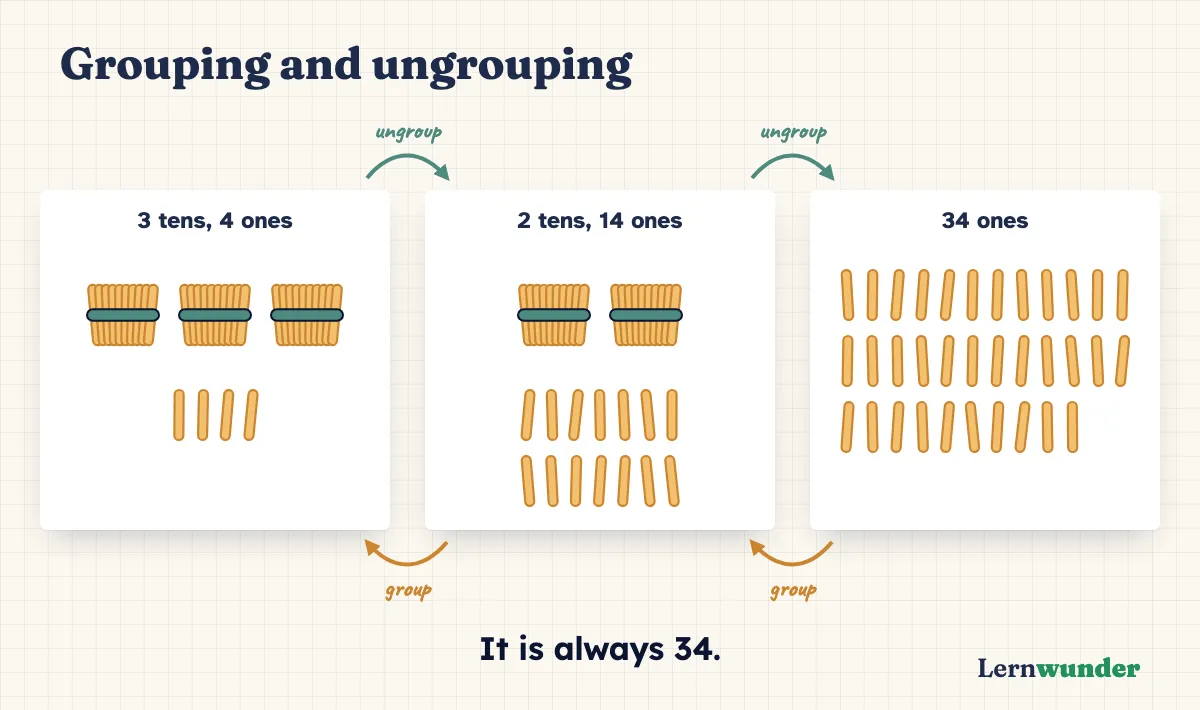
Why is ungrouping just as important?
Because children need it as soon as they calculate. With 52 − 7 the two ones are not enough. You have to “open” a ten and then have 4 tens and 12 ones. This is what is often called regrouping or “borrowing”. A child who has only learned that a ten is a solid block is puzzled here. A child who knows that grouping and ungrouping are two directions of the same thing has a tool.
This way of thinking also helps with bridging ten. With 8 + 5, ten gets filled and three are left over. More in our article Bridging ten.
What you can do
- Bundle it yourselves. Give your child 30 to 50 straws, toothpicks or pasta pieces and some rubber bands. “How many are there? Make it easy for yourself.” Many children come up with bundles of ten on their own. If not, suggest it.
- Ask about meaning. Instead of “Where are the tens?” try: “Show me what the 3 in 34 means.” The answer tells you more than any worksheet.
- There and back. Show 34 with three bundles and four single straws. Then untie a bundle: “How many are there now?” The insight to aim for: it is still 34.
- Use money. Swap ten 1p or 1¢ coins for a 10p coin or a dime, and back again. That is grouping in everyday life.
- Say numbers in tens. Now and then say “three tens and four ones” instead of just “thirty-four”. It makes audible what the digits mean.
- Show empty places. Put 30 and 3 side by side. What is different? The zero shows: there are no ones here, but the place stays.
Why this matters to us
Place value is the fourth station on our learning path, after quantities, number bonds and bridging ten. We are currently working on a new app on this topic. One decision has already been made: children will group ten into a bundle themselves, and every bundle can be undone again. They will not be handed ready-made tens.
Frequently asked questions
When do children learn place value? The basics of tens and ones usually come at the end of Year 1 and in Year 2, when numbers to 100 are introduced. But the interviews by Ross (1986) show that understanding keeps developing into grades 4 and 5.
Are base-ten blocks bad? No. They are a good tool once a child understands that a rod is ten ones. Before that, making bundles yourself is worth it.
My child can name tens and ones. Do they understand it? Check with objects: ask them to show what each digit means. If they push two single objects aside for the 2 in 26, the understanding is not there yet, even if the words are.
Sources
- Carbonneau, K. J., Marley, S. C. & Selig, J. P. (2013). A meta-analysis of the efficacy of teaching mathematics with concrete manipulatives. Journal of Educational Psychology, 105(2), 380–400. https://doi.org/10.1037/a0031084
- Fuson, K. C., Wearne, D., Hiebert, J. C., Murray, H. G., Human, P. G., Olivier, A. I., Carpenter, T. P. & Fennema, E. (1997). Children’s conceptual structures for multidigit numbers and methods of multidigit addition and subtraction. Journal for Research in Mathematics Education, 28(2), 130–162. https://doi.org/10.5951/jresematheduc.28.2.0130
- Laski, E. V., Vasilyeva, M. & Schiffman, J. (2016). Longitudinal comparison of Montessori versus non-Montessori students’ place-value and arithmetic knowledge. Journal of Montessori Research, 2(1). https://doi.org/10.17161/jomr.v2i1.5677
- Mix, K. S., Prather, R. W., Smith, L. B. & Stockton, J. D. (2014). Young children’s interpretation of multidigit number names: From emerging competence to mastery. Child Development, 85(3), 1306–1319. https://doi.org/10.1111/cdev.12197
- Moeller, K., Pixner, S., Zuber, J., Kaufmann, L. & Nuerk, H.-C. (2011). Early place-value understanding as a precursor for later arithmetic performance: A longitudinal study on numerical development. Research in Developmental Disabilities, 32(5), 1837–1851. https://doi.org/10.1016/j.ridd.2011.03.012
- Ross, S. H. (1986). The development of children’s place-value numeration concepts in grades two through five. ERIC ED273482. https://eric.ed.gov/?id=ED273482
- Ross, S. H. (1989). Parts, wholes, and place value: A developmental view. Arithmetic Teacher, 36(6), 47–51. https://doi.org/10.5951/AT.36.6.0047
- Ross, S. & Sunflower, E. (1995). Place-value: Problem-solving and written assessment using digit-correspondence tasks. ERIC ED389624. https://eric.ed.gov/?id=ED389624
Lernwunder editorial team · Chaolan Lu