In short: Children demonstrably learn maths from each other too: a meta-analysis found a moderate positive effect of peer-assisted learning on achievement in primary school (Rohrbeck et al., 2003). What matters is that children talk about maths and explain things to each other. That is why we are building our game for comparing quantities so that two children play on one iPad and take turns saying who has more.
An invented but typical scene: two children lean over a tablet. “I’ve got two more than you!” – “No you haven’t, look!” One child points at the coins lying side by side and counts the ones left over. “One, two. Fine, you’re right.” There is more maths in that little argument than on many a worksheet.
Do children really learn from each other?
Yes, that is well supported, with caveats. A meta-analysis reviewed studies of approaches in which primary school children help each other, for example as learning partners or tutors (Rohrbeck et al., 2003). The results:
- On average, achievement improved measurably (weighted effect size d = 0.33). That is a small to moderate effect.
- Younger children and children from low-income families benefited most.
- Approaches worked better when children were rewarded together, were measured against their own progress and had a say in how they worked.
A second review of 17 maths studies came to a similar picture for children with, or at risk of, learning difficulties: peer-mediated learning was moderately effective, most clearly in primary school and for computation (Kunsch et al., 2007).
Very young children benefit as well. In a study across 20 kindergarten classes, children practised maths in fixed pairs twice a week for 15 weeks. Children at every achievement level made more progress than in the comparison classes, including children with special needs (Fuchs et al., 2001).
Why does talking about maths matter so much?
Because language is not a side channel here; it is part of the learning itself. In preschool classes where teachers talked more about numbers, amounts and comparisons, children’s maths knowledge grew more over the year. The amount of “math talk” was not related to what the children knew at the start of the year (Klibanoff et al., 2006).
For small-group work, a review set out which conversations really help: detailed explanations rather than bare answers, and help that responds to what the other child actually needs. One effective approach is to design the task so that children have to explain things to each other (Webb, 1991).
Does a game help?
One study tested exactly this in everyday preschool settings. Children played a simple number board game in small groups. Afterwards they compared numbers better, counted more accurately, recognised more numerals and estimated more precisely on a number line. It also worked when a classroom assistant led the game, and the children stayed engaged over several sessions (Ramani et al., 2012).
Competing or cooperating?
We want to be honest here: our game is a competitive game. Whoever fills their treasure chest first wins. Research takes a critical view of competition. A large meta-analysis of 148 studies with young adolescents found that cooperative goals went along with higher achievement and better relationships than competition or working alone (Roseth et al., 2008). Whether the same holds for six-year-olds playing a dice game has not been studied.
So we have tried to keep competition small:
- The die decides, not ability. The stronger child does not automatically win.
- Comparing is a shared moment. Both look at the same coins, and the sentence has to be true for both.
- The same amount is not a wasted turn. In a tie nobody captures anything, yet the round still counts as a success for both. If a whole game ends in a draw, both get a puzzle piece for their treasure map.
How we are building the game for two
This is what partner mode looks like at our current stage of development:
- One device, two children. Each child picks their own sea creature as a game piece, first one, then the other. No second device, no network.
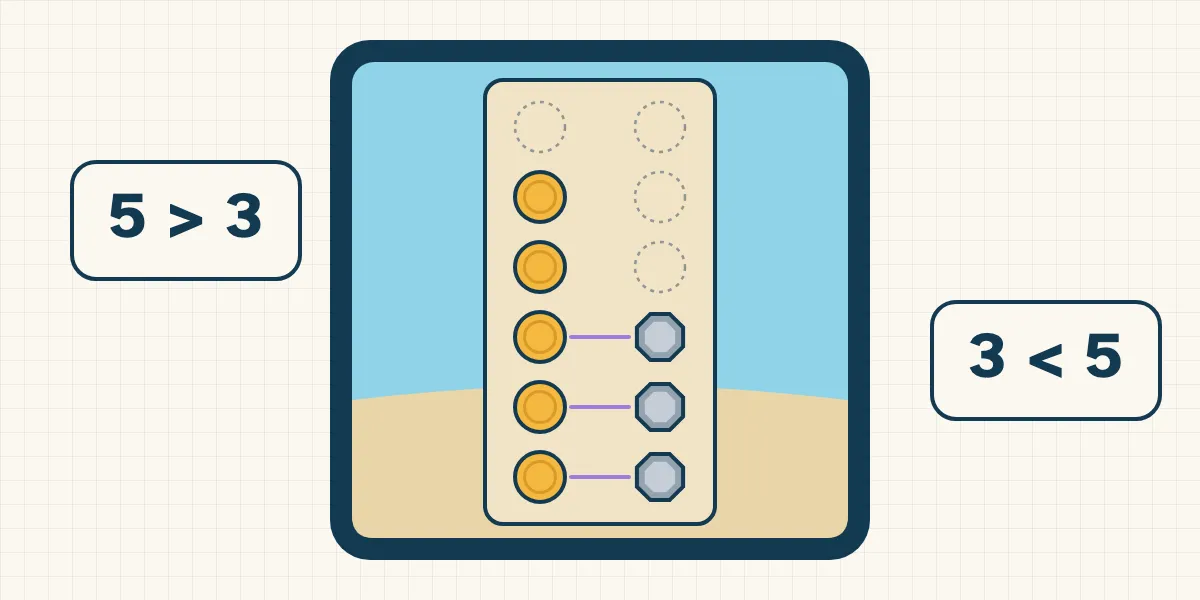
- A shared middle. Both place their coins on the same board, one child on the left in gold, the other on the right in silver. The coins lie in rows side by side, so pairs form by themselves.
- Taking turns to answer. Each round, a different child does the comparing, and who rolls first switches too. Above the three sentence cards it says who is being asked: “Which sentence is true for you?”
- Sentences from your own point of view. The cards say “I have more than you”, “I have less than you” and “We have the same amount”. Every card can be read aloud on request.
- The difference is the loot. Whoever has more drags the coins without a partner into their own chest.
The first-person sentences are the heart of the decision. If one child has five coins and the other three, “I have more than you” and “I have less than you” are both correct, depending on who is speaking. Because the role changes every round, both children practise both directions, and turning the comparison around is the harder part for many children. How the signs > and < show the same relationship from two sides is explained in our post Does the alligator eat the bigger number?.

And why the iPad? A tablet offers enough space for a shared board with big coins that small fingers can grab easily. That is why we are planning the game for iPad. For children playing alone, we are also developing a separate mode with an in-game opponent.
What you can do
- Roll together. Two children, two dice, buttons in two colours. Whoever has more takes the buttons without a partner. It is the table version of the idea from our post A pirate island for comparing quantities.
- Ask for full sentences. Not “me” or “more”, but “I have more than you”. The sentence frames from More, less or the same? help with this.
- Swap roles. A different child answers every round, including the one who has less.
- The “show me” rule. Before taking any loot, the child shows which buttons have no partner.
- Celebrate a tie. “We have the same amount!” is a lovely sentence, not a lost turn.
- Sit nearby now and then. A quick “How can you tell?” from an adult gets the explanations going.
Frequently asked questions
Won’t two children on one device just argue? Sometimes, and a bit of arguing about “who has more?” is even welcome if it is settled by pointing and counting. Fixed roles each round help, because it is clear whose turn it is.
What if one child is much further ahead? In the kindergarten study, children at every achievement level benefited from learning in pairs (Fuchs et al., 2001). In a dice game, chance also evens out a lot.
Can a child play alone? Yes, we are developing a separate mode for that. Playing together remains the heart of the game for us.
When will the game be released? We will report here when it is ready.
Sources
- Fuchs, L. S., Fuchs, D. & Karns, K. (2001). Enhancing kindergartners’ mathematical development: Effects of peer-assisted learning strategies. The Elementary School Journal, 101(5), 495–510. https://doi.org/10.1086/499684
- Klibanoff, R. S., Levine, S. C., Huttenlocher, J., Vasilyeva, M. & Hedges, L. V. (2006). Preschool children’s mathematical knowledge: The effect of teacher “math talk”. Developmental Psychology, 42(1), 59–69. https://doi.org/10.1037/0012-1649.42.1.59
- Kunsch, C. A., Jitendra, A. K. & Sood, S. (2007). The effects of peer-mediated instruction in mathematics for students with learning problems: A research synthesis. Learning Disabilities Research & Practice, 22(1), 1–12. https://doi.org/10.1111/j.1540-5826.2007.00226.x
- Ramani, G. B., Siegler, R. S. & Hitti, A. (2012). Taking it to the classroom: Number board games as a small group learning activity. Journal of Educational Psychology, 104(3), 661–672. https://doi.org/10.1037/a0028995
- Rohrbeck, C. A., Ginsburg-Block, M. D., Fantuzzo, J. W. & Miller, T. R. (2003). Peer-assisted learning interventions with elementary school students: A meta-analytic review. Journal of Educational Psychology, 95(2), 240–257. https://doi.org/10.1037/0022-0663.95.2.240
- Roseth, C. J., Johnson, D. W. & Johnson, R. T. (2008). Promoting early adolescents’ achievement and peer relationships: The effects of cooperative, competitive, and individualistic goal structures. Psychological Bulletin, 134(2), 223–246. https://doi.org/10.1037/0033-2909.134.2.223
- Webb, N. M. (1991). Task-related verbal interaction and mathematics learning in small groups. Journal for Research in Mathematics Education, 22(5), 366–389. https://doi.org/10.5951/jresematheduc.22.5.0366
Lernwunder editorial team · Chaolan Lu