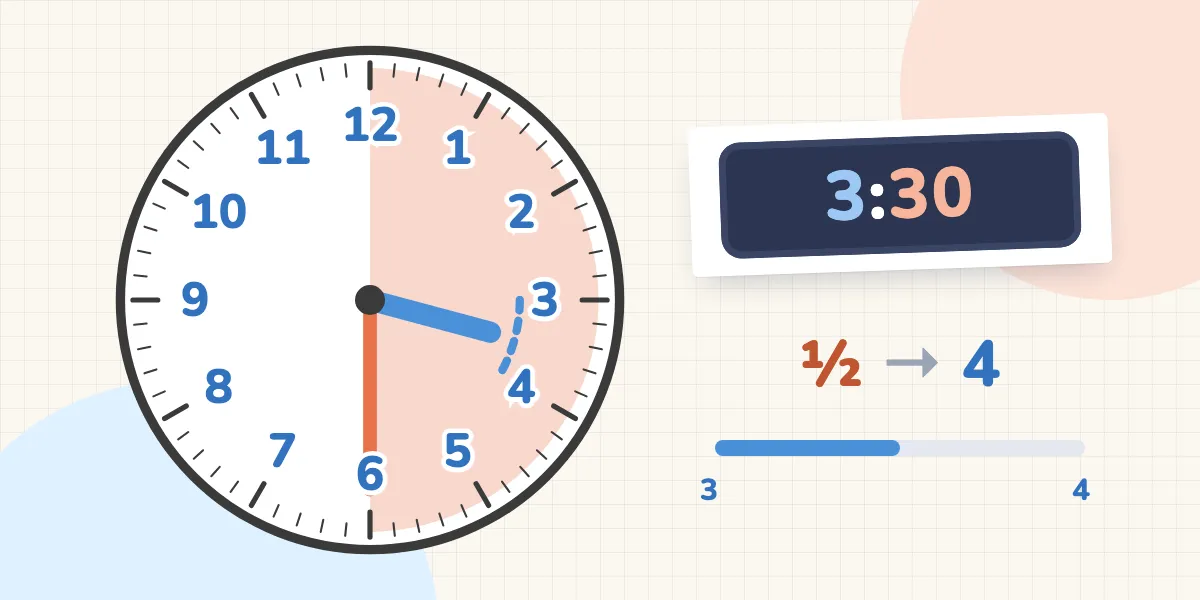
Short answer: Half hours are where many children first stumble when telling the time. In English, 3:30 is “half past three”, and in everyday British speech often just “half three”. In German and Dutch, the same time is called “halb vier”, literally “half four”, because it counts towards the coming hour. For bilingual families this is a real trap. The best help is to explain “half” as half of the way round and to show where the hour hand actually points.
A made-up but typical scene: a German-English family, a note on the fridge from Grandma in Hamburg: “Komme um halb vier.” The child, who learnt to tell the time at an English school, reads “half four” and expects her at 4:30. Grandma rings the doorbell at 3:30.
Children who only speak English have their own version of this. They hear “half past three”, see the short hand sitting between the 3 and the 4, and are not sure which number it belongs to. In our article why telling the time is so hard the language of the clock was one of four hurdles. Here we look at the half hour in detail.
What does “half past three” actually mean?
“Half past three” means that half of the hour after three o’clock has gone: it is 3:30. English names the hour that is running and adds what has passed since.
On the clock you can see this in two places. The long hand points to the 6: it has gone half way round. And the short hand sits exactly between the 3 and the 4: half way from three to four. That second detail is the one children miss most often. They have learnt that “the short hand shows the hour”, but at 3:30 it does not point at any number.
Why does German say “half four” for 3:30?
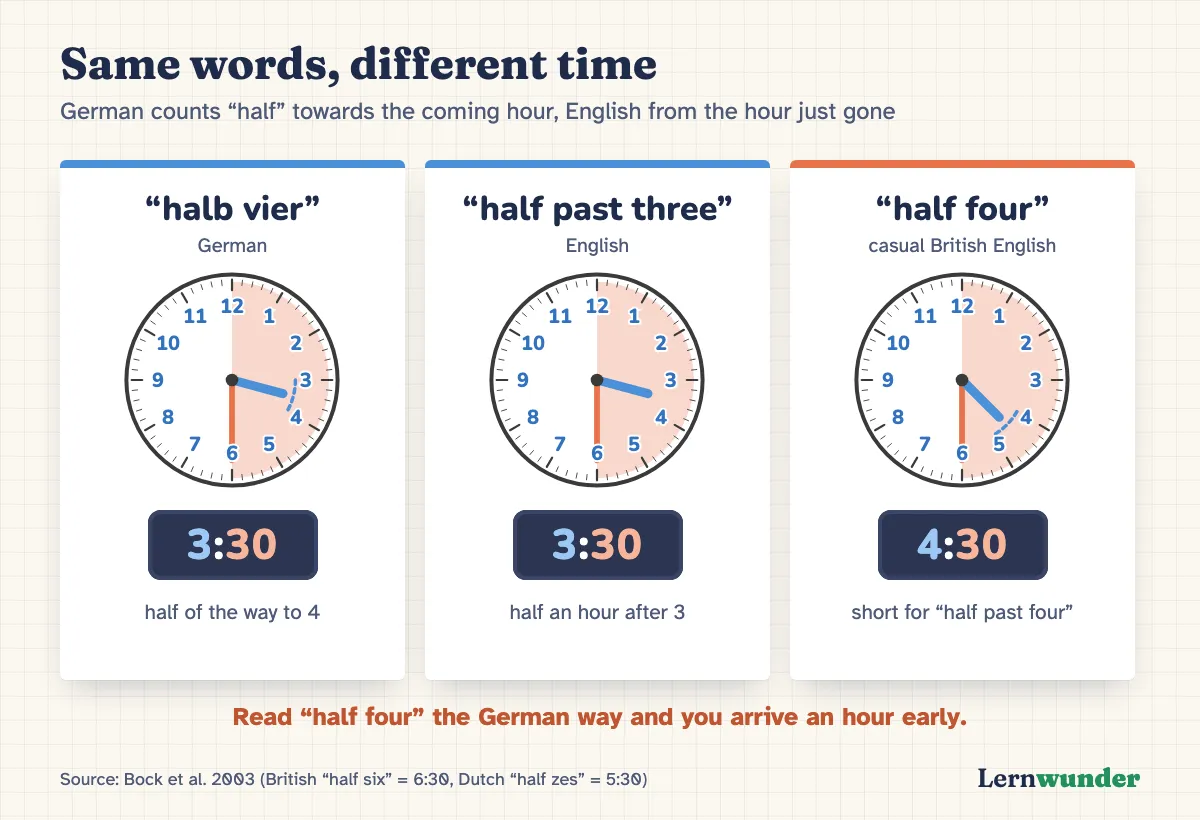
Because languages divide the clock differently. Bock, Irwin, Davidson and Levelt (2003) studied how people get from seeing a clock to saying the time and compared English with Dutch. Their example is exactly our topic: for a speaker of British English, “half six” means 6:30, while the Dutch “half zes” means 5:30.
German works like Dutch. “Halb vier” means half of the way to four, so 3:30. According to Bock et al. (2003), some Germanic languages use the half hour as a second reference point next to the full hour. German speakers typically use it from five minutes before to five minutes after the half hour, which gives times like “fünf vor halb vier”, literally “five to half four”, for 3:25.
So the same two words, “half four”, mean 4:30 in casual British English and 3:30 in German.
Are there regional differences, too?
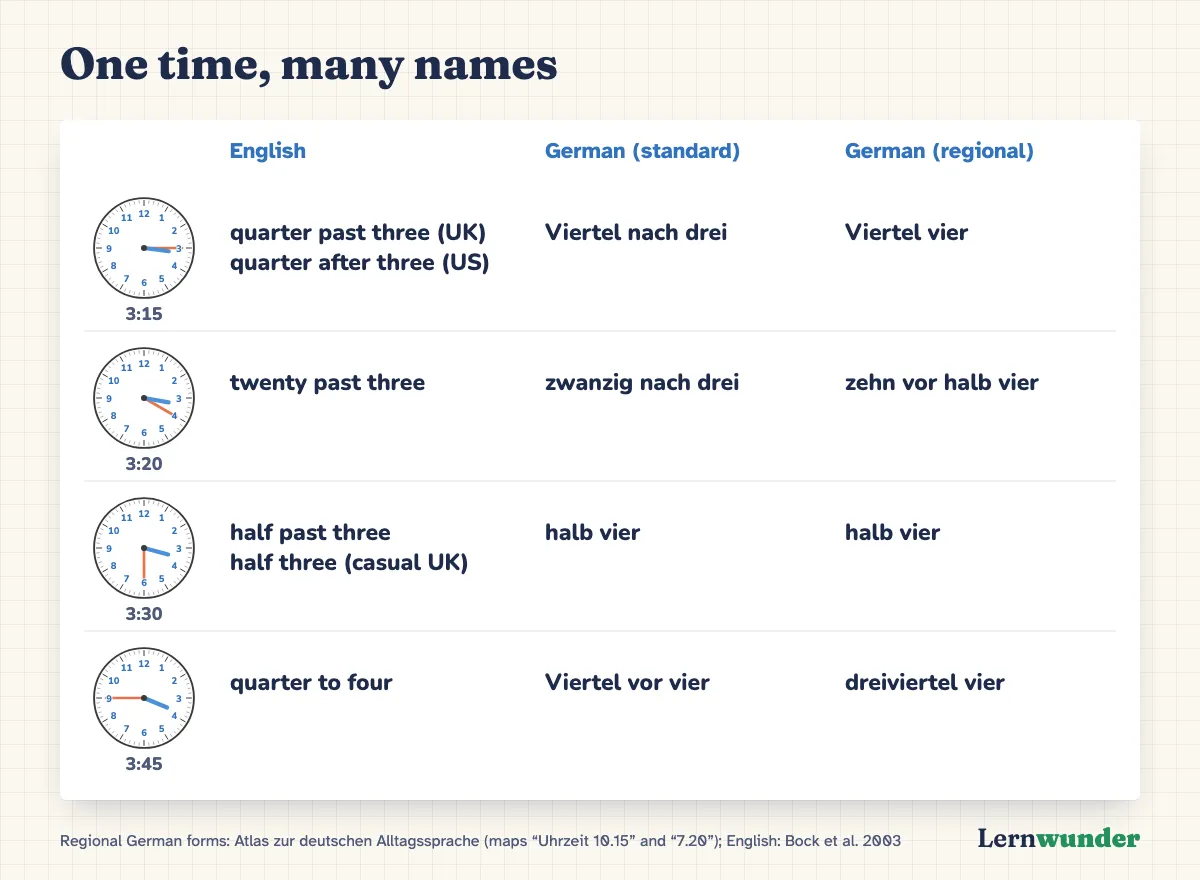
Yes, within English and even more within German. British speakers say “quarter past three”; in American English you also hear “quarter after three”. In German, an atlas of everyday speech has mapped the variants:
- 7:20: in eastern Germany most people say “zehn vor halb acht” (“ten to half eight”), in the west “zwanzig nach sieben” (“twenty past seven”). In the south and in Austria both occur (Atlas zur deutschen Alltagssprache, map “Uhrzeit 7.20, 7.40, 7.05”).
- 10:15: the north-west and south-east of Germany say “Viertel nach zehn” (“quarter past ten”), a broad belt in between and eastern Austria say “Viertel elf” (“quarter eleven”), counting towards the coming hour. The distribution has barely changed since the 1970s, though “Viertel elf” has become less common overall (Atlas zur deutschen Alltagssprache, map “Uhrzeit 10.15”).
What does research say about children and the half hour?
Honestly: not much. We have not found a study that measures specifically how often children confuse the half hour because of the language. What exists are findings that fit this confusion well.
Half hours come early. Older developmental studies found that children read half hours at around seven, after full hours (as summarised by Burny et al., 2013). That is the age at which the half-hour rule appears.
In a Flemish study of 725 children in grades 1 to 6, Burny, Valcke and Desoete (2012) sorted clock-reading errors into types. One was the wrong reference point: children counted from the wrong hour or quarter. Another was mixing up “to” and “past”. The children in that study speak Dutch, the language with the same “half four” logic as German.
Williams (2012) observed children learning to tell the time in class. He describes how children need different mental pictures for o’clock, for times like “quarter past three” and for times like “three fifteen”. Children who were confident with one kind of time could slip again with the next. The half hour asks for such a new picture: the hour hand is no longer on a number.
What you can do
- First the clock, then the words. Set 3:30 and ask your child to describe what they see: long hand on the 6, short hand between 3 and 4. Only then add the name.
- Explain “half” as a journey. “The short hand has gone half of the way from three to four. Half an hour has passed since three o’clock.”
- Move the hour hand, too. Turn the minute hand from 3:00 to 3:30 and let the hour hand travel with it. A homemade clock needs your help here, see Make a learning clock.
- Play “spot the mistake”. Set half past three with the hour hand between 4 and 5. Your child explains what is wrong.
- Name the trap in bilingual families. Tell your child openly: “half past three” and German “halb vier” are the same time; British “half four” is an hour later.
- Accept every regional form. “Quarter after” and “quarter past” are both right. Tell your child that they mean the same thing.
When half hours usually come up is described in When can children tell the time?.
What we are working on
For Tinu Time, our app for learning to tell the time that is currently in development, we are planning a short unit on the half hour at the start of the “half past” step, as announced in Analogue before digital. The draft:
- The orange minute hand moves slowly from the 12 to the 6, and the blue hour hand travels from the 3 to half way between 3 and 4.
- For German, a side-by-side comparison shows that “halb vier” is 3:30, not 4:30.
- In the exercises that follow, 4:30 is deliberately one of the answer options. If a child picks it, the app should recognise this particular mistake and explain the half hour again, rather than just saying “wrong”.
We also want families to choose between “quarter past” and “quarter after” in English, and between “Viertel nach drei” and “Viertel vier” in German. The app is not finished. We will test with children whether the unit works before we say more.
Frequently asked questions
When should my child be able to read half past? Many children read half hours at around seven (as summarised by Burny et al., 2013). Much depends on when telling the time is taught at school.
Should I say “three thirty” instead of “half past three”? As a bridge it can help, because the hour comes first and stays the same. But your child will hear “half past” everywhere, so link the two: “Three thirty, that’s half past three.”
My child knows o’clock but keeps getting half past wrong. Is that normal? Yes. With each new kind of time, old mistakes often return for a while (Williams, 2012). Keep explaining the journey of the hour hand and practise in short sessions.
Sources
- Atlas zur deutschen Alltagssprache (AdA). Map “Uhrzeit: 10.15” (round 7, page dated 24 January 2012). https://www.atlas-alltagssprache.de/runde-7/f11e/
- Atlas zur deutschen Alltagssprache (AdA). Map “Uhrzeit: 7.20, 7.40, 7.05” (page dated 20 December 2012). https://www.atlas-alltagssprache.de/uhrzeit/
- Bock, K., Irwin, D. E., Davidson, D. J. & Levelt, W. J. M. (2003). Minding the clock. Journal of Memory and Language, 48(4), 653–685. https://doi.org/10.1016/S0749-596X(03)00007-X
- Burny, E., Valcke, M. & Desoete, A. (2012). Clock reading: An underestimated topic in children with mathematics difficulties. Journal of Learning Disabilities, 45(4), 351–360. https://doi.org/10.1177/0022219411407773
- Burny, E., Valcke, M., Desoete, A. & Van Luit, J. E. H. (2013). Curriculum sequencing and the acquisition of clock-reading skills among Chinese and Flemish children. International Journal of Science and Mathematics Education, 11(3), 761–785. https://doi.org/10.1007/s10763-012-9362-z
- Williams, R. F. (2012). Image schemas in clock-reading: Latent errors and emerging expertise. Journal of the Learning Sciences, 21(2), 216–246. https://doi.org/10.1080/10508406.2011.553259
Lernwunder editorial team · Chaolan Lu