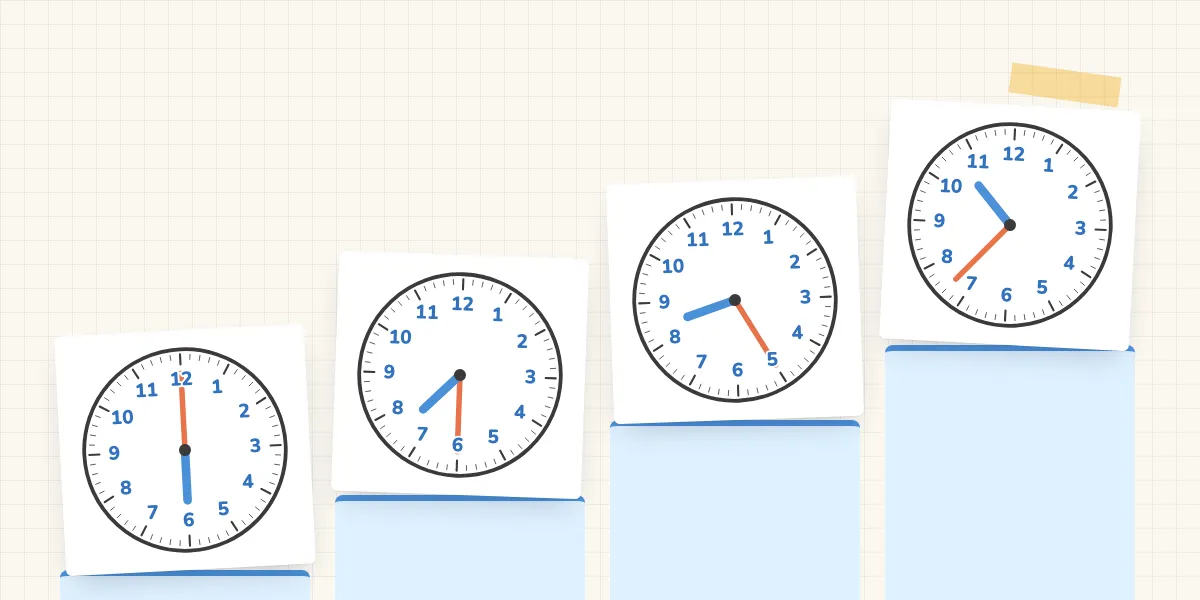
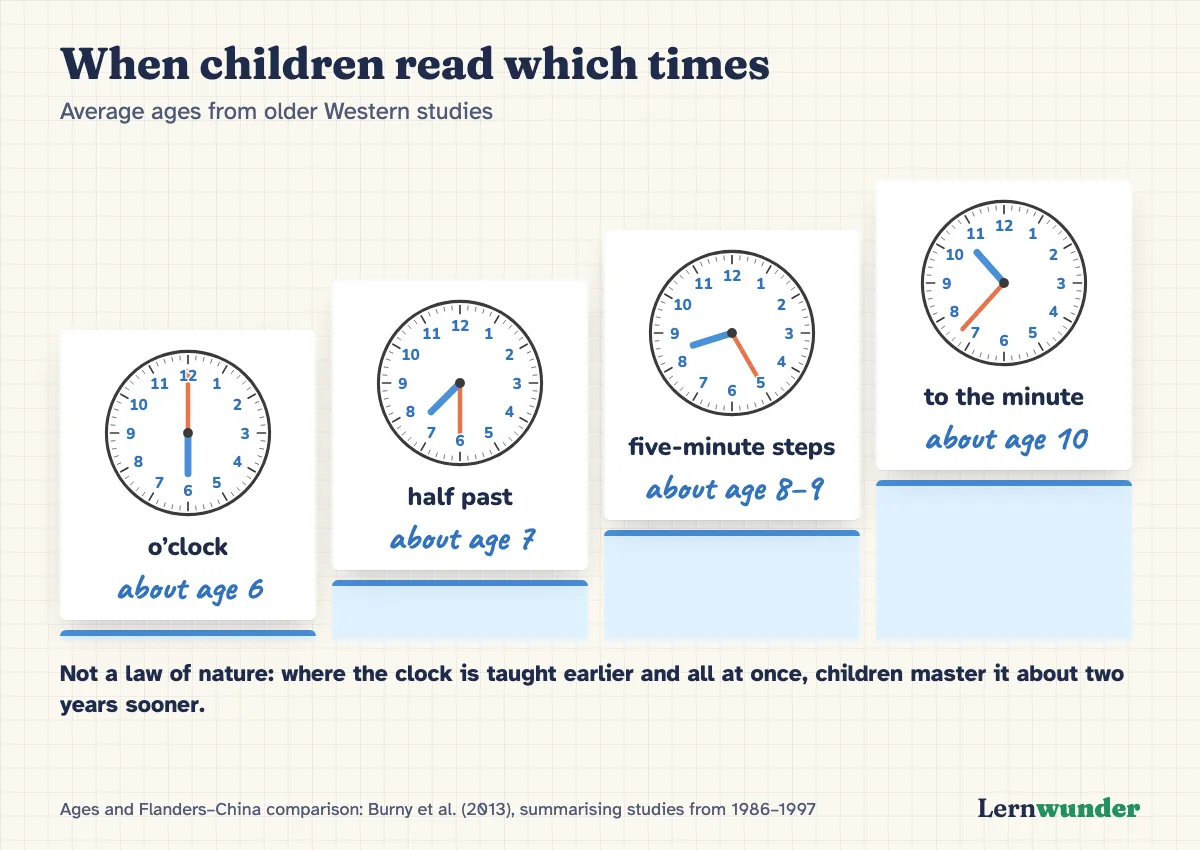
In short: Older Western studies found a typical sequence: o’clock times at about age six, half past at about seven, five-minute steps at eight to nine, and the exact minute at about ten. These ages are not a law of nature, though: where the clock is taught earlier and all at once, children master it about two years sooner. In England, the national curriculum starts with o’clock and half past in Year 1.
“My daughter is seven and still can’t tell the time. Is that normal?” Many parents ask something like this, often when classmates are proudly showing off their first watch. The short answer: yes, it is normal. The longer answer shows why telling the time depends less on age than on what a child has already learned.
At what age can children tell the time?
There is no single moment when a child “can do the clock”. Telling the time grows in steps, from rough to ever finer times. Burny and colleagues (2013) summarise older Western developmental studies from the 1980s and 1990s like this:
| What the child can read | Typical age |
|---|---|
| o’clock (“three o’clock”) | about 6 |
| half past (“half past three”) | about 7 |
| five-minute steps (“ten past four”) | about 8 to 9 |
| every single minute (“twenty-three minutes past four”) | about 10 |
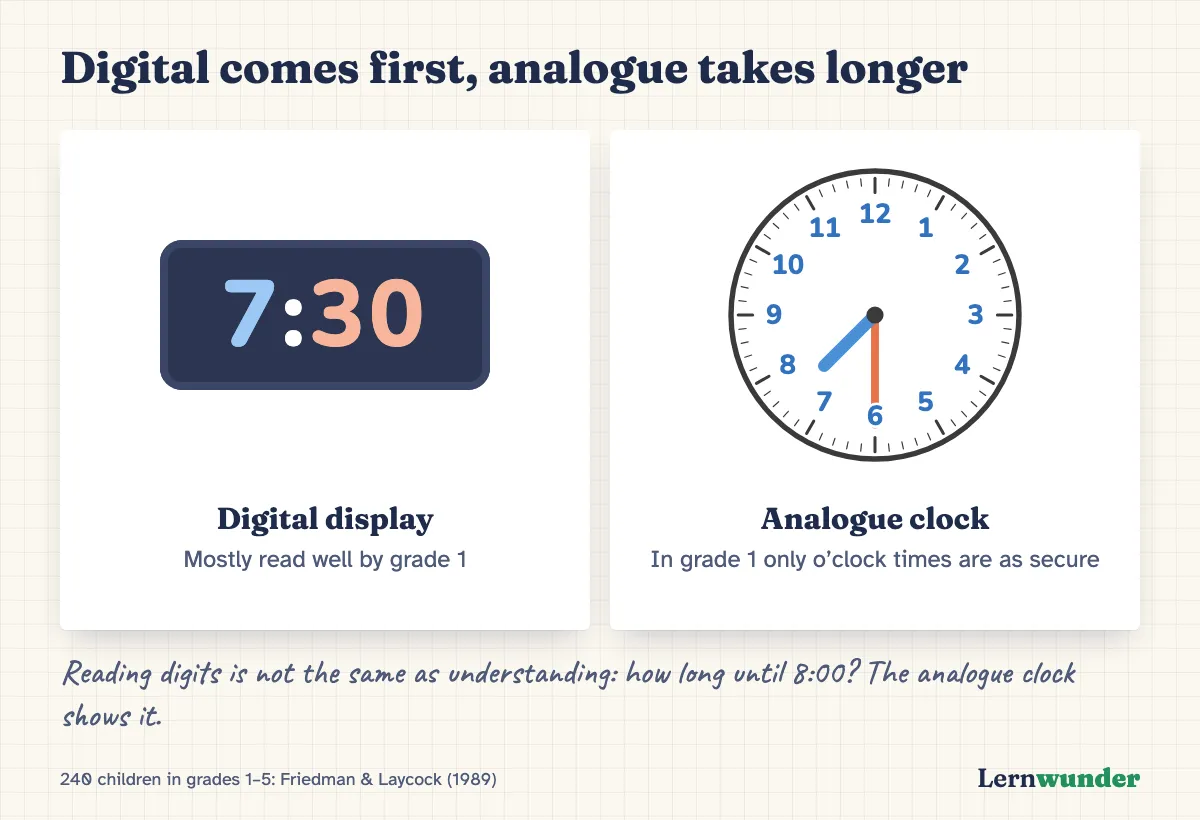
This matches one of the best-known studies on the topic: Friedman and Laycock (1989) tested 240 children from first to fifth grade. On the analogue clock, only o’clock times were read about as well as on a digital display. Some other times remained difficult even for the oldest children in the study.
Can children read a digital clock earlier?
Yes. In Friedman and Laycock’s study (1989), reading digital times was already well developed in first grade. On the analogue clock, that was true only for o’clock times.
A second finding is interesting: when children had to add half an hour to a time, the digital display gave no overall advantage. Reading digits and understanding how time passes are two different things. The study also found something encouraging: even the youngest children knew when many activities happen during the day and in which order. They just had not yet linked those activities to clock times.
Is it about age or about teaching?
Largely about teaching. Burny and colleagues (2013) compared Flemish children with children from Beijing and also analysed the textbooks of both countries. In Flanders, as in many Western countries, the clock is introduced step by step across several school years, following the age stages above. In China, clock reading is taught at about age six rather than spread over years. The result: the Chinese children could tell the time about two years earlier.
The researchers conclude that the old age stages are neither universal nor necessarily the best way to teach the clock. The early studies set out to describe natural development and hardly considered the role of teaching.
For parents this means two things. A child who cannot tell the time at seven is not “late”. And calm, targeted practice is worth it, because it really does make a difference.
What does the curriculum expect?
Here is one example we checked ourselves, the national curriculum in England (Department for Education, version updated 2021):
- Year 1: tell the time to the hour and half past the hour, and draw the hands on a clock face to show these times.
- Year 2: tell and write the time to five minutes, including quarter past and quarter to.
- Year 3: tell and write the time from an analogue clock, including Roman numerals and 12-hour and 24-hour clocks.
In Germany, where our team works, the clock likewise appears in grades 1 and 2 and is deepened in grades 3 and 4. Curricula differ from country to country, and so does the amount of practice time schools can give it.
When should I look more closely?
A Flemish study of 725 children found that children with maths difficulties had more trouble with the clock in almost every grade (Burny et al., 2012). The researchers advise paying attention when a child already struggles badly with the basics in grades 1 and 2, that is, with o’clock and half past. This is not a diagnosis: many children simply need more time. How to spot maths difficulties is described in our post recognising maths difficulties. Why telling the time is so demanding in the first place is explained in why reading an analogue clock is so hard.
What you can do
- Start with the daily routine. Children know their day before they know the clock (Friedman & Laycock, 1989). Link the two: “We have breakfast at seven o’clock. Look, the short hand is on the seven.”
- One step at a time. O’clock first, then half past. Move on when a step is secure, not when a birthday suggests it.
- Hang an analogue clock where your child can see it. At your child’s eye level, in the bedroom or the kitchen.
- Ask casually. “What time is it, roughly?” works better than a clock test at the dinner table.
- Compare digital and analogue. When the oven shows 7:30, look at the wall clock together: where are the hands now?
- Be patient with “quarter to”. Counting back from the next hour is a step of its own and often needs its own explanation.
What we are working on
We are currently working on an app called Tinu Time, designed to teach children the analogue clock step by step. The age studies confirmed one thing for us: what matters is not how old a child is but which step they are on. So we are planning a learning path in stages, where every child starts where they are and only moves on once a step is secure. The app is not finished yet. More when it is ready.
Frequently asked questions
At what age should a child be able to tell the time? Many children read o’clock times at about six, but often only read to the exact minute at about ten (Burny et al., 2013). The range is wide and depends a lot on teaching.
Can you start with the clock before school? Playfully, yes, for example with o’clock times and the daily routine. For five-minute steps, a child needs to count securely in fives.
Is it enough if my child can read a digital clock? For reading the time, yes; for understanding durations, not necessarily. Children read digits early, but in Friedman and Laycock’s study (1989) the digital display did not help with calculating times.
My child is in third grade and still can’t tell the time. What now? Find out which steps are secure and which are not, and continue practising from there. If o’clock and half past are also very hard, it is worth talking to the teacher.
Sources
- Burny, E., Valcke, M. & Desoete, A. (2012). Clock reading: An underestimated topic in children with mathematics difficulties. Journal of Learning Disabilities, 45(4), 351–360. https://doi.org/10.1177/0022219411407773
- Burny, E., Valcke, M., Desoete, A. & Van Luit, J. E. H. (2013). Curriculum sequencing and the acquisition of clock-reading skills among Chinese and Flemish children. International Journal of Science and Mathematics Education, 11(3), 761–785. https://doi.org/10.1007/s10763-012-9362-z
- Department for Education (2021). National curriculum in England: mathematics programmes of study (page updated 28 September 2021). https://www.gov.uk/government/publications/national-curriculum-in-england-mathematics-programmes-of-study/national-curriculum-in-england-mathematics-programmes-of-study
- Friedman, W. J. & Laycock, F. (1989). Children’s analog and digital clock knowledge. Child Development, 60(2), 357–371. https://doi.org/10.2307/1130982
Lernwunder editorial team · Chaolan Lu