Comparing quantities · ages 5 to 8
Who has more?
Before children can calculate, they need to compare. More, fewer, the same – this foundation decides whether numbers will make sense later on.
Your coins
5 is more than 3
Piet the Parrot
Comparing quantities · ages 5 to 8
Before children can calculate, they need to compare. More, fewer, the same – this foundation decides whether numbers will make sense later on.
Your coins
5 is more than 3
Piet the Parrot
Comparing quantities

More, less or the same?
On six Caribbean islands, children aged 5 to 8 learn the one skill that comes before arithmetic – comparing quantities. Roll the dice, lay out coins, look closely: from counting one by one to the greater-than, less-than and equals signs. Fully voiced in six languages, with a two-player mode on a single iPad.
Ages 5 to 8 · iPad
Notes
A look inside
Screenshots from the app
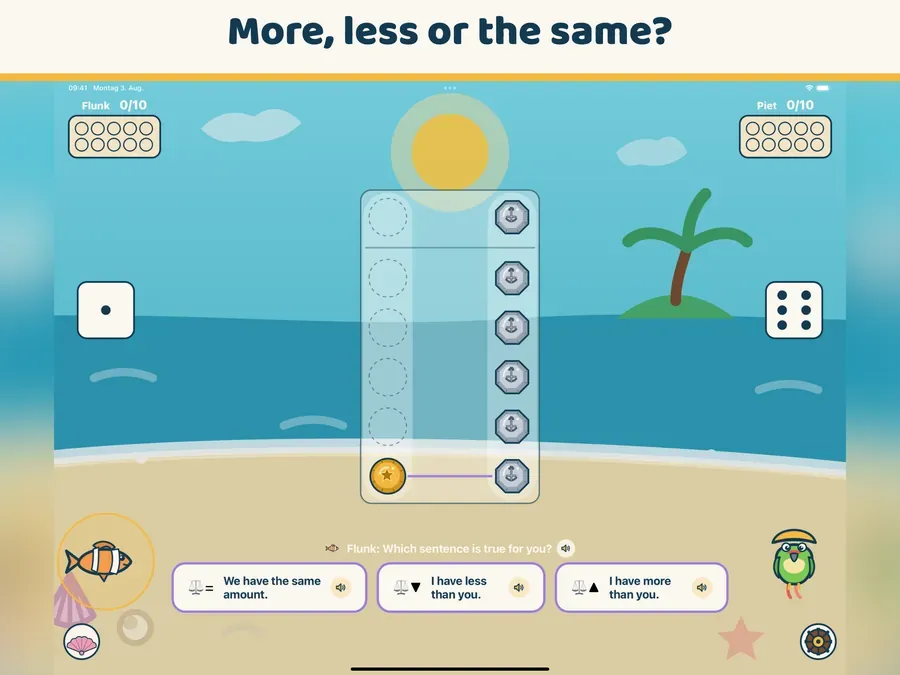

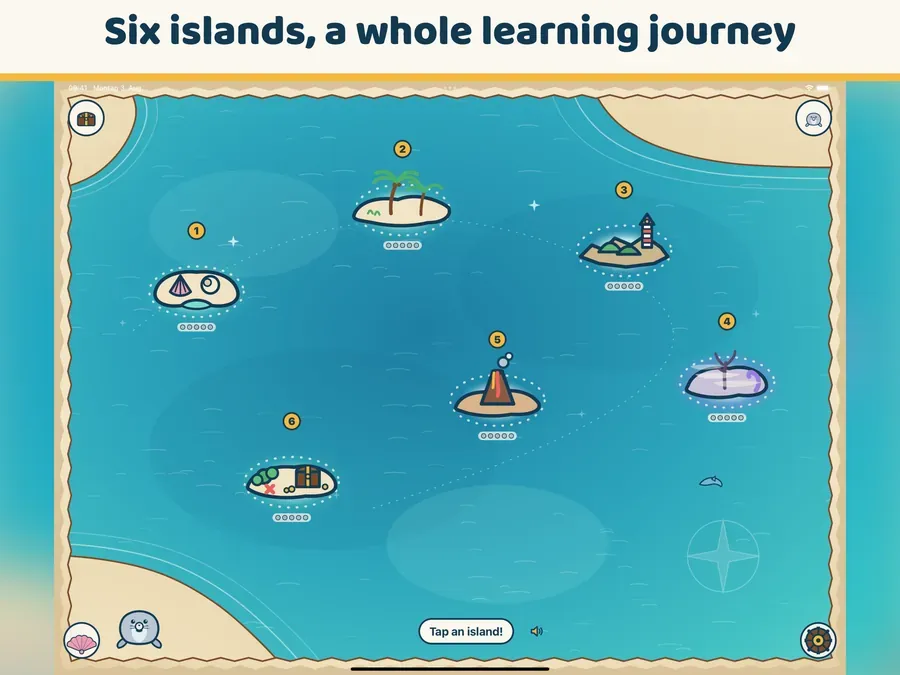
Before children can calculate, they need to be able to compare. “More than”, “less than”, “the same as” – this foundation decides whether numbers will later make sense or simply be memorised. Mengenpiraten wraps exactly that step into a pirate adventure: roll the dice, lay gold coins on the deck, look closely. Who has more? Who has less? Do we have the same?
The six islands build on one another and follow proven primary-school teaching practice:
Until Treasure Island, the result is shown in words (“4 more than 2”); only then do the signs arrive. After three games won, the next island opens up – and sailing back is always possible.
The power of five, the ten-frame in the treasure chest and one-to-one matching are built in throughout. Matching lines appear exactly when a child needs them, and fade away again as soon as they can manage without.
Every instruction is spoken aloud and can be repeated at any time. The app is fully voiced in six languages – German, English, French, Spanish, Chinese and Russian – not just the menus, but every single spoken sentence.
Mistakes trigger friendly hints, never penalties. There are no timers, no lives and no red. When a child corrects themselves, that is exactly what gets praised.
In partner mode the tablet lies between two children and they play against each other. And the most valuable thing happens all by itself: they start talking about mathematics. “I have two more than you!” is a better learning moment than any worksheet.
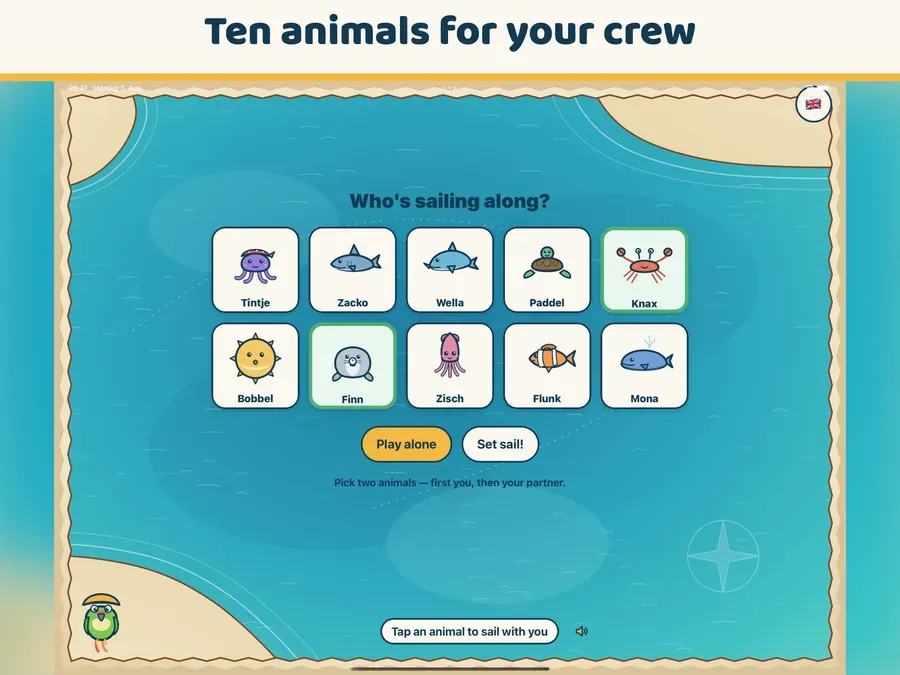
Ten animals are up for selection – Tintje the octopus, Zacko the shark, Wella the dolphin, Paddel the turtle, Knax the crab, Bobbel the pufferfish, Finn the seal, Zisch the squid, Flunk the fish and Mona the whale. Each animal has its own progress, so siblings never get in each other’s way. In single play, Piet the parrot takes on the challenge – and he sometimes miscounts, so the child gets to help him.
A separate area behind an adult gate shows the learning status as a traffic light that never turns red, along with progress per island and settings for sound, music, subtitles and hints. Playing time is tracked quietly – as information, not as leverage.
The vertical game board, the large touch areas and above all the partner mode need the space of a tablet. On a phone, two children side by side simply wouldn’t work.
No ads. No in-app purchases. No external links. The app works entirely offline – all data stays on the device and can be deleted at any time in the parents’ area.
Where next?
 Number Sense: Learn MathComing soon
 ZahlzerlegungLearning maths through play
