 App
App
Ene Mene Miste
Fair teams in ten seconds
 App
App
Fair teams in ten seconds
Screenshots from the app


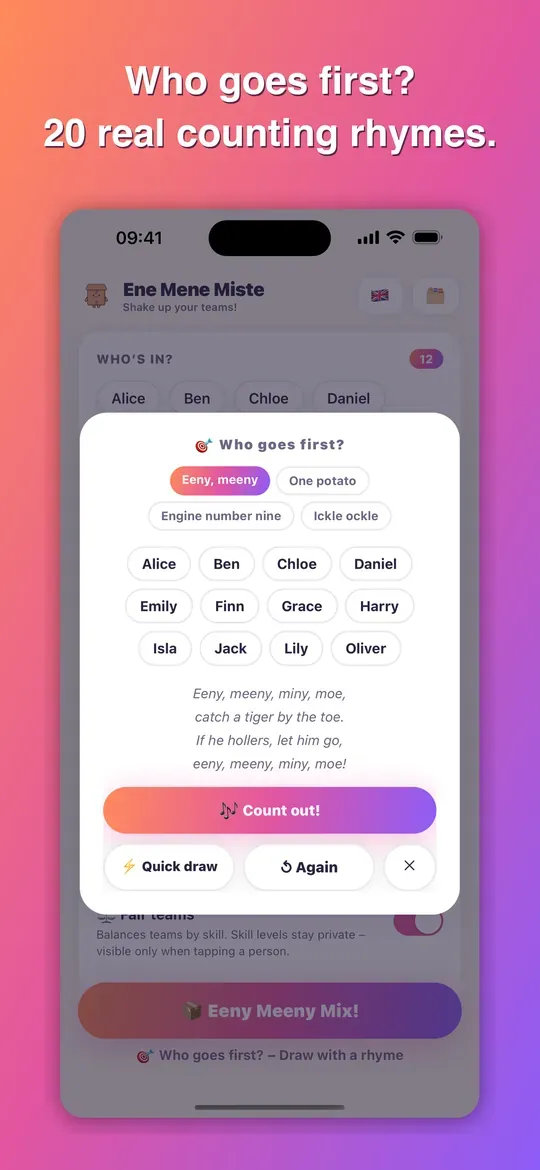

Splitting a group into teams rarely takes long – but it always takes long at the exact moment you can least afford it: in front of the class, on the sports field, in a workshop. Ene Mene Miste turns a list of names into random, balanced teams in under ten seconds. And it feels like counting out on the playground, not like configuring administrative software.
The flow is deliberately short: enter the names, choose the number of teams, shuffle. Whole class lists can be pasted in one go – the app works out for itself whether the names are separated by line breaks or commas. Then the box rattles, the counting rhyme pops up word by word, and the team cards glide into view.
“12 people → 4 teams: 3 · 3 · 3 · 3” appears on screen before you shuffle – and that is exactly what you get. If wishes make a distribution mathematically impossible, the app says so beforehand instead of surprising you afterwards. That sounds obvious, but it isn’t: this is precisely the point where team-picking apps lose their users’ trust.
There is no settings page with dozens of switches. Whatever concerns a particular person sits with that person: a tap on a name opens everything about them.
As soon as you give one person a skill level, fair mode switches itself on.
Skill ratings are sensitive, and the app is often used in public – on the projector in front of the class, in a circle on the sports field. That is why the stars appear only in the person’s own panel, which whoever is running the session opens privately: never in the overview, never on the team cards, never when sharing. Nobody can see that they have “only one star”. In fair mode the team cards show only the total per team – proof that the mix was balanced, without exposing anyone.
The counting-out ritual from childhood, as a game in its own right: the word jumps from name to name, whoever the last word lands on is out – round after round, until one person is left. Twenty genuine counting-out rhymes from five countries are included, all of them spoken aloud.
Some of them have a follow-up. The German counting rhyme “Eene, meene, muh” (roughly: “Eeny, meeny, moo”) carries on after the hit with “Raus bist du noch lange nicht, sag mir erst, wie alt du bist!” (roughly: “You’re not out yet – first tell me how old you are!”). The person who was hit says their age, the app counts on exactly that many steps, and only whoever the final step lands on is really out. If you’re in a hurry, take the instant draw instead.
German, English, French, Spanish and Chinese – and not merely translated, but with the rhymes children in each country actually say out loud. The team names are localised too. Switching languages becomes a game in itself: children change the language just to hear the French rhyme.
Not happy with a line-up? Tap the person, move them to another team, done. The app suggests, you decide. And once the teams are set, you share them as text in the class chat, via the share dialogue, or as a designed image for the noticeboard – without typing anything out again.
The app needs no connection. It collects nothing, sends nothing and shows no advertising – it is used in front of children, after all. Names and lists stay on the device. Saved groups such as “Year 7b” or “Football Thursday” can be reloaded at any time, along with their skill levels and links.
Built for school, sport, workshops, children’s birthday parties and games nights.