Telling the time · ages 5 to 10
What time is it?
--:--
Drag the long hand – the short one follows, just like on a real clock.
Nine levels, not a random quiz
Level 1: Getting to know the clock face
Telling the time · ages 5 to 10
--:--
Drag the long hand – the short one follows, just like on a real clock.
Nine levels, not a random quiz
Level 1: Getting to know the clock face
Telling the time

Learning to tell the time – step by step
Tinu, a friendly little alarm clock, guides children aged 5 to 10 through nine stages – from their first look at a clock face to the 24-hour format and elapsed time. Every explanation is read aloud and shown on the clock, and eight learning games keep motivation high. No ads, no internet.
Ages 5 to 10
Notes
A look inside
Screenshots from the app
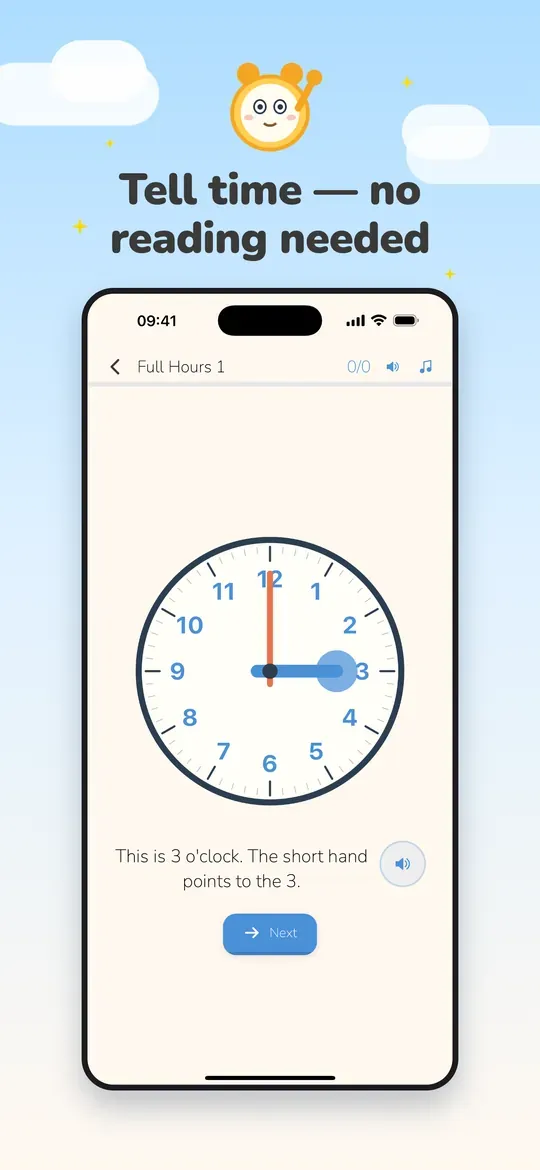
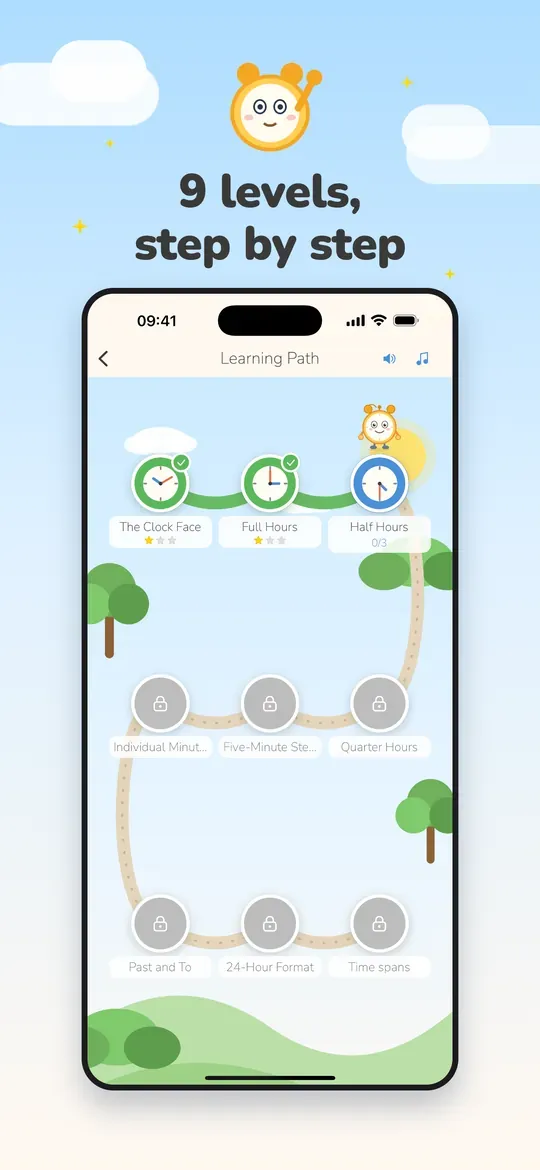
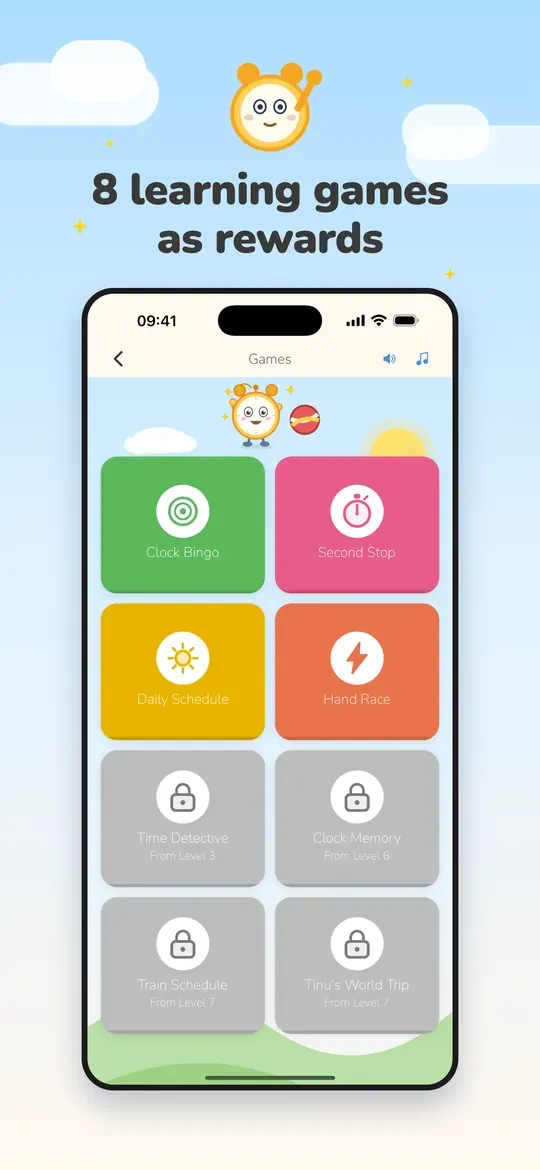
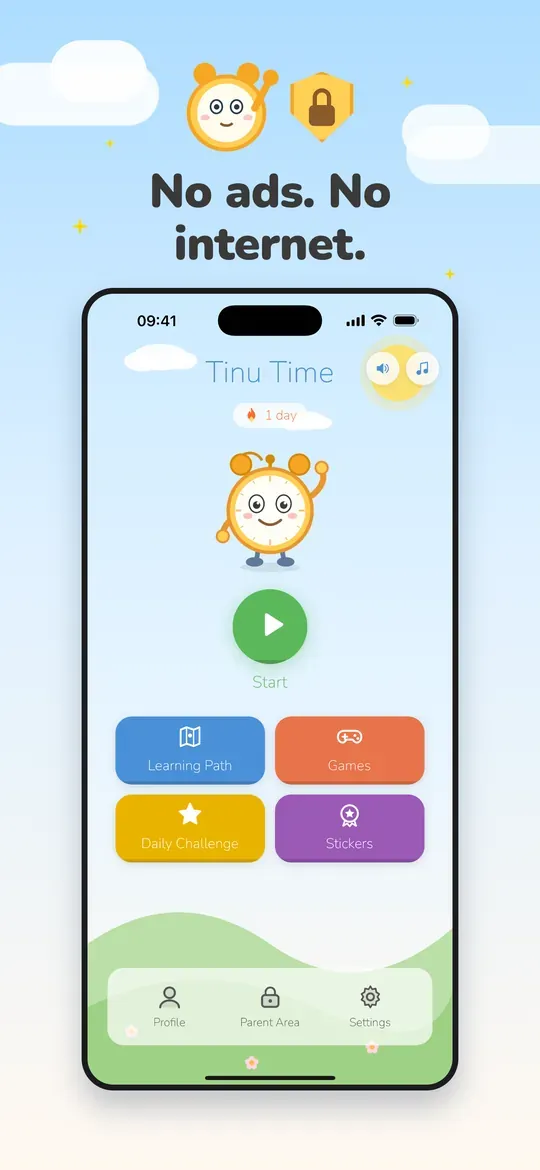
Analogue clocks are disappearing from everyday life, and the curriculum rarely leaves much room for telling the time. Tinu Time takes that time. Tinu, a golden-yellow alarm clock with bell ears, explains every lesson in his own voice and demonstrates it directly on the clock. That is why children who cannot read yet can learn completely on their own.
The learning path is a real staircase, not a pile of exercises:
Each stage ends with a mastery test, and the final test runs without any hints. Pass it, and you are a time expert. A placement test recognises what a child already knows, so nobody has to repeat what they mastered long ago.
The most common stumbling block in German gets a lesson of its own: “halb vier” means 3:30, not 4:30. When the app detects a typical mix-up – the half-hour trap or swapped hands – a matching mini help clock appears instead of an error message. And because southern Germany and Austria speak differently, the settings let you choose “Viertel vier” instead of “Viertel nach drei”.
Clock bingo, hand racing, time detective, daily routine, time memory, train timetable, Tinu’s world tour through the time zones and second stop. The games unlock as soon as the necessary knowledge is there, and adapt their difficulty to the current stage – so there is no shortcut around the learning.
On top of that come fifteen collectible stickers, from the sundial to the atomic clock, plus badges and unlockable clock designs.
The daily challenge is deliberately short and uses a review system based on the Leitner principle: times a child has securely mastered appear less often, while the difficult ones come back automatically until they stick.
German, English, French, Spanish, Chinese and Polish – interface and speech output complete. Tinu sounds the same in every language, which is handy for multilingual families and for a first encounter with a foreign language: times can be practised in English or French without switching apps.
Behind an arithmetic gate sits a parents’ area with learning progress, an analysis of where practice is most needed and concrete recommendations. Everything can also be reset there. For accessibility there is a colourblind mode, a motor-skills aid with larger touch areas, a dyslexia-friendly font and sliders for volume and music.
Tinu Time never opens a single internet connection – not “no ads”, but technically no way to transmit data at all. No account, no subscription, no in-app purchases. Buy once, done.
Where next?
 DroptiplyMultiplication as a puzzle – blocks that make sense
A new stop is being built in between:
8Noa Learn Math
in the making
 Förderplanung (support planning)Coming soon
 Ene Mene MisteFair teams in ten seconds
