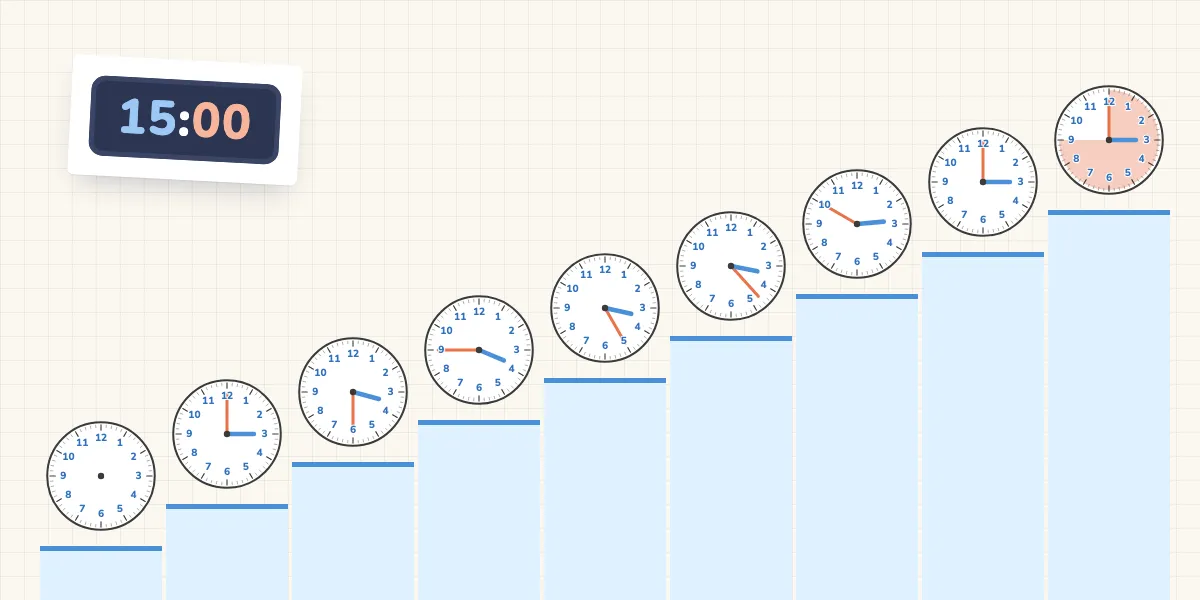
In short: Telling the time is best learned step by step: first the clock face, then o’clock, half past and quarter hours, then five-minute steps and single minutes. The analogue clock comes first, because children read digital displays early anyway, while the hands show how hours and minutes relate. For our app Tinu Time, which is still in the making, we are planning a learning path in nine steps.
Our earlier posts on the clock looked at why reading an analogue clock is so hard and when children can tell the time. Today we turn to the question that follows: in what order is it best learned? And why does the analogue clock come first for us, when digits glow everywhere in everyday life?
Why learn the clock in steps?
Because the analogue clock throws many hurdles at children at once: two hands, two scales, steps of five, an hour hand that keeps moving, and a language of its own. Offering everything at once quickly overwhelms. In a study of 725 primary school children, the most common error in grade 1 was looking at only one hand (Burny et al., 2012). For precise times, miscounting and wrong reference points were added: the more steps a time requires, the more can go wrong.
The classic developmental studies describe a sequence that follows exactly this rise in difficulty: o’clock, half past, five-minute steps, single minutes (summarised in Burny et al., 2013). Williams (2012) observed that children need different mental pictures for o’clock times, for “quarter past three” and for “three fifteen”, and that the order in which these are learned explains typical errors.
Does learning in steps mean learning slowly?
No, and that matters to us. Burny and colleagues (2013) show that children in China master the clock about two years earlier than children in Flanders, because there it is taught earlier and all at once rather than spread over several school years. The old age stages are not a timetable anyone has to follow.
Our conclusion: the order of the steps makes sense; the pace belongs to the child. A step is done when it is secure, not when a certain age is reached. And a child who can already read o’clock times should not have to start again from scratch.
Why analogue before digital?
Children can read digital times early. In Friedman and Laycock’s study (1989) of 240 children in grades 1 to 5, this was already well developed in first grade; on the analogue clock it was true only for o’clock times. You might conclude: then let’s just use the digital clock.
The same study, however, shows where the limit is. When children had to add half an hour to a time, the digital display gave no overall advantage. Reading is not the same as understanding. In our view, this is the heart of it: on an analogue clock you see how much of the hour has passed and how much is left. A digital display gives only a number. And because children read digits early anyway, time spent on the analogue clock is, in our view, time well invested.
There is a practical reason too: in the study by Burny et al. (2012), analogue clock reading was a better indicator of maths difficulties than digital clock reading. To us, that suggests the analogue clock demands exactly the kind of thinking that learning is about.

What do the nine steps look like?
For Tinu Time we are working on a learning path with nine steps. The first six follow the sequence from research; the last three go beyond it:
| Step | Content | Why here |
|---|---|---|
| 1 | The clock face: numbers, hands, direction, counting in fives | basics before any time is read |
| 2 | O’clock | only one hand needs interpreting |
| 3 | Half past | the hour hand’s first visible movement |
| 4 | Quarter hours: quarter past, quarter to | “past” and “to” are added |
| 5 | Five-minute steps | the 4 now means 20 |
| 6 | Every single minute | precise counting between the marks |
| 7 | To and past, plus the link to the digital clock | only now does the digital display appear |
| 8 | 24-hour clock: 3 pm is 15:00 | everyday life with timetables and digital clocks |
| 9 | Durations: how long does it take? | clock times are used for calculating |

What else are we planning?
Several decisions follow directly from the error analyses:
- Fixed colours. In the app, hours are always blue and minutes always orange, on the hands and on the numbers. This is meant to counter the most common error, attending to only one hand. We do not know of a study that tests this exact colour choice; it is a reasoned design decision.
- An hour hand that moves along. When the minute hand is turned, the hour hand moves with it, like on a real clock. That way a child sees why quarter to four is not four yet.
- “Half past” explained, not just tested. Especially for German, where “halb vier” means 3:30, half past gets its own explanation at the start.
- Regional ways of speaking. Families should be able to choose, for example, between “quarter past” and “quarter after”.
- Check, then move on. Before each new step, a short check should show whether the previous one is secure. A placement test should spare children who already know some of it from repeating everything.
Tinu Time is still a work in progress. We will test how much of this holds up in everyday use with children before saying more.
What you can do
- Find your child’s step. Ask, in turn, for an o’clock time, a half past, a quarter hour and a five-minute time. Start where it gets stuck.
- Stay on one step. Practise only half past for a week before adding quarter hours.
- Analogue first, digital as a check. Read the hands first, then look at the phone or the oven: was it right?
- Make durations visible. “Dinner is in half an hour.” Show which part of the clock that is.
- Make your own clock. You will find instructions with colour-coded hands in make a learning clock.
Frequently asked questions
Why nine steps? The first six follow the order in which children typically learn clock times. After that come “to” and “past”, the 24-hour clock and durations, which are needed in everyday life.
Should my child not use digital clocks at all? They should. Analogue before digital does not mean analogue instead of digital. The digital clock is a good check once the hands are understood.
How long does one step take? It varies a lot. What matters is that a step is secure before the next one begins, not how fast that happens.
Sources
- Burny, E., Valcke, M. & Desoete, A. (2012). Clock reading: An underestimated topic in children with mathematics difficulties. Journal of Learning Disabilities, 45(4), 351–360. https://doi.org/10.1177/0022219411407773
- Burny, E., Valcke, M., Desoete, A. & Van Luit, J. E. H. (2013). Curriculum sequencing and the acquisition of clock-reading skills among Chinese and Flemish children. International Journal of Science and Mathematics Education, 11(3), 761–785. https://doi.org/10.1007/s10763-012-9362-z
- Friedman, W. J. & Laycock, F. (1989). Children’s analog and digital clock knowledge. Child Development, 60(2), 357–371. https://doi.org/10.2307/1130982
- Williams, R. F. (2012). Image schemas in clock-reading: Latent errors and emerging expertise. Journal of the Learning Sciences, 21(2), 216–246. https://doi.org/10.1080/10508406.2011.553259
Lernwunder editorial team · Chaolan Lu