In short: Internationally educated nurses now account for all of the growth in Germany’s nursing workforce. In their first weeks they often face four hurdles at once: a lower status than in their home country, a ward language that no language course teaches, a differently organised kind of nursing, and a team they still have to become part of. Research shows what helps: a dedicated preceptor, a planned orientation, the right placement and language training aimed at everyday work on the ward.
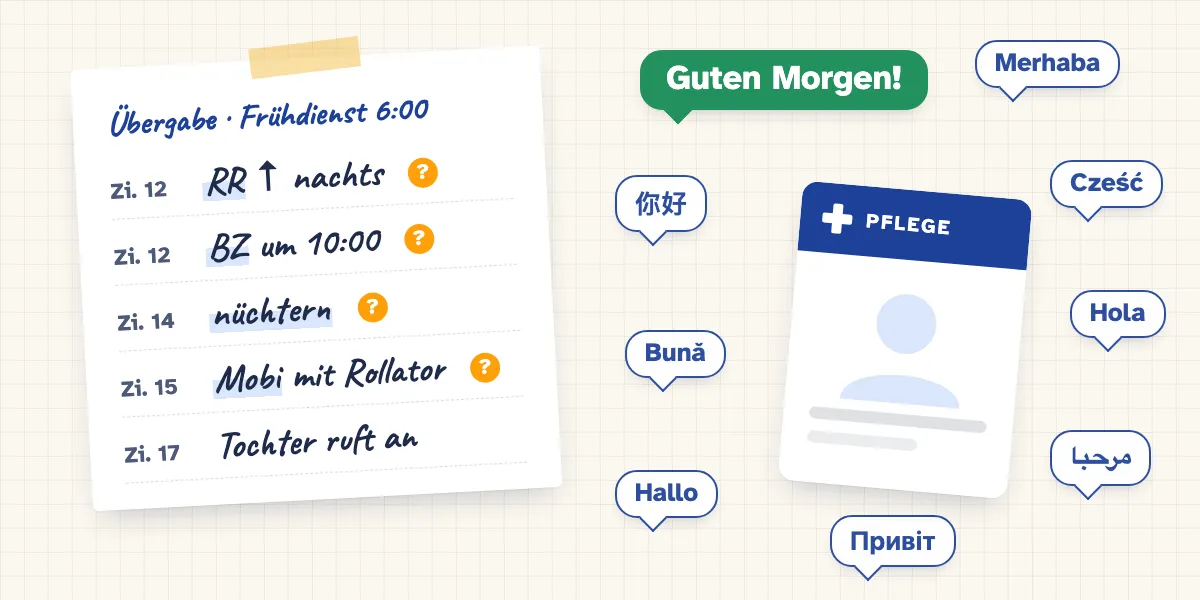
Six a.m., early shift, handover in the nurses’ station. The night nurse talks fast, in short bursts: “Room twelve, BP high overnight, BG at ten, the man in fourteen is nil by mouth.” Everyone nods. The new colleague, who arrived a week ago and spent ten years in intensive care back home, writes as fast as she can. She has learned German, passed exams, filled in forms. Nobody prepared her for this moment.
The scene is made up, but it is typical. It is the reason Lernwunder exists. Before we built a single learning app, we asked ourselves: what exactly makes the start so hard?
How many internationally educated nurses work in Germany?
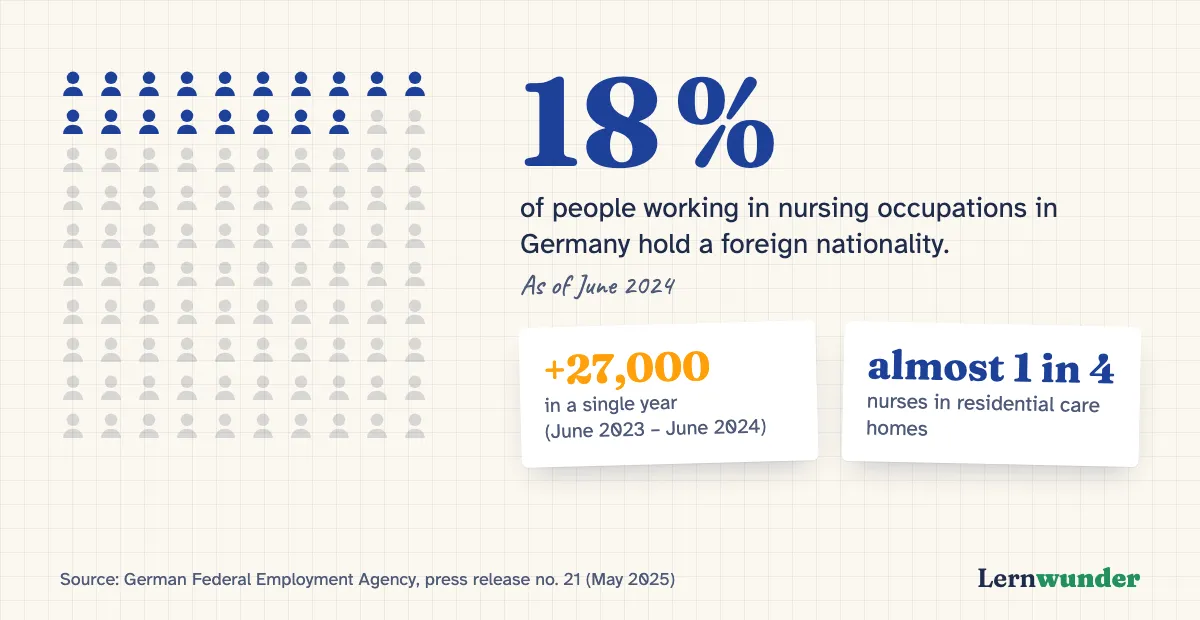
More than most people realise. According to the German Federal Employment Agency, 18 percent of people working in nursing occupations held a foreign nationality in June 2024; in residential care homes it was almost one in four. Between June 2023 and June 2024 alone, the number of nurses with a foreign passport grew by 27,000. For three years in a row, growth in German nursing has come exclusively from foreign nurses (Bundesagentur für Arbeit, 2025).
Without these colleagues, wards would close. Which makes it all the more important whether they stay.
What makes the first weeks on the ward so hard?
Research does not describe one single problem, but several that hit at the same time.
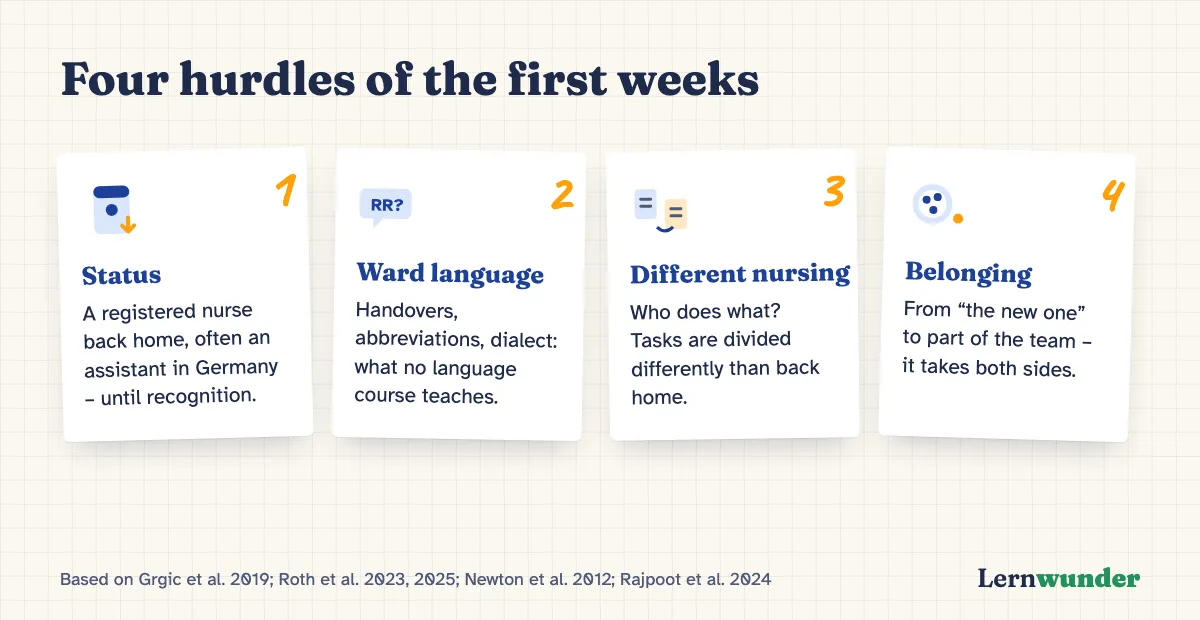
1. Too little and too much at the same time
Nurses from outside the EU often start as nursing assistants until their qualification is recognised. A German policy brief describes this start as under-challenge: recognition could take up to 18 months, and in an assistant role, qualified nurses can hardly show what they are able to do. Their prior experience often goes unnoticed (Grgic et al., 2019).
At the same time, nurses interviewed at hospitals in southern Germany report the opposite: because of staff shortages, newcomers often have to take full responsibility for patients too early during orientation. That raises the load for everyone and leads to frustration on both sides (Roth et al., 2025).
2. The language of the ward
Language is the first hurdle named in almost every study (Roth et al., 2023; Pressley et al., 2022). It is rarely about grammar. It is about telegraphic handovers, abbreviations, phone calls with doctors, regional dialect at the bedside, and how to kindly explain to a confused elderly patient that he must not eat. On top of that, nurses who still feel unsure in the language find it hard to show their professional competence (Grgic et al., 2019).
3. Nursing works differently
In many countries nursing is a university degree, and nurses take on tasks that are reserved for doctors in Germany, while basic care is less part of their daily work. Nurses trained in Germany have developed their own sense of who does which tasks and who gets to decide what. When these two ideas meet, misunderstandings and conflicts arise that have little to do with skill (Grgic et al., 2019).
4. Belonging
A review of international studies describes a “cultural displacement” that stems mainly from language differences, the feeling of being an outsider and an unfamiliar nursing practice (Newton et al., 2012). In the German study, domestically trained nurses themselves openly named “othering” of new colleagues as a barrier, up to and including racism (Roth et al., 2023). A more recent review criticises a one-way integration logic: newcomers are expected to adapt, while little is expected of the team (Rajpoot et al., 2024).
What has been shown to help?
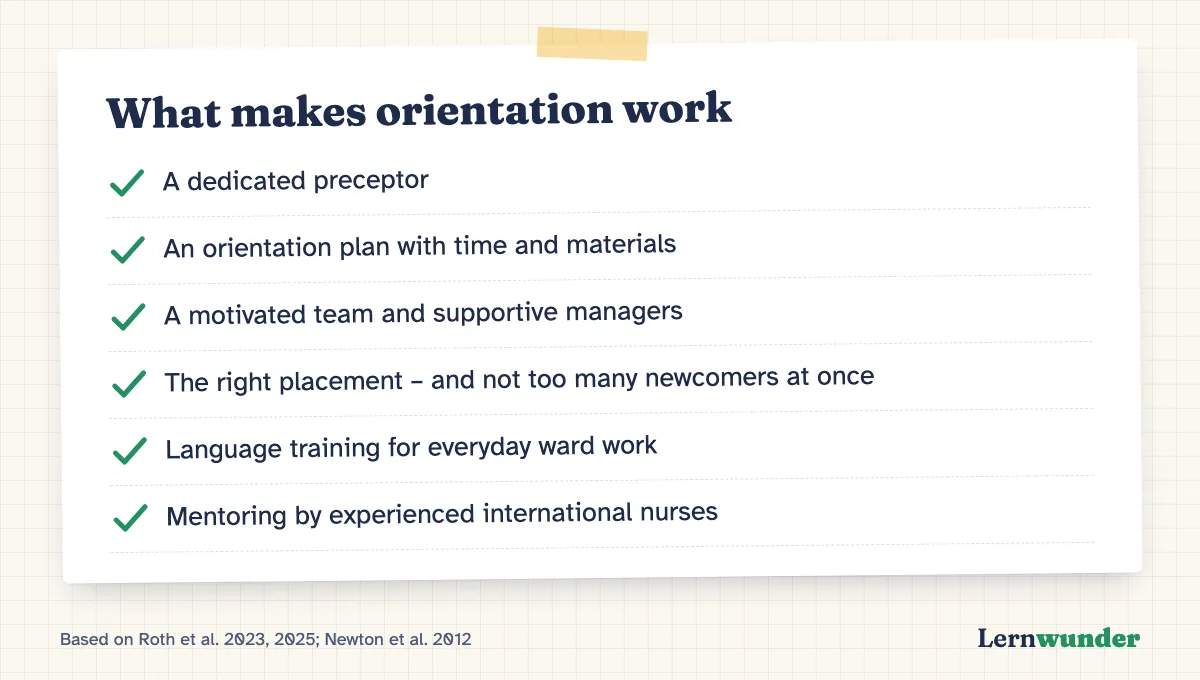
The good news: studies agree remarkably well on what makes orientation work.
- A dedicated preceptor who provides consistency in the early weeks (Roth et al., 2023).
- A structured orientation programme with a plan, materials and time, rather than “just tag along” (Roth et al., 2023).
- A motivated team and managers who actively support integration (Roth et al., 2023; Roth et al., 2025).
- The right placement: nurses in the study suggested, for example, that someone without ICU experience should not start in intensive care but first settle in linguistically on a general ward, and that teams should not take on too many newcomers at once (Roth et al., 2025).
- Targeted language training for everyday work, plus practical skills training (Roth et al., 2023).
- Mentoring by experienced internationally educated nurses who have walked the same path (Newton et al., 2012).
What you can do
If you are onboarding international colleagues:
- In the first week, ask specifically about their experience: which wards, which tasks, which equipment? This makes visible what an assistant role hides.
- Spell out abbreviations once during handover (“BP, that’s blood pressure”). It takes seconds and saves questions.
- Offer to repeat or write down a handover, without turning it into a test.
- Explain the “why” behind routines you take for granted, such as who decides what in your hospital.
- Invite them to share a break. Arriving is not only about work.
If you are new on the ward yourself:
- Keep your own ward dictionary: every new word with its German article and one sentence in which you heard it.
- Ask early for a dedicated contact person if there is none.
- Talk about your experience, even while you work as an assistant. It is an asset to the team.
- Connect with colleagues who have made the same journey, in your hospital or in networks.
Why this topic matters to us
Lernwunder did not start with a maths app, but with this question: how can we help people who bring all the professional skills and still struggle in their first weeks with the language of the ward? Much of this is the job of employers, teams and policy makers. But part of it is learning: words, sentences and abbreviations that can be practised, even after a long shift. That is where our first ideas begin. In the next articles we take a closer look at the professional language of nursing in Germany.
Frequently asked questions
How many nurses in Germany come from abroad? In June 2024, 18 percent of people working in nursing occupations held a foreign nationality, almost one in four in residential care homes (Bundesagentur für Arbeit, 2025).
Why do foreign-trained nurses often start as nursing assistants in Germany? Until a qualification from outside the EU is recognised, they may not work as registered nurses, so many start in an assistant role. How long recognition takes varies; a 2019 policy brief mentions up to 18 months (Grgic et al., 2019). For individual cases, the responsible recognition authority is the right place to ask.
Is language the biggest problem? It is mentioned most often, but rarely on its own. Status, different ways of working and acceptance in the team all play a part. That is why a language certificate alone is not enough.
What helps most during orientation? A dedicated preceptor, a planned orientation, the right placement and a team that sees integration as a shared task (Roth et al., 2023; Roth et al., 2025; Rajpoot et al., 2024).
Sources
- Bundesagentur für Arbeit (2025). Neue Pflegekräfte kommen vor allem aus dem Ausland [New nurses come mainly from abroad]. Press release no. 21, 9 May 2025. https://www.arbeitsagentur.de/presse/2025-21-tag-der-pflege-neue-pflegekraefte-kommen-vor-allem-aus-dem-ausland
- Grgic, M., Larsen, C., Rand, S., Riedel, B. & Voss, D. (2019). Vertane Chancen der Fachkräftebindung in der Pflege [Missed opportunities for retaining skilled nurses]. Policy Brief no. 005. Hans-Böckler-Stiftung. https://www.boeckler.de/pdf/p_fofoe_pb_005_2019.pdf
- Newton, S., Pillay, J. & Higginbottom, G. (2012). The migration and transitioning experiences of internationally educated nurses: a global perspective. Journal of Nursing Management, 20(4), 534–550. https://doi.org/10.1111/j.1365-2834.2011.01222.x
- Pressley, C., Newton, D., Garside, J., Simkhada, P. & Simkhada, B. (2022). Global migration and factors that support acculturation and retention of international nurses: A systematic review. International Journal of Nursing Studies Advances, 4, 100083. https://doi.org/10.1016/j.ijnsa.2022.100083
- Rajpoot, A., Merriman, C., Rafferty, A. M. & Henshall, C. (2024). Transitioning experiences of internationally educated nurses in host countries: A narrative systematic review. International Journal of Nursing Studies Advances, 6, 100195. https://doi.org/10.1016/j.ijnsa.2024.100195
- Roth, C., Breckner, A., Wensing, M., Mahler, C., Krug, K. & Berger, S. (2023). Barriers and enabling factors for workplace integration of internationally qualified nurses: A qualitative study of perceptions of German nurses. Nursing Open, 10(8), 5225–5235. https://doi.org/10.1002/nop2.1760
- Roth, C., Breckner, A., Krug, K., Mahler, C., Wensing, M. & Berger, S. (2025). Integrating internationally qualified nurses: a qualitative exploration of nurse managers’ influence from nurses’ experiences. BMC Nursing, 24, 233. https://doi.org/10.1186/s12912-025-02875-7
Lernwunder editorial team · Chaolan Lu