
In short: Problems like 8 + 5 can be solved without counting in several ways: make ten first and then go on, use a near double, use two fives, or use an easier related fact. Children benefit when they know several strategies and learn to pick the right one. Studies show that strategies taught with understanding transfer to new problems, while drill alone hardly does (Baroody et al., 2016).
An invented but typical scene from a “maths talk” in Year 1: the teacher writes 7 + 8 on the board. Lena says: “I did 7 + 7, that’s 14, and then one more.” Jonas: “I filled up the 7 to 10, so I took 3 from the 8, and 5 were left.” Mila: “Two fives are ten, and then 2 and 3 more.” Three children, three ways, three times 15. That variety is exactly the goal.
The first article in this series looked at why bridging ten is so hard and how easily children get stuck in the counting trap. This one is about the ways out.
Which bridging ten strategies are there?
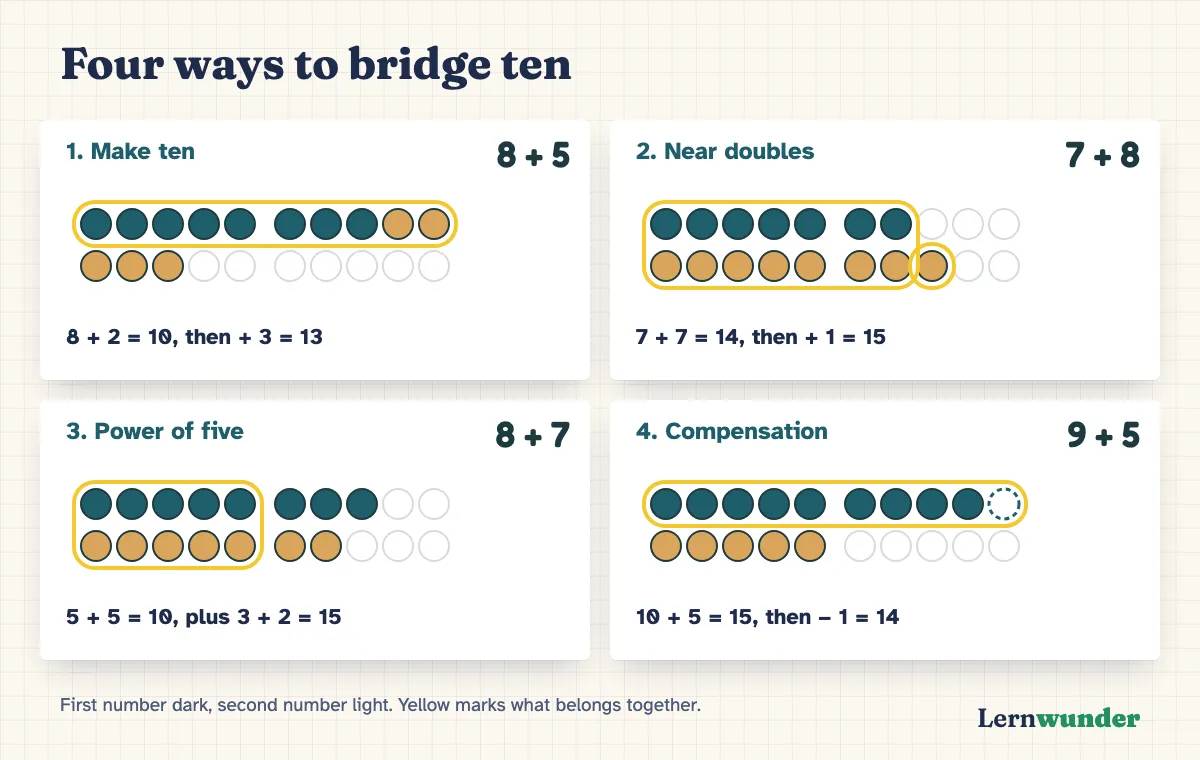
Four strategies come up again and again in classrooms and in research.
1. Make ten (bridging through ten). 8 + 5 becomes 8 + 2 = 10 and then 10 + 3 = 13. The child splits the second number so that the first one is filled up to exactly ten. This needs secure number bonds to ten, the bonds within 10, and knowing that “ten and three” is thirteen.
2. Near doubles. 7 + 8 is 7 + 7 and one more, so 15. Many children know doubles early, often from their hands.
3. The power of five: two fives make ten. 8 + 7 becomes (5 + 3) + (5 + 2): the two fives make 10, plus 3 and 2, so 15. How the five-structure helps children see quantities is explained in The Power of Five.
4. Compensation: go via 10 and adjust. 9 + 5 is one less than 10 + 5, so 14. This works especially well with 9 or 8.
Subtraction offers the same variety: 13 − 5 by going back to ten first (13 − 3 = 10, then take away 2 more), 13 − 9 by counting up or “think addition” (from 9 to 13 is 4), or through the related fact (13 − 5 = 8, because 8 + 5 = 13).
Isn’t one method enough?
Making ten is reliable, but not always the shortest way. For 7 + 8, near doubles are often quicker; for 9 + 6, compensation. Researchers call the goal adaptive expertise: a child knows several strategies and chooses the one that suits the problem and themselves (Verschaffel et al., 2009). The authors stress that the learning context matters as well. For us that means: a child who only ever sees one method in class has little reason to choose another.
A study with 83 first graders shows why this matters. They had been taught two strategies for sums over ten in class: decomposing to ten and using doubles. Children with strong maths skills used both strategies faster and more accurately. But they were no better than their peers at choosing which strategy fits which problem (Torbeyns et al., 2005). Knowing several strategies is only half the story. Choosing needs practice of its own.
What does research say about practising strategies?
Strategies transfer, drill hardly does. In an experiment with 85 children from kindergarten to grade 3, groups practised on a computer twice a week for twelve weeks. One group worked on the “use 10” strategy (9 + 5 is one less than 10 + 5), another on “subtraction as addition” (for 8 − 5, ask: what plus 5 makes 8?), a third practised with pure drill. Afterwards the strategy groups solved unpractised problems of their type more fluently than the comparison groups; the drill group showed no such advantage (Baroody et al., 2016).
Guidance matters. In a study with 78 first graders, highly guided discovery of doubles relationships led to more transfer to unpractised problems than extra practice alone (Purpura et al., 2016). For us that means: children do not reliably find strategies on their own. They need materials, questions and conversations that make the relationship visible.
Derive early instead of counting for long. In four Austrian classes that worked on number bonds and deriving from the start, children at the end of Year 1 counted far less often on bridging-ten problems than in an earlier sample (Gaidoschik & Fellmann, 2015). The numbers are in our first article.
What you can do
- Building blocks first. Check that number bonds to ten, doubles up to 5 + 5 and “ten and …” are secure. Without them every strategy stays hard work.
- Build a strategy with objects. Two empty egg cartons with ten cups each make a twenty-frame. Build 8 + 5 with buttons: first the first carton is full, three go into the second.
- Show doubles with hands. 6 + 6 is two full hands and two single fingers, so 10 + 2. Then 6 + 7: “And one more?”
- Easy or hard? Write problems on cards (10 + 3, 8 + 5, 9 + 6, 7 + 7) and let your child sort them: which are easy, which are not? Ask: “Why is 10 + 3 so easy?” That shows what going via ten is good for.
- Compare methods. “How did you work it out? I did it like this. Which way do you like better?” That is a maths talk for two.
- From objects to the head. Build the problem, then cover the buttons with a cloth and let your child describe the steps. Only then try it without objects. More on this path in Enactive, iconic, symbolic.
What we are working on: a bridge of planks
Our new app “Bridging Ten - Learn Math” (German: “Zehnerübergang - Mathe lernen”) is in the works. Its play world is an archipelago where the child builds bridges between islands together with Pim the otter. Some decisions are already made, and we explain them here.
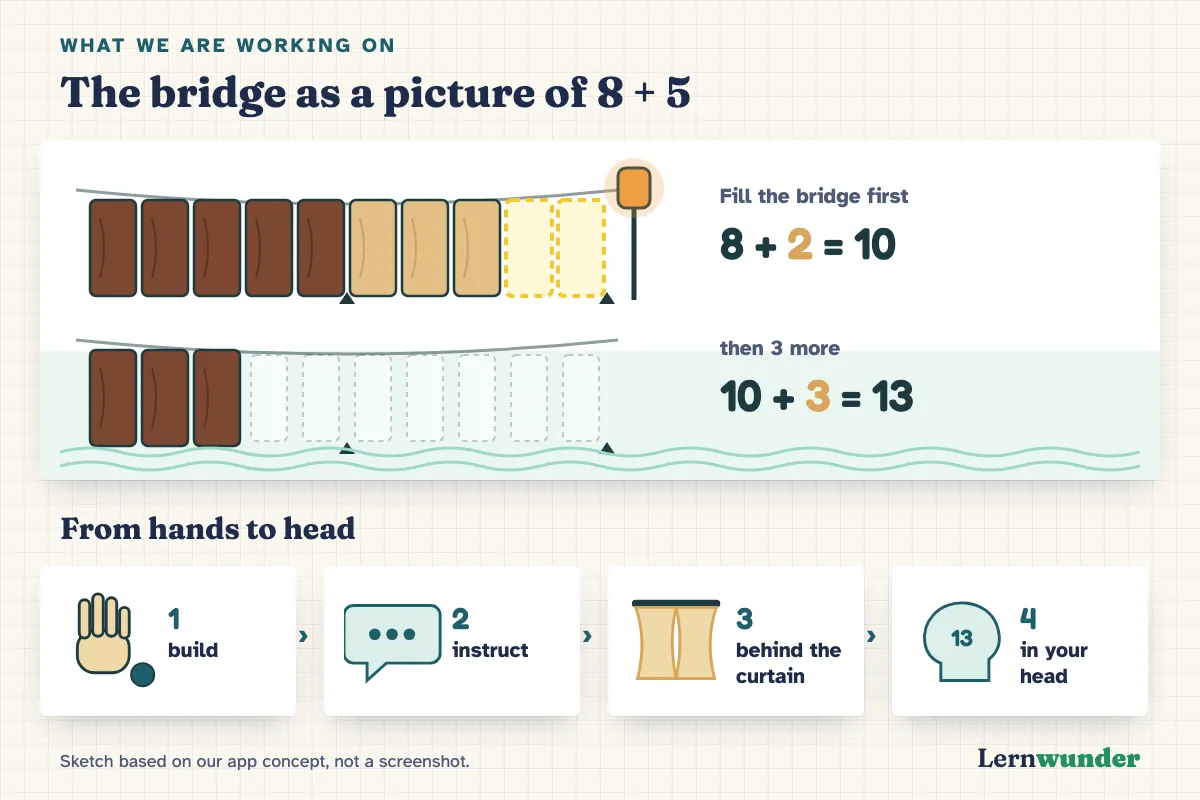
Every bridge has exactly ten planks. Five are dark wood, five light wood. The planks have no numbers, only a notch at five and at ten. That makes the bridge a twenty-frame in play form: you can see how many planks are down and how many are missing, without counting. “Seven are down, how many are missing?” is simply making ten. And 8 + 5 means: fill the bridge first, then three steps further.
Several strategies instead of one procedure. The strategies come as cards: fives, doubles, the ten trick and the bridge, that is, making ten. The child chooses. After a problem, other characters show their method, like in a maths talk. This is meant to practise choosing, which according to Torbeyns et al. (2005) does not come by itself.
Hands, then picture, then head. Each strategy goes through four steps: the child builds the problem, then tells Pim what to build, then the same happens behind a curtain, and finally they calculate in their head. We want to design this step from objects to mental images deliberately, rather than jumping straight from hands to numbers.
No red, no time pressure. A mistake is a “wobbly plank” that gets fixed. Why we avoid red is explained in Why mistakes should not be red.
The app is built on proven primary school teaching methods. It does not replace teaching or extra support, and it is not yet in any store.
Frequently asked questions
Which strategy should my child learn first? Many children find doubles and the five-structure easier on their own. Making ten needs more prerequisites. More important than the order is that the building blocks are secure and that you talk about methods.
Doesn’t learning several methods confuse children? Not if the methods are introduced one after another and compared. The studies by Torbeyns et al. (2005) and Baroody et al. (2016) show that first graders can use and transfer several strategies.
Does my child have to know all facts by heart in the end? Many facts become quick to recall over time. But strategies stay valuable as a way back when a fact slips.
Does this work for bigger numbers too? Yes. 38 + 6 works the same way: first to 40, then 4 more. Children who understand how tens and ones fit together transfer the method more easily.
Sources
- Baroody, A. J., Purpura, D. J., Eiland, M. D., Reid, E. E. & Paliwal, V. (2016). Does fostering reasoning strategies for relatively difficult basic combinations promote transfer by K-3 students? Journal of Educational Psychology, 108(4), 576–591. https://doi.org/10.1037/edu0000067
- Gaidoschik, M. & Fellmann, A. (2015). Zählendes Rechnen im 1. Schuljahr: (Vermutlich) weder notwendig noch förderlich [Counting-based calculation in Year 1: (probably) neither necessary nor helpful]. In F. Caluori, H. Linneweber-Lammerskitten & C. Streit (Eds.), Beiträge zum Mathematikunterricht 2015 (pp. 296–299). WTM. https://doi.org/10.17877/DE290R-16634
- Purpura, D. J., Baroody, A. J., Eiland, M. D. & Reid, E. E. (2016). Fostering first graders’ reasoning strategies with basic sums: The value of guided instruction. The Elementary School Journal, 117(1), 72–100. https://doi.org/10.1086/687809
- Torbeyns, J., Verschaffel, L. & Ghesquière, P. (2005). Simple addition strategies in a first-grade class with multiple strategy instruction. Cognition and Instruction, 23(1), 1–21. https://doi.org/10.1207/s1532690xci2301_1
- Verschaffel, L., Luwel, K., Torbeyns, J. & Van Dooren, W. (2009). Conceptualizing, investigating, and enhancing adaptive expertise in elementary mathematics education. European Journal of Psychology of Education, 24(3), 335–359. https://doi.org/10.1007/BF03174765
Lernwunder editorial team · Chaolan Lu