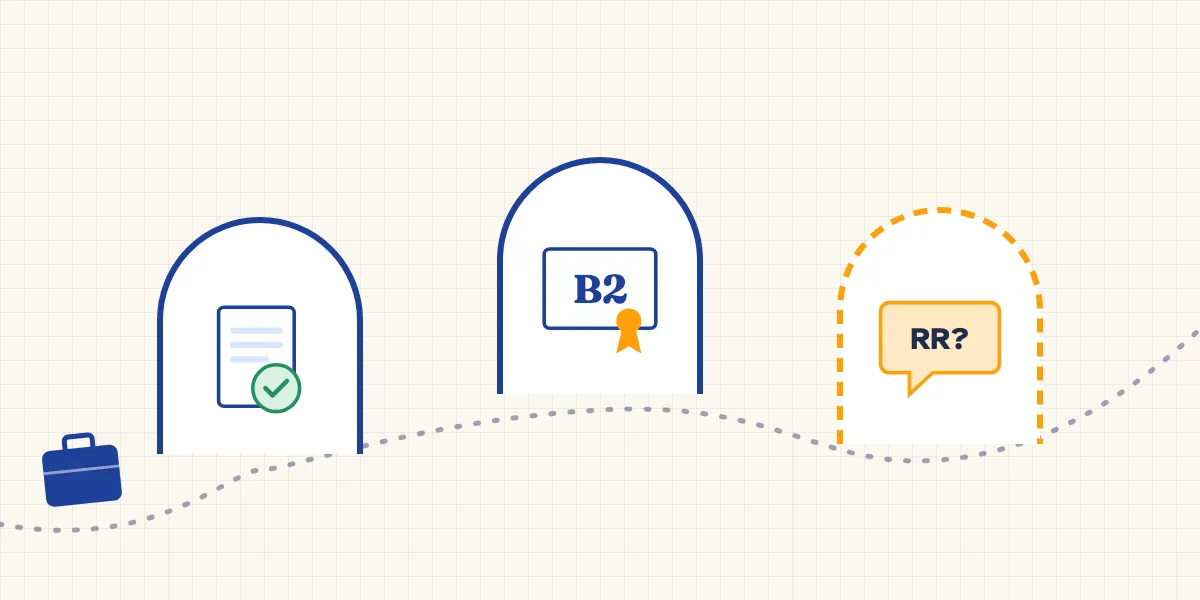
In short: To work as a registered nurse in Germany with a foreign nursing qualification, you need a state licence. That requires recognition of your qualification and sufficient German, usually at level B2. A third gate is not officially tested: the specialist language of everyday ward work. According to surveys, this is where the biggest difficulties lie, especially on the phone and in documentation.
Our last article looked at the first weeks on the ward. Today we take a step back: what has to happen before a nurse from abroad is even allowed to work as a registered nurse in Germany? The road is long, and it has three gates.
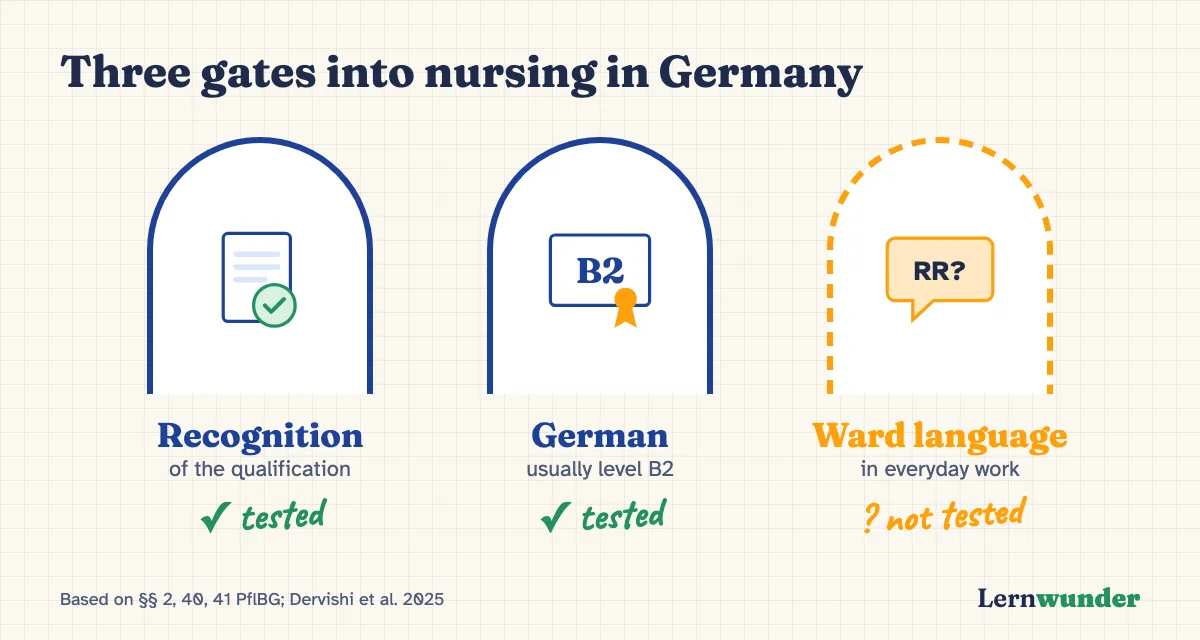
What do you need to work as a nurse in Germany?
Only people holding a licence may use the professional title “Pflegefachfrau” or “Pflegefachmann” (registered nurse). The German Nursing Professions Act lists four requirements: completed training, reliability, health fitness and “the knowledge of German required to practise the profession” (§ 2 PflBG). For training completed abroad, the first requirement is met through recognition, the fourth through proof of German. The authorities of the 16 federal states are responsible.
Gate 1: How does recognition work?
It depends on where the qualification was obtained.
Qualification from the EU, the EEA or Switzerland. Many of these qualifications fall under an EU-wide rule (Directive 2005/36/EC): if the training meets the common minimum requirements and the qualification is listed, the requirement is considered met (§ 41 PflBG).
Qualification from any other country (“third country”). Here the authority checks whether the training is equivalent. If there are substantial differences from German training that work experience does not make up for, an equivalent level of knowledge must be demonstrated (§ 40 PflBG). There are two ways to do this, and the applicant may choose:
- a knowledge test (Kenntnisprüfung) based on the content of the German state examination, or
- an adaptation course (Anpassungslehrgang) of up to three years, ending with an exam.
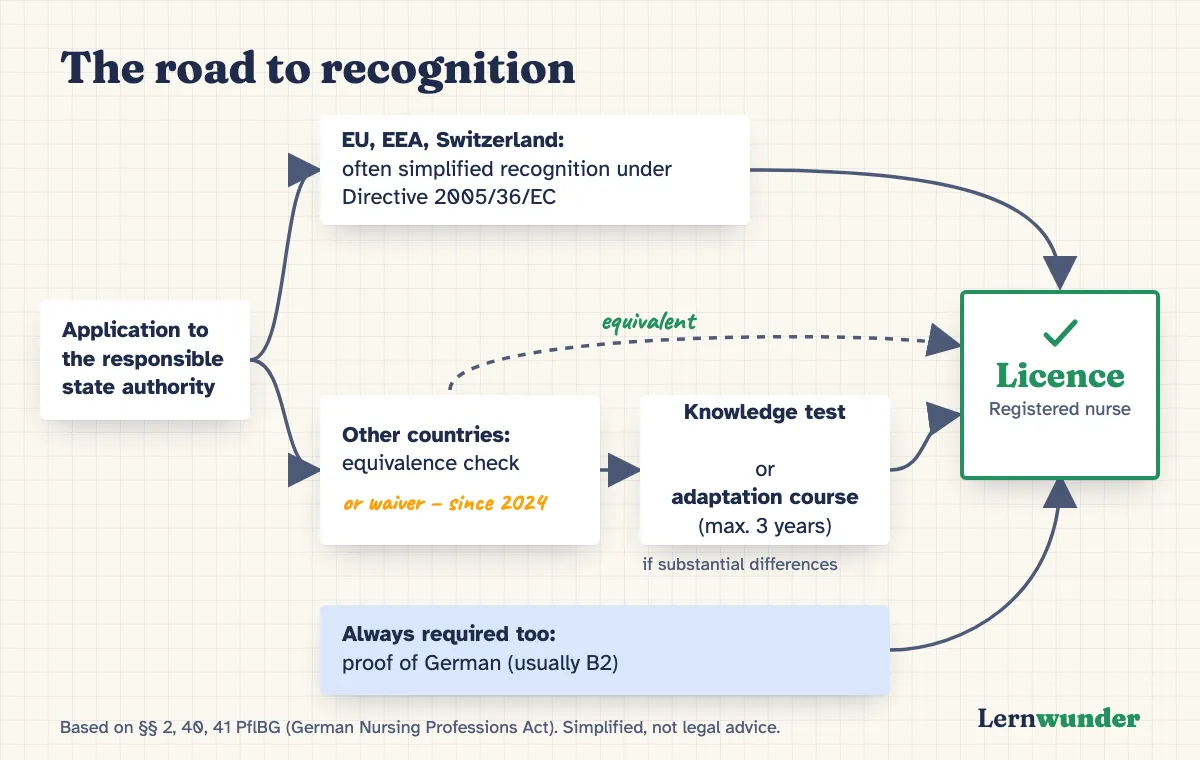
New since 2024: applicants who do not want to wait for the often lengthy document check can waive it and go straight to the knowledge test or the adaptation course (§ 40(3a) PflBG). The same reform standardised the required documents across Germany (Die Bundesregierung, 2023). If you want to plan ahead, you can also request a separate decision on your professional qualification (§ 43 PflBG).
How long all of this takes varies widely. A 2019 policy brief mentions up to 18 months for nurses from third countries. During that time, many already work in Germany, but as nursing assistants (Grgic et al., 2019).
Gate 2: What level of German do nurses need?
The law only speaks of the “required” knowledge of German. The federal states decide what that means in practice. Most often, proof at level B2 of the Common European Framework of Reference is required.
One example: the Hessian State Office for Health and Care accepts general B2 certificates, but also nursing-specific exams such as “telc Deutsch B2 Pflege” or the “Goethe-Test PRO Pflege”. Other states use their own specialist language exams (Fachsprachenprüfung), which Hesse usually accepts. Important: proof of German is needed in addition, even after passing the knowledge test (Hessisches Landesamt für Gesundheit und Pflege, 2024).
Gate 3: Why is B2 often not enough on the ward?
B2 describes good general language ability. On the ward, something else comes in: technical terms, abbreviations, fixed phrases and conversations that no general course practises.
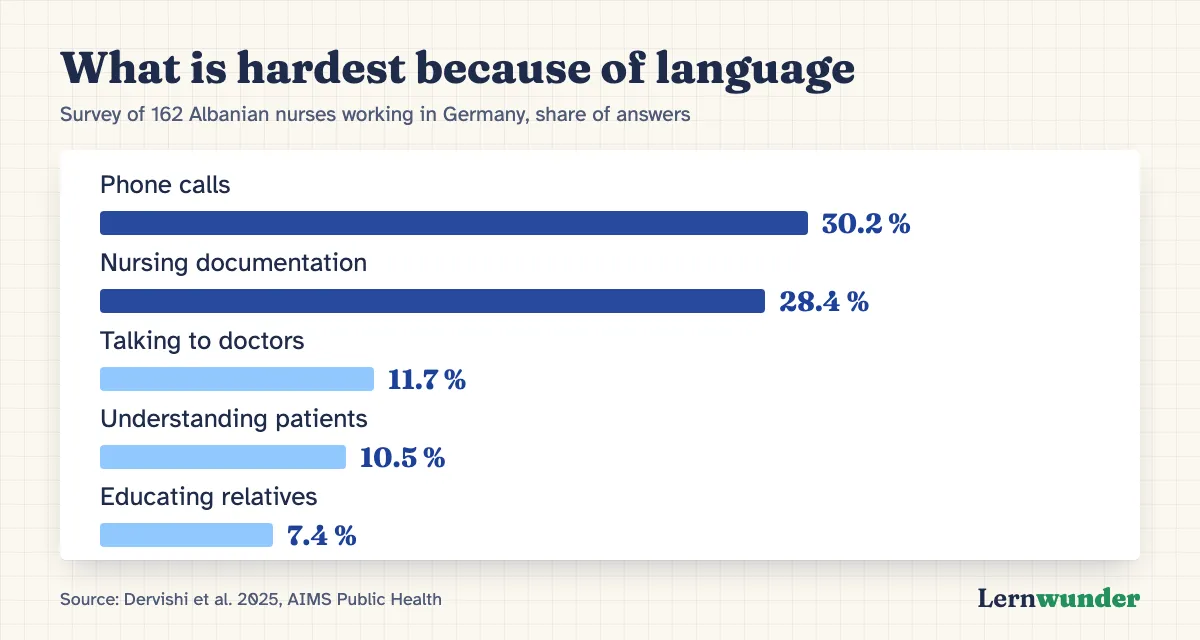
How big this gap is shows in a survey of 162 Albanian nurses working in Germany. Many have a good basic command of German, but lack medical and nursing terminology. Asked which task they found hardest because of language, they most often named phone calls (30.2%) and nursing documentation (28.4%), followed by talking to doctors (11.7%) and understanding patients (10.5%) (Dervishi et al., 2025).
This matches what nursing teams at German hospitals report: whether the transition works depends strongly on onboarding and communication within the team, and on how realistic expectations of the new professional role are (Schumann et al., 2024).
Phone calls are no coincidence: there are no facial expressions, no gestures, no way to point at something. And in documentation every word counts, because it is an important legal record.
What you can do
If you are planning to move to Germany as a nurse:
- Find out early which state authority is responsible for you and which language certificates it accepts. The rules differ.
- If a nursing-specific exam is offered and accepted (e.g. “telc Deutsch B2 Pflege”), it pays off twice: you already practise real work situations.
- Alongside exam preparation, learn the phrases you will need every day: phone calls with other wards, doctors and relatives. Practise them out loud.
- Collect phrases from documentation: how to describe observations briefly and objectively.
If you employ internationally educated nurses:
- Plan realistically for the time until recognition and talk openly about which tasks are possible during that time.
- Practise phone calls during orientation, for example with a call guide next to the phone.
- Share good examples of documentation from your own hospital.
This article does not replace individual advice. Binding information comes from the responsible authority in your federal state.
Why this topic matters to us
For the first two gates there are authorities, exams and courses. For the third gate there is hardly anything. Yet it is specialist language that decides whether a nurse feels confident on the ward. This gap keeps us thinking. In our next article we look at why nursing German is almost a language of its own.
Frequently asked questions
What level of German do nurses need for recognition in Germany? Usually B2. The exact requirements and accepted certificates are set by the federal states; some require their own specialist language exam.
What is the difference between the knowledge test and the adaptation course? The knowledge test is based on the content of the German state examination. The adaptation course lasts up to three years and ends with an exam on its content. Applicants may choose between the two (§ 40(3) PflBG).
Do I have to wait for the equivalence check? No. Since 2024 you can waive the equivalence check and go straight to the knowledge test or adaptation course (§ 40(3a) PflBG). The authority must explain the consequences of this waiver.
Is a nursing qualification from the EU recognised automatically? Many EU qualifications benefit from simplified recognition under EU Directive 2005/36/EC. Proof of German is still required.
Sources
- Die Bundesregierung (2023). Pflegestudiumstärkungsgesetz [Act to strengthen university nursing education]. 18 December 2023. https://www.bundesregierung.de/breg-de/service/archiv-bundesregierung/pflegestudiumstaerkungsgesetz-2192580
- Dervishi, A., Jäger, S., Duka, B., Kika, E., Bezhani, V., Lena, A. & Ivziku, D. (2025). Integration of Albanian nurses in Germany: Employment challenges and opportunities – A descriptive study. AIMS Public Health, 12(2), 399–417. https://doi.org/10.3934/publichealth.2025023
- Gesetz über die Pflegeberufe (Pflegeberufegesetz – PflBG) [German Nursing Professions Act], §§ 2, 40, 41, 43. https://www.gesetze-im-internet.de/pflbg/
- Grgic, M., Larsen, C., Rand, S., Riedel, B. & Voss, D. (2019). Vertane Chancen der Fachkräftebindung in der Pflege [Missed opportunities for retaining skilled nurses]. Policy Brief no. 005. Hans-Böckler-Stiftung. https://www.boeckler.de/pdf/p_fofoe_pb_005_2019.pdf
- Hessisches Landesamt für Gesundheit und Pflege (2024). Nachweis ausreichender Sprachkenntnisse … [Proof of sufficient German for the recognition of foreign nursing qualifications]. As of 24 July 2024. https://hlfgp.hessen.de/sites/hlfgp.hessen.de/files/2024-11/pflegefachberuf_merkblatt_deutschkenntnisse_202407.pdf
- Schumann, M., Peppler, L., Beck, P. & Schenk, L. (2024). Navigating transitions: a qualitative study of nursing teams’ experiences of educational and cultural transitions in Germany. BMC Nursing, 23, 725. https://doi.org/10.1186/s12912-024-02383-0
Lernwunder editorial team · Chaolan Lu