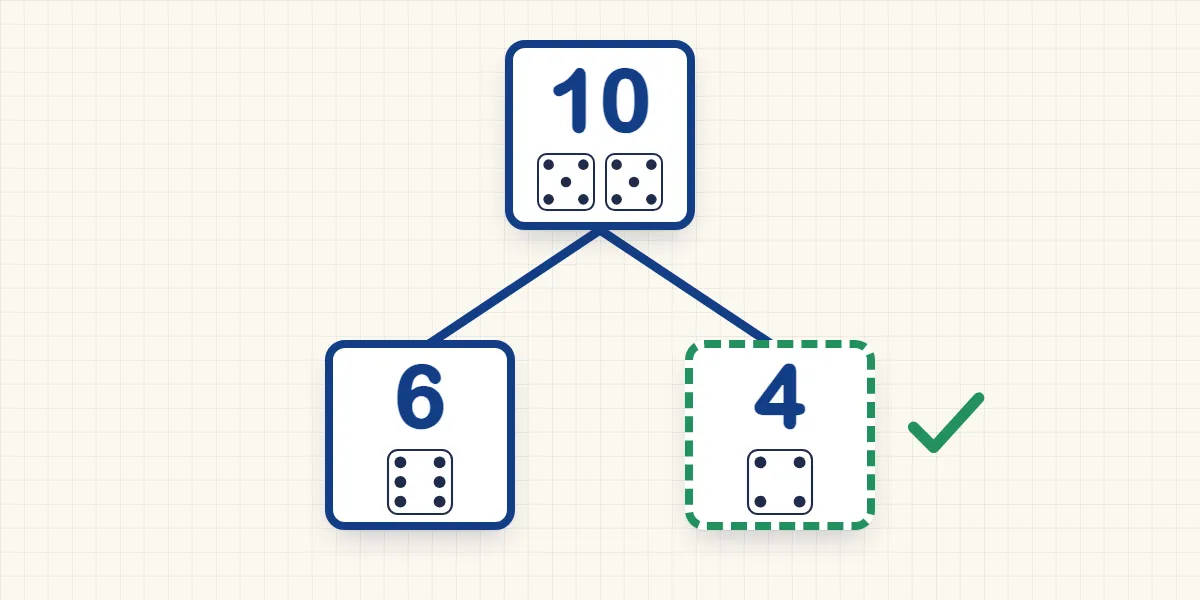
In short: In maths, a mistake is not an accident but a moment when learning can work especially well. Whether it does depends on the feedback: a bare “wrong” achieves little, showing the correct answer helps much more, and feedback that explains helps most. That is why, after a mistake in Zahlzerlegung, the complete number house appears: the whole with both parts, each shown as a digit and a quantity picture.
Picture this (a made-up but typical example): your child is splitting 10 into two parts. The 6 is already there; the second part is missing. Your child puts down a 3. What do you say?
Most adults instinctively say: “No, that’s wrong, try again.” It’s well-meant. But it only tells the child that something is off, not what and not why. That difference is what this post is about.
Why are mistakes so valuable for learning?
Memory researcher Janet Metcalfe reviewed the laboratory evidence. Her conclusion: making errors and then getting corrective feedback is good for learning. Corrective feedback is crucial, ideally including a look at how the mistake came about. People who are allowed to make and correct errors in low-stakes practice are better prepared for high-stakes moments later (Metcalfe, 2017).
For children, that means a wrong number bond is not a sign of failure. It is an opportunity, and it shouldn’t be wasted.
What kind of feedback actually helps?
Feedback is among the most powerful influences on learning, but its effect can be positive or negative, depending on the type of feedback and how it is given (Hattie & Timperley, 2007). A large meta-analysis of 435 studies confirmed an overall medium effect and showed that how much feedback achieves depends heavily on the information it contains (Wisniewski, Zierer & Hattie, 2020).
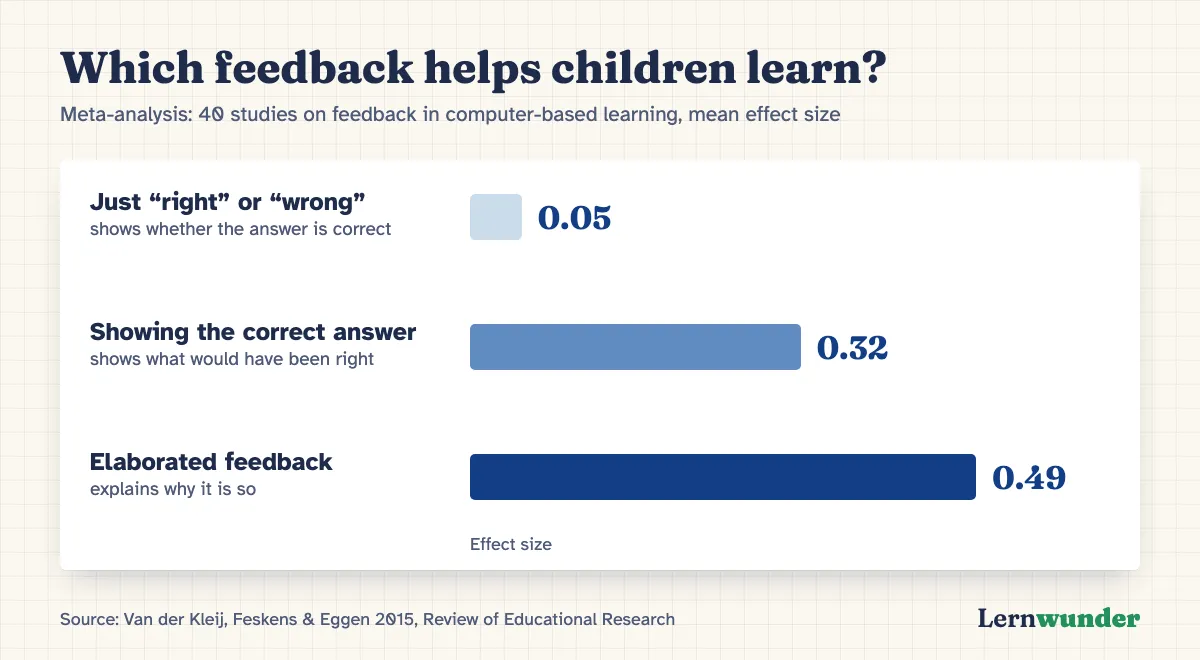
Especially relevant for learning apps is a meta-analysis of 40 studies on feedback in computer-based learning. It compares three types (Van der Kleij, Feskens & Eggen, 2015):
- Just “right” or “wrong”: effect size 0.05, practically no effect.
- Showing the correct answer: 0.32.
- Elaborated feedback, such as an explanation: 0.49.
Effects were larger in mathematics than in other subjects.
Can feedback do harm?
Yes. A classic meta-analysis found that feedback improves performance on average but makes it worse in more than a third of cases. Feedback that shifts attention away from the task and towards the self was least effective (Kluger & DeNisi, 1996). “You just can’t do this” or a disappointed face point exactly there.
Prior knowledge matters too. In experiments with primary school children, brief right/wrong feedback helped children who did not yet know a strategy, but tended to harm children who had already been taught a correct one (Fyfe & Rittle-Johnson, 2016). Feedback is not automatically a good thing.
Valerie Shute sums up the research this way: good formative feedback is non-evaluative, supportive, timely and specific (Shute, 2008).
What does that mean for number bonds?
With number bonds, the “explanation” is often already in the picture. A child who sees that four more dots are needed to turn six into ten doesn’t need a lecture. What helps is feedback that shows the whole number bond again: the whole at the top, the two parts below, in a way that makes the quantities visible. You can read more about this idea in our post on the number house.
What you can do
- Ask before you judge. “How did you work that out?” Often you’ll spot where the thinking went off track, such as counting one too many.
- Show, don’t tell. Lay out the whole with buttons or fingers: “Here are six. How many more make ten?” Your child finds the right number.
- Say the whole bond. “Ten is six and four.” A full sentence sticks better than a single number.
- Talk about the task, not the person. Instead of “But you knew that already!”, try “Let’s look again at how many there are.”
- Bring the task back. If the same bond comes up again a few minutes later, your child can show they’ve got it now.
How we solved it in Zahlzerlegung
In Zahlzerlegung (available in German only), the child drags a number card into the empty field of the number house. If the number is wrong, this is what happens:
- The field gets a red border, and on an iPhone the device vibrates briefly. There is no sound, no text and no sad face.
- The star on the small ladder next to the task moves back to the start. So the task will come up more often in the next rounds.
- After two seconds the wrong card disappears. In its place, the correct number appears with a green border for three seconds before the next task.
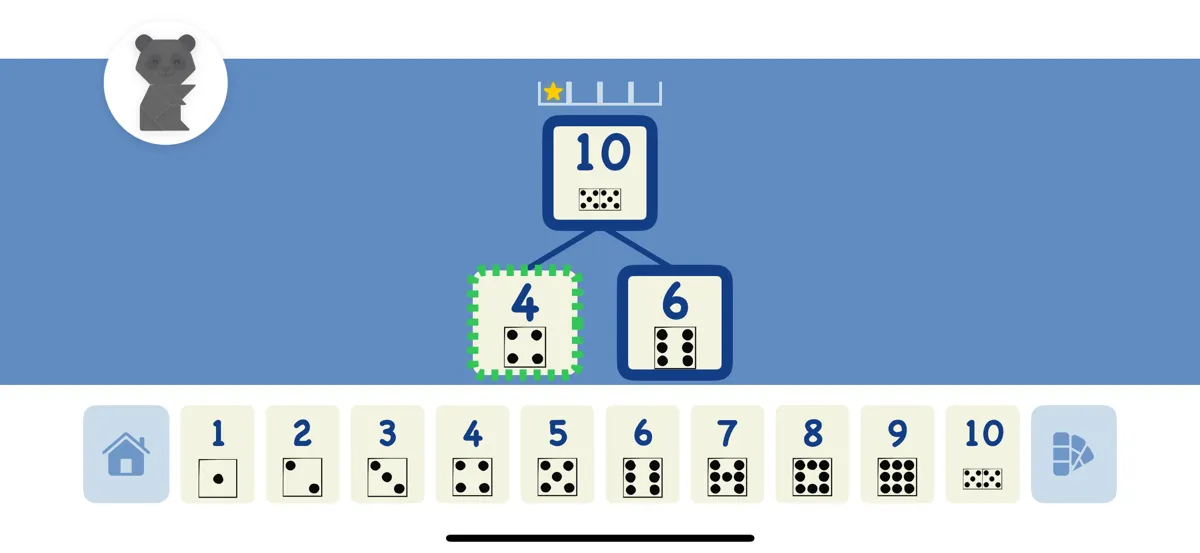
The design decision behind this: after a mistake, a child should not only learn that the answer was wrong but what right looks like. Because every card shows a digit and a quantity picture, the complete number house is left on screen: the whole and both of its parts, as numbers and as amounts. The child doesn’t just see “4”; they see that six and four dots together make ten. The three seconds are deliberate, to leave time to look.
To be honest: in research terms this is mainly “showing the correct answer”, supported by a picture. The app does not give a verbal explanation. The “How did you get there?” part can only be done by a person. That is why it’s worth sitting next to your child now and then and trying the tips above.
And about the red border: it marks the spot where something doesn’t fit. But the last colour a child sees for every task is green, on the correct answer.
Frequently asked questions
Should I correct every mistake straight away? Usually yes, but ideally so that your child sees or finds the correct answer themselves. Feedback that shows or explains works far better than a bare “wrong” (Van der Kleij et al., 2015).
My child gets upset about mistakes. What helps? Shift attention to the task, not the child. Feedback aimed at the person is the least effective (Kluger & DeNisi, 1996). A calm “Let’s see how many there are” takes the pressure off. More in our post on maths anxiety in children.
How soon should a missed task come back? Soon, but not immediately. In Zahlzerlegung it returns to the first learning level and therefore appears more often in the next rounds.
Is it a problem if my child guesses? No. Even a guessed error followed by correction is a learning opportunity (Metcalfe, 2017). What matters is that the right answer becomes visible.
Sources
- Fyfe, E. R. & Rittle-Johnson, B. (2016). Feedback both helps and hinders learning: The causal role of prior knowledge. Journal of Educational Psychology, 108(1), 82–97. https://doi.org/10.1037/edu0000053
- Hattie, J. & Timperley, H. (2007). The power of feedback. Review of Educational Research, 77(1), 81–112. https://doi.org/10.3102/003465430298487
- Kluger, A. N. & DeNisi, A. (1996). The effects of feedback interventions on performance: A historical review, a meta-analysis, and a preliminary feedback intervention theory. Psychological Bulletin, 119(2), 254–284. https://doi.org/10.1037/0033-2909.119.2.254
- Metcalfe, J. (2017). Learning from errors. Annual Review of Psychology, 68, 465–489. https://doi.org/10.1146/annurev-psych-010416-044022
- Shute, V. J. (2008). Focus on formative feedback. Review of Educational Research, 78(1), 153–189. https://doi.org/10.3102/0034654307313795
- Van der Kleij, F. M., Feskens, R. C. W. & Eggen, T. J. H. M. (2015). Effects of feedback in a computer-based learning environment on students’ learning outcomes: A meta-analysis. Review of Educational Research, 85(4), 475–511. https://doi.org/10.3102/0034654314564881
- Wisniewski, B., Zierer, K. & Hattie, J. (2020). The power of feedback revisited: A meta-analysis of educational feedback research. Frontiers in Psychology, 10, 3087. https://doi.org/10.3389/fpsyg.2019.03087
Lernwunder editorial team · Chaolan Lu