
Short answer: Large long-term studies show that children with colour vision deficiency learn as well as other children. Problems start when learning materials carry information through colour alone. The fix is redundant coding: every colour gets a second cue, such as a shape. That is why the gold coins in Number Pirates are round with a star and the silver coins are octagonal with an anchor.
A made-up scene: two siblings are playing on a tablet, each with their own counters. The younger one taps one of his sister’s pieces and says, “That one’s mine.” She laughs, he goes red and doesn’t want to play any more. Nobody in the family knows yet that he can barely tell certain colours apart.
Moments like this are small, but they add up. In our article on accessible practice we looked at how many children are affected and why colour should never be the only cue. Here we go one step further: what does that mean for a game in which two children have to tell their coins apart on a shared board?
How many children are colour blind, and when do you find out?
In a mixed class there is often one child with congenital colour vision deficiency, usually a boy. We summarised the worldwide figures in accessible practice. Britain has particularly solid data: in the 1958 birth cohort, 12,534 children were tested with the Ishihara plates at age eleven. 6.7 per cent of boys and 1.1 per cent of girls had a colour vision deficiency (Cumberland et al., 2004).
When it is noticed varies a lot. Reliable testing is possible early: in a study of boys aged 4 to 7, a game-like tablet test identified every child that the Ishihara test for people who cannot yet read classed as colour deficient (Tang et al., 2022). But by no means every child is tested. For design, that means an app for five- to eight-year-olds has to assume that some of its players do not know about it yet.
Do colour-blind children learn less well?
No, and that is good news. The same British cohort was followed for decades. Children with colour vision deficiency did no worse in maths and reading at seven and sixteen, and there was no difference in school qualifications (Cumberland et al., 2004). A review of school screening reaches the same conclusion: the stronger evidence points to no link with educational achievement (Ramachandran et al., 2014).
So the problem is not the child, it is the material. A review of the consequences of colour vision deficiency sums it up: most people affected have difficulties when colour is used to code information. They search more slowly and less successfully when a target is defined by its colour, and they may be unreliable when a colour name is used as a label, as in “take the green ones” (Cole, 2004).
Why isn’t a well-chosen colour enough?
An eye-tracking study shows where exactly it goes wrong. People with colour vision deficiency were much worse at finding red objects on a lawn. But once they were looking straight at a target, they almost always identified it correctly (Kugler et al., 2015). Colour no longer guides the eye to the target from the corner of the eye. Yet that is exactly what a child needs on a board with up to twelve coins per side: to see at a glance which coins are theirs.
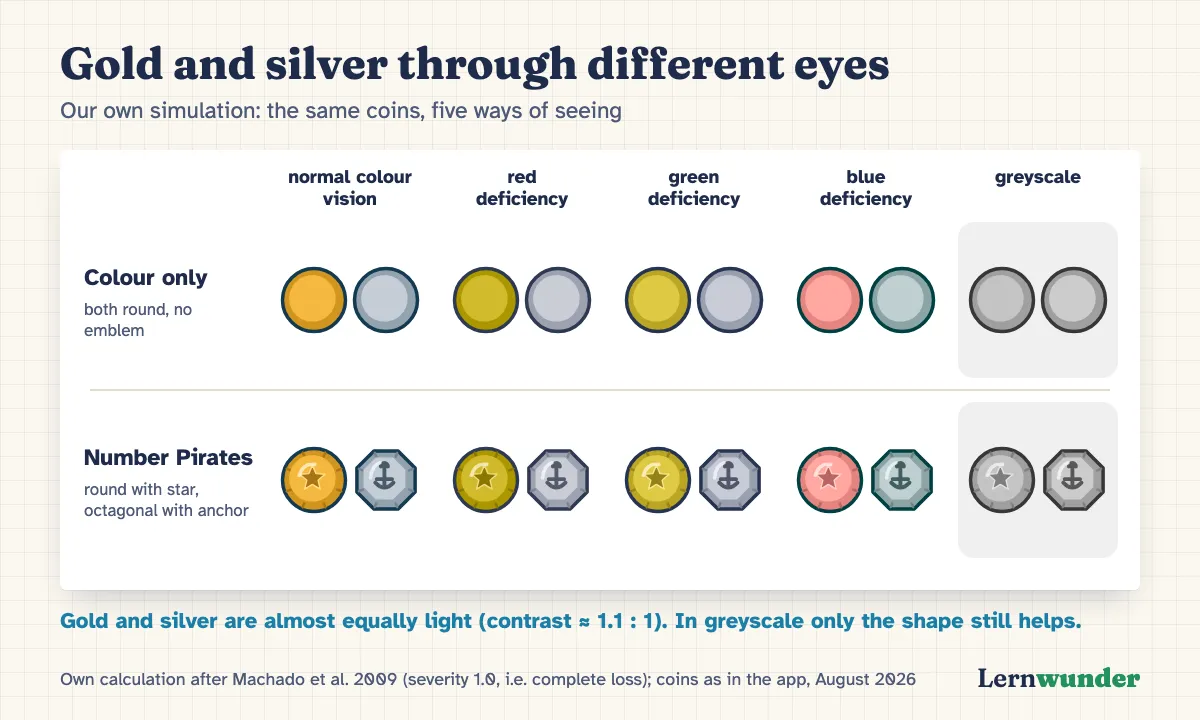
Gold and silver are already a fairly robust choice. We ran both coin colours through a widely used model of colour vision deficiency (Machado et al., 2009). With red or green deficiency, gold becomes a muted yellow and silver stays grey, so the difference remains visible. But the two colours are almost equally light, with a contrast ratio of roughly 1.1 to
- In greyscale, in bright sunlight on a screen, or with the rare forms of complete colour blindness, they are hard to tell apart. That is our own calculation, not a study.
What is redundant coding?
Redundant coding means that one piece of information is carried by two features at once, for example colour and shape. If one fails, the other still works. The Web Content Accessibility Guidelines require exactly this in success criterion 1.4.1: colour must not be the only visual means of conveying information, indicating an action, prompting a response or distinguishing a visual element. The guidance also says explicitly that this should not discourage anyone from using colour (W3C, 2018). Colour stays allowed and useful, it just needs a partner.
One detail from research is still worth knowing: a second cue does not help automatically. In an older study, people only got faster once they actually used the redundant coding. If they did not know about it, it could even slow them down (Shieh, 1998). For design, that means the second cue has to be the same everywhere, so that children can rely on it.
What you can do
- Choose counters by shape. For home-made games, don’t just use red and green buttons: try round buttons against square blocks, or pasta shapes.
- Add to colour names. Instead of “take the green ones”, say “take the round green ones” or “take the ones on your side”. That helps every child, not only those with colour vision deficiency.
- Fixed sides. When two children play, each sits on their own side and always puts their pieces there. Position is a third cue that costs nothing.
- Symbols on worksheets. Wherever colours are used to sort things in class or in exercise books, a small symbol next to them helps: circle, triangle, star.
- Ask calmly. If your child keeps mixing up the same colours, mention it to your GP, paediatrician or optometrist. A test is quick and possible from nursery age.
How we solved it in Number Pirates
Since the launch in August, Number Pirates (“Mengenpiraten” in German) has followed a fixed rule from our style guide: the two sides are never told apart by colour alone. In practice:
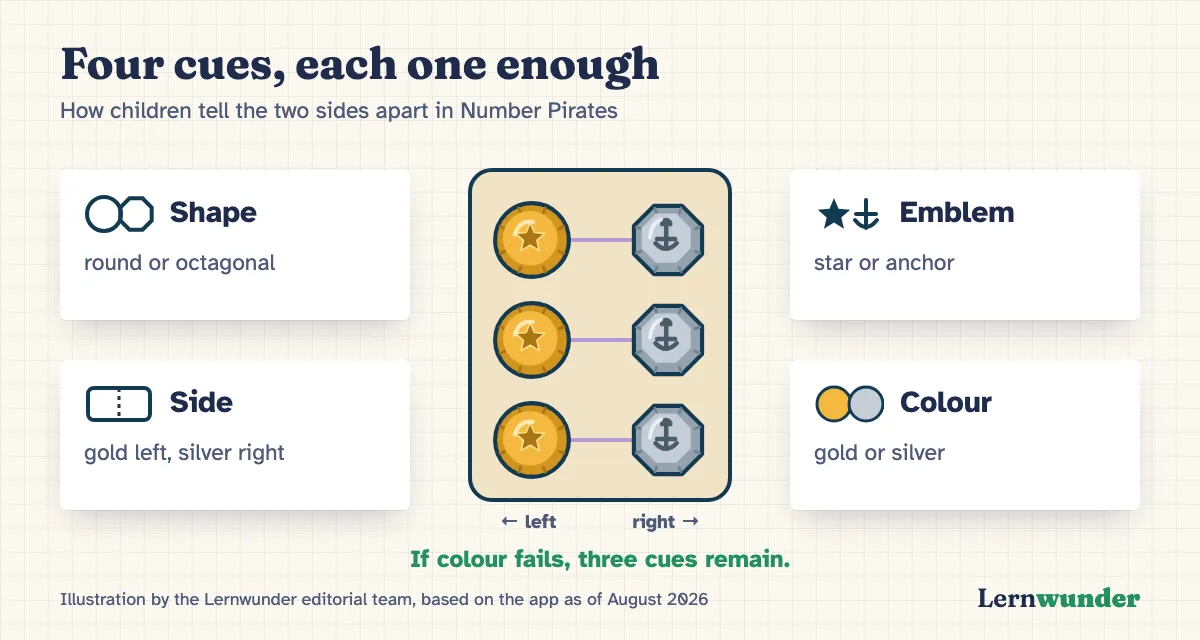
- Shape. Gold coins are round, silver coins are octagonal. The edges have a thick dark outline so the shape is easy to see even when small.
- Emblem. Every gold coin carries an embossed star, every silver coin an anchor: a third cue that also helps in poor light.
- Side. On the shared board, gold is always on the left and silver always on the right. In the practice mode Quick Loot, gold is on the left too.
- The same everywhere. Round and octagonal hold on the board, in the coin supply and when taking the loot. Children learn the cue once and can rely on it after that.
- Whose turn it is is shown by a gold ring around the child’s animal picture, with the picture and name above the sentence cards as well. That doesn’t depend on colour alone either.
Why gold and silver, and not red and green? Because red–green is exactly the pair that fails most often, and because red is never an error colour in our apps anyway. More on that in why mistakes should not be red. In the parents’ area, too, every traffic-light dot in green, yellow or orange has a percentage next to it, so nobody has to read progress from a colour.
We name two limits openly. In the treasure chests, the filled spaces are coloured only, and all of them are round. But every chest shows the child’s name and a count such as 7/10. And in Quick Loot the answers say “Gold has more than silver.” A child who struggles with the colours can find gold there by its round shape and its place on the left. Number Pirates has no separate colour-blind mode. It doesn’t need one, because the distinction is built in from the start. How the two-player game works is described in two players, one iPad. The app does not replace an eye test or an educational assessment.
Frequently asked questions
Can my colour-blind child play Number Pirates? Yes. The sides differ in shape, emblem and position, not just colour. The colours themselves don’t matter for the game.
Should I have my child tested for colour vision deficiency? If they keep confusing certain colours, yes. A test is quick and possible from about age four (Tang et al., 2022). Ask your GP, paediatrician or optometrist.
Is a colour-blind child at a disadvantage at school? Large studies show no disadvantage in learning itself (Cumberland et al., 2004). What gets in the way is material that relies on colour alone. Let the teacher know so they can add symbols to colours.
Is it only boys? Boys are affected far more often, but girls can be too. In the British cohort it was 6.7 per cent of boys and 1.1 per cent of girls (Cumberland et al., 2004).
Find out more on the Number Pirates page.
Sources
- Cole, B. L. (2004). The handicap of abnormal colour vision. Clinical and Experimental Optometry, 87(4–5), 258–275. https://doi.org/10.1111/j.1444-0938.2004.tb05056.x
- Cumberland, P., Rahi, J. S. & Peckham, C. S. (2004). Impact of congenital colour vision deficiency on education and unintentional injuries: Findings from the 1958 British birth cohort. BMJ, 329(7474), 1074–1075. https://doi.org/10.1136/bmj.38176.685208.F7
- Kugler, G., ’t Hart, B. M., Kohlbecher, S., Bartl, K., Schumann, F., Einhäuser, W. & Schneider, E. (2015). Visual search in the real world: Color vision deficiency affects peripheral guidance, but leaves foveal verification largely unaffected. Frontiers in Human Neuroscience, 9, 680. https://doi.org/10.3389/fnhum.2015.00680
- Machado, G. M., Oliveira, M. M. & Fernandes, L. A. F. (2009). A physiologically-based model for simulation of color vision deficiency. IEEE Transactions on Visualization and Computer Graphics, 15(6), 1291–1298. https://doi.org/10.1109/TVCG.2009.113
- Ramachandran, N., Wilson, G. A. & Wilson, N. (2014). Is screening for congenital colour vision deficiency in school students worthwhile? A review. Clinical and Experimental Optometry, 97(6), 499–506. https://doi.org/10.1111/cxo.12187
- Shieh, K.-K. (1998). Effectiveness of redundant color coding in multidimensional identification. Perceptual and Motor Skills, 86(2), 615–625. https://doi.org/10.2466/pms.1998.86.2.615
- Tang, T., Álvaro, L., Alvarez, J., Maule, J., Skelton, A., Franklin, A. & Bosten, J. (2022). ColourSpot, a novel gamified tablet-based test for accurate diagnosis of color vision deficiency in young children. Behavior Research Methods, 54(3), 1148–1160. https://doi.org/10.3758/s13428-021-01622-5
- W3C (2018). Web Content Accessibility Guidelines (WCAG) 2.1, success criterion 1.4.1 “Use of Color”, with “Understanding Success Criterion 1.4.1”. https://www.w3.org/TR/2018/REC-WCAG21-20180605/ · https://www.w3.org/WAI/WCAG21/Understanding/use-of-color.html
Lernwunder editorial team · Chaolan Lu