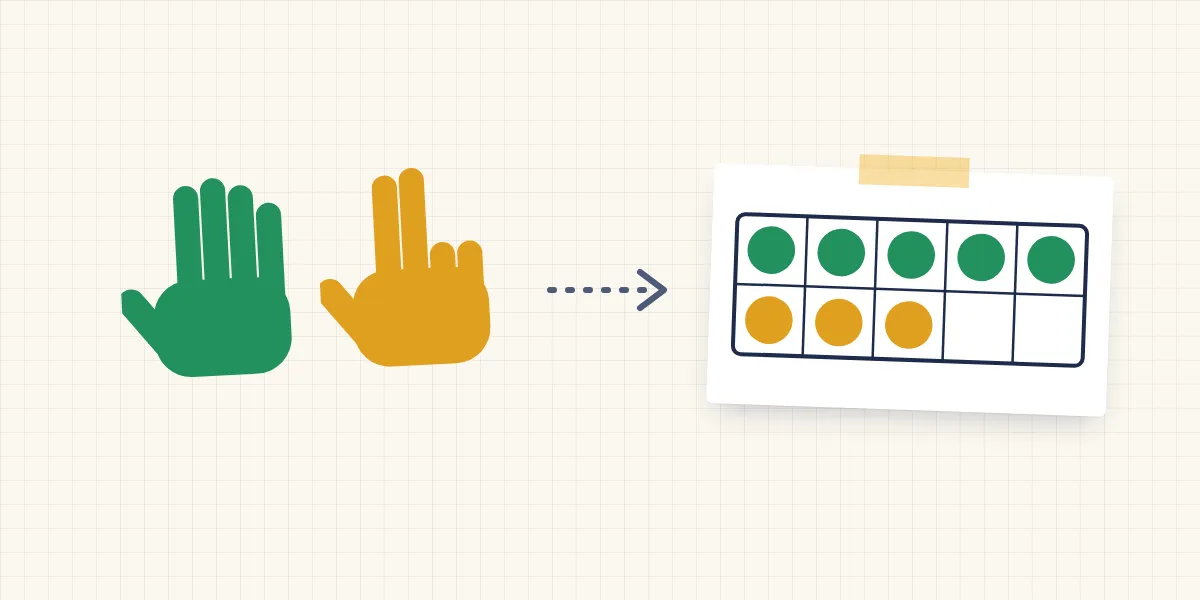
In short: Counting on fingers is normal and useful at first: fingers help children understand numbers as amounts. It becomes a problem when a child keeps counting out simple, well-practised sums step by step for months. Entrenched counting is slow and error-prone, and it hides the relationships between numbers. The way out is not a finger ban but structured pictures of amounts, number bonds and deriving new facts from known ones.
A made-up but typical scene: a maths lesson in second grade. The sum is 6 + 7. Under the desk, small fingers move while lips silently count: seven, eight, nine, ten, eleven, twelve, thirteen. The answer is right. Still, the teacher wonders whether it is a problem that Mia is still calculating like this in her second year at school.
What is counting-based calculation?
Counting-based calculation means a child solves a sum by counting rather than by working with numbers. There are stages. For 8 + 4, a child can
- count all: eight fingers, four fingers, then all twelve from the start,
- count on: from eight, “nine, ten, eleven, twelve”,
- derive: “8 + 2 is 10, and 2 more is 12”, or simply know the answer.
The first two are counting strategies; the third is not. The German clinical guideline on dyscalculia names exactly this move, from counting (9, 10, 11, 12) to non-counting strategies (8 + 2 + 2), as a central hurdle (Haberstroh & Schulte-Körne, 2019).

Are fingers bad for maths?
No. Children across cultures use their fingers to count and calculate, and fingers give early access to key ideas: matching each object with exactly one number, and seeing that a whole is made of parts (Soylu et al., 2018).
For a long time there were two camps. Cognitive neuroscience stresses that good finger-based number representations go hand in hand with better arithmetic. Maths education, on the other hand, recommends moving children away from their fingers, in a particular order: fingers first, then structured representations such as rows of dots and ten frames, then mental images (Moeller et al., 2011). Both fit together once you look at timing.
That is exactly what a US longitudinal study of 217 children shows, following them from kindergarten (average age 5.7) to the end of second grade. At first, children who used their fingers were more accurate: the correlation between finger use and correct answers was 0.60. By the end of second grade it had reversed to −0.15. The researchers conclude that fingers help most when children are first learning number combinations, and that this benefit fades over time (Jordan et al., 2008).

When does counting become a problem?
When it sticks. The guideline summary is clear: finger counting in itself is not a sign of dyscalculia. Persistent finger counting, especially for easy, frequently repeated sums, does point to a problem (Haberstroh & Schulte-Körne, 2019). Almost all children with maths difficulties struggle to recall simple facts like 6 + 3 quickly and accurately (Gersten et al., 2005).
How long counting can persist is shown by a study of 200 seventh graders. Fewer than half were truly proficient with simple addition. 35 percent mostly counted on and got it right; 16 percent counted and often made mistakes. Those who counted often showed lower maths achievement, even when their answers were correct (Hopkins & Bayliss, 2017).
In our view, the core of the problem is that counting starts from scratch with every sum. A child who counts out 8 + 4 experiences a chain of steps, but not the relationship “8 and 2 make 10”. Those relationships are exactly what children need later for bridging through ten, larger numbers and times tables.
How does a child move beyond counting?
Not through bans, but by being given something better:
- Amounts with structure. Five as a full hand, seven as “five and two”. Five- and ten-structures make the parts visible. A row of fingers on its own, however, mainly highlights five and ten; other number bonds need extra representations such as dot fields (Martignon & Rechtsteiner, 2022).
- Number bonds. A child who knows that 8 is made of 5 and 3, or 6 and 2, can derive instead of count. More in our article on number bonds.
- Deriving facts. Using known facts to find new ones: 6 + 6 = 12, so 6 + 7 is one more.
What you can do
- Don’t ban fingers. A ban only moves the counting under the desk or into the head.
- Show finger patterns instead of counting. “Show me seven without counting”: a full hand and two fingers at once.
- Quick-look game. Briefly show dice patterns, rows of five or egg boxes and ask: “How many?” Then: “How did you see it so fast?”
- Collect number bonds to ten. 7 and 3, 6 and 4: with linking cubes, counters or fingers, always keeping the whole in view.
- Ask about the method. “How did you work it out?” shows whether a child counts or derives, without putting them on the spot.
- If patterns persist, talk to the school. How to recognise maths difficulties is covered in Recognising maths difficulties.
How we solved it in Zahlzerlegung
Our first maths app, Zahlzerlegung (German for “number decomposition”), arrived in the App Store a few days ago (more in the launch article). It practises exactly the step away from counting: the number bonds of the numbers 4 to 10 in a number house.
Two decisions relate directly to this article. First, the quantity pictures show amounts with structure: with dots, tally marks and fingers, seven appears as a full row of five plus two. Second, the app does not only check whether an answer is right, but also how quickly it comes. A number bond only counts as learned once it has been answered correctly several times within about five seconds. A child who takes longer is not moved back, but keeps practising that bond. Over time, counting turns into knowing. The app is in German. It does not replace specialist support for dyscalculia.
Frequently asked questions
Is it OK for my child to use fingers in first grade? Yes. At first, fingers are a useful aid (Jordan et al., 2008; Soylu et al., 2018). What matters is that structured pictures and number bonds are added over time.
When should finger counting worry me? When a child keeps counting out simple, well-practised sums step by step for months (Haberstroh & Schulte-Körne, 2019). There is no fixed date.
Is counting on better than counting all? It is progress, but still a counting strategy. The goal is strategies like “make ten first, then add the rest” or direct recall.
Does banning finger counting help? No. It is more helpful to offer structured pictures of amounts and number bonds so that the child naturally stops needing their fingers (Moeller et al., 2011).
Sources
- Gersten, R., Jordan, N. C. & Flojo, J. R. (2005). Early identification and interventions for students with mathematics difficulties. Journal of Learning Disabilities, 38(4), 293–304. https://doi.org/10.1177/00222194050380040301
- Haberstroh, S. & Schulte-Körne, G. (2019). The diagnosis and treatment of dyscalculia. Deutsches Ärzteblatt International, 116(7), 107–114. https://doi.org/10.3238/arztebl.2019.0107
- Hopkins, S. & Bayliss, D. (2017). The prevalence and disadvantage of min-counting in seventh grade: Problems with confidence as well as accuracy? Mathematical Thinking and Learning, 19(1), 19–32. https://doi.org/10.1080/10986065.2017.1258613
- Jordan, N. C., Kaplan, D., Ramineni, C. & Locuniak, M. N. (2008). Development of number combination skill in the early school years: when do fingers help? Developmental Science, 11(5), 662–668. https://doi.org/10.1111/j.1467-7687.2008.00715.x
- Martignon, L. & Rechtsteiner, C. (2022). The benefits of an interdisciplinary approach to mathematics education on issues around computation in school. Frontiers in Psychology, 13, 533402. https://doi.org/10.3389/fpsyg.2022.533402
- Moeller, K., Martignon, L., Wessolowski, S., Engel, J. & Nuerk, H.-C. (2011). Effects of finger counting on numerical development – the opposing views of neurocognition and mathematics education. Frontiers in Psychology, 2, 328. https://doi.org/10.3389/fpsyg.2011.00328
- Soylu, F., Lester, F. K. & Newman, S. D. (2018). You can count on your fingers: The role of fingers in early mathematical development. Journal of Numerical Cognition, 4(1), 107–135. https://doi.org/10.5964/jnc.v4i1.85
Lernwunder editorial team · Chaolan Lu