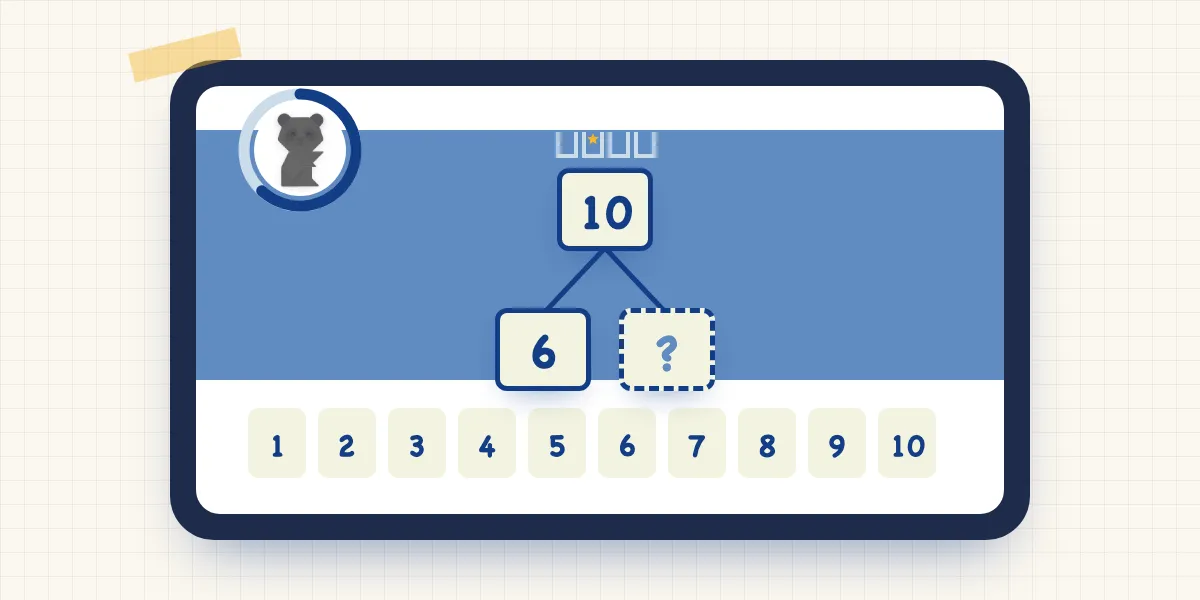
In short: Zahlzerlegung (“number decomposition”) is available on the App Store from today, for iPhone and iPad. It helps children aged about 5 to 7 practise number bonds to 10: one whole, two parts, one part missing. There are no ads, no subscription and no sounds, it works offline, and the app is available in German only.
Over the past weeks we have explained why number bonds are the key to arithmetic and what the number house has to do with it. Today the app we were working on has been released on the App Store. In this post we describe, plainly, what it does and what it doesn’t.
What does the app practise?
Zahlzerlegung practises exactly one thing: the key number bonds of the numbers 3 to 10, without zero and without repeating turnaround facts. The aim is for children to recall them over time instead of counting them out.
Every task has the same shape, familiar from the number house and from number bond diagrams: the whole at the top, the two parts below, joined by two lines. One part is missing. The child drags the matching number from the bar at the bottom into the empty box. No reading is needed.
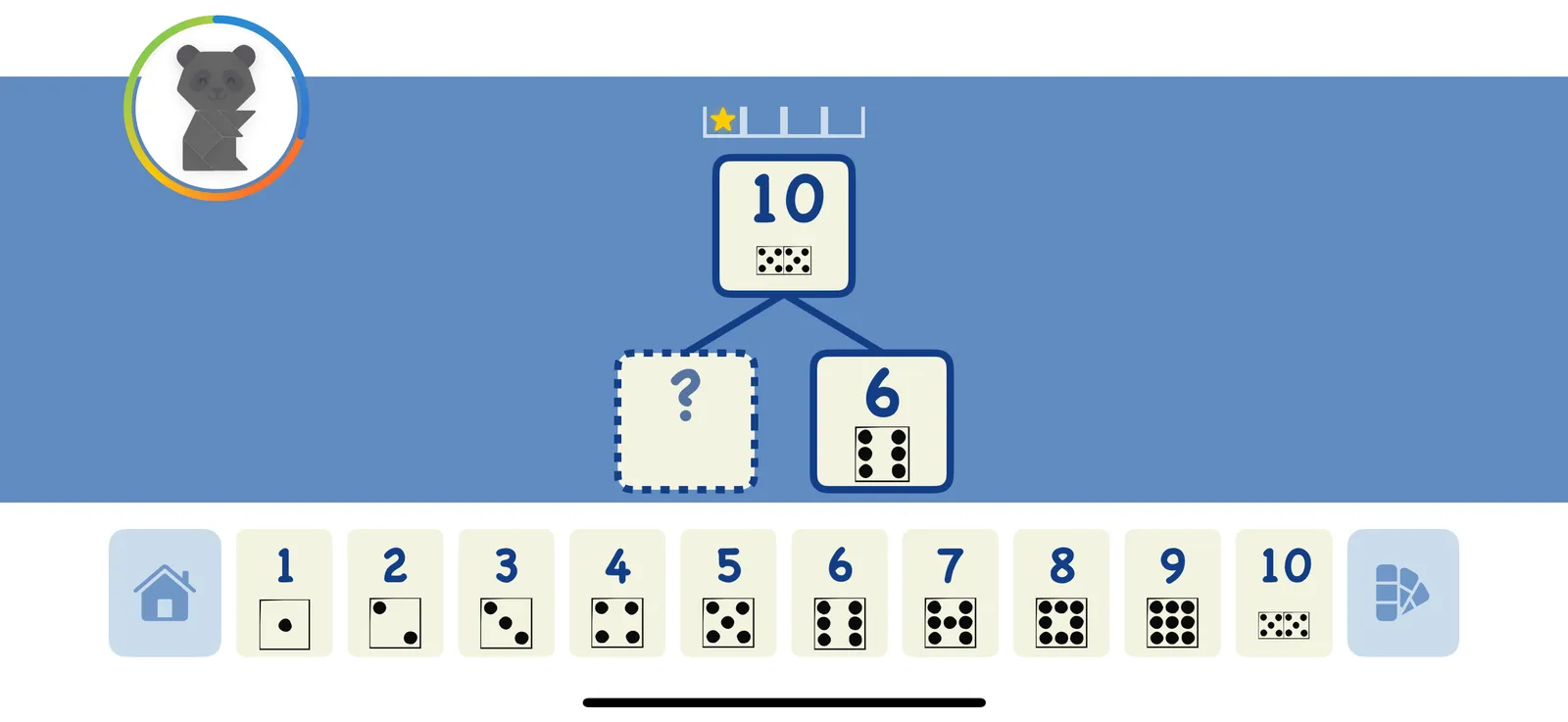
Every number appears as a numeral and as a quantity picture. Children can choose between five quantity pictures, including dice patterns, fingers, tally marks and dots. This keeps the quantity behind the number visible, which matters because part-whole understanding does not come from numerals alone (Marx et al., 2025).
How does practice work?
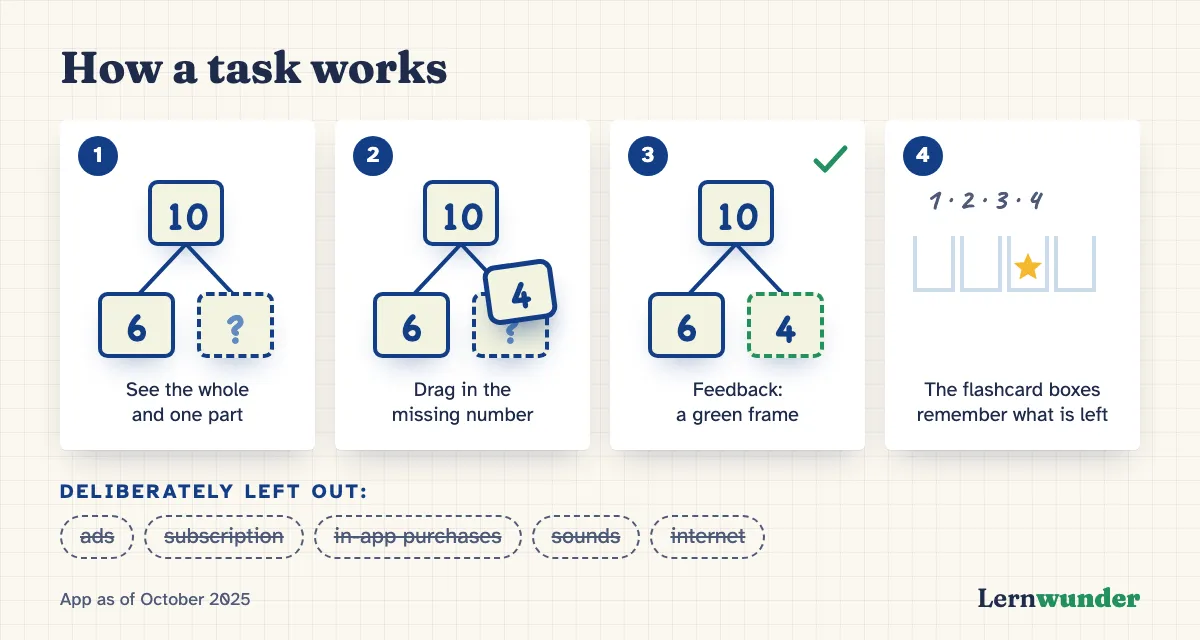
Feedback. If the answer is right, the box gets a green frame. If it is wrong, the box is marked, and after a short moment the correct number appears with a green frame so the child sees the matching bond.
Flashcards. Behind the scenes, a flashcard system with four boxes (the Leitner system) does the planning. New and shaky number bonds come up more often, secure ones less often. A wrong answer sends a bond back to the start. A small star above the task shows which box it is currently in.
Timer ring. A ring around the child’s animal runs for five seconds. It tells apart whether a bond is already recalled or still being worked out. It never ends a task, though: once it has run out, the child can keep thinking in peace. We explain why we built it this way in a separate post.
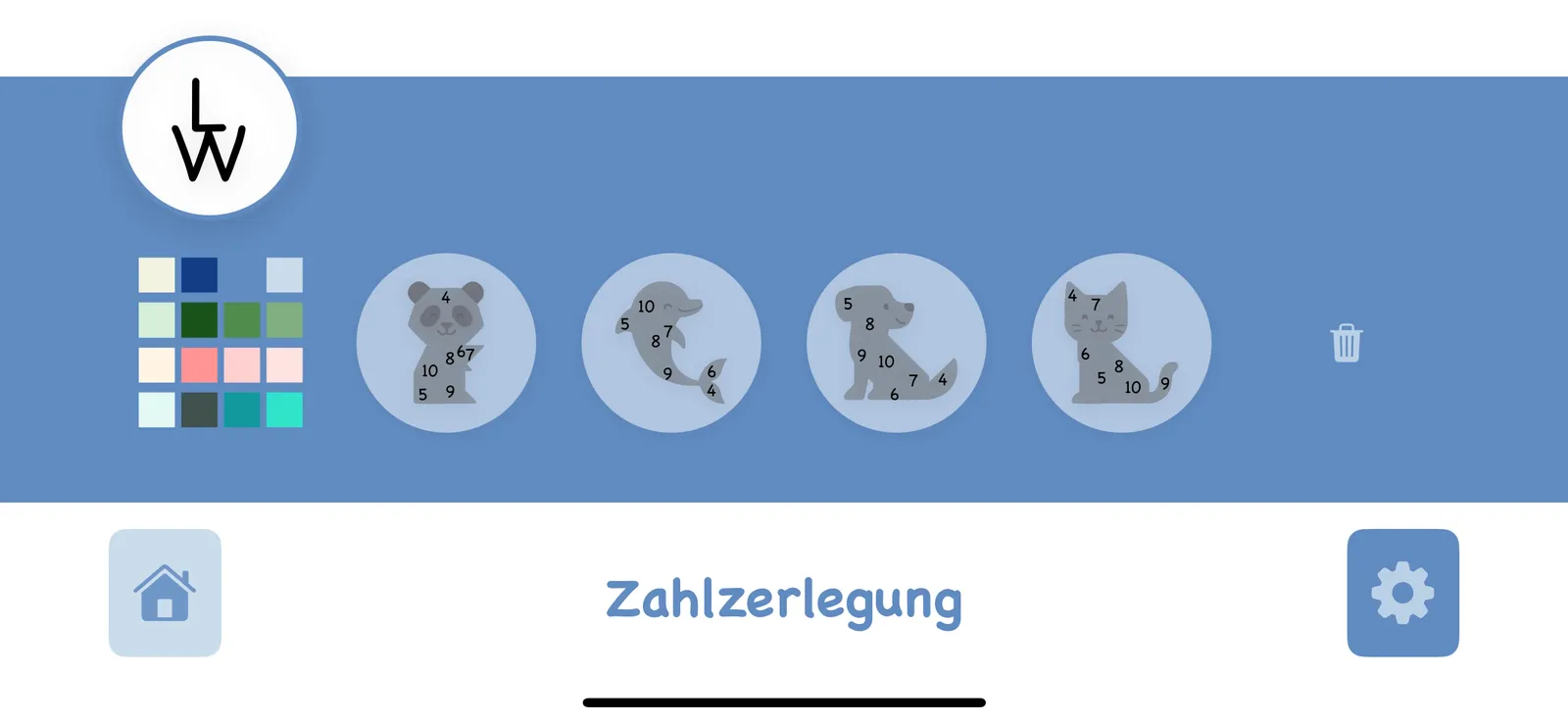
Progress. Each child picks a tangram animal: panda, dolphin, dog or cat. Up to four children can practise on one device, each with their own progress. When all bonds of a number from 4 to 10 are secure, one piece of the animal fills with colour. Now and then a sticker appears, and children who master every number receive a certificate.
What the app deliberately does not do
- No ads, no subscription, no in-app purchases. In a study of 135 popular apps for children aged five and under, 95% contained some form of advertising, and apps labelled “educational” were hardly less affected (Meyer et al., 2019). We wanted to rule that out from the start.
- No sounds. The app is purely visual and can be used in a classroom or waiting room without disturbing anyone.
- No internet, no account. The app makes no network requests; all progress stays on the device.
- No time pressure that takes anything away. The ring measures, but it does not punish.
- No replacement for objects and conversation. Discovering number bonds with buttons, fingers and shake boxes first remains important. The app takes over the regular practice that follows.
- No English version. The app is in German. It uses very little text, but the text it has is German.
Who is the app for?
For children aged about 5 to 7, in their last year of kindergarten and their first year of school. Whether it also suits older children who still count a lot is best decided case by case by parents and teachers; the design is deliberately calm rather than playful.
We say it openly to parents and teachers: the app supports one foundation. It is no substitute for a professional assessment or for learning therapy. Good learning apps support active, engaged, meaningful and socially interactive learning with a clear goal (Hirsh-Pasek et al., 2015). An app struggles with the social part, so it is worth sitting alongside now and then and asking questions.
What you can do
Even with an app, conversation remains the most valuable part:
- Ask how they knew. “How did you know it was 4?” shows whether a child recalls, derives or counts.
- Bring it into real life. What was 10 = 6 + 4 in the app becomes 10 forks when laying the table, with 6 already in place.
- Short and often. A few minutes a day help more than one long session a week.
- Switch the quantity picture. Once a child knows the dice patterns well, try fingers or tally marks, so the quantity stays in view.
Frequently asked questions
Is the app available in English or other languages? No, the app is available in German only, although it uses very little text.
Is there an Android version? No, Zahlzerlegung is currently available for iPhone and iPad only.
Does my child need an account? No. There is no account and no sign-up. Progress stays on the device.
Can I reset the progress? Yes, progress can be reset in the settings.
More about the app on the Zahlzerlegung page.
Sources
- Hirsh-Pasek, K., Zosh, J. M., Golinkoff, R. M., Gray, J. H., Robb, M. B. & Kaufman, J. (2015). Putting education in “educational” apps: Lessons from the science of learning. Psychological Science in the Public Interest, 16(1), 3–34. https://doi.org/10.1177/1529100615569721
- Marx, C., Roesch, S., Moeller, K. & Benz, C. (2025). From the whole to its parts – A systematic analysis of affordances for learning part-whole-relations in digital apps. International Electronic Journal of Mathematics Education, 20(1), em0802. https://doi.org/10.29333/iejme/15677
- Meyer, M., Adkins, V., Yuan, N., Weeks, H. M., Chang, Y.-J. & Radesky, J. (2019). Advertising in young children’s apps: A content analysis. Journal of Developmental & Behavioral Pediatrics, 40(1), 32–39. https://doi.org/10.1097/DBP.0000000000000622
Lernwunder editorial team · Chaolan Lu