
In short: Counting-out rhymes exist in many languages and are remarkably alike: usually four lines with four strong beats each. For young children, rhymes are a language game, and children who know many early tend to read better later. Counting out is only random, though, if nobody chooses where to start: once you know the word count, you can work out who will be out.
A playground, five children in a circle, one of them pointing at each in turn: “Eeny, meeny, miny, moe …”. On the last word someone is out, then it starts again until only one is left. (An invented scene, but one almost everyone has lived through.)
A counting-out rhyme is a short verse in which each word or syllable is given to one person in turn, to decide who goes first or who is “it”. It is an old tool for making a choice look fair. Behind the game there is language, rhythm and a little maths.
Are counting-out rhymes really everywhere?
As early as 1888, Henry Carrington Bolton collected counting-out rhymes from around the world, helped by many correspondents and by children themselves. His book contains 877 numbered rhymes and examples from at least twenty languages, including German, French, Spanish, Turkish, Japanese and Arabic. In Scotland, he noted, the practice was called “chapping out” or “titting out” (Bolton, 1888).
Bolton describes the procedure much as we know it today: each child gets one word, the counter includes themselves, and whoever gets the last word is out. He believed the rhymes went back to ancient practices of casting lots. That is a 19th-century interpretation that is hard to test today.
Why do counting-out rhymes sound alike in many languages?
In 1966 the linguist Robbins Burling compared children’s rhymes across languages. His finding: many consist of four lines, and each line has four main beats, evenly spaced in time. Some beats are silent, like a rest in music. Each language fills this pattern in its own way, but the similarities are greater than in more elaborate poetry (Burling, 1966).
Later work looked more closely. Andy Arleo tested whether such a symmetrical pattern holds up in English and French counting-out rhymes and in English skipping rhymes (Arleo, 2006). Kelly and Rubin showed that the rhythm of English counting-out rhymes follows the same rules as adult verse, such as the alternation of stressed and unstressed syllables. Variants of one common rhyme mostly changed it in ways that kept the rhythm or even improved it (Kelly & Rubin, 1988).
That is why nonsense words like “eeny meeny”, “ene mene” or “am stram gram” work so well: what counts is the beat, not the meaning.
What do rhymes have to do with learning to read?
Rhymes train the ear for sounds. Researchers call this phonological awareness: the ability to hear syllables, rhymes and individual sounds in words.
In a longitudinal study of 64 English-speaking children, followed from just over three to just over six years old, early knowledge of nursery rhymes was strongly related to later reading and spelling. This held even after social background, IQ and the children’s initial phonological skills were taken into account. The researchers suggest that rhymes build sensitivity to sounds, which in turn helps children learn to read (Bryant et al., 1989).
One caveat: the study shows a link, not proof that rhymes cause better reading. And it looked at nursery rhymes in general, not counting-out rhymes in particular. Rhyming certainly does no harm.
How random is counting out, really?
Less than it looks. The following calculation is our own, not a research finding.
“Eeny, meeny, miny, moe, catch a tiger by the toe. If he hollers, let him go, eeny, meeny, miny, moe” has 20 words. With six children in a circle and the first child starting with themselves, the last word always lands on child 2. Count syllables instead of words and you get 28 beats, and child 4 is out. Keep going to the end and words always leave child 5 as the last one standing, syllables child 3.
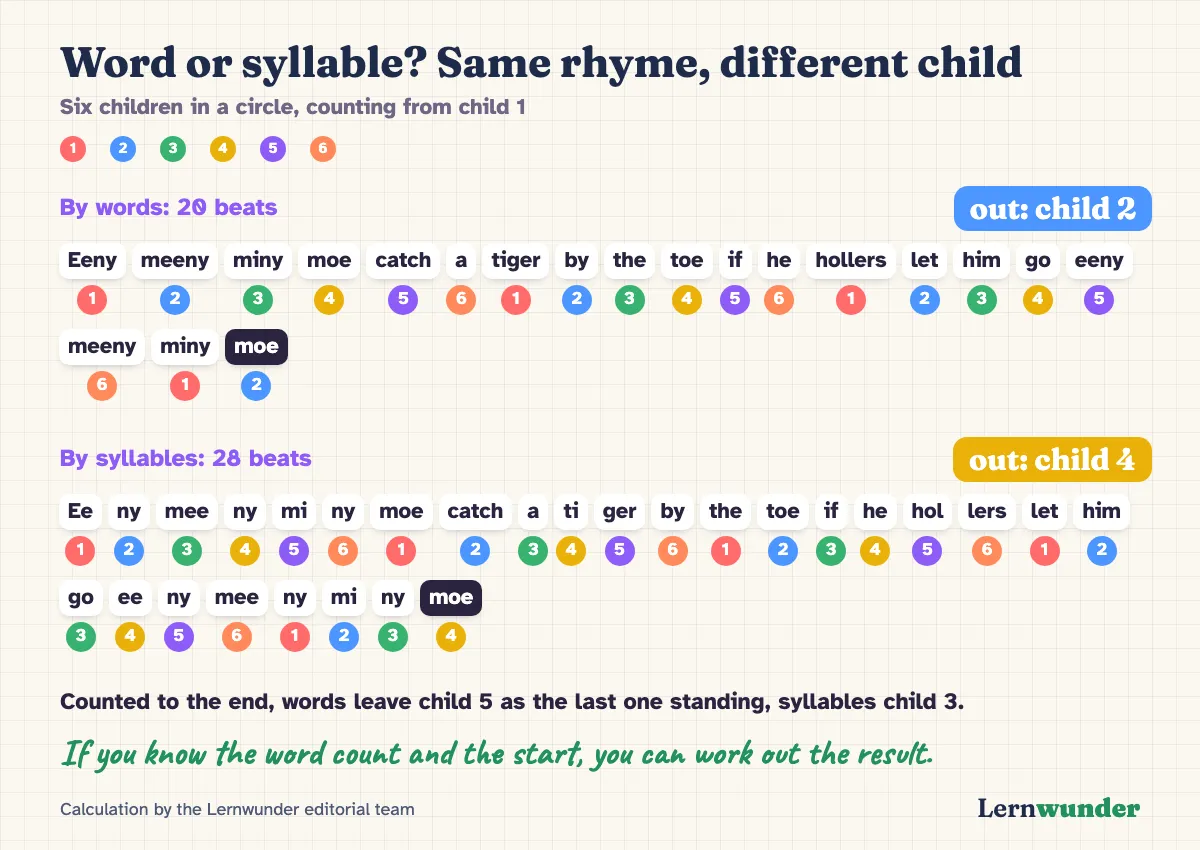
So the result depends on just three things: the number of beats, the number of children and the starting point. Anyone who knows the rhyme and does the sums can steer the outcome. This is not just theory. One of Bolton’s correspondents recalled that, as a skilful counter with a pairing rhyme, he always managed to end up with his favourite schoolmate (Bolton, 1888).
Counting out only becomes fair when the starting point is random. Then every child has the same chance. Rhymes with an extra twist, such as asking someone’s age and counting on, make mental arithmetic harder but don’t change the principle.
What you can do at home or in class
- Collect rhymes. Ask which counting-out rhymes children know from home, in any language. Put them on a poster.
- Clap the beat. Clap the syllables first, then only the strong beats. The four-by-four pattern becomes audible.
- Word or syllable? Count how many words and how many syllables a rhyme has. That’s sound work and counting in one.
- Predict. From about age eight: “There are six of us, the rhyme has 20 words. Who’s out?” That’s division with remainders in real life.
- Count out fairly. Roll a die for the starting point or let someone else choose where to begin.
- Invent new rhymes. Four lines, four beats, nonsense allowed. Rhyming practises exactly the sound skills from the study above.
How we solved it in Ene Mene Miste
Our tool Ene Mene Miste is named after the German version of “eeny, meeny”. Under “Who goes first?” the app counts like a playground: word by word the highlight jumps from name to name, whoever gets the last word is out, until one person is left. A synthetic voice reads the rhyme aloud.
The app comes with 20 rhymes, four each in German, English, French, Spanish and Chinese. The rhymes change with the app language, so they are not translations. Three rhymes stop to ask the age of the person hit and count on that many steps; the French “Pique nique douille” counts three more at the end.
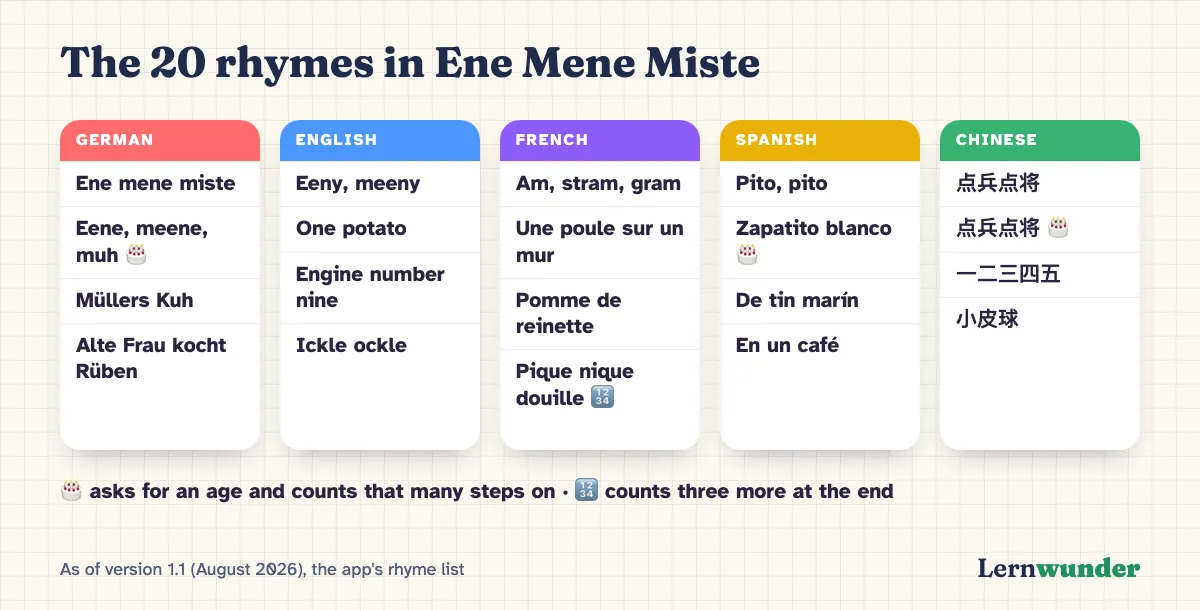
Worth knowing: the app counts like a child would, starting with the first name on the list. The result is just as predictable as on the playground, as described above. If you need true randomness, tap “Quick draw” and the app picks without a rhyme.
Frequently asked questions
Where does “eeny, meeny” come from? Nobody knows for sure. Bolton recorded many related forms in 1888, from English “eeny, meeny” to German “ene, mene”. His collection also records an older American version with a racist slur in the second line; the app uses the version with “tiger”.
From what age are rhymes worthwhile? In the study by Bryant and colleagues, rhyme knowledge was measured from just over three. Counting out itself works as soon as children can follow a finger around the circle.
So is counting out fair or not? Fair in procedure, but not random, as long as someone picks the start and does the sums. Draw the starting point by lot and it is fair.
Do you count words or syllables? Both are common. What matters is that everyone agrees beforehand, because it changes the result.
Sources
- Arleo, A. (2006). Do children’s rhymes reveal universal metrical patterns? In P. Hunt (Ed.), Children’s Literature: Critical Concepts in Literary and Cultural Studies (Vol. 4, pp. 39–56). Routledge. https://shs.hal.science/halshs-00637386
- Bolton, H. C. (1888). The Counting-Out Rhymes of Children: Their Antiquity, Origin, and Wide Distribution. A Study in Folk-Lore. London: Elliot Stock. https://archive.org/details/countingoutrhyme00bolt
- Bryant, P. E., Bradley, L., Maclean, M. & Crossland, J. (1989). Nursery rhymes, phonological skills and reading. Journal of Child Language, 16(2), 407–428. https://doi.org/10.1017/S0305000900010485
- Burling, R. (1966). The metrics of children’s verse: A cross-linguistic study. American Anthropologist, 68(6), 1418–1441. https://doi.org/10.1525/aa.1966.68.6.02a00040
- Kelly, M. H. & Rubin, D. C. (1988). Natural rhythmic patterns in English verse: Evidence from child counting-out rhymes. Journal of Memory and Language, 27(6), 718–740. https://doi.org/10.1016/0749-596X(88)90017-4
Lernwunder editorial team · Chaolan Lu