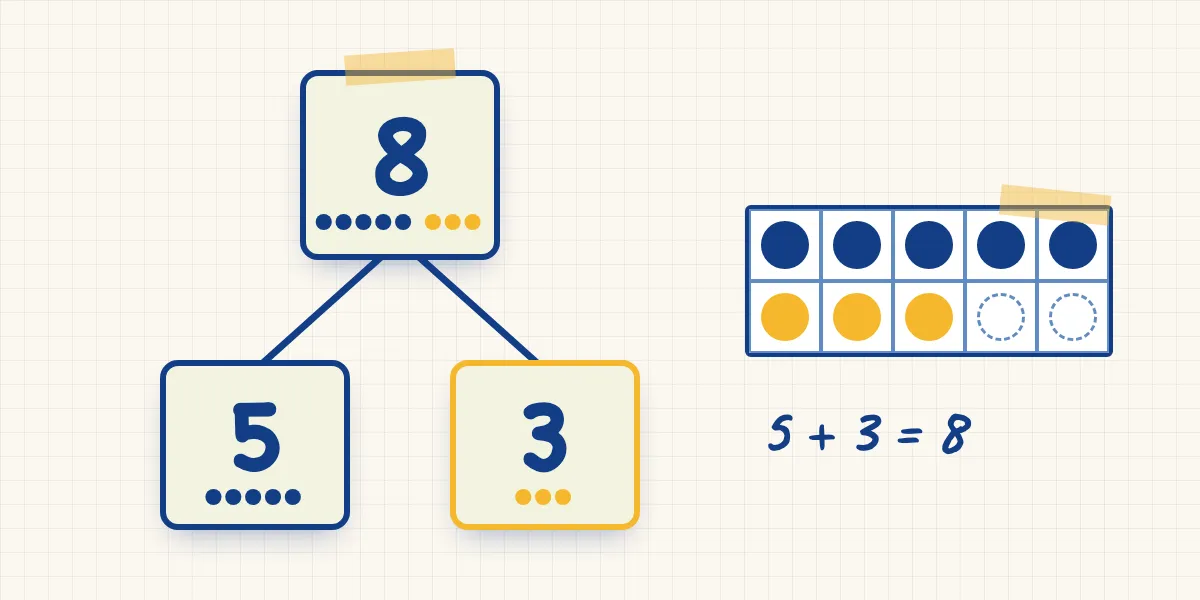
In short: Number bonds describe how a number, the whole, is made of two parts: 8 is 5 and 3, but also 6 and 2. This part-whole understanding is what allows children to stop counting in ones and, later, to add confidently across ten. Research shows that children who know and use number bonds calculate more accurately and more flexibly. Memorising facts on its own, however, is not enough.
Here is a scene many parents will recognise (made up for illustration): a child works out 8 + 5. She holds up a fist, whispers “nine, ten, eleven, twelve, thirteen” and flicks out one finger after another. The answer is right. Another child says almost at once: “Two more makes ten, then three more, so thirteen.” Both are in their first year of school. The difference between them has a name: number bonds, or number decomposition.
Our last post looked at maths anxiety in children. Today we look at the foundation that confident calculation rests on.
What are number bonds?
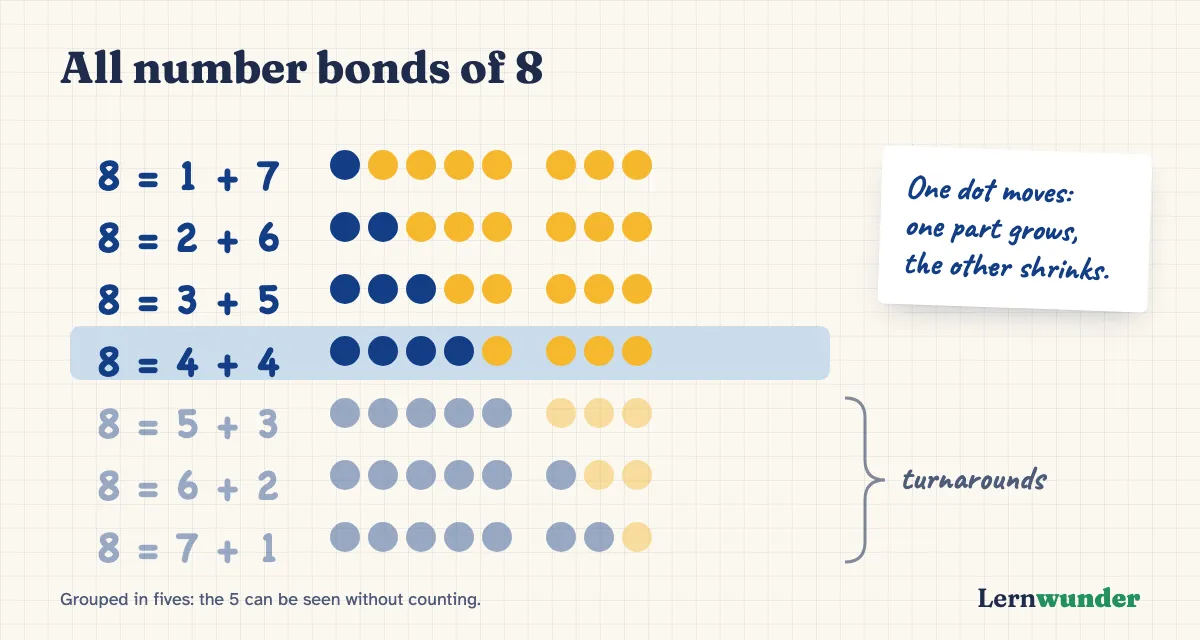
A number bond splits a number into two (or more) parts that together make the whole again. The number 8 can be split into 7 and 1, 6 and 2, 5 and 3, or 4 and 4. The underlying idea is called part-whole understanding: a number is not just a position in the counting sequence (“8 comes after 7”), it is a quantity made up of smaller quantities.
A position paper on mathematical learning difficulties by Gaidoschik and colleagues describes exactly this step as decisive: children need to see numbers not only as positions in a sequence but also as quantities that can be broken into smaller quantities (Gaidoschik et al., 2021).
Why do number bonds matter so much?
Because every bond turns into several facts at once. A child who knows that 8 is made of 5 and 3 also knows 5 + 3, 3 + 5, 8 − 3 and 8 − 5 without counting any of them. Ching and Nunes (2017) studied precisely this link between addition and subtraction. They followed 115 children in Hong Kong from first into second grade. Knowing such part-whole relations (if 5 + 3 = 8, then 8 − 3 = 5) explained the largest share of mathematical achievement of all the factors they measured, even after age, IQ, working memory and counting ability were taken into account.
Back in 2010, Jordan, Glutting and Ramineni showed that a short number sense screen at the start of first grade predicted maths achievement at the end of first and third grade, independently of language, spatial skills and memory.
What do number bonds have to do with bridging through ten?
A lot. Adding across ten is where counting children often stall. To work out 8 + 5 by counting on, a child has to keep track of five separate steps, and each step is a chance to slip. A child who knows number bonds needs two steps: split 5 into 2 and 3, make 8 up to 10 with the 2, then add 3.
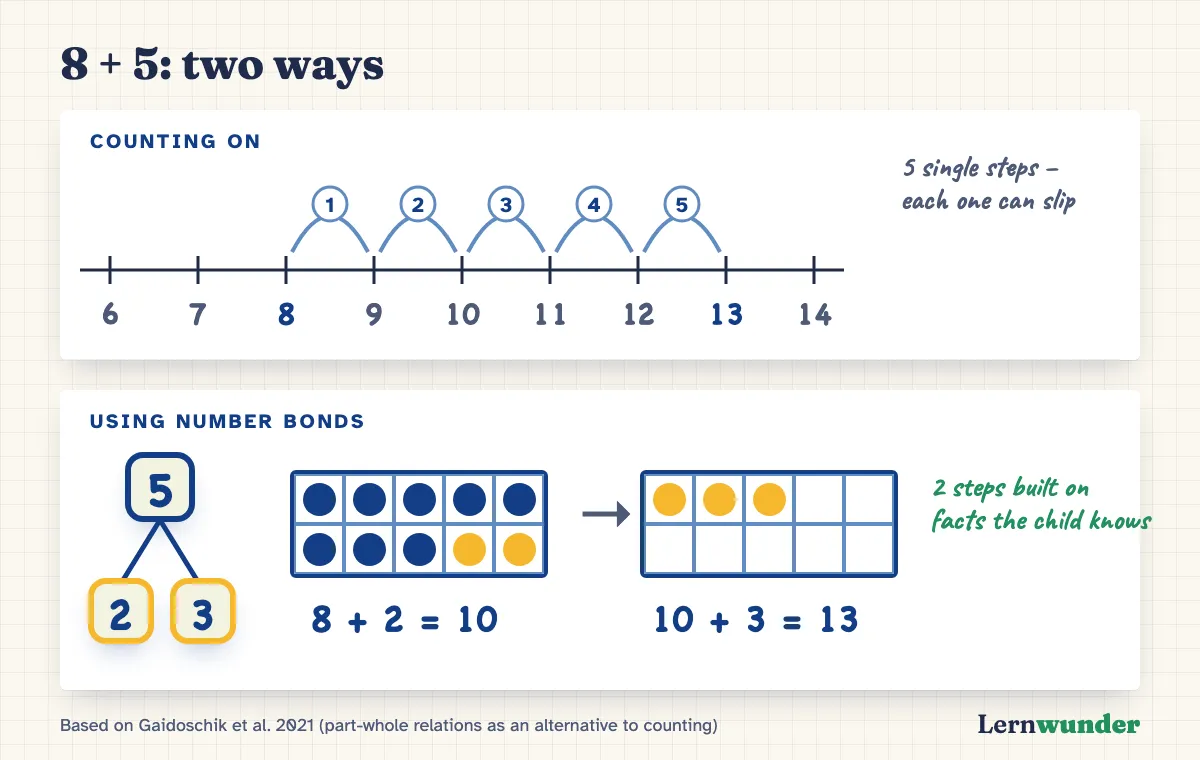
The position paper by Gaidoschik et al. (2021) spells this out: part-whole relations make non-counting calculation possible within 10 and for problems that cross ten. If the bonds up to 10 are not secure, children are often left with counting as their only tool. And persistent counting in turn makes it harder for facts to stick in memory.
The effect reaches into bigger numbers too. In a study with 152 first graders from the United States and Taiwan, children who were fluent with basic facts and often used decomposition solved two-digit additions more accurately (Vasilyeva, Laski & Shen, 2015).
Can number bonds be taught, or do they develop on their own?
They can be taught, and it is worth practising them deliberately. In an experimental study, Cheng (2012) taught five- and six-year-olds to solve addition problems by decomposing numbers. Afterwards the children relied less on counting. Whether they used efficient strategies depended on how systematically they knew the part-part-whole relations of the numbers 1 to 10.
Björklund, Marton and Kullberg (2021) analysed 2,184 observations of four- to seven-year-olds solving arithmetic tasks. Among the aspects children need to learn to tell apart in order to calculate well is the part-whole relation: distinguishing parts from the whole, decomposing numbers, recognising that order doesn’t matter, and seeing how addition and subtraction are linked.
One caveat matters: memorising number bonds is necessary but not sufficient (Gaidoschik et al., 2021). Children only move away from counting when they understand how numbers and facts are connected. Drilling a list of “8 = 5 + 3” without seeing the quantities behind it does little.
What you can do at home or in class
These activities need no screen and take only a few minutes:
- Bonds on your hands. Show 8 fingers: 5 on one hand, 3 on the other. Ask: “How else can you show 8?” (4 and 4, 6 and 2). A full hand of five helps children see amounts without counting.
- Shake box. Put 8 buttons in a box with a divider. Shake, open, look: “3 on this side – how many on the other?” Look first, predict later.
- Hide and seek. Put 7 pebbles on the table and hide a few under a cup. “I can see 4. How many are hiding?” The bond becomes a problem with a missing part.
- Write them in order. List all bonds of a number: 8 = 1 + 7, 2 + 6, 3 + 5 … and ask: “What do you notice?” Many children spot the pattern themselves.
- Friends of ten. Use an egg box with 10 cups: “7 are full – how many more to make 10?” Bonds to 10 matter most for bridging through ten.
- Ask about the method, not the speed. “How did you work that out?” helps more than a stopwatch.
If a child in second grade still counts out almost every fact up to 10, it is worth talking to the teacher. This article is no substitute for a professional assessment.
Why this matters to us
When we turned from nursing to maths, it was clear where we would begin: with number bonds. The topic is small enough to practise calmly and fundamental enough to carry everything that comes later. We are currently working on an app that starts right here. What it looks like, and why, is something we will share in the coming posts.
Frequently asked questions
At what age do children learn number bonds? Many children gain first experiences at nursery or kindergarten, for example when sharing things out. In school, number bonds to 10 are a core topic of the first year (Year 1 or first grade, depending on the country).
Does my child need to know all number bonds by heart? In the long run, bonds to 10 should be quick to recall. But the way there goes through understanding: seeing quantities, spotting patterns, using connections. Memorising without understanding helps little (Gaidoschik et al., 2021).
Is it a problem if my child still counts on their fingers? Counting is a normal and important stage. It becomes a problem when it remains the only strategy for a long time. Fingers can also support number bonds, for example when 8 is seen as “a whole hand and 3”.
Which number bonds matter most? The bonds to 10, because they carry bridging through ten, and bonds involving 5, because they make quantities up to 10 easy to see.
Sources
- Björklund, C., Marton, F. & Kullberg, A. (2021). What is to be learnt? Critical aspects of elementary arithmetic skills. Educational Studies in Mathematics, 107(2), 261–284. https://doi.org/10.1007/s10649-021-10045-0
- Cheng, Z.-J. (2012). Teaching young children decomposition strategies to solve addition problems: An experimental study. The Journal of Mathematical Behavior, 31(1), 29–47. https://doi.org/10.1016/j.jmathb.2011.09.002
- Ching, B. H.-H. & Nunes, T. (2017). The importance of additive reasoning in children’s mathematical achievement: A longitudinal study. Journal of Educational Psychology, 109(4), 477–508. https://doi.org/10.1037/edu0000154
- Gaidoschik, M., Moser Opitz, E., Nührenbörger, M. & Rathgeb-Schnierer, E. (2021). Besondere Schwierigkeiten beim Mathematiklernen [Particular difficulties in learning mathematics]. Mitteilungen der Gesellschaft für Didaktik der Mathematik, 47(111S). https://ojs.didaktik-der-mathematik.de/index.php/mgdm/article/download/1042/1156
- Jordan, N. C., Glutting, J. & Ramineni, C. (2010). The importance of number sense to mathematics achievement in first and third grades. Learning and Individual Differences, 20(2), 82–88. https://doi.org/10.1016/j.lindif.2009.07.004
- Vasilyeva, M., Laski, E. V. & Shen, C. (2015). Computational fluency and strategy choice predict individual and cross-national differences in complex arithmetic. Developmental Psychology, 51(10), 1489–1500. https://doi.org/10.1037/dev0000045
Lernwunder editorial team · Chaolan Lu