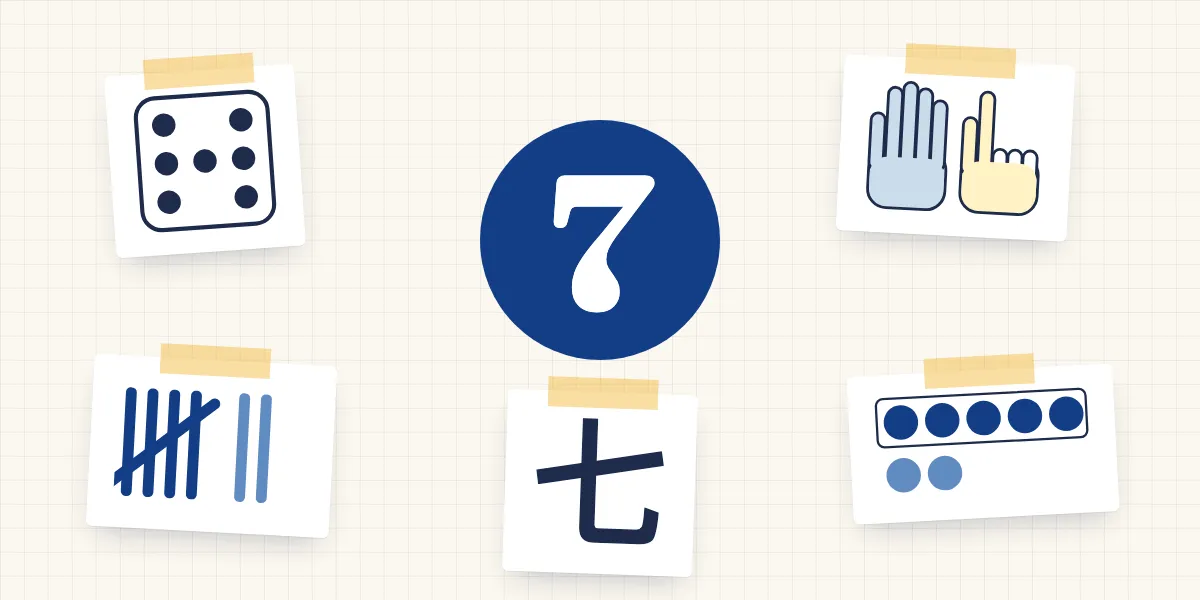
In short: Quantity pictures such as dice patterns, fingers, tally marks or rows of dots show a number as an amount. Each picture reveals a different structure. Children who move between several pictures and compare them come to know the number itself, not just one picture of it. This only works when the pictures are well structured and do not change too quickly.
A scene many parents will recognise (made up, but typical): during a board game your child shouts “Six!” the moment the die lands. At dinner you hold up six fingers, and they start counting: “One, two, three …”. So do they understand six or not?
The honest answer: they know one picture of six very well. The number itself, the amount behind every picture, has not quite landed yet. That is what this post is about.
What are quantity pictures, and why isn’t one enough?
A quantity picture is any representation that shows how many: dots on a die, fingers, tally marks, counters in a ten frame. The digit “6”, by contrast, is a symbol. It does not look like six.
Children learn numbers by linking symbols to amounts. With only one quantity picture, there is a risk that the child memorises the picture rather than the number. The six on a die becomes a familiar pattern that seems to have nothing to do with six fingers.
That is why the German national education standards for primary maths explicitly ask children to show numbers “in different ways” and to relate these representations to each other (KMK, 2022).
What does research say about multiple representations?
Learning from multiple representations has been studied for a long time. Shaaron Ainsworth proposed a widely cited framework. Her conclusion: multiple representations can bring unique benefits when people are learning complex new ideas, but many studies show that these benefits do not appear automatically (Ainsworth, 2006).
An earlier experiment with primary school children shows why. The children were learning to estimate the results of calculations, and the hardest part was translating between very different representations. Children given two pictures, or two mathematical representations, got better at judging their estimates. Children given a mix of pictures and symbols did not improve at first, only after extra time (Ainsworth, Bibby & Wood, 2002).
In her review, Martina Rau calls this the “representation dilemma”: children are expected to learn content from representations they do not yet understand themselves. Multiple representations therefore help only under certain conditions, above all when children also learn how a picture shows a quantity (Rau, 2017).
At home, that means: variety, yes, but with conversation. The learning happens when children compare, not when they simply look.
Why are structured pictures better than random piles?
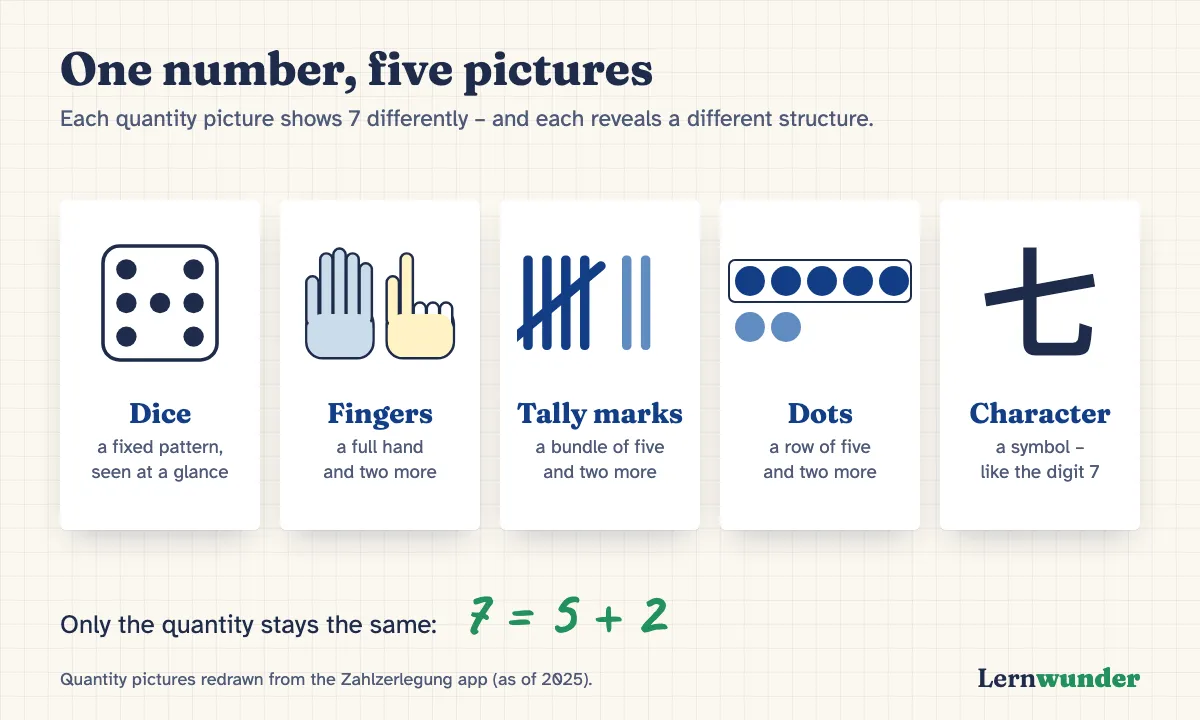
Seven dots scattered at random have to be counted. Seven dots arranged as a row of five with two underneath can be seen at a glance. Starkey and McCandliss (2014) called this way of seeing amounts through sub-groups “groupitizing”, a step beyond subitizing. In their study of 378 children from kindergarten to third grade, kindergarteners did not yet benefit from grouped dot patterns. From first grade on, children enumerated grouped sets faster than unstructured ones, and this advantage grew with every grade. It was also linked to arithmetic fluency.
That is why good quantity pictures are structured: tally marks are bundled in fives, a ten frame fills a row of five first, and fingers naturally make a full hand. You can read more about why five is so useful in our post on the power of five.
And what about fingers?
Fingers are the quantity picture children always carry with them. A study of four- to seven-year-olds concluded that fingers are useful for counting but not strictly necessary for developing accurate number skills (Lafay et al., 2013). A large training study in France with 328 kindergarteners, however, found a striking effect: children who did not use their fingers and received finger counting training raised their accuracy on addition problems from 37 to 77 percent, while the control group went from 40 to 48 percent (Poletti et al., 2025).
So fingers are a valuable quantity picture, especially when children see a full hand as “five” instead of counting each finger. When finger counting turns into a brake is the topic of our post on counting-based calculation.
Concrete or abstract: which comes first?
A systematic review recommends a sequence called “concreteness fading”: start with concrete representations and then move explicitly and gradually to more abstract ones (Fyfe et al., 2014). Objects and fingers come first, structured dot and tally pictures in the middle, the digit at the end. What matters is that the child sees how the stages connect.
What you can do
- One number, three pictures. Show the same number as a dice pattern, on fingers and as buttons in a row. Ask: “What is the same in all of them?”
- Play translator. “Show me the five on the die with your fingers.” Or the other way round: you hold up seven fingers, your child draws them as tally marks.
- Say the structure out loud. Not “one, two, three …” but “a full hand and two more”. The picture turns into a number bond: 7 = 5 + 2.
- Secure first, then switch. Once one picture is secure, add the next. Don’t switch with every task, or translating becomes the main job.
- Lead to the symbol. Finally, put the digit next to the pictures: “All of these are 7.”
How we solved it in Zahlzerlegung
In our app Zahlzerlegung (available in German only) no number appears on its own. Every number card shows the digit and a quantity picture together, both in the number house and on the cards the child drags into it. Symbol and amount are linked in every task.
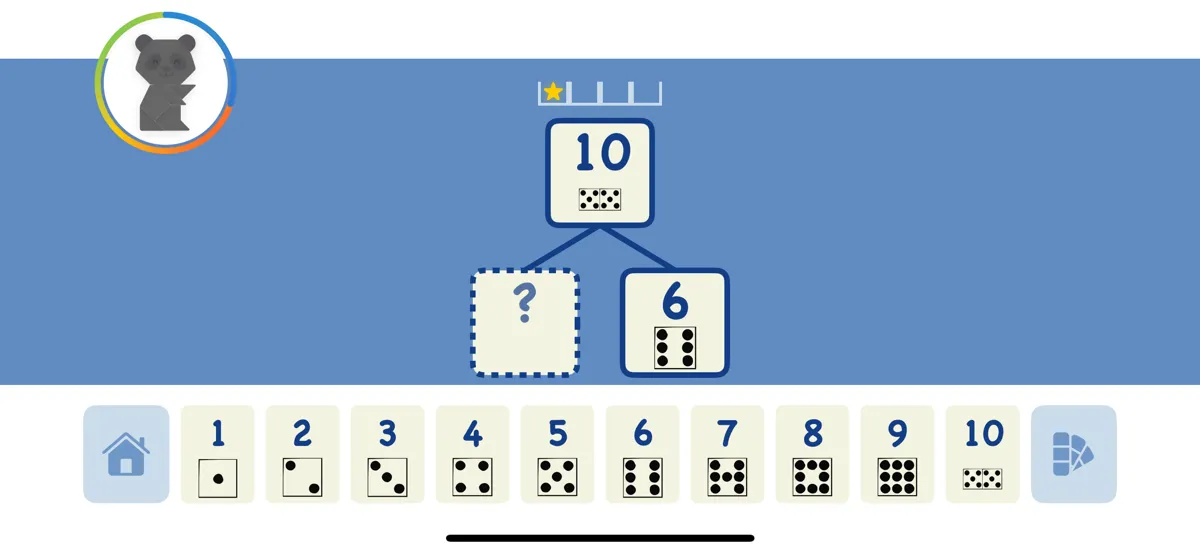
There are five quantity pictures: dice, fingers, tally marks, dots and Chinese numerals. The app starts with dice patterns. A button in the game lets you switch to another picture at any time.
Three decisions lie behind this:
- Structured pictures. Tally marks are grouped in bundles of five, dots fill a row of five before continuing below, fingers show a full hand and the rest on the second. Each picture already contains the number bond.
- A symbol for comparison. Chinese numerals are not a quantity picture but a different symbol system. In 一, 二, 三 you can still see the strokes; from 四 on you can’t. With older children, this is a nice way to talk about the fact that our digits are agreed-upon symbols, too.
- Switch when the child is ready. The app does not swap pictures on its own with every task. A child should be able to focus on the number bond, not on constant translating. Our suggestion: start with one picture and switch once the bonds are secure. That is when you find out whether your child knows the number or just the picture.
The app does not replace talking about the pictures. Your child learns most when you compare together: “Where can you see the five here?”
Frequently asked questions
Which quantity picture is best? There is no single best picture. Good ones have a clear structure, ideally in fives. Comparing several pictures brings the most benefit.
Won’t switching pictures confuse my child? It can, if you switch too early or too often. Translating between representations is demanding (Ainsworth, Bibby & Wood, 2002). So: one picture until it’s secure, then the next, and talk about it.
Should my child stop using their fingers? No. Fingers are a useful quantity picture (Poletti et al., 2025). The goal is to see the hand as a whole: “five and two” instead of counting to seven.
From what age do structured pictures help? In Starkey and McCandliss’s (2014) study the advantage appeared from first grade and grew afterwards. Offering structured amounts earlier does no harm, though.
Sources
- Ainsworth, S. (2006). DeFT: A conceptual framework for considering learning with multiple representations. Learning and Instruction, 16(3), 183–198. https://doi.org/10.1016/j.learninstruc.2006.03.001
- Ainsworth, S., Bibby, P. & Wood, D. (2002). Examining the effects of different multiple representational systems in learning primary mathematics. Journal of the Learning Sciences, 11(1), 25–61. https://doi.org/10.1207/S15327809JLS1101_2
- Fyfe, E. R., McNeil, N. M., Son, J. Y. & Goldstone, R. L. (2014). Concreteness fading in mathematics and science instruction: A systematic review. Educational Psychology Review, 26(1), 9–25. https://doi.org/10.1007/s10648-014-9249-3
- Kultusministerkonferenz (2022). Bildungsstandards für das Fach Mathematik Primarbereich [National education standards for primary mathematics] (resolution of 15 Oct 2004, as amended 23 Jun 2022). https://www.kmk.org/fileadmin/Dateien/veroeffentlichungen_beschluesse/2022/2022_06_23-Bista-Primarbereich-Mathe.pdf
- Lafay, A., Thevenot, C., Castel, C. & Fayol, M. (2013). The role of fingers in number processing in young children. Frontiers in Psychology, 4, 488. https://doi.org/10.3389/fpsyg.2013.00488
- Poletti, C., Krenger, M., Létang, M., Hennequin, B. & Thevenot, C. (2025). Finger counting training enhances addition performance in kindergarteners. Child Development, 96(1), 251–268. https://doi.org/10.1111/cdev.14146
- Rau, M. A. (2017). Conditions for the effectiveness of multiple visual representations in enhancing STEM learning. Educational Psychology Review, 29(4), 717–761. https://doi.org/10.1007/s10648-016-9365-3
- Starkey, G. S. & McCandliss, B. D. (2014). The emergence of “groupitizing” in children’s numerical cognition. Journal of Experimental Child Psychology, 126, 120–137. https://doi.org/10.1016/j.jecp.2014.03.006
Lernwunder editorial team · Chaolan Lu