In short: Deriving a fact means working out an unknown sum from one you already know: 7 + 8 from 7 + 7, or 8 + 5 by making ten first. Studies show that children who learn reasoned strategies can also solve facts they have never practised, and do so better than with drill alone. That is what “Aufgabenfamilien: Mathe lernen” is about, an app that is currently taking shape. Its game world is called Lichterwald. The app is available in German only.
A scene at the kitchen table (made up, but typical): “Seven plus eight?” The child holds up their hands and starts counting on from seven. They arrive at fifteen, slightly out of breath. Two minutes later, for seven plus seven, the answer comes at once: “Fourteen, I know that one.” The bridge between the two facts is short. The child just hasn’t seen it yet.
What does deriving a fact mean?
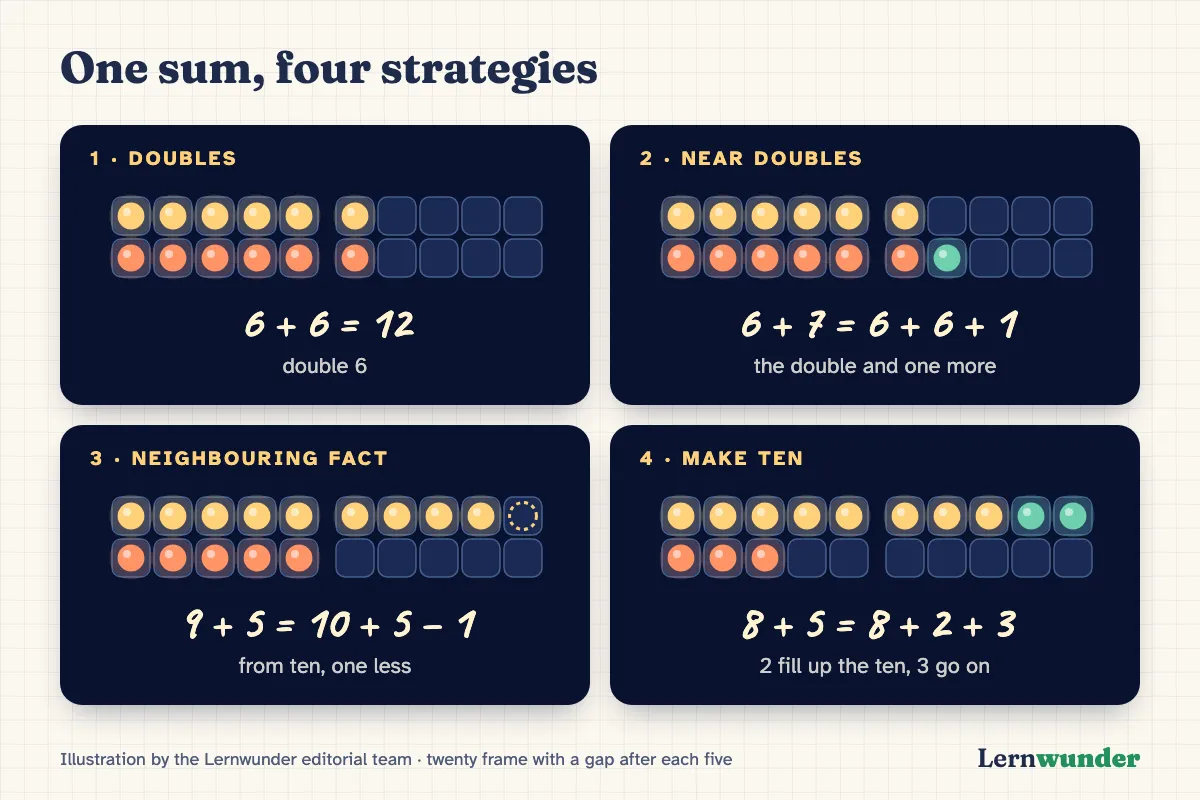
Deriving means using a fact you already know well to solve a new one. In our article on number bonds to ten we showed that derived facts are later recalled from memory more often than counted ones. This article is about the strategies themselves, mainly for sums up to 20:
| Strategy | Example | How you think it |
|---|---|---|
| Doubles | 6 + 6 | “Double six, twelve.” |
| Near doubles | 6 + 7 | “6 + 6 is 12, one more: 13.” |
| Use a neighbouring fact | 9 + 5 | “10 + 5 is 15, one less: 14.” |
| Make ten | 8 + 5 | “8 + 2 is 10, then 3 more: 13.” |
| Think addition | 13 − 8 | “From 8 to 13 is 5.” |
We covered the last one in our article on inverse relations.
What does research say?
Understanding and strategies go together. Canobi, Reeve and Pattison (1998) studied six- to eight-year-olds. Children who understood that numbers can be split up and that addends can be swapped or regrouped used decomposition and retrieval strategies more often, and solved unfamiliar problems faster and more accurately.
Reasoned strategies transfer. In a study with 85 children from kindergarten to third grade, one group spent twelve weeks practising the “use ten” strategy with reasons (“10 + 5 is 15, 9 is one less than 10, so 9 + 5 is one less than 15”). Another group practised the same facts as drill. Afterwards, the strategy group was more fluent with +8 and +9 facts they had never practised. The drill group did less well here (Baroody et al., 2016).
For doubles, guidance matters. 78 first graders practised doubles or “plus one”, either with highly guided discovery of the relationships or through practice alone. Guided discovery helped children transfer what they had learnt to related, unpractised facts. For doubles, it beat practice alone (Purpura et al., 2016).
Children need time, and take different routes. In Japan, where making ten is a valued method in the classroom, first graders gradually used it more and more over the school year. Counting and seeing groups helped them along, and each child got there by a different path (Murata, 2004). In another study, 83 first graders had learnt two strategies for sums like 8 + 7: making ten and using doubles. Higher achievers applied them faster and more accurately, but did not choose between them more cleverly than lower achievers (Torbeyns, Verschaffel & Ghesquière, 2005).
For parents, we take this to mean: it is worth talking about strategies rather than just checking answers. And it is normal for a child to stick with a favourite strategy for a long time.
What you can do
- Secure the doubles. With fingers, a mirror or two matching dice: 3 + 3, 4 + 4, 5 + 5. They are anchors for many other facts.
- Discover “one more”. Ask 6 + 6, then straight after 6 + 7. Ask: “What’s different?”
- Patterns instead of single sums. 6 + 1, 6 + 2, 6 + 3, 6 + 4: “What happens to the answer?” Sequences like this make neighbouring facts visible.
- Two egg boxes for making ten. Eight eggs in the first box, five more arrive: two fill the box, three go into the second. “Make ten first” becomes something you can hold.
- Ask about the strategy. “How did you work that out?” Praise the strategy, not the child: “You used the double.”
- Don’t ban counting. Counting is a start. Show a shorter route alongside it and let your child choose.
- A few facts, often. Five minutes every day beats one long session a week.
Lichterwald takes shape
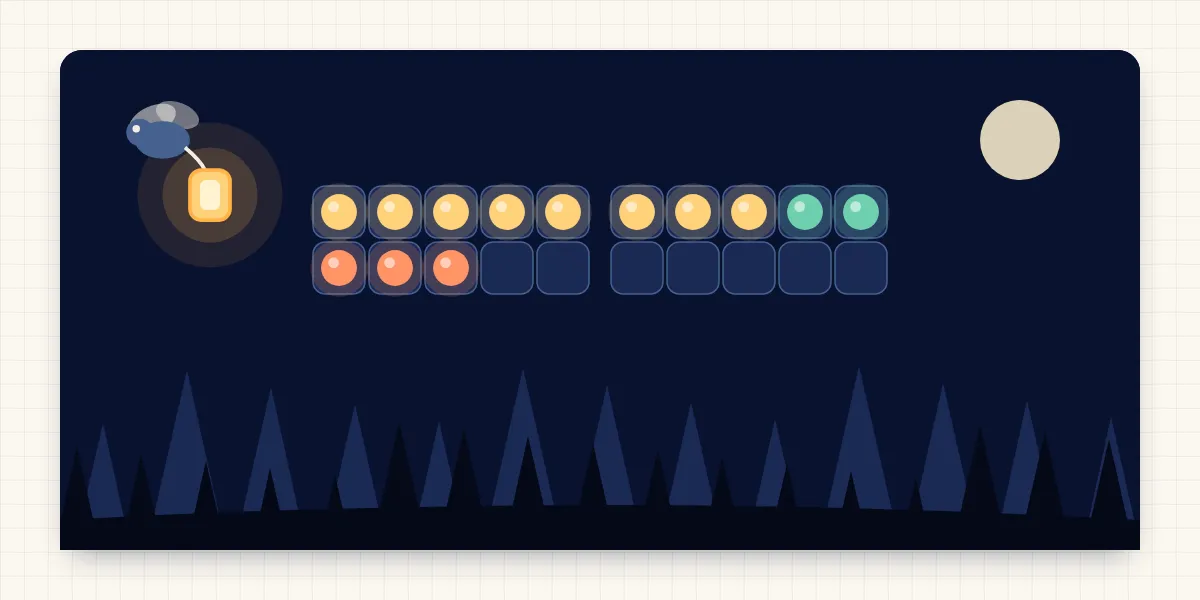
We are working on a new app: “Aufgabenfamilien: Mathe lernen” (German for “Fact families: learn maths”). It is currently taking shape and is not in any store yet. Its game world is called Lichterwald, the “forest of lights”. Lumi, a firefly, guides children through a forest at night where scattered families of lights need to find each other again. Lumi speaks all the instructions, so no reading is needed. To be clear: the app is available in German only.
What we have decided for derived facts:
- Lights land as a group. On the lantern shelf, two rows of ten with a gap after every five (a twenty frame), lights are never counted out one by one. Eight appears as five and three.
- Every strategy has a place. At the mirror lake, frogs double everything. Later, a double is sometimes followed by its “one more” fact, such as 7 + 7 and then 7 + 8. On the star bridge the first ten fills up before the lights move on: for 8 + 5, two fill the first ten and three cross over. Short sequences like 6 + 1, 6 + 2, 6 + 3 invite children to spot a pattern.
- Lumi names the strategy. After a solved problem Lumi says, for example, that the child went to ten first and then on. Sometimes Lumi also asks “How did you see it?”, and the child taps one of several spoken strategies. Counting is an allowed answer.
- No “wrong”, no clock. When something goes wrong, the lights “flicker” thoughtfully and the help gets clearer step by step. There is no visible time, no points, no streaks. A night lasts about seven minutes and ends with a sunrise.
Why? Because the research above shows that strategies work when they are reasoned and visible, not when facts are simply repeated often enough. More about the app on the page Aufgabenfamilien: Mathe lernen.
Frequently asked questions
Which strategy should my child learn first? Doubles and the number bonds to ten. “One more”, neighbouring facts and making ten all build on them.
Does my child need to master every strategy? No. What matters is deriving rather than counting. Many children have a favourite strategy, and that is fine (Torbeyns et al., 2005).
Isn’t deriving slower than memorising? At first, yes. But derived facts become known facts over time, and with reasons children can also handle new facts (Baroody et al., 2016).
Is the app available in English? No. “Aufgabenfamilien: Mathe lernen” is available in German only. The activities in this article work in any language. An app is also no substitute for a proper assessment if a child keeps relying on counting.
Sources
- Baroody, A. J., Purpura, D. J., Eiland, M. D., Reid, E. E. & Paliwal, V. (2016). Does fostering reasoning strategies for relatively difficult basic combinations promote transfer by K-3 students? Journal of Educational Psychology, 108(4), 576–591. https://doi.org/10.1037/edu0000067
- Canobi, K. H., Reeve, R. A. & Pattison, P. E. (1998). The role of conceptual understanding in children’s addition problem solving. Developmental Psychology, 34(5), 882–891. https://doi.org/10.1037/0012-1649.34.5.882
- Murata, A. (2004). Paths to learning ten-structured understandings of teen sums: Addition solution methods of Japanese grade 1 students. Cognition and Instruction, 22(2), 185–218. https://doi.org/10.1207/s1532690xci2202_2
- Purpura, D. J., Baroody, A. J., Eiland, M. D. & Reid, E. E. (2016). Fostering first graders’ reasoning strategies with basic sums: The value of guided instruction. The Elementary School Journal, 117(1), 72–100. https://doi.org/10.1086/687809
- Torbeyns, J., Verschaffel, L. & Ghesquière, P. (2005). Simple addition strategies in a first-grade class with multiple strategy instruction. Cognition and Instruction, 23(1), 1–21. https://doi.org/10.1207/s1532690xci2301_1
Lernwunder editorial team · Chaolan Lu