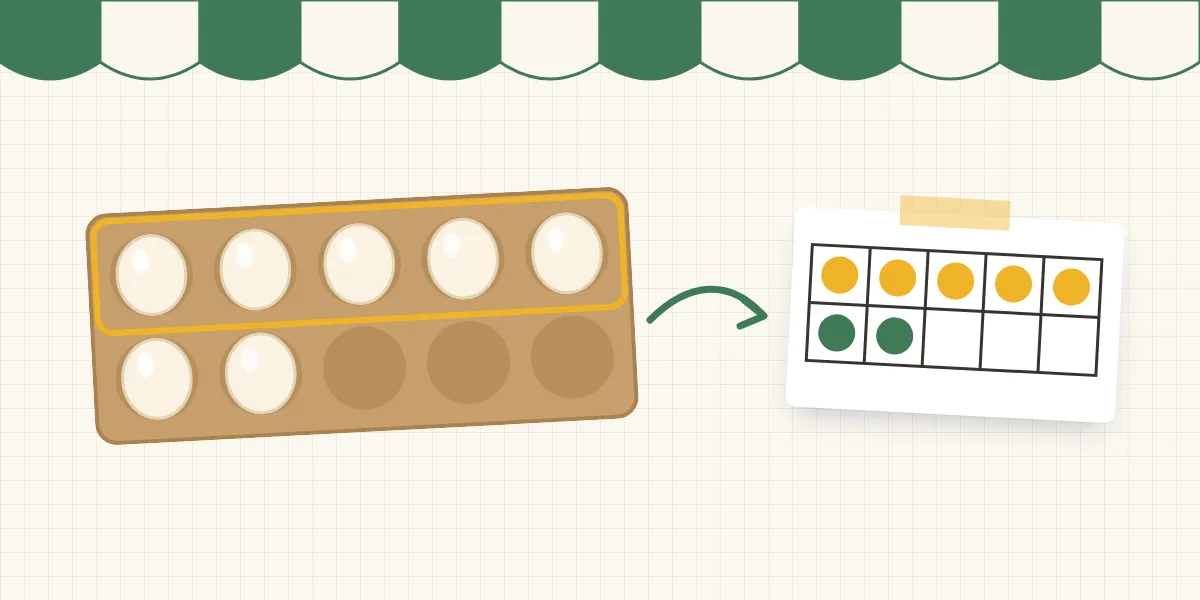
In short: A ten frame is a grid of two rows with five spaces each. A ten-egg box is built exactly the same way, which makes it one of the best maths tools you already have at home. Children who notice patterns and structure in amounts tend to understand maths better overall. But a manipulative only helps if the child actually sees the structure and talks about it.
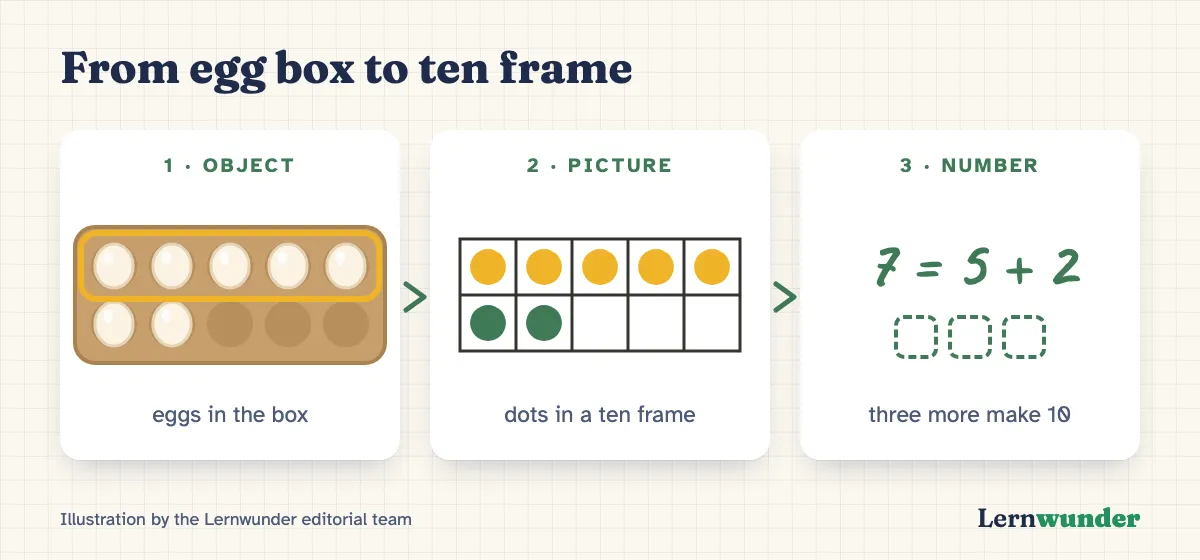
A scene from the farmers’ market (made up, but typical): a child carries the egg box to the car and peeks inside. “Three are missing,” she says, without counting. She has seen five eggs on top, two below and three empty cups. That single glance holds a surprising amount of maths: seven as five and two, and three as the amount still missing to make ten.
In How Many Things Can Children See at a Glance? we looked at how the eye for small amounts develops. This article is about the tool that carries that skill into school: the ten frame.
What is a ten frame?
A ten frame is a grid with two rows of five spaces. It is filled from left to right, top row first, then the bottom row. That gives every number up to ten a fixed picture: seven is a full row plus two, nine is “one missing”. Two ten frames stacked together make a twenty frame, which you will find on many Year 1 and first-grade desks.
The five is no accident. Five is one hand, and five things are still easy to take in as a whole. How grouping in fives helps children recognise amounts is explained in our article on the power of five.
Why an egg box?
A ten-egg box has exactly this shape: two rows, five cups per row. So it is a ten frame that children know long before they meet one at school. Three things make it especially useful:
- Empty spaces are visible. A cup without an egg is a gap you can see. The box shows not only how many there are, but also how many are missing to make ten.
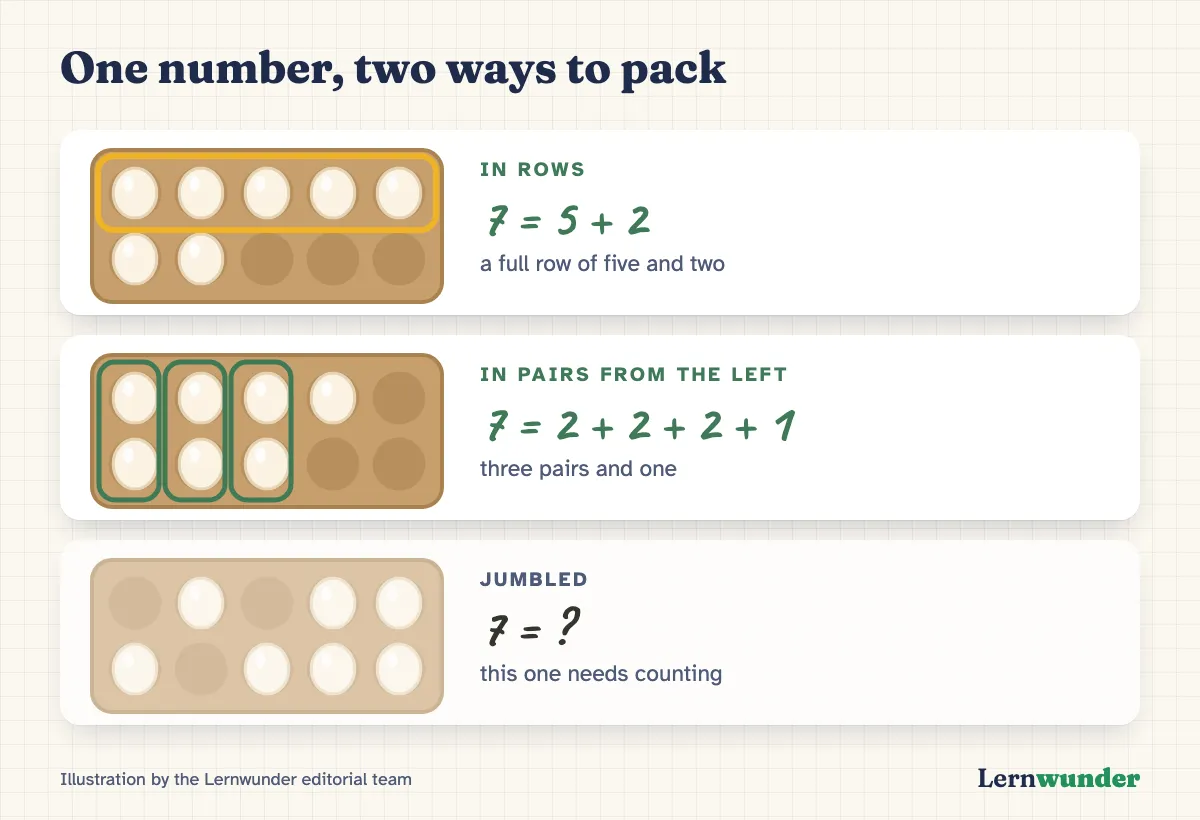
- It allows two ways of seeing. You can fill it row by row (five and two) or in pairs from the left (two, four, six, seven). Both are structures, and both beat a random scatter.
- It is part of everyday life. Talking about eggs while shopping is maths that does not look like school.
What does research say about pattern and structure?
Noticing structure in amounts is more than a nice extra. Mulligan and Mitchelmore (2009) describe a general trait they call “awareness of mathematical pattern and structure”. In a study of 103 first graders it could be measured reliably and was linked to children’s overall mathematical understanding.
How differently children start out is shown in a study of school starters by Lüken (2012). Overall, the children brought a lot of feeling for pattern and structure with them before any formal teaching. Yet the gap between high and low achievers was large.
The good news: an eye for structure can be fostered. An Australian longitudinal study with 319 kindergarten children tested a programme that included structured counting and grouping, grids and partitioning amounts. At the end of the year the children did better on a maths assessment than a comparison group, and the difference was still clearly measurable ten months later (Mulligan, Oslington & English, 2020).
For the twenty frame itself there is a direct finding: first graders recognise amounts in it faster than in scattered dots, and those who do this well also do better at arithmetic (Obersteiner et al., 2014). We describe that study in more detail in our article on subitizing.
Do manipulatives always help?
Not automatically. A meta-analysis of 55 studies with 7,237 learners found small to moderate benefits for teaching with concrete manipulatives compared with teaching using only numbers and symbols, and moderate to large benefits for retention. How strong the effect was, however, depended clearly on how the materials were used (Carbonneau, Marley & Selig, 2013).
One detail is especially interesting for parents. McNeil and colleagues (2009) gave primary school children real notes and coins while they solved money word problems. These children solved fewer problems correctly than children without the materials. In a second experiment, children with particularly realistic play money made the most errors. When materials look very real and appealing, they also distract.
For the egg box, we take this to mean: it helps when the structure is the focus. Identical beads, pasta shapes or buttons work better than a jumble of colourful toys. And the conversation (“How did you see it?”) is at least as important as the box itself.
What you can do
Our subitizing article describes the “egg box flash” and the “how many to ten?” game. Here are activities that go one step further:
- Play egg shop. One child is the customer, the other the shopkeeper: “Seven eggs, please.” The shopkeeper packs them so the customer can see at once whether it is right. Then swap roles.
- Two ways to pack. Pack the same number row by row (five and two) and in pairs from the left (two, two, two and one). Ask: “Where do you see the seven faster?” There is no wrong answer.
- From box to paper. Draw a ten frame together, two rows of five squares, and draw the eggs in as dots. That is the step from object to picture.
- Two boxes, twenty cups. One full box and one box with three eggs: “Ten and three, thirteen.” Ten becomes a unit.
- One more, one less. With seven eggs in the box, add one and ask, without recounting: “And now?” This prepares adding and subtracting.
- Name the empty cups. “Nine eggs, one cup empty. Nine and one make ten.” These are the number bonds to ten that our article on number bonds is all about.
- Stay relaxed when your child counts. Counting is not a mistake. Lay out the same amount again in order and let your child compare.
Why this matters to us
We are working on a new app in which exactly this egg box plays the lead role. The idea is a small, hand-drawn market. Children help out at the stalls: they take in eggs in a box or apples in a crate at a glance, and they pack goods themselves so that others can recognise them quickly. Seeing and arranging go together, just like in the activities above.
For now this is a plan, not a finished app. We will write about it again once it takes shape. Until then, an empty egg box from the recycling is all you need.
Frequently asked questions
What is the difference between a ten frame and a twenty frame? A ten frame has two rows of five spaces. A twenty frame is made of two ten frames and shows numbers up to 20 as “ten and some more”.
What age is the ten-egg box suitable for? The last year of preschool or kindergarten and the first year of school. Younger children are better off starting with a six-egg box and just a few objects.
Do I need to buy a ten frame? No. An egg box or a hand-drawn grid does the same job. What matters is always filling from the left, row by row, so that every number gets its fixed picture.
My child cannot recognise amounts in the box at a glance. Is that a warning sign? Not necessarily. Children differ a lot when they start school (Lüken, 2012), and an eye for structure can be practised. If a child is still counting everything one by one in Year 2 or second grade, it is worth talking to the teacher. Games and apps are no substitute for a proper assessment.
Sources
- Carbonneau, K. J., Marley, S. C. & Selig, J. P. (2013). A meta-analysis of the efficacy of teaching mathematics with concrete manipulatives. Journal of Educational Psychology, 105(2), 380–400. https://doi.org/10.1037/a0031084
- Lüken, M. M. (2012). School starters’ early structure sense. PNA, 7(1), 41–50. https://doi.org/10.30827/pna.v7i1.6133
- McNeil, N. M., Uttal, D. H., Jarvin, L. & Sternberg, R. J. (2009). Should you show me the money? Concrete objects both hurt and help performance on mathematics problems. Learning and Instruction, 19(2), 171–184. https://doi.org/10.1016/j.learninstruc.2008.03.005
- Mulligan, J. & Mitchelmore, M. (2009). Awareness of pattern and structure in early mathematical development. Mathematics Education Research Journal, 21(2), 33–49. https://doi.org/10.1007/BF03217544
- Mulligan, J., Oslington, G. & English, L. (2020). Supporting early mathematical development through a ‘pattern and structure’ intervention program. ZDM, 52(4), 663–676. https://doi.org/10.1007/s11858-020-01147-9
- Obersteiner, A., Reiss, K., Ufer, S., Luwel, K. & Verschaffel, L. (2014). Do first graders make efficient use of external number representations? The case of the twenty-frame. Cognition and Instruction, 32(4), 353–373. https://doi.org/10.1080/07370008.2014.948681
Lernwunder editorial team · Chaolan Lu