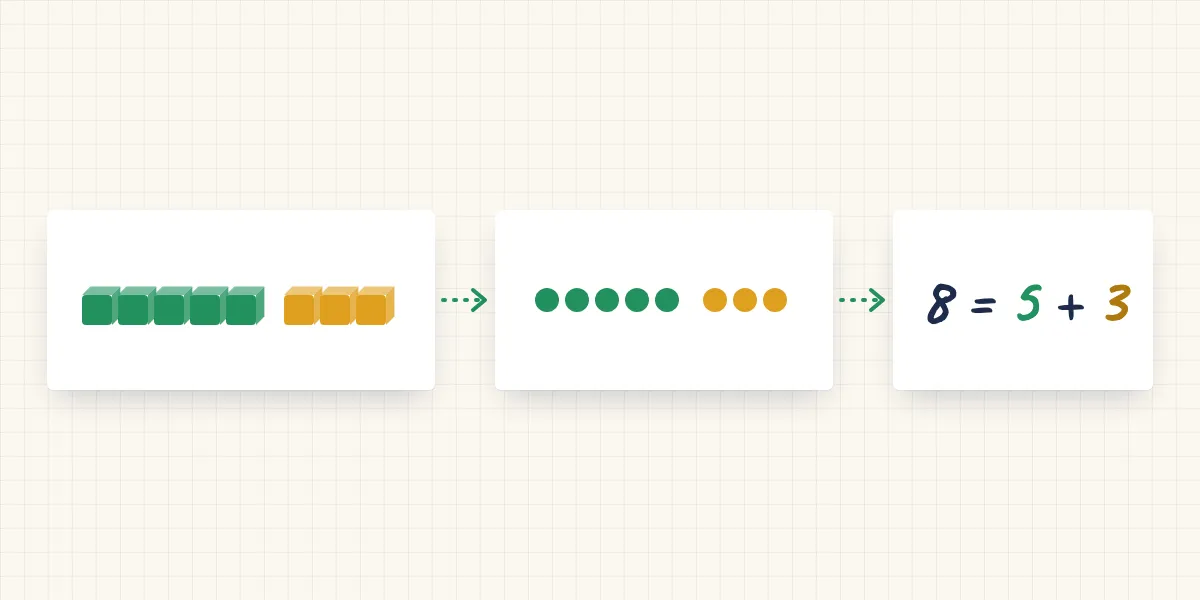
In short: Children can represent maths in three ways: through action (enactive), through pictures (iconic) and through symbols. In English-speaking classrooms this is often called the concrete–pictorial–abstract (CPA) approach. Children learn best when they move back and forth between these modes, not when they tick off one stage after another. Manipulatives demonstrably help, but not on their own: they work when they are simple and are linked, step by step, to pictures and numbers.
A made-up but typical scene: Lea has eight counters in front of her and pushes five of them to the left. “Five and three!” she calls out. On the worksheet next to her it says 8 = 5 + ☐. Lea stares at the box and does not know what to write. With her hands she has got it. With the symbols, not yet.
That gap between doing and symbols is exactly what this idea is about.
What are the enactive, iconic and symbolic modes?
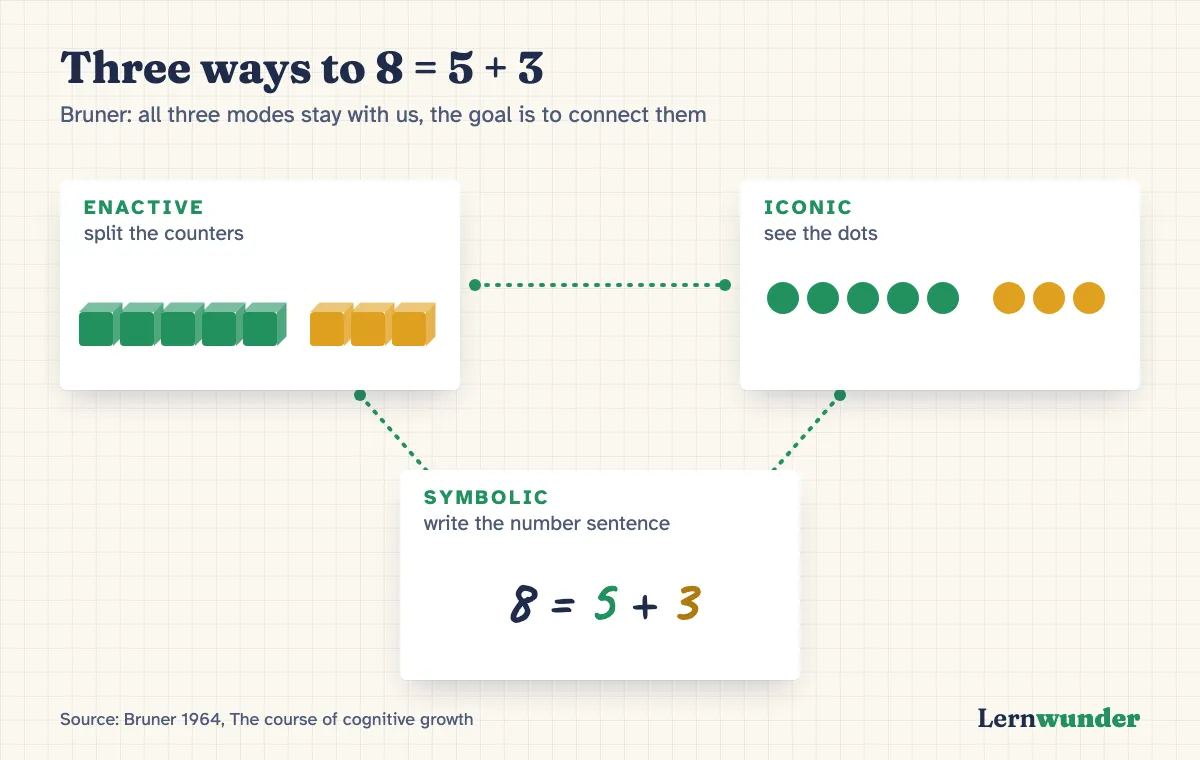
The psychologist Jerome Bruner distinguished three ways in which people represent experience (Bruner, 1964):
- Enactive, through action: we know something “in our muscles”, like riding a bike or tying a knot.
- Iconic, through images: we picture something or imagine its spatial layout.
- Symbolic, through signs: words and numerals that do not resemble what they stand for. The numeral 8 does not look like eight things.
Primary maths teaching has turned this into a principle: concepts should be built with concrete materials, pictures and numbers. One detail from Bruner’s text is often overlooked. The three modes do appear one after another in a child’s development, and each builds on the previous one. But all three remain intact throughout life (Bruner, 1964). So the goal is not to leave the concrete behind as fast as possible, but to connect the three levels.
Do manipulatives really help children learn maths?
On average, yes. A meta-analysis combined 55 studies with more than 7,000 learners from kindergarten to university. Teaching with manipulatives did better than teaching with abstract symbols only, with small to moderate effects. The advantage was clearest for retaining what was learned and smaller for problem solving and transfer to new problems. And how well manipulatives worked depended strongly on how they were used in teaching (Carbonneau, Marley & Selig, 2013).
Why are manipulatives not enough on their own?
Because a counter is two things at once: an object to play with and a symbol for “one”. Children have to learn to see it as a symbol. Researchers call this dual representation. The more interesting an object is in itself, the harder that becomes. On top of that, eye-catching materials can invite play instead of thinking. McNeil and Jarvin (2007) therefore recommend using highly familiar or perceptually interesting manipulatives sparingly.
In everyday terms: plain two-colour counters or linking cubes often work better than glittery figures. And the material has to be explicitly connected to the picture and the number. Children do not jump from the counters to the number sentence by themselves.
What is concreteness fading?
Concreteness fading describes exactly that transition. You start with concrete materials and then explicitly and gradually fade them in favour of more abstract representations (Fyfe, McNeil, Son & Goldstone, 2014). The authors name four advantages:
- Children can interpret unclear symbols through familiar objects.
- Physical experience grounds abstract thinking.
- Memorable images are created that children can fall back on when symbols lose their meaning.
- Children learn to strip away irrelevant features and see what is general.
For the number 8 this might look like: first eight real counters, then a dot picture with five and three dots, then just the numbers.

Does swiping on a tablet count as doing?
Partly. Virtual manipulatives, meaning counters, ten-sticks or fraction strips on a screen, are well researched. A review of 46 studies with 104 effect sizes found moderate effects overall compared with other forms of teaching. Among the helpful features, the authors list that digital representations can be linked simultaneously (for example counters and a number that change together), that they are precise and that they focus attention on what matters (Moyer-Packenham & Westenskow, 2016).
Our own view: a finger dragging an image across a screen is not the same as a hand that grabs, counts and restacks cubes. Virtual manipulatives are strongest at linking pictures and numbers. They do not replace real hands-on work.
What you can do
- Start with real things. Eight buttons, pieces of pasta or counters on the table. “Make two piles.”
- Keep it plain. Uniform materials distract less than favourite toys.
- Ask for a drawing. “Draw what you made.” Dots are enough, ideally in rows of five (why, see our article on the power of five).
- Add the number. First next to the picture, then on its own. That way the concrete fades step by step.
- Ask the other way round. “This says 8 = 6 + 2. Can you build it?” A child who can get from the symbol back to the material has understood it.
- Allow going back. When things get hard, reaching for counters is not a step backwards. It is Bruner’s principle in action.
How we approached it in Zahlzerlegung
In our app Zahlzerlegung (currently in German only), every number key carries two representations at once: the numeral and a quantity picture, shown as dice patterns, fingers, tally marks or dots. The child drags the right number into the gap of the number bond. Picture and symbol therefore always appear together, and the quantity picture can be switched. Why we offer several quantity pictures is explained in a separate article.
We are just as clear about what the app does not do: it cannot replace the enactive level, grabbing and moving real objects. And it does not fade the quantity picture automatically. We therefore see Zahlzerlegung as a bridge between pictures and numbers that works best next to real counters on the table. How splitting numbers works is explained in our article on number bonds.
Frequently asked questions
Does my child always have to start with manipulatives? For new content it is a good start. But more important than the order is that the levels are connected (Fyfe et al., 2014).
So is counting on fingers good? Fingers are manipulatives you always have with you. It only becomes a problem if a child is still only counting after a long time. More on this in our article on counting-based calculation.
Are learning apps worse than real manipulatives? Not across the board. Virtual manipulatives show moderate effects on average (Moyer-Packenham & Westenskow, 2016). But they do not replace real objects in the hand.
When does a child no longer need manipulatives? There is no fixed age. According to Bruner (1964), all three modes stay with us; adults, too, like to reach for sketches or objects when something is new.
Sources
- Bruner, J. S. (1964). The course of cognitive growth. American Psychologist, 19(1), 1–15. https://doi.org/10.1037/h0044160
- Carbonneau, K. J., Marley, S. C. & Selig, J. P. (2013). A meta-analysis of the efficacy of teaching mathematics with concrete manipulatives. Journal of Educational Psychology, 105(2), 380–400. https://doi.org/10.1037/a0031084
- Fyfe, E. R., McNeil, N. M., Son, J. Y. & Goldstone, R. L. (2014). Concreteness fading in mathematics and science instruction: A systematic review. Educational Psychology Review, 26(1), 9–25. https://doi.org/10.1007/s10648-014-9249-3
- McNeil, N. M. & Jarvin, L. (2007). When theories don’t add up: Disentangling the manipulatives debate. Theory Into Practice, 46(4), 309–316. https://doi.org/10.1080/00405840701593899
- Moyer-Packenham, P. S. & Westenskow, A. (2016). Revisiting the effects and affordances of virtual manipulatives for mathematics learning. In Utilizing Virtual and Personal Learning Environments for Optimal Learning (pp. 186–215). IGI Global. https://doi.org/10.4018/978-1-4666-8847-6.ch009
Lernwunder editorial team · Chaolan Lu