In short: Lernwunder began with a question from nursing: how do you help people who are highly capable but stumble over one missing foundation? The same question comes up in primary school maths. Early number skills predict later maths achievement better than almost anything else, and in Germany around one in five children at the end of Year 4 (fourth grade) does not reach the minimum standard in maths. That is why we are now building maths apps too: calm, pressure-free and grounded in proven primary maths teaching.
Our first articles were about nurses who move to Germany: their first weeks on the ward and the long road through recognition and specialist language. From today we are also writing about something that seems far removed from that: children learning to calculate. This article explains why, for us, it is not a break.
What does nursing have to do with maths?
Very little in content. A surprising amount in how people learn. While looking at the situation of internationally educated nurses, we noticed a pattern that we now see everywhere:
- People fail at a foundation, not at the job itself. An experienced intensive care nurse seems unsure because she does not know the abbreviations used at handover. A child seems “bad at maths” because they still count 8 + 4 one step at a time. In both cases we see the symptom and miss what is actually missing.
- Foundations need practice that does not shame. Anyone who feels exposed by every mistake practises less, whether after a long shift or in Year 2.
- Language and mental images carry everything else. On the ward it is specialist language; in maths it is a clear picture of what a number is and what it is made of. Without that base, every next step is harder.
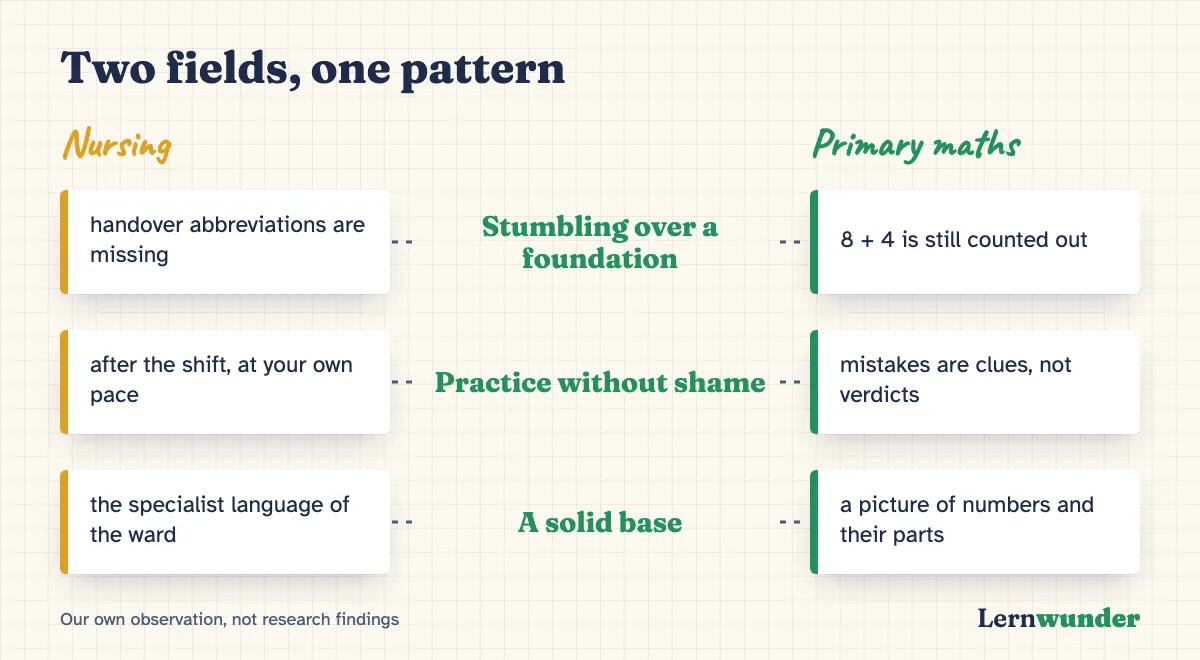
These three points are our own observation, not research findings. Why we focus on the first years of school, however, is well supported.
Why primary school maths?
Because foundations laid early have a very long reach. Three findings convinced us:
- Maths at school entry is the strongest predictor of later achievement. An analysis of six large longitudinal studies compared which skills at school entry predict later attainment. Early maths skills had the greatest predictive power, ahead of reading and attention (Duncan et al., 2007).
- The head start lasts into adolescence. Maths skills at four and a half predicted maths achievement at age 15, even after accounting for reading, general cognitive skills and family background. How much children gained before first grade was an even stronger predictor (Watts et al., 2014).
- Number sense in kindergarten sets the learning curve. Children with weak early number competence were not only behind through the end of third grade, they also learned more slowly. The lower results of children from low-income families were largely explained by weaker early number competence (Jordan et al., 2009).
A British cohort study even found links between maths and reading attainment at age 7 and socioeconomic status at age 42, beyond family background and intelligence (Ritchie & Bates, 2013). Studies like these show associations, not simple causes. But they show that the early years are worth the effort.
How are German primary schools doing in maths?
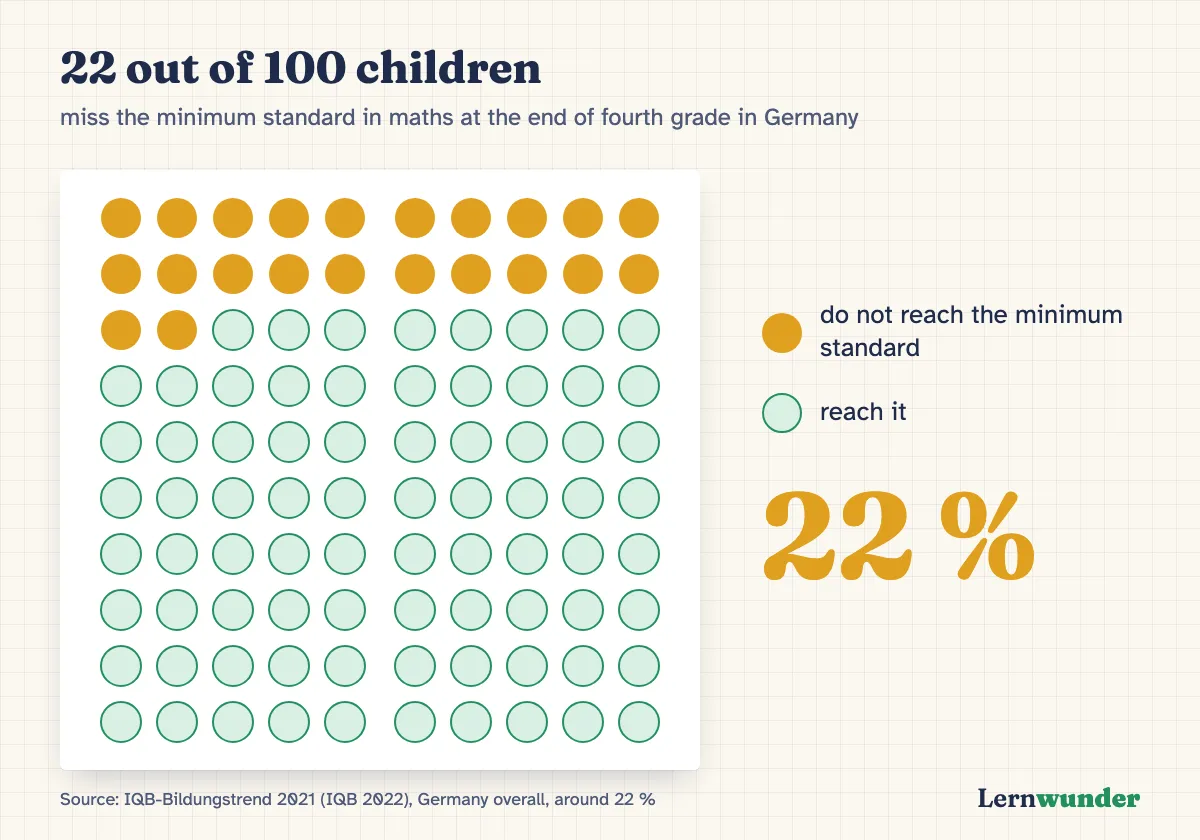
Not well. Germany’s national assessment (IQB-Bildungstrend 2021) tested almost 27,000 fourth graders. Around 22 percent did not even reach the minimum standard in maths, a level every child is expected to reach. In some federal states the share was considerably higher (IQB, 2022).
There are many reasons behind that number: lessons cancelled, the after- effects of the pandemic, language, family background. An app solves little of that. But part of it is learning work on the foundations, and that is where good practice can help.
Maths is actually beautiful. Why does it feel different to so many?
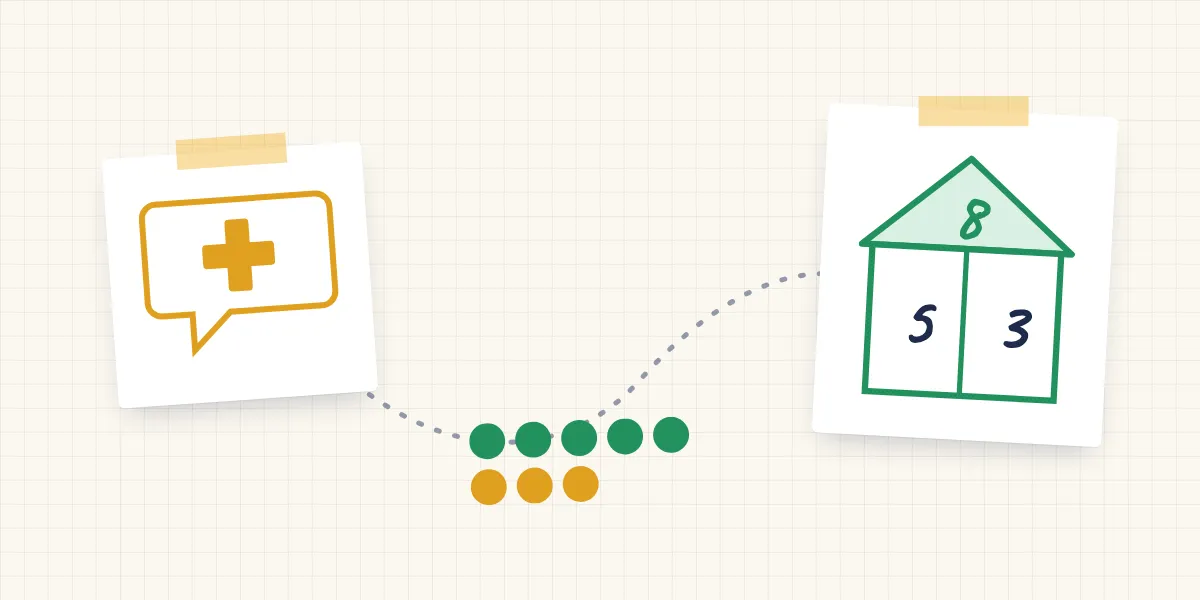
This is what concerns us most. Young children in many countries like maths; over the years, attitudes often get worse (Dowker et al., 2016). Yet the first numbers hold so much beauty: eight dots can be seen as five and three, as four and four, as two fours. Once a child discovers that, they no longer need to count.
Still, for many children maths soon becomes tied to pressure, time limits and the feeling of “I can’t do this”. That is the subject of our next article: maths anxiety in children, where it comes from and what helps.
What you can do
No app needed, just things you already have at home:
- See amounts instead of counting them. Put five gummy bears in a row and two underneath. Ask: “How many, without counting?”
- Find number bonds while laying the table. “There are six of us. Four plates are out. How many are missing?”
- Talk about mistakes with curiosity. “How did you work that out?” helps more than “Wrong.”
- Talk about maths positively. “I was never good at maths either” is meant kindly, but it can stick.
What we are working on
Our work on a language aid for internationally educated nurses continues; we will write more about it soon. Alongside it, our first primary maths app is in the making. It will focus on a single foundation that is central to learning to calculate. We will explain which one, and why, over the coming weeks. Our standard stays the same as in nursing: built on proven primary maths teaching, calm, ad-free and without pressure. An app replaces neither good teaching nor support from specialists; it can help with practice.
Frequently asked questions
Is Lernwunder leaving nursing behind? No. Language for everyday nursing remains a focus of its own. Maths is being added.
Why primary school maths in particular? Because early number skills strongly predict later maths achievement (Duncan et al., 2007; Watts et al., 2014), and gaps in these foundations are hard to close later (Jordan et al., 2009).
How many children struggle with maths? In Germany’s 2021 national assessment, around 22 percent of fourth graders missed the minimum standard in maths (IQB, 2022). That is not the same as dyscalculia; we will cover that in a separate article.
Sources
- Dowker, A., Sarkar, A. & Looi, C. Y. (2016). Mathematics Anxiety: What Have We Learned in 60 Years? Frontiers in Psychology, 7, 508. https://doi.org/10.3389/fpsyg.2016.00508
- Duncan, G. J., Dowsett, C. J., Claessens, A., Magnuson, K., Huston, A. C., Klebanov, P., … Japel, C. (2007). School readiness and later achievement. Developmental Psychology, 43(6), 1428–1446. https://doi.org/10.1037/0012-1649.43.6.1428
- Institut zur Qualitätsentwicklung im Bildungswesen (IQB) (2022). IQB-Bildungstrend 2021 (national assessment of fourth graders in German and maths). Results page and report (Waxmann). https://www.iqb.hu-berlin.de/bt/BT2021/Bericht/
- Jordan, N. C., Kaplan, D., Ramineni, C. & Locuniak, M. N. (2009). Early math matters: Kindergarten number competence and later mathematics outcomes. Developmental Psychology, 45(3), 850–867. https://doi.org/10.1037/a0014939
- Ritchie, S. J. & Bates, T. C. (2013). Enduring links from childhood mathematics and reading achievement to adult socioeconomic status. Psychological Science, 24(7), 1301–1308. https://doi.org/10.1177/0956797612466268
- Watts, T. W., Duncan, G. J., Siegler, R. S. & Davis-Kean, P. E. (2014). What’s past is prologue: Relations between early mathematics knowledge and high school achievement. Educational Researcher, 43(7), 352–360. https://doi.org/10.3102/0013189X14553660
Lernwunder editorial team · Chaolan Lu