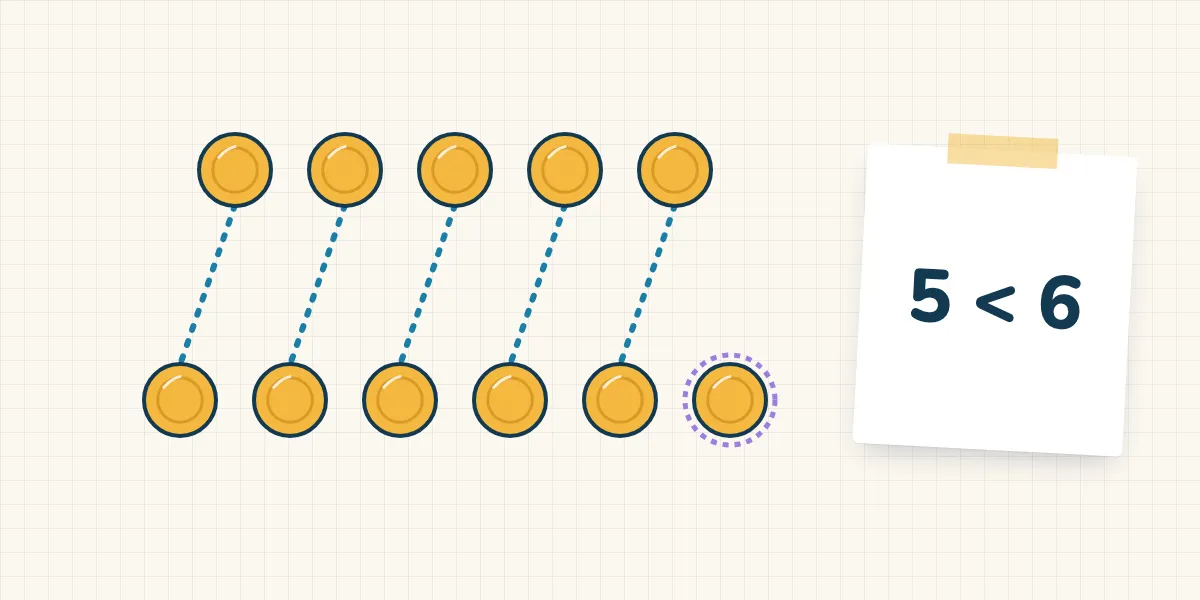
In short: Before children calculate, they need to judge where there is more, where there is less and when two amounts are the same. A meta-analysis covering 17,201 participants shows that people who are good at comparing amounts and numbers tend to do better in maths, with a slightly stronger link for comparing digits than for comparing dot sets. The basis of “the same number” is one-to-one correspondence, and it is easy to practise with everyday things.
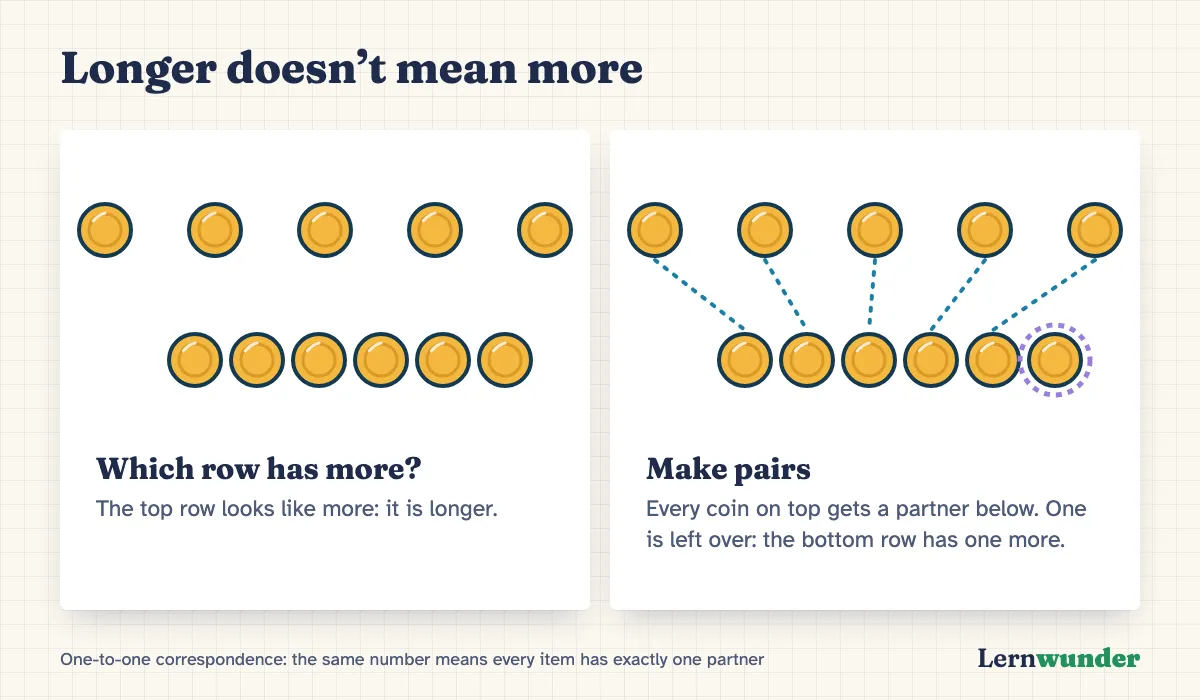
An invented but familiar scene: two siblings are sharing gummy bears. “You’ve got more!” “No, I haven’t!” The older one lays the bears out in two rows, always one opposite one. At the end she has one left over. Without counting, it is clear: she has one more. This little argument contains one of the most important foundations of mathematics.
What does “comparing amounts” actually mean?
Comparing amounts means judging whether one set contains more, fewer or the same number of things as another. Researchers distinguish two kinds:
- Non-symbolic: children compare sets directly, such as two piles of marbles or two dot pictures.
- Symbolic: children compare numbers, for example “Which is more, 7 or 4?”, as digits or number words.
Then there is one-to-one correspondence: you make pairs, so every item in one set gets exactly one partner from the other. If nothing is left over, there are the same number. If something is left over, that set has more. This works without knowing a single number.
How early can children compare amounts?
Earlier than you might think, but not completely. In a study of children aged 32 to 36 months who did not yet securely know number words beyond four, the children used one-to-one correspondence to reconstruct sets of five or six puppets exactly. But this only worked as long as the puppets stayed the same. When a puppet was added, removed or swapped for another, they lost track (Izard et al., 2014). The researchers describe a partial understanding of exact numbers before children have number words for them.
A second study shows how closely counting and equality are linked. For the numbers five and six, children understood either both or neither: that the last number counted tells you how many there are, and that two sets have the same number exactly when they can be matched up in pairs (Sarnecka & Wright, 2013). For parents this means: practising counting and making pairs are not separate exercises; they support each other.
Why is “less” harder than “more”?
Many children understand “more” long before “less”. A classic study of children aged three and a half to four found that only one child consistently understood “less” correctly. The others mostly treated “less” as if “more” had been said (Donaldson & Balfour, 1968). The study is old and small, only 15 children. But it explains something many parents notice, and it is a good reason to use the word “less” on purpose and often.
Why does comparing come before calculating?
Because calculating builds on knowing how big numbers are. A child who does not know that 7 is more than 4 will find it hard to judge whether 7 − 4 has a small or a large answer.
Research supports this with solid numbers. A meta-analysis pooled 45 articles with 284 effect sizes and 17,201 participants (Schneider et al., 2017). The results:
- The ability to compare amounts and numbers is reliably linked to maths performance across all age groups.
- The link is somewhat stronger for comparing digits (r = .30) than for comparing dot sets (r = .24).
- It is strongest for mental arithmetic and early maths skills, exactly where the size of numbers matters.
A longitudinal study followed 395 children from kindergarten to second grade (Desoete et al., 2012). How well the children compared dot sets in kindergarten predicted their arithmetic a year later. Children who later had maths learning difficulties already showed weaknesses in comparing amounts and digits in kindergarten.
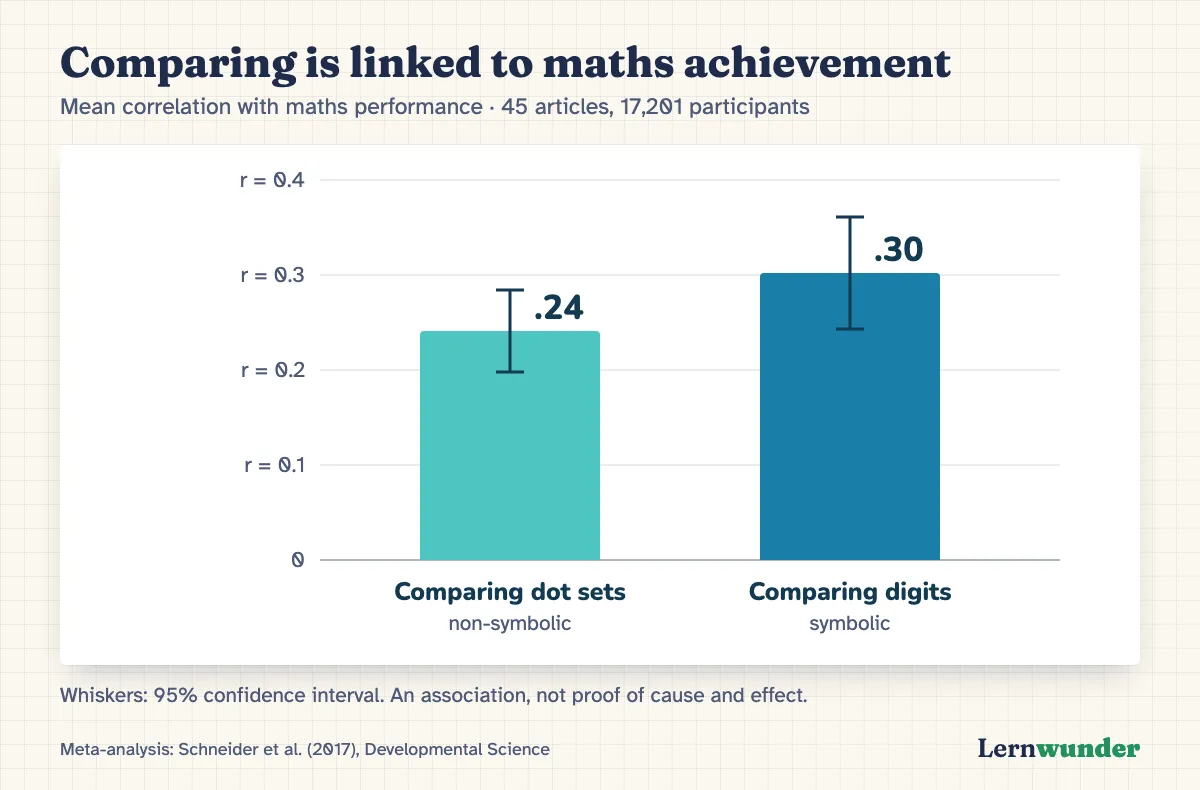
Context matters here: a correlation of .24 or .30 is a moderate link. Comparing is one foundation among several, not a test that decides a child’s future. And associations do not prove that comparison exercises alone will lead to better maths grades.
Can comparing be practised?
There are encouraging signs. In one study, preschoolers from low-income families played a simple board game with numbered squares in several short sessions, about an hour in total. Afterwards they compared numbers better, counted more reliably and recognised more numerals. The gains were still there nine weeks later. Children who played the same game with coloured squares instead of numbers did not improve (Ramani & Siegler, 2008).
What you can do
- Make pairs. Laying the table: is there a spoon for every plate? Sorting socks, pairing shoes, matching chairs to children. Then ask: “Is anything left over? Which is more?”
- Use the three phrases. “More”, “less” (or “fewer”), “the same”, in everyday life and on purpose. “Less” needs extra practice.
- Who has more? Each child rolls a die and puts down that many counters. Who has more, and how many more? This turns comparing into a first difference.
- Lay amounts out neatly. Amounts arranged in rows of five can be compared at a glance. How this works is explained in our post on the power of five.
- Number board games. Simple games with numbered squares from 1 to 10 or 1 to 100 combine counting, numerals and size.
- More or less card game. Turn over two number cards; the bigger number wins. If your child is unsure, lay the matching amount next to each card.
Why this matters to us
Comparing is part of everything we have worked on so far. To break a number into parts, a child needs to know that the parts are smaller than the whole. To move beyond counting-based calculation, a child needs a sense of how big numbers are. We are currently thinking about what a game could look like in which children compare amounts and see the difference. We cannot say more about it yet.
Frequently asked questions
When can children compare amounts? Some children use one-to-one correspondence before the age of three (Izard et al., 2014). A full understanding of “the same number” develops together with counting (Sarnecka & Wright, 2013).
My child counts both sets instead of comparing. Is that a problem? No, counting is a good strategy. Also show how to make pairs, so your child learns that both lead to the same answer.
Is it a warning sign if my child mixes up “less” and “more”? In preschoolers, usually not; it is common (Donaldson & Balfour, 1968). If comparing is still very hard in first grade, have a look at our post on recognising maths difficulties.
Sources
- Desoete, A., Ceulemans, A., De Weerdt, F. & Pieters, S. (2012). Can we predict mathematical learning disabilities from symbolic and non-symbolic comparison tasks in kindergarten? Findings from a longitudinal study. British Journal of Educational Psychology, 82(1), 64–81. https://doi.org/10.1348/2044-8279.002002
- Donaldson, M. & Balfour, G. (1968). Less is more: A study of language comprehension in children. British Journal of Psychology, 59(4), 461–471. https://doi.org/10.1111/j.2044-8295.1968.tb01163.x
- Izard, V., Streri, A. & Spelke, E. S. (2014). Toward exact number: Young children use one-to-one correspondence to measure set identity but not numerical equality. Cognitive Psychology, 72, 27–53. https://doi.org/10.1016/j.cogpsych.2014.01.004
- Ramani, G. B. & Siegler, R. S. (2008). Promoting broad and stable improvements in low-income children’s numerical knowledge through playing number board games. Child Development, 79(2), 375–394. https://doi.org/10.1111/j.1467-8624.2007.01131.x
- Sarnecka, B. W. & Wright, C. E. (2013). The idea of an exact number: Children’s understanding of cardinality and equinumerosity. Cognitive Science, 37(8), 1493–1506. https://doi.org/10.1111/cogs.12043
- Schneider, M., Beeres, K., Coban, L., Merz, S., Susan Schmidt, S., Stricker, J. & De Smedt, B. (2017). Associations of non-symbolic and symbolic numerical magnitude processing with mathematical competence: A meta-analysis. Developmental Science, 20(3), e12372. https://doi.org/10.1111/desc.12372
Lernwunder editorial team · Chaolan Lu