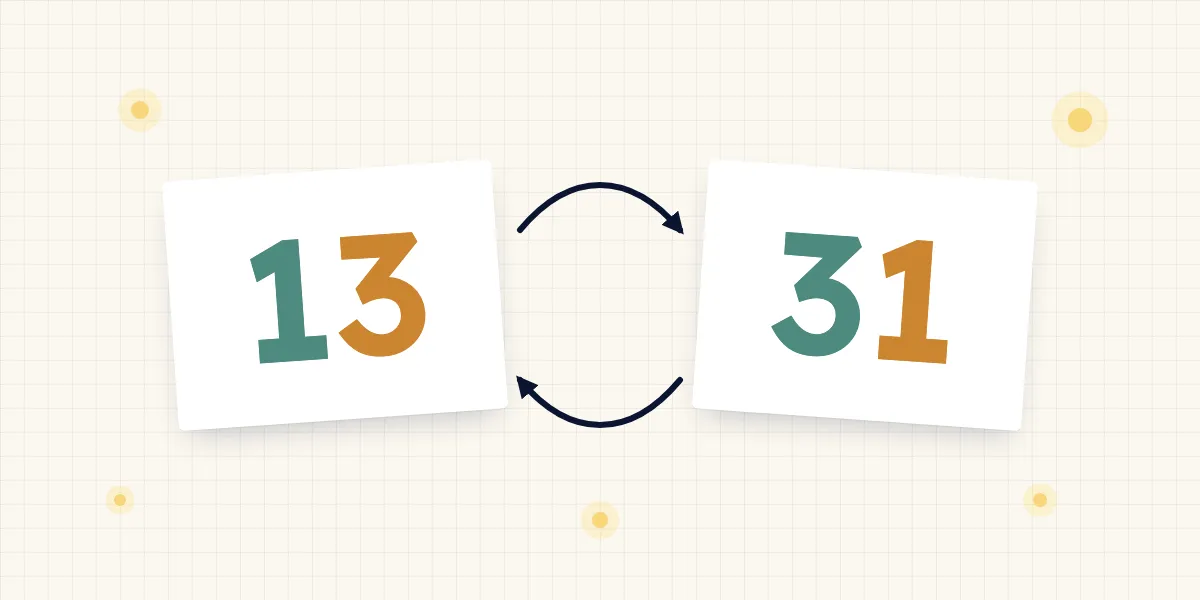
In short: A number reversal means swapping tens and ones, for example writing 52 instead of 25. Reversals are especially common in German, because German number words say the ones before the tens: 25 is “fünfundzwanzig”, literally “five-and-twenty”. This inversion is a peculiarity of German and a few other languages; in English it only affects the teens. German-speaking first graders made more errors than Japanese peers when writing numbers to dictation, and reversals were their most common error (Moeller et al., 2015). What helps is making tens and ones clearly audible and visible.
An invented but typical scene from a number dictation in a German Year 2 class: the teacher says “dreiundvierzig”, forty-three, but literally “three-and-forty”. One child immediately writes a 3, pauses and squeezes the 4 in on the left. Another writes 34. A third hears “three”, writes 3 and forgets the rest. All three listened carefully. The problem lies in the word itself.
What is a number reversal?
A number reversal (sometimes called a digit reversal or inversion error) happens when a child swaps tens and ones: they hear or read 25 and write or say 52. Reversals occur when writing numbers to dictation, when reading numbers aloud and during calculation, when an intermediate result gets flipped in the head. This is different from writing a single digit back to front, like a mirrored 3, which is a separate issue.
Why does this happen in German in particular?
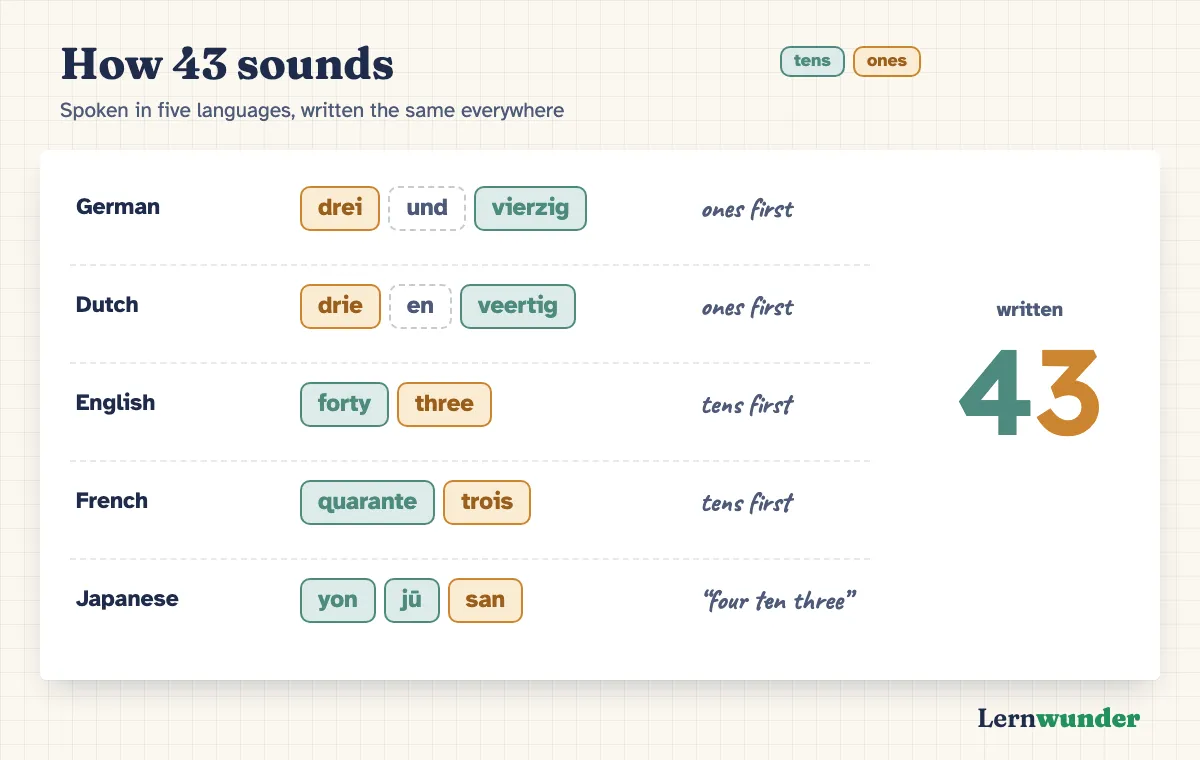
Because speaking and writing run in opposite directions. In “dreiundvierzig” the ones come first, on paper the tens. A child has to hold the whole word in mind, reorder it and only then write. Researchers call this property number word inversion.
Inversion is a peculiarity of German, shared by Dutch and Danish, among others. English, French and Italian say the tens first: “forty-three”, “quarante-trois”. Chinese and Japanese are especially transparent: 43 is literally “four ten three”. English does have one inverted stretch: the teens. “Thirteen” names the three first, just like German “dreizehn”.
What does the research say?
Reversals follow from language. Zuber and colleagues (2009) asked German-speaking seven-year-olds in Austria to translate numbers between digits and number words. Inversion was a major problem. About half of the errors were reversals (Zuber et al., 2009, as summarised by Moeller et al., 2015). Which errors a child made was also related to different components of working memory.
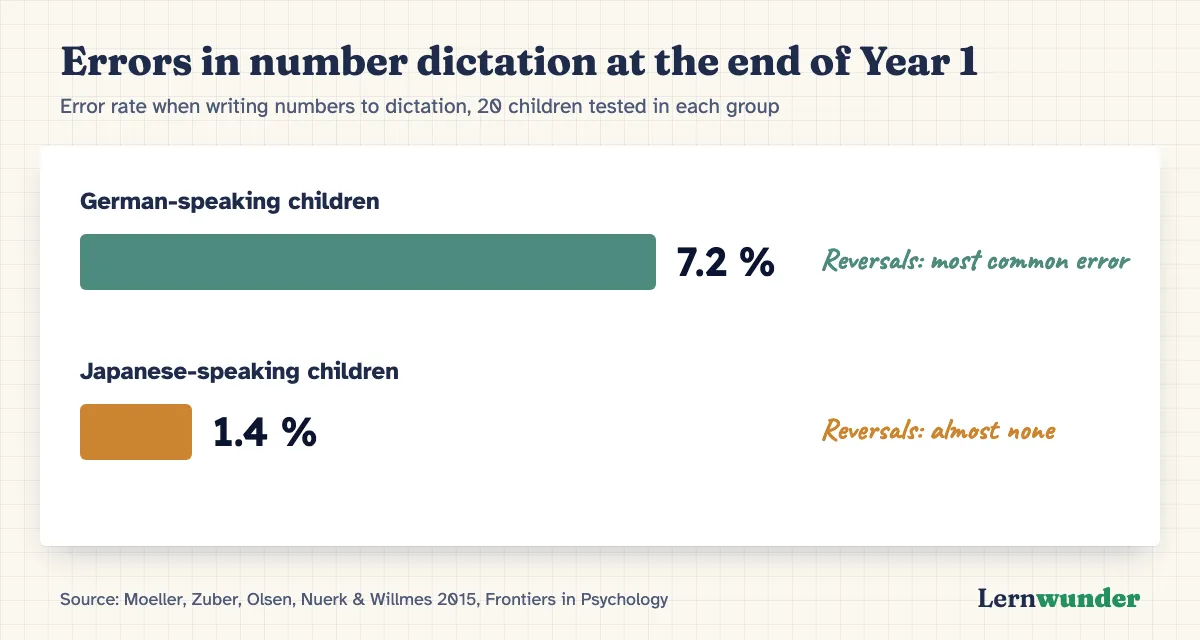
The comparison with Japanese is striking. Moeller and colleagues (2015) dictated numbers to 20 German-speaking and 20 Japanese-speaking children at the end of first grade. None of the German-speaking children had been noted for maths difficulties. Even so, they made more errors overall (7.2% vs 1.4%). Reversals were their most common error type; in the Japanese children they hardly occurred.
It is the language, not the child. In Belgium, children in Dutch- and French-speaking schools write the same digits but say them differently. Imbo and colleagues (2014) found that both groups made the same number of writing errors overall. But reversals were much more common in the Dutch-speaking children. Language was the only significant predictor of reversals, whereas working memory predicted other errors.
English has its own stumbling block. Clayton et al. (2020) compared 177 German-speaking and 309 English-speaking children in Year 1. The German-speaking children made more errors with two-digit numbers; the English-speaking children made more errors writing the teens, the one place where English is inverted too. In both languages, number writing predicted arithmetic skills.
Inversion reaches into calculation. Göbel and colleagues (2014) gave addition problems to German- and Italian-speaking children aged seven to nine. Problems with carrying were harder for everyone. But in the German-speaking children the difference in response times was larger. Language also shapes how children calculate with tens and ones.
Language shapes how children picture numbers. An earlier study with first graders from five countries found that children’s mental representation of number is influenced by features of their language (Miura et al., 1993).
What does this mean if my child learns maths in English?
English-speaking children have it easier from 20 upwards, because “forty-three” follows the written order. The teens are the exception: “fourteen” and “forty” also sound alike. Children who grow up with German, Dutch or Danish at home, or who switch between languages, may meet the full inversion problem. Knowing where it comes from helps you respond calmly.
Is a reversal a warning sign?
On its own, usually not. The studies show that reversals are common in German-speaking children who are learning perfectly normally. Look closer if a child not only reverses numbers but also cannot show what the digits mean, for example that the 4 in 43 stands for forty. Then it is worth checking place value understanding, as described in our article Tens and ones. If difficulties persist, talk to the teacher.
What you can do
- Say the tens first. When practising, add “four tens, three ones”. That way your child hears the order in which the number is written.
- Listen first, then write. In a dictation, wait for the whole number, repeat it aloud, then write it, tens first. This takes load off memory.
- Build it with objects. Let your child build the number with bundles of ten and single items before writing it. A child looking at four bundles is less likely to write a 3 first.
- Compare twin numbers. Put 34 and 43 side by side: what is the same, what is different? Which is bigger? It makes the difference tangible.
- Practise sound pairs. Fourteen or forty? Sixteen or sixty? Say a word, your child points to the matching card.
- Be patient. Reversals are not carelessness. A calm “read it back to me” helps more than a red pen.
What we are working on
Our new app “Place Value: Learn Math” (German: “Stellenwertsystem Mathe lernen”) with the character Fünkli is in the works. In it, children bundle ten little light beings, the Funklis, into a Tenling themselves. Against reversals we rely on three ideas.
A transparent number word. Grandmother Dezi also says every number the way it is built: 34 is “three Tenlings, four Funklis”. That is the same help that languages like Japanese offer naturally.
Tens first. In the German version, when an inverted number word is spoken, the tens floor of the tower lights up first. The companion Pip reminds the child: Tenlings first, the Funklis come last.
Reversals as a puzzle, not a mistake. In the story, a whirlwind swaps the floors of a tower. The child discovers that 43 and 34 are different numbers and restores order.
All texts are voiced, so children do not need to read. The app is not yet in any store. It does not replace teaching or extra support.
Frequently asked questions
Is a number reversal a sign of dyscalculia? On its own, usually not. Reversals are common in German-speaking children, even without maths difficulties. What matters more is whether a child understands what tens and ones mean.
Until what age are reversals normal? The studies do not give a fixed age. Reversals mainly appear in Years 1 and 2, when two-digit numbers are new. If they become less frequent, things are on track.
Should children write numbers from right to left? We advise against it. It does not solve the problem and causes new difficulties with three-digit numbers. Better: hear the whole number first, then write the tens.
Do multilingual children find it harder? It depends on the languages. Children whose home language says the tens first already know a more transparent form. It can help to use that form deliberately when practising.
Sources
- Clayton, F. J., Copper, C., Steiner, A. F., Banfi, C., Finke, S., Landerl, K. & Göbel, S. M. (2020). Two-digit number writing and arithmetic in Year 1 children: Does number word inversion matter? Cognitive Development, 56, 100967. https://doi.org/10.1016/j.cogdev.2020.100967
- Göbel, S. M., Moeller, K., Pixner, S., Kaufmann, L. & Nuerk, H.-C. (2014). Language affects symbolic arithmetic in children: The case of number word inversion. Journal of Experimental Child Psychology, 119, 17–25. https://doi.org/10.1016/j.jecp.2013.10.001
- Imbo, I., Vanden Bulcke, C., De Brauwer, J. & Fias, W. (2014). Sixty-four or four-and-sixty? The influence of language and working memory on children’s number transcoding. Frontiers in Psychology, 5, 313. https://doi.org/10.3389/fpsyg.2014.00313
- Miura, I. T., Okamoto, Y., Kim, C. C., Steere, M. & Fayol, M. (1993). First graders’ cognitive representation of number and understanding of place value: Cross-national comparisons: France, Japan, Korea, Sweden, and the United States. Journal of Educational Psychology, 85(1), 24–30. https://doi.org/10.1037/0022-0663.85.1.24
- Moeller, K., Zuber, J., Olsen, N., Nuerk, H.-C. & Willmes, K. (2015). Intransparent German number words complicate transcoding: A translingual comparison with Japanese. Frontiers in Psychology, 6, 740. https://doi.org/10.3389/fpsyg.2015.00740
- Zuber, J., Pixner, S., Moeller, K. & Nuerk, H.-C. (2009). On the language specificity of basic number processing: Transcoding in a language with inversion and its relation to working memory capacity. Journal of Experimental Child Psychology, 102(1), 60–77. https://doi.org/10.1016/j.jecp.2008.04.003
Lernwunder editorial team · Chaolan Lu