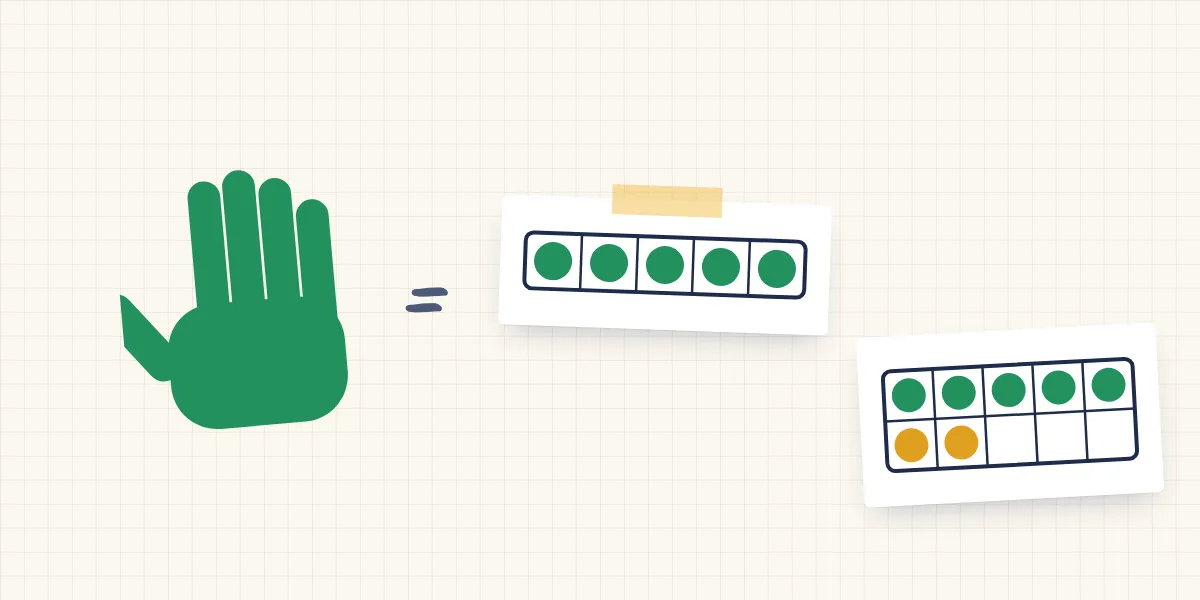
In short: People can take in up to three or four things at a glance without counting (subitizing). Larger amounts can still be recognised instantly if they are grouped: seven dots as a full row of five and two. Children develop this “structured seeing” from around first grade, and those who are good at it tend to do better at arithmetic. The power of five builds on exactly this: amounts are always organised in fives and tens, so children see them rather than count them.
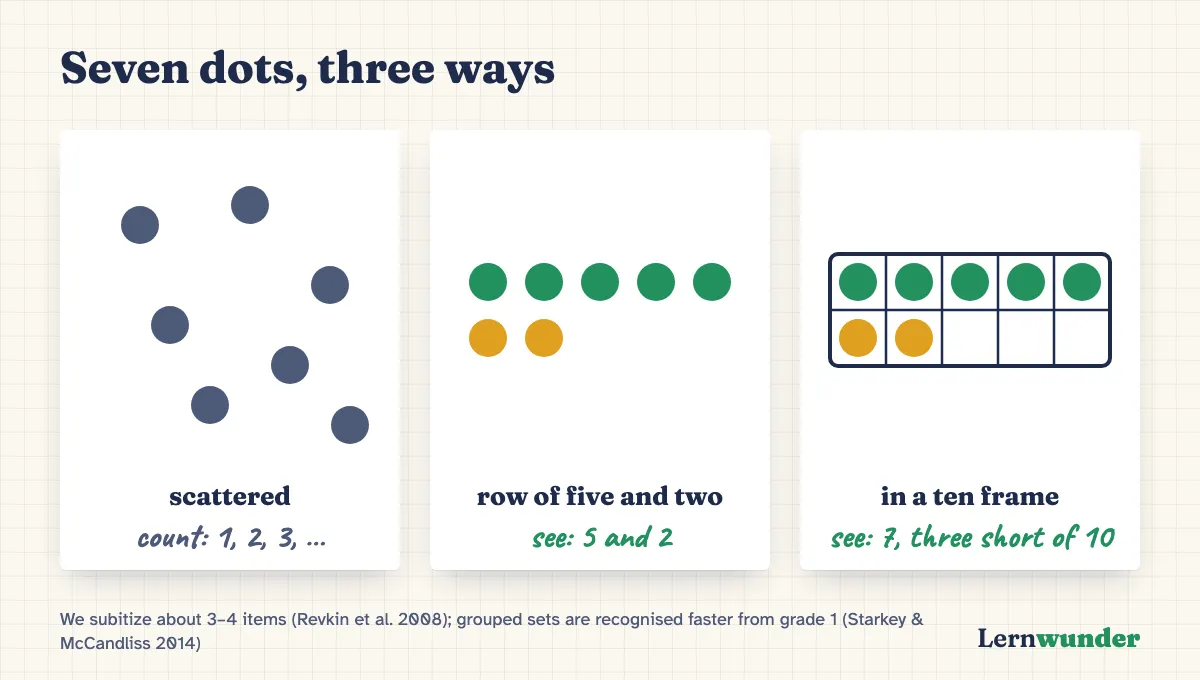
A small experiment to try yourself: ask someone to scatter seven coins on the table and look for just one second. How many were there? Now lay five coins in a row and two underneath. One second again. Most adults notice the difference straight away. For children learning to calculate, it is even bigger.
How many things can we take in at a glance?
We recognise very small amounts instantly and without mistakes. This is called subitizing. The limit is about three to four items. In an experiment with adults, accuracy for amounts from one to four was much higher than ordinary estimation would predict; the researchers conclude there is a dedicated mechanism for small numbers (Revkin et al., 2008).
From five upwards, we start counting or estimating. So five sits just beyond what we see “just like that”. That is exactly what makes it so interesting.
How do children see larger amounts without counting?
By grouping. When things are arranged in small groups, each group is taken in at a glance and the whole is put together. Researchers call this groupitizing.
- It develops at school. In a study of 378 children from kindergarten to third grade, grouping did not yet help kindergartners. From first grade on, children recognised grouped amounts faster than unstructured ones, and the advantage grew with every school year (Starkey & McCandliss, 2014).
- It is already arithmetic. Another study shows that people mentally add or multiply groups rather than count when they enumerate grouped sets. In children this ability appears after about a year of formal schooling and is linked to arithmetic skills (Ciccione & Dehaene, 2020).
- It is linked to maths achievement. Among 1,209 students in grades 3 to 8, the ability to use grouping was an important predictor of maths achievement and was linked to conceptual understanding (Guillaume et al., 2023).
One caveat: these studies show associations and developmental patterns. They do not prove that a particular training with fives on its own leads to better maths grades.
Why five?
Because it is everywhere children meet amounts: one hand has five fingers, and two hands make ten. Seven becomes “a full hand and two”, eight “a full hand and three”. In German-speaking maths education this principle is known as the Kraft der Fünf, the power of five: amounts are shown so that five is visible as a block, with the rest beside it. Martignon and Rechtsteiner (2022) illustrate this with seven: on one side as a block of five and two, on the other as a block of four and three, or as the dice six and one.
In our view, five has two advantages at once. It is big enough to split numbers up to ten into two manageable parts, and small enough that a child can still take in the part above or below it at a glance. Five and two, five and three, five and four: the rest always stays within subitizing range.
How does structure help with calculating?
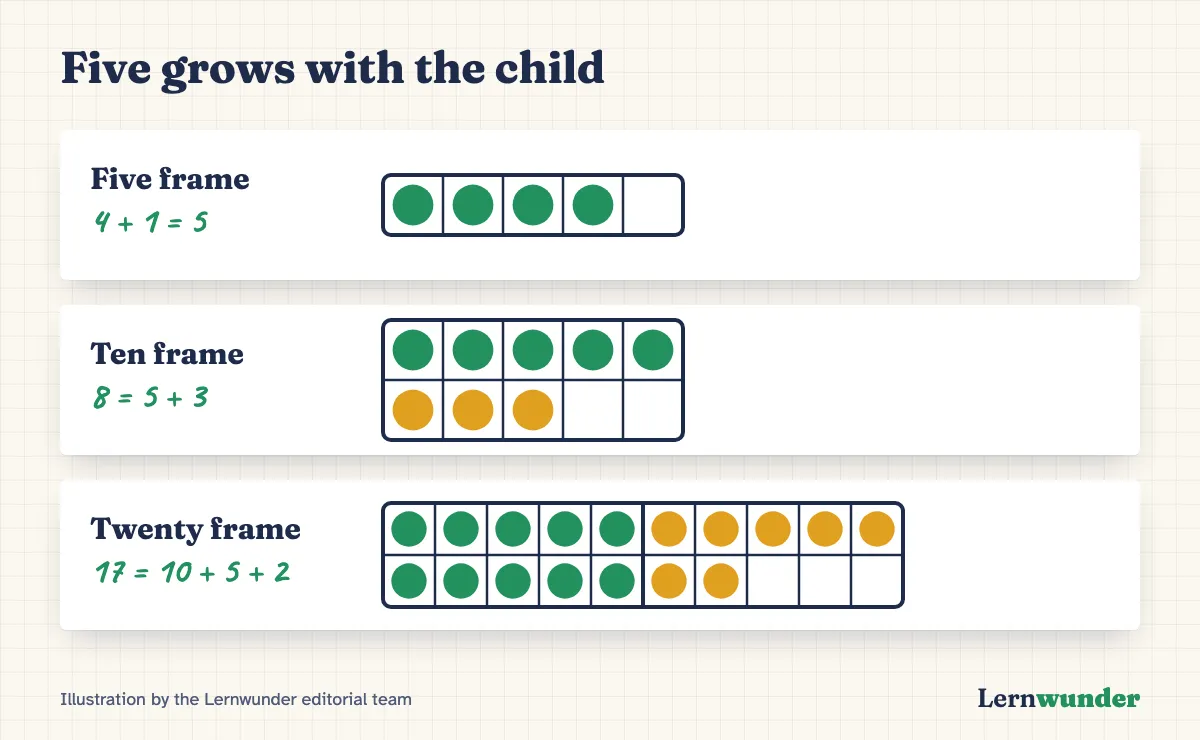
Structure makes number bonds visible before a child calculates them. A child who sees eight as “five and three” already has 8 = 5 + 3 in front of them. We explain why number bonds matter so much in our article on number bonds.
A ten frame, two rows of five, also shows what is missing to make ten: with seven, three spaces are empty. That is exactly the knowledge a child needs later for sums like 7 + 5 that bridge through ten. A twenty frame or a rekenrek repeats the same structure. Five is not replaced; it grows with the child.
Importantly, a row of fingers on its own is not enough. It mainly highlights five and ten. For other number bonds, children need additional pictures such as dot fields (Martignon & Rechtsteiner, 2022). When finger counting helps and when it becomes a problem is covered in our article on counting-based calculation.
What you can do
- An egg box as a ten frame. A ten-egg box has two rows of five. Put marbles or pasta in it: “How many? How many more to make ten?”
- Show finger patterns. “Show me eight without counting”: a full hand and three fingers, all at once.
- Quick look. Show dot cards or an egg box for one second, then cover it. Ask: “How did you see it?”
- Bead string with a colour change. Five blue beads, five white beads, alternating. That way five stays visible even on long strings.
- Rearrange dice patterns. How else can you lay out six? As five and one, as two threes?
- Don’t rush. If a child still counts, that is fine. Show the same amount in a structured way and let them discover it.
Why this matters to us
For us, the power of five is not an add-on but a foundation. In our app Zahlzerlegung (a number bonds app, in German), amounts shown as dots, tally marks and fingers always appear as a full row of five plus the rest, never as a random heap. Why the app also pays attention to whether a number bond is recalled or counted is explained in our article on recall instead of counting.
Frequently asked questions
What does “the power of five” mean? A teaching principle: amounts are shown grouped in fives and tens so that children recognise them at a glance and see number bonds like 7 = 5 + 2 instead of counting.
How many things can children take in at a glance? About three to four (Revkin et al., 2008). Larger amounts can be recognised without counting when they are grouped, an ability that develops from first grade (Starkey & McCandliss, 2014).
From what age can children practise with fives? Playfully even before school, for example with finger patterns and dice. In studies, children clearly benefit from grouped amounts from first grade on (Starkey & McCandliss, 2014).
So should children stop counting altogether? No, counting stays important. The goal is that children no longer have to count small amounts and simple sums.
Sources
- Ciccione, L. & Dehaene, S. (2020). Grouping mechanisms in numerosity perception. Open Mind, 4, 102–118. https://doi.org/10.1162/opmi_a_00037
- Guillaume, M., Roy, E., Van Rinsveld, A., Starkey, G. S., Project iLead Consortium, Uncapher, M. R. & McCandliss, B. D. (2023). Groupitizing reflects conceptual developments in math cognition and inequities in math achievement from childhood through adolescence. Child Development, 94(2), 335–347. https://doi.org/10.1111/cdev.13859
- Martignon, L. & Rechtsteiner, C. (2022). The benefits of an interdisciplinary approach to mathematics education on issues around computation in school. Frontiers in Psychology, 13, 533402. https://doi.org/10.3389/fpsyg.2022.533402
- Revkin, S. K., Piazza, M., Izard, V., Cohen, L. & Dehaene, S. (2008). Does subitizing reflect numerical estimation? Psychological Science, 19(6), 607–614. https://doi.org/10.1111/j.1467-9280.2008.02130.x
- Starkey, G. S. & McCandliss, B. D. (2014). The emergence of “groupitizing” in children’s numerical cognition. Journal of Experimental Child Psychology, 126, 120–137. https://doi.org/10.1016/j.jecp.2014.03.006
Lernwunder editorial team · Chaolan Lu