In short: After a mistake, children above all need information about how to get it right, not a verdict on themselves. In studies, feedback that carries a lot of information is about four times as effective as rewards or punishment, and feedback aimed at the person can even do harm. That the colour red itself lowers performance, on the other hand, is not reliably established. So our principle is: a mistake should show how the problem is built. Our first app still shows a red border when an answer is wrong; going forward, we want to do without it.
A made-up but familiar scene: an exercise book comes home from school. Nineteen answers are right, one is not. The child only looks at the one that is crossed out in red. “I can’t do it,” they say, although they got almost everything right.
For generations, red has been the colour of “wrong” at school. In this article we look at what actually helps children after a mistake, and we are honest about where we have learned something ourselves.
What makes feedback after a mistake effective?
Feedback is one of the most powerful influences on learning, but it can work in either direction. What matters is the kind of feedback a child gets and how it is given (Hattie & Timperley, 2007).
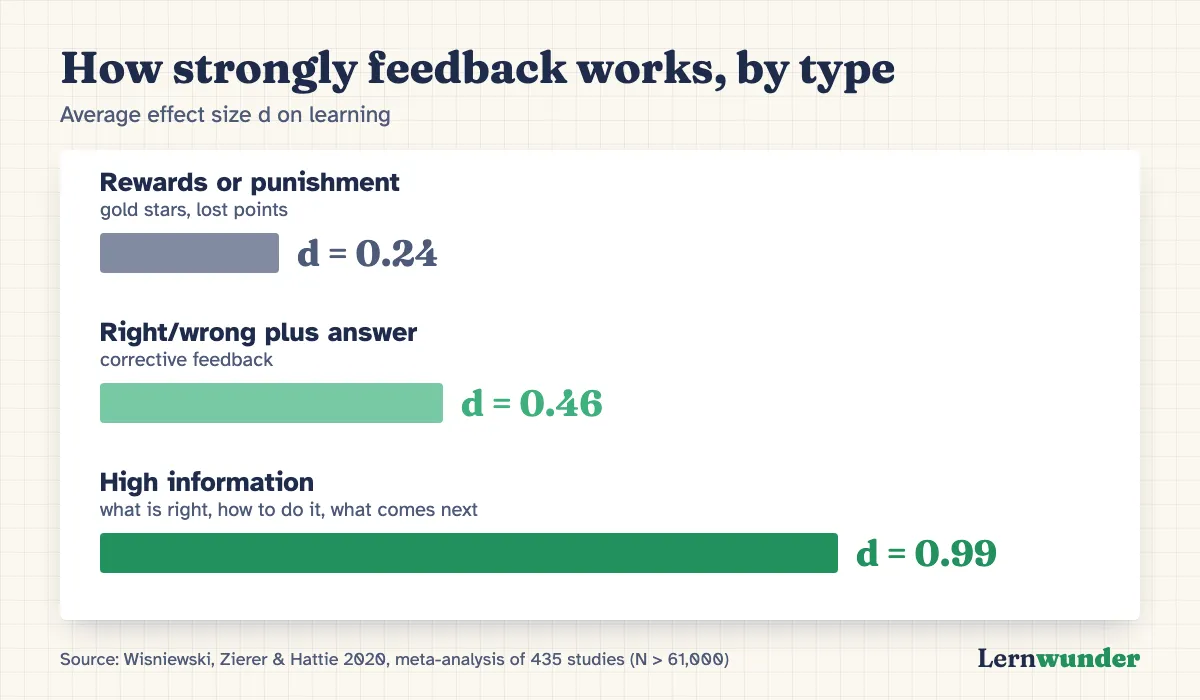
A meta-analysis of 435 studies with more than 61,000 learners shows how big the differences are. On average, feedback had a medium effect (d = 0.48). Broken down by type:
- rewards or punishment (a gold star, lost points): d = 0.24,
- corrective feedback (“right/wrong” plus the answer): d = 0.46,
- high-information feedback (what was right, how to approach it, what comes next): d = 0.99
(Wisniewski et al., 2020). For motivational outcomes, 21 percent of the effects were even negative, and most of these came from feedback without information, in other words pure rewards or punishments.
Can feedback do harm?
Yes. An earlier large meta-analysis of 607 effect sizes found that feedback improved performance on average, but in more than a third of cases it made performance worse. The more feedback draws attention away from the task and towards the self, the less it helps (Kluger & DeNisi, 1996).
The same goes for praise. In a series of experiments with fifth graders, some children were praised for their intelligence (“You’re clever”), others for their effort. After a setback, the “clever” children gave up sooner, enjoyed the tasks less and performed worse (Mueller & Dweck, 1998). A mistake then quickly becomes proof of not being clever after all.
Are mistakes bad for learning?
No, often the opposite is true. A review of laboratory studies concludes that making errors followed by corrective feedback benefits learning. Discussing the reasoning that led to the mistake is particularly helpful. Tolerating errors also encourages learners to approach tasks actively and with curiosity (Metcalfe, 2017).
So the key is not to avoid mistakes, but to make sure something instructive happens after them.
Does the colour red really make children perform worse?
We need to be honest here. In 2007, a research group reported that even a brief glimpse of red before a test lowers performance. The researchers’ explanation: red is associated with danger and failure (Elliot et al., 2007). Later studies, however, often failed to confirm this. A 2020 meta-analysis found no difference for knowledge and anagram tests and only a small one for reasoning tests. After correcting for publication bias, no reliable evidence for a red effect remained (Gnambs, 2020).
So we are not avoiding red because the colour alone would make children worse at maths. Our reason is a different one, and it is our own reasoning: at school, red carries a fixed meaning. It says “wrong”, and often “bad” too. It is the prime example of feedback without information. A red border does not tell a child how the problem is built. It only tells them they failed.
What you can do
- Mark what went well. Tick the correct answers with a green pen and talk through the one that went wrong together.
- Ask about the method. “How did you work it out?” There is often a sensible idea behind a mistake.
- Let children find the mistake. “One answer on this page isn’t right yet. Can you find it?” That turns a verdict into a task.
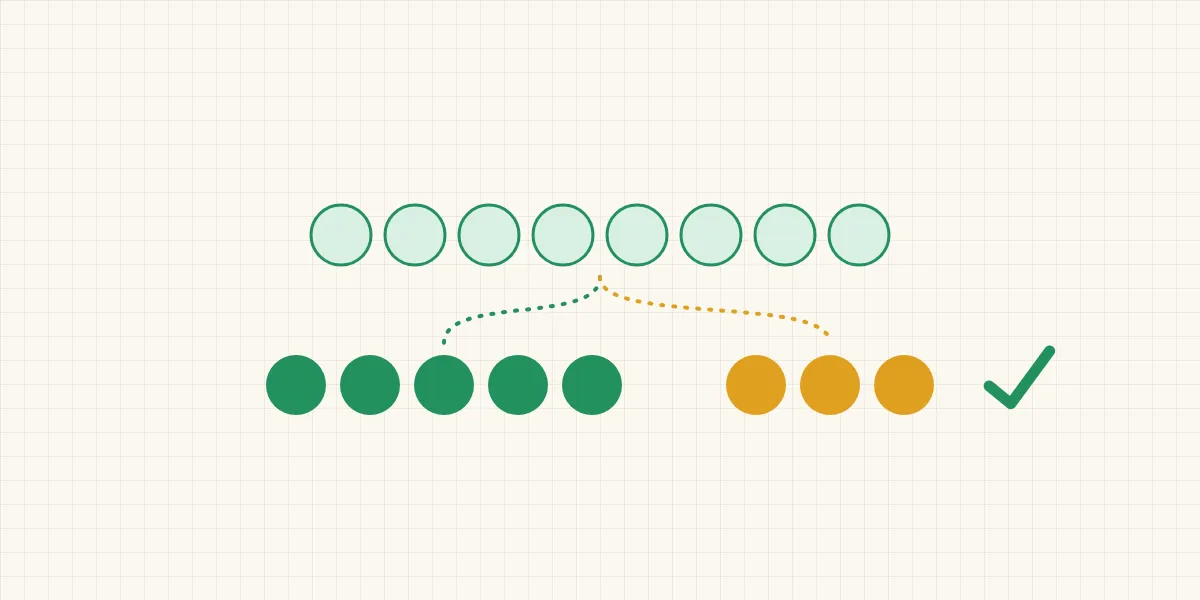
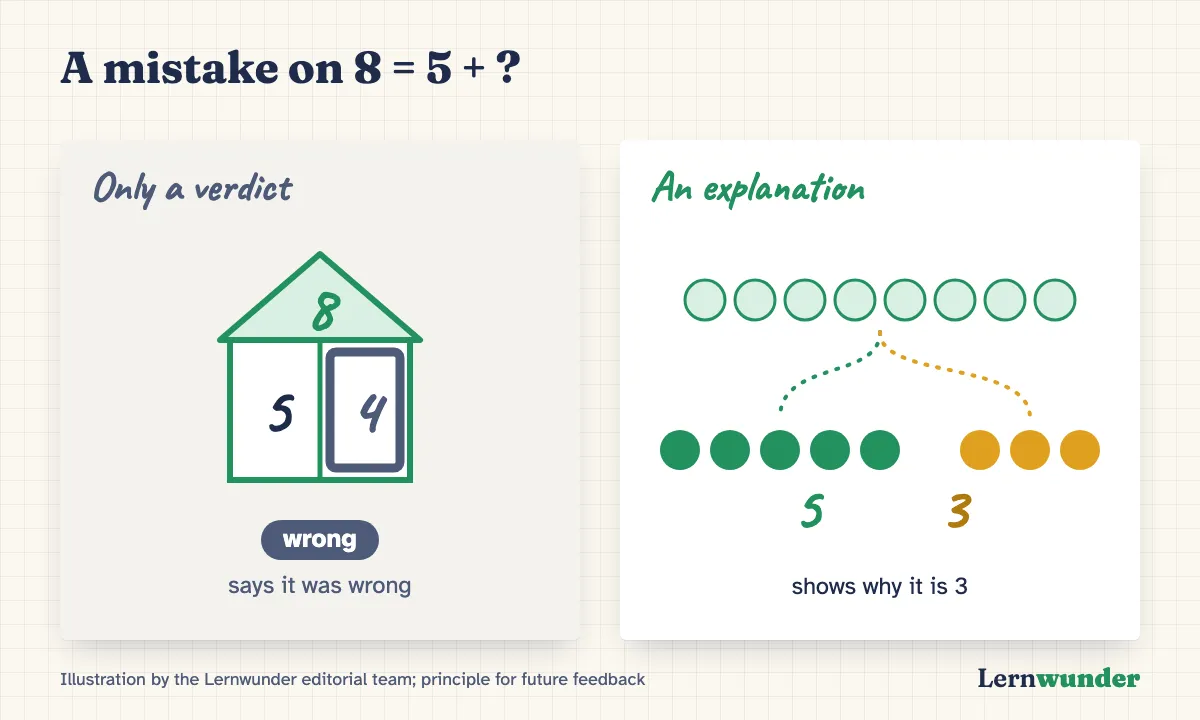
- Show the structure, not just the answer. For 8 = 5 + ?, eight counters split into five and the rest help more than simply saying “3”.
- Praise strategies, not talent. “You made ten first, clever!” rather than “You’re so smart” (Mueller & Dweck, 1998).
- Talk about your own mistakes. When adults say “Oops, I got that wrong, let me check again”, children learn that mistakes are part of thinking.
How we handle it in our apps
Honesty means saying this: our first maths app, Zahlzerlegung (a number bonds app, in German), shows a red border around the box when an answer is wrong. After that, the correct answer appears with a green border. A number bond that was answered wrongly also drops back in the learning progress and so comes up more often until it sticks. There are no points or lives to lose.
Knowing what we have gathered in this article, we would not build the red border that way today. Our principle for everything we develop from now on is: a mistake is not marked in red, it is explained. For a number bond like 8 = 5 + 3, that could mean the whole visibly splitting into its parts, eight dots into five and three. The child then sees why the answer is three, instead of only learning that their answer was wrong. This is what we are working on. We cannot yet say when or in what form it will arrive in Zahlzerlegung.
Frequently asked questions
Should mistakes not be marked at all? They should. Children need to know that something isn’t right. But that information only becomes useful when it shows how to get it right (Hattie & Timperley, 2007; Wisniewski et al., 2020).
Is the colour red harmful? There is no reliable evidence for that (Gnambs, 2020). Red is mainly a problem as a bare verdict without explanation.
Then why does Zahlzerlegung show a red border? Because that is how we decided when we built the app. We now see it differently and are working on feedback that shows the parts instead of red.
Isn’t praise always good? Praise for effort and strategies helps more than praise for talent. Children praised for intelligence gave up sooner after setbacks (Mueller & Dweck, 1998).
Sources
- Elliot, A. J., Maier, M. A., Moller, A. C., Friedman, R. & Meinhardt, J. (2007). Color and psychological functioning: The effect of red on performance attainment. Journal of Experimental Psychology: General, 136(1), 154–168. https://doi.org/10.1037/0096-3445.136.1.154
- Gnambs, T. (2020). Limited evidence for the effect of red color on cognitive performance: A meta-analysis. Psychonomic Bulletin & Review, 27(6), 1374–1382. https://doi.org/10.3758/s13423-020-01772-1
- Hattie, J. & Timperley, H. (2007). The power of feedback. Review of Educational Research, 77(1), 81–112. https://doi.org/10.3102/003465430298487
- Kluger, A. N. & DeNisi, A. (1996). The effects of feedback interventions on performance: A historical review, a meta-analysis, and a preliminary feedback intervention theory. Psychological Bulletin, 119(2), 254–284. https://doi.org/10.1037/0033-2909.119.2.254
- Metcalfe, J. (2017). Learning from errors. Annual Review of Psychology, 68, 465–489. https://doi.org/10.1146/annurev-psych-010416-044022
- Mueller, C. M. & Dweck, C. S. (1998). Praise for intelligence can undermine children’s motivation and performance. Journal of Personality and Social Psychology, 75(1), 33–52. https://doi.org/10.1037/0022-3514.75.1.33
- Wisniewski, B., Zierer, K. & Hattie, J. (2020). The power of feedback revisited: A meta-analysis of educational feedback research. Frontiers in Psychology, 10, 3087. https://doi.org/10.3389/fpsyg.2019.03087
Lernwunder editorial team · Chaolan Lu