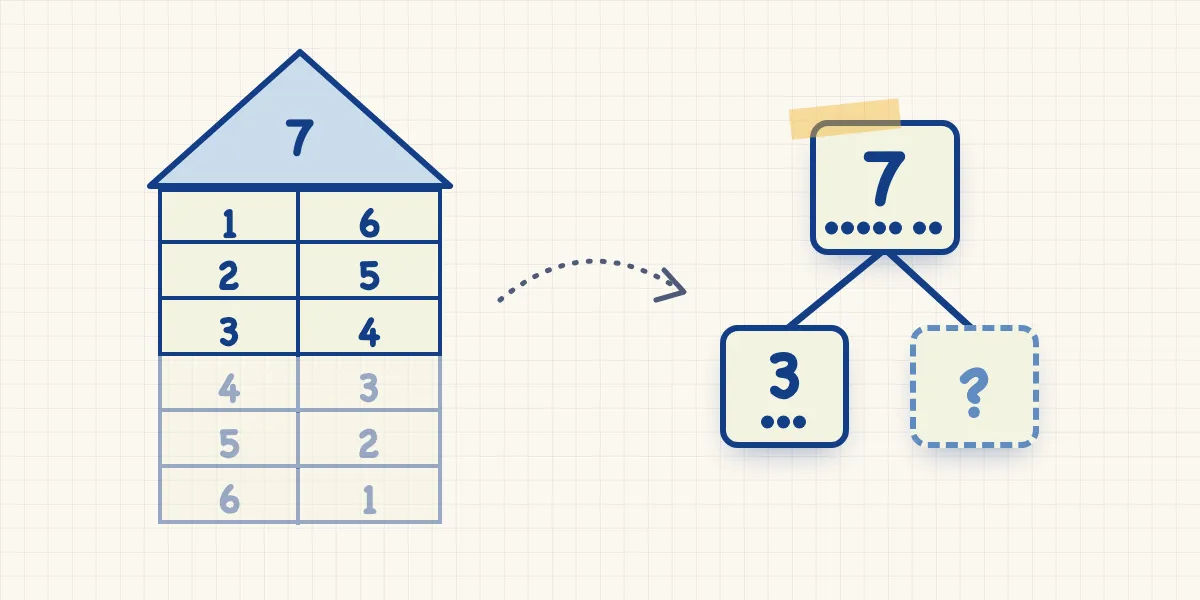
In short: A number house sets out all the number bonds of one number in order: the whole sits in the roof, and each floor holds a pair of parts that make the whole. Used well, it reveals patterns and links addition with subtraction. Its simplest form, one whole and two parts, is the basic shape of the app we are currently building.
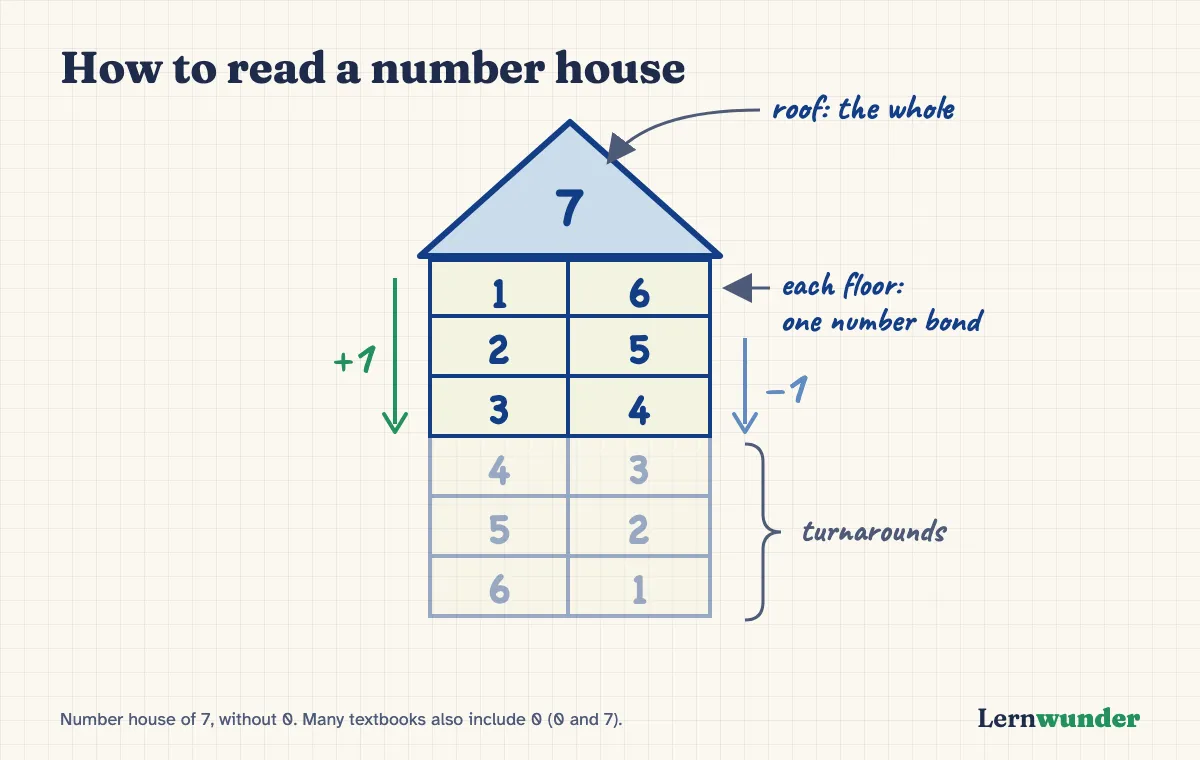
A classroom scene (made up for illustration): a child is filling in the number house for 7 in her exercise book. For every floor she counts again on her fingers: 1 and … 6. 2 and … 5. On the fourth floor she pauses: “The left side goes up by one each time, and the right side goes down by one.” From then on she is quick. In that moment she has learned more than seven separate facts.
In our main article we explained why number bonds are the key to arithmetic. Today we look at a tool many German children meet at school: the Zahlenhaus, or number house.
What is a number house?
A number house is a table shaped like a house. A number sits in the roof, for example 7. Below it are floors with two rooms each. Every floor holds two numbers that add up to 7: 1 and 6, 2 and 5, 3 and 4, and so on. Depending on the textbook, the house starts at 0 or at 1 and includes or leaves out the turnaround facts.
In English-speaking classrooms, the closest relative is the number bond diagram or part-whole model: the whole at the top, two parts below, joined by lines. Both show the same idea: a number as a whole made of two parts.
How do you use a number house well?
The value of a number house lies not in filling it in but in putting things in order. Fill the floors systematically and the pattern appears: one part grows, the other shrinks, the whole stays the same. Discovering instead of counting is the point.
Marx, Roesch, Moeller and Benz (2025) brought together the research on this. Their conclusion: learning environments for part-whole relations should move step by step from handling objects, to pictures, to numbers. Children should first find number bonds themselves, for example with a shake box, then record them in order, and only then practise with tasks where one part is missing.
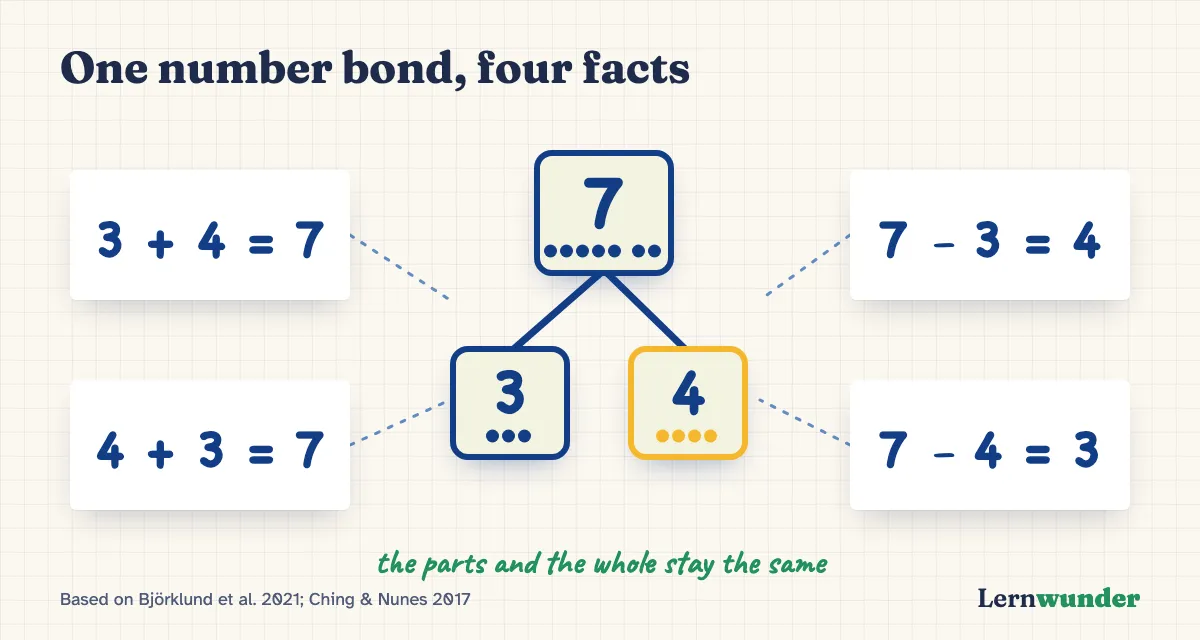
A house also contains more facts than you might think. A floor with 3 and 4 under the 7 gives four calculations: 3 + 4, 4 + 3, 7 − 3 and 7 − 4. This link between addition and subtraction is one of the things children need to discern to calculate well (Björklund, Marton & Kullberg, 2021). In a longitudinal study of 115 children, exactly this kind of knowledge explained the largest share of later maths achievement (Ching & Nunes, 2017).
Where does the number house fall short?
A number house can be filled in without understanding anything. A child can count out every floor separately, or mechanically count up on the left and down on the right without thinking about quantities. The house ends up full, but the counting stays.
A position paper by Gaidoschik and colleagues makes the same point: a stock of memorised facts is necessary but not sufficient. What matters is that children understand how numbers relate (Gaidoschik et al., 2021). And Cheng (2012) showed in an experiment with five- and six-year-olds that whether children calculate efficiently depends on how systematically they know the part-whole relations of the numbers up to 10.
So the number house is a good tool for putting bonds in order, but no substitute for working with real quantities.
What you can do at home or in class
- Build first, write later. Put 7 buttons in a box with a divider, shake it and note what comes out. After a few rounds, sort the results together into a number house.
- Ask about the pattern. “What do you notice from top to bottom?” Let your child put the rule into words.
- Cover a room. Hide one number with a sticky note: “Under the 7 there is a 2. Who lives next door?” It is the same as 2 + ? = 7, just friendlier.
- One floor, four facts. Find the matching addition and subtraction facts for each floor, perhaps as a dice game.
- Give the house of 10 pride of place. Its bonds are needed again and again for bridging through ten. Stick it on the fridge.
- Draw the quantities. Add dots next to the numbers, ideally in groups of five, so the child sees the parts instead of counting them.
If these activities stay very hard for a child over a longer period, our article on recognising maths difficulties may help.
What we are working on
Our first app is in the making, and it starts with the number house. More precisely, with its smallest unit: one whole and two parts, like the roof with a single floor. This basic shape is simple enough for children to grasp without reading, yet it carries the whole idea of number bonds. One part is missing, and the child fills it in.
Why reduce it so far? A recent study of 18 maths apps on the German market found none that builds part-whole relations systematically from objects to numbers. Most focus on automating facts (Marx et al., 2025). We take that finding seriously: an app cannot replace building with buttons and shake boxes. What it can do well is the part that everyday life often has no time for: calm, regular practice until the bonds are secure. We want numbers always to appear together with quantity pictures, so that the child sees the parts.
According to Hirsh-Pasek and colleagues (2015), good learning apps support active, engaged, meaningful and socially interactive learning, each with a clear learning goal. No app can replace talking about numbers, which is why the activities above belong alongside it. The app will be released soon, and we will show what it looks like when it is ready. One thing up front: we are building it in German.
Frequently asked questions
Should the number house include 0? Textbooks do both. Including 0 makes the house complete, but the bonds that matter most for calculating are those without 0.
Should the turnaround facts be in the house? For discovering the pattern, yes. For practice, half is often enough, because 3 + 4 and 4 + 3 are the same knowledge.
Is a number house the same as a number pyramid (number wall)? No. In a number pyramid two neighbouring bricks add up to the brick above. That also practises addition, but it is a different task.
When should a child know the number houses by heart? Over the course of the first school year, bonds to 10 should become steadily more secure. Understanding them matters more than a deadline.
Sources
- Björklund, C., Marton, F. & Kullberg, A. (2021). What is to be learnt? Critical aspects of elementary arithmetic skills. Educational Studies in Mathematics, 107(2), 261–284. https://doi.org/10.1007/s10649-021-10045-0
- Cheng, Z.-J. (2012). Teaching young children decomposition strategies to solve addition problems: An experimental study. The Journal of Mathematical Behavior, 31(1), 29–47. https://doi.org/10.1016/j.jmathb.2011.09.002
- Ching, B. H.-H. & Nunes, T. (2017). The importance of additive reasoning in children’s mathematical achievement: A longitudinal study. Journal of Educational Psychology, 109(4), 477–508. https://doi.org/10.1037/edu0000154
- Gaidoschik, M., Moser Opitz, E., Nührenbörger, M. & Rathgeb-Schnierer, E. (2021). Besondere Schwierigkeiten beim Mathematiklernen [Particular difficulties in learning mathematics]. Mitteilungen der Gesellschaft für Didaktik der Mathematik, 47(111S). https://ojs.didaktik-der-mathematik.de/index.php/mgdm/article/download/1042/1156
- Hirsh-Pasek, K., Zosh, J. M., Golinkoff, R. M., Gray, J. H., Robb, M. B. & Kaufman, J. (2015). Putting education in “educational” apps: Lessons from the science of learning. Psychological Science in the Public Interest, 16(1), 3–34. https://doi.org/10.1177/1529100615569721
- Marx, C., Roesch, S., Moeller, K. & Benz, C. (2025). From the whole to its parts – A systematic analysis of affordances for learning part-whole-relations in digital apps. International Electronic Journal of Mathematics Education, 20(1), em0802. https://doi.org/10.29333/iejme/15677
Lernwunder editorial team · Chaolan Lu