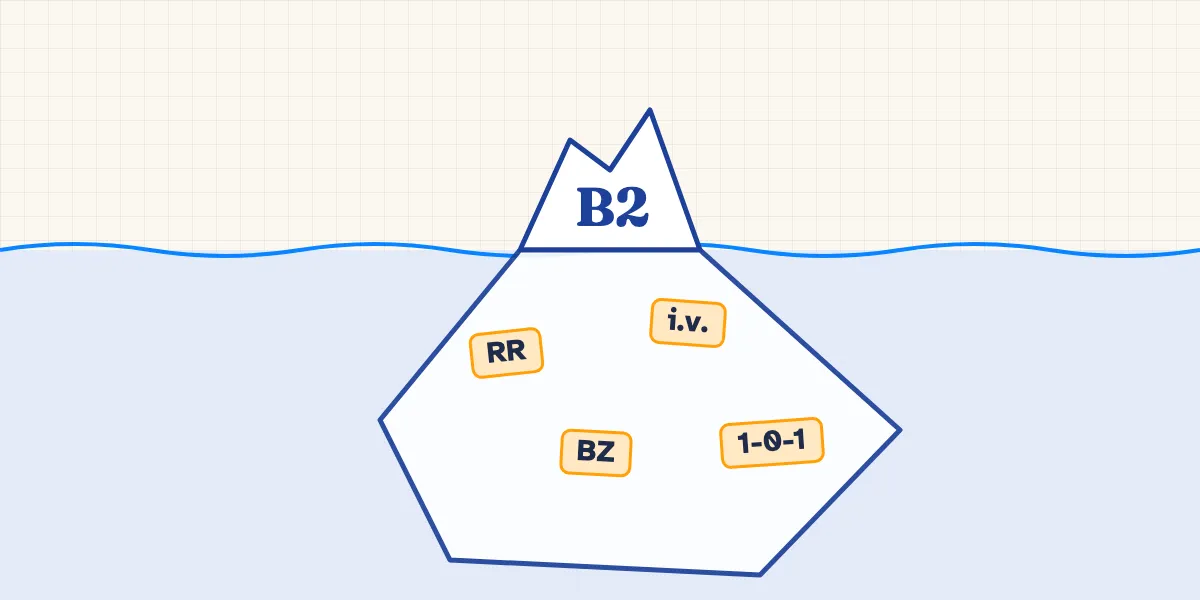
In short: A B2 certificate shows that someone can communicate confidently in everyday life and understand the main ideas of specialist discussions. Ward work asks for more: medical terms, abbreviations, fixed phrases and quick switches between talking to patients, giving handover and writing documentation. Linguists call these different registers. Practising them on purpose closes the gap between “speaks German” and “speaks ward German”.
“I passed B2 with a good score,” says the new colleague. Chatting with a patient about her grandchildren goes fine. Then comes handover: “Fourteen is post-op, drain’s barely draining, mobilise to the edge of the bed only.” In German, at handover speed. Suddenly she understands half of it. The scene is made up, but it describes exactly what keeps appearing in research.
In our post on the long road into nursing in Germany we described three gates: recognition, proof of German, and specialist language. Today is about the third gate. Why is the language of the ward almost a language of its own?
What does a B2 certificate actually certify?
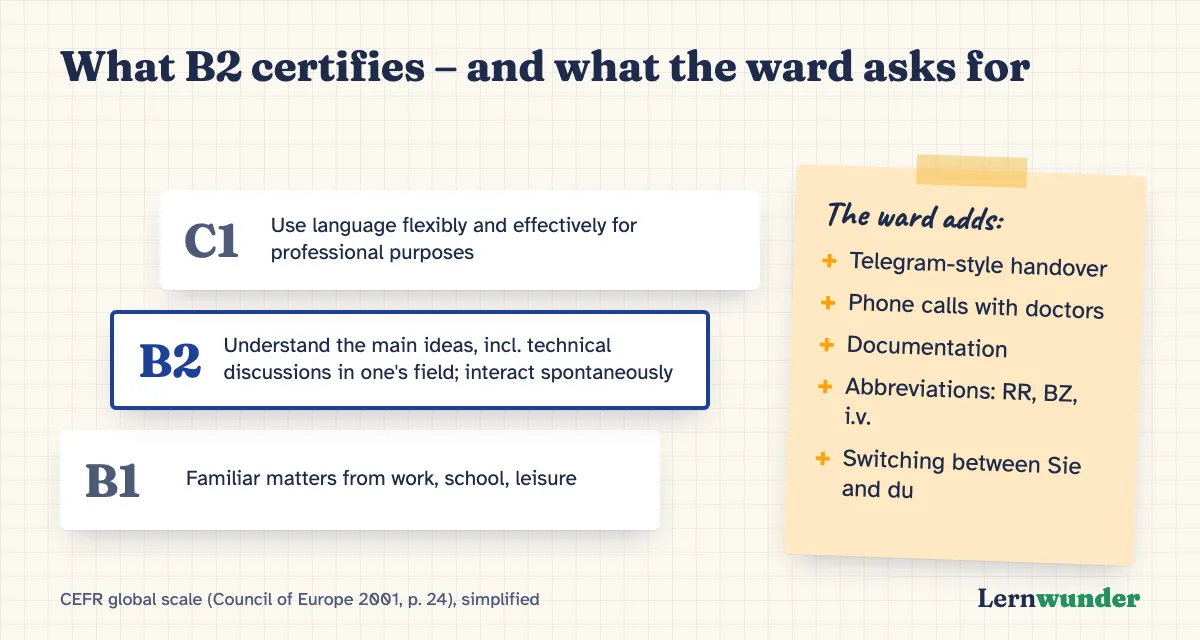
The Common European Framework of Reference for Languages (CEFR) describes B2 like this: a B2 user can understand the main ideas of complex text, including technical discussions in their field of specialisation, and can interact with enough fluency and spontaneity that regular conversation with native speakers works without strain for either side (Council of Europe, 2001).
That is a lot. But look closely: at B2, specialist content is about understanding the main ideas. Only at C1 does the scale say a learner can use language flexibly and effectively for professional purposes (Council of Europe, 2001). On the ward, understanding the main ideas is rarely enough. What counts is the one word that falls during handover, and being able to say and write it correctly yourself.
How is specialist language different from everyday language?
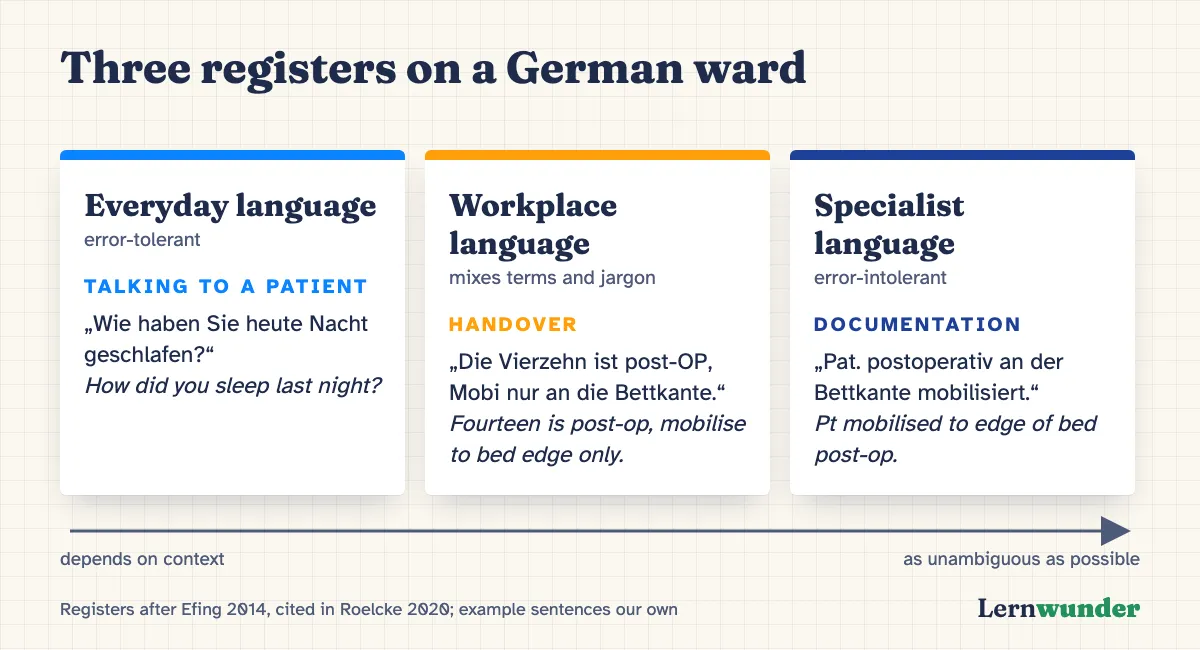
Linguists distinguish registers: ways of speaking and writing that fit particular situations. The German linguist Thorsten Roelcke summarises a widely used model (after Efing, 2014) (Roelcke, 2020):
- General language is used in familiar everyday situations, depends heavily on context and is error-tolerant. A wrong article hardly matters.
- Specialist language is shaped by writing, aims to be independent of context, is complex and error-intolerant. It has its own vocabulary and fixed patterns.
- Workplace language sits in between. It mixes elements of all registers: technical terms next to professional jargon, plus typical kinds of texts and conversations.
Roelcke stresses that specialist and workplace language cannot be cleanly separated. Professional communication draws on several registers at once (Roelcke, 2020). That is exactly what happens on a ward.
Why is nursing language especially hard?
Because nurses switch between these registers all the time. A study in London hospitals looked at what internationally educated nurses have to do with language: elicit information, reassure, instruct, give opinions, disagree, each time in a way that fits doctors, patients or relatives. Nurses must be able to translate between everyday and medical registers. That requires socio-pragmatic skills which the general language test required there (IELTS) largely does not assess (Sedgwick & Garner, 2017).
Then there are abbreviations that even professionals do not always understand. In a British survey, 46 nurses and doctors were asked to define 20 abbreviations from real patient records. On average they managed 32 percent. Three quarters of the abbreviations had at least one other possible meaning (Jayatilake & Oyibo, 2023). So specialist language is not only new to migrants. Native speakers also learn it on the job, and much of it differs from hospital to hospital.
What do studies of migrant nurses show?
An observational study followed 13 overseas-qualified nurses in an Australian hospital for twelve weeks. Their exchanges with colleagues and doctors were affected by hesitancy and a lack of assertiveness. Small talk and laughter happened with colleagues from similar cultural backgrounds but rarely with local colleagues. The researchers also stress that poor communication was not always caused by the new nurses (Philip et al., 2019).
For Germany, the evidence is thinner. A review found only five German papers among 56 studies on nurse migration. In all of them, language plays a central role, and feelings of disempowerment are mainly attributed to insufficient language skills. The authors recommend systematically developing language and communication skills for everyday and workplace situations (Smith et al., 2022). An interview study with 24 migrant and 24 German-born home care nurses in Hamburg reached a similar conclusion: language differences are a main stressor in the team (Schilgen et al., 2019).
A Canadian review sums up what follows from this: learning an additional language is a long-term process with several stages. Good programmes teach technical language and the socio-pragmatics of professional communication (Lum et al., 2015).
What you can do
If you are new on a German ward:
- Keep a ward notebook with three columns: the word, how colleagues say it, and how you would explain it to a patient.
- Learn every noun with its article, including medical terms: die Drainage (the drain), der Zugang (the IV line), das Röhrchen (the sample tube).
- Write down abbreviations from handover and ask once how they are meant on your ward.
- Listen for when colleagues say “du” and when they say “Sie”, and how their tone changes with the doctor.
If you are onboarding international colleagues:
- Say a handover sentence twice: once in jargon, once spelled out.
- Put a list of the abbreviations used on your ward in the staff room.
- Praise questions. Someone who asks has understood what matters.
Why this topic matters to us
Language courses and exams prepare people for general German, and that is good. For the language of the ward, though, there is surprisingly little that nurses can practise alone, in small portions, after a shift. That is what we are thinking about right now: a learning aid that brings together medical terms with their articles, abbreviations and the sentences of everyday ward life. It is in the making. How we want to handle the different registers is the subject of one of our next posts.
Frequently asked questions
Is B2 German enough to work as a nurse in Germany? B2 is usually required for recognition. On the ward, nurses additionally need specialist vocabulary, abbreviations and the ability to switch between everyday and specialist language. These are best learned deliberately, alongside work.
What is the difference between specialist language and workplace language? Specialist language is precise, shaped by writing and error-intolerant. Workplace language mixes technical terms, jargon and everyday language, depending on the situation (Roelcke, 2020).
Is C1 the answer? C1 describes language “for professional purposes”, but C1 is still a general level. The vocabulary and habits of a particular ward have to be learned either way.
Do German-born nurses understand all abbreviations? No. Studies show that trained professionals, too, often cannot interpret abbreviations reliably (Jayatilake & Oyibo, 2023).
Sources
- Council of Europe (2001). Common European Framework of Reference for Languages: Learning, Teaching, Assessment. Cambridge University Press, p. 24 (global scale). Read in the reproduction in Hawkins, J. A. & Filipović, L., Criterial Features in L2 English, Cambridge University Press: https://assets.cambridge.org/97805211/84779/excerpt/9780521184779_excerpt.pdf
- Jayatilake, D. C. & Oyibo, S. O. (2023). Interpretation and misinterpretation of medical abbreviations found in patient medical records: A cross-sectional survey. Cureus, 15(9), e44735. https://doi.org/10.7759/cureus.44735
- Lum, L., Dowedoff, P., Bradley, P., Kerekes, J. & Valeo, A. (2015). Challenges in oral communication for internationally educated nurses. Journal of Transcultural Nursing, 26(1), 83–91. https://doi.org/10.1177/1043659614524792
- Philip, S., Woodward-Kron, R. & Manias, E. (2019). Overseas qualified nurses’ communication with other nurses and health professionals: An observational study. Journal of Clinical Nursing, 28(19–20), 3505–3521. https://doi.org/10.1111/jocn.14942
- Roelcke, T. (2020). Berufssprache und Berufliche Kommunikation – eine konzeptionelle Klärung [Workplace language and professional communication]. Sprache im Beruf, 3(1), 3–17. https://doi.org/10.25162/sprib-2020-0001
- Schilgen, B., Handtke, O., Nienhaus, A. & Mösko, M. (2019). Work-related barriers and resources of migrant and autochthonous homecare nurses in Germany: A qualitative comparative study. Applied Nursing Research, 46, 57–66. https://doi.org/10.1016/j.apnr.2019.02.008
- Sedgwick, C. & Garner, M. (2017). How appropriate are the English language test requirements for non-UK-trained nurses? A qualitative study of spoken communication in UK hospitals. International Journal of Nursing Studies, 71, 50–59. https://doi.org/10.1016/j.ijnurstu.2017.03.002
- Smith, J. B., Herinek, D., Woodward-Kron, R. & Ewers, M. (2022). Nurse migration in Australia, Germany, and the UK: A rapid evidence assessment of empirical research involving migrant nurses. Policy, Politics, & Nursing Practice, 23(3), 175–194. https://doi.org/10.1177/15271544221102964
Lernwunder editorial team · Chaolan Lu