In short: Children who practise their times tables spread over several days, and recall the answers themselves while they do it, remember them better than after one long session. It’s one of the best-established findings in learning research, including with primary school children. Droptiply uses both: shaky facts come up more often, facts just practised take a break, and anything that hasn’t come up for a few days moves back up the queue.
A made-up scene that many families will recognise: on Friday there’s a test on the 8 times table. On Thursday evening the child sits at the kitchen table for half an hour, reciting the table over and over. The test goes fine. Three weeks later, in the middle of a word problem, 6 × 8 has gone again.
The child didn’t practise too little. They just practised it all at once. That’s enough for a test the next day, but hardly for long-term memory.
Why is spaced practice better than cramming?
Spaced practice means the same amount of practice, but spread over several short sessions with gaps in between, instead of packed into one sitting. The benefit is exceptionally well documented. A large meta-analysis looked at 839 comparisons from 317 experiments. The result: spaced learning beats massed learning, and the best gap between sessions depends on how long you want to remember something. The longer the knowledge needs to last, the longer the gap can be (Cepeda et al., 2006).
A review comparing ten common study techniques gave only two its top rating: spaced practice and practice testing. Both help learners of different ages and abilities, across many kinds of tasks and in real classrooms (Dunlosky et al., 2013). Combining the two amplifies the effect (Kang, 2016).
Does this work for children, and for maths?
Yes, with a few caveats. In a study with 213 children in grades 3 and 7, one group did three practice sets in one day, the other one set a day on three days. In grade 7 the spaced group did better after one week and after six weeks. In grade 3 the advantage showed up after one week, but was no longer clearly detectable after six (Barzagar Nazari & Ebersbach, 2019).
For fast recall of basic facts specifically, there’s a study with 48 third graders practising addition facts. Everyone had the same practice time per day. Those who spread it over two or four points in the day became fluent faster than children who practised it all in one go (Schutte et al., 2015). In children aged 5 to 7, spaced sessions also helped with learning science concepts: they were better at applying what they’d learned to new examples (Vlach & Sandhofer, 2012).
Why does recalling matter more than rereading?
In a much-cited experiment, students learned vocabulary. Once a word had been recalled correctly, it was either studied again or tested again. Studying again made no difference a week later. Testing again made a large one. And the students themselves couldn’t tell what had helped them (Karpicke & Roediger, 2008).
For times tables this means: reading through the times table chart again feels like practice but does little. Answering a fact yourself, even with mistakes, works far better. That’s the step from working it out to recalling it.
What you can do
- Short and often. Five minutes on four days beats twenty minutes on Thursday evening. Even two short rounds on the same day, morning and afternoon, help.
- Quiz rather than read out. Your child says the answer and you listen. If they’re stuck, give a hint (“What’s 5 × 8?”), but not the answer straight away.
- A flashcard box with three sections. One fact per card. Cards that are secure move one section back and come up less often. Cards that aren’t stay at the front. Section 1 every day, section 2 every few days, section 3 once a week.
- Mix instead of reciting the table. Reciting a table from the start lets a child count along. Mixed facts require real recall. In an experiment with maths problems, mixed practice sets also produced much better results a week later, though that study was with adults (Rohrer & Taylor, 2007).
- Keep the old tables in play. When it’s the 7 times table’s turn, throw in a few facts from the 5s and 2s.
How we built it into Droptiply
When Droptiply came out in April, we promised to explain in more detail how the app decides which fact comes next. Here it is.
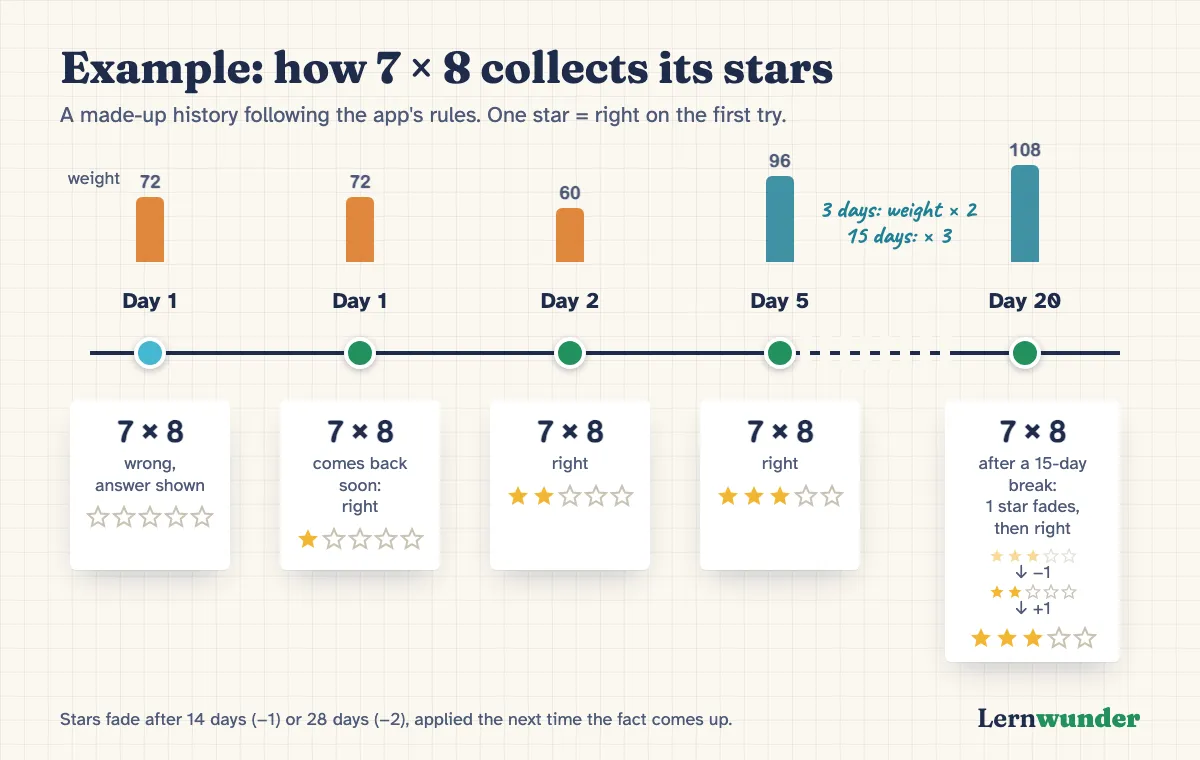
Stars for secure recall. Each of the 100 facts has up to five stars. A star is earned when the answer is right on the first try. How fast it came doesn’t matter. If it only works on the second or third try, there’s no new star; only a fact with no stars at all gets its first one after several such attempts. Shaky facts stay shaky and come back soon.
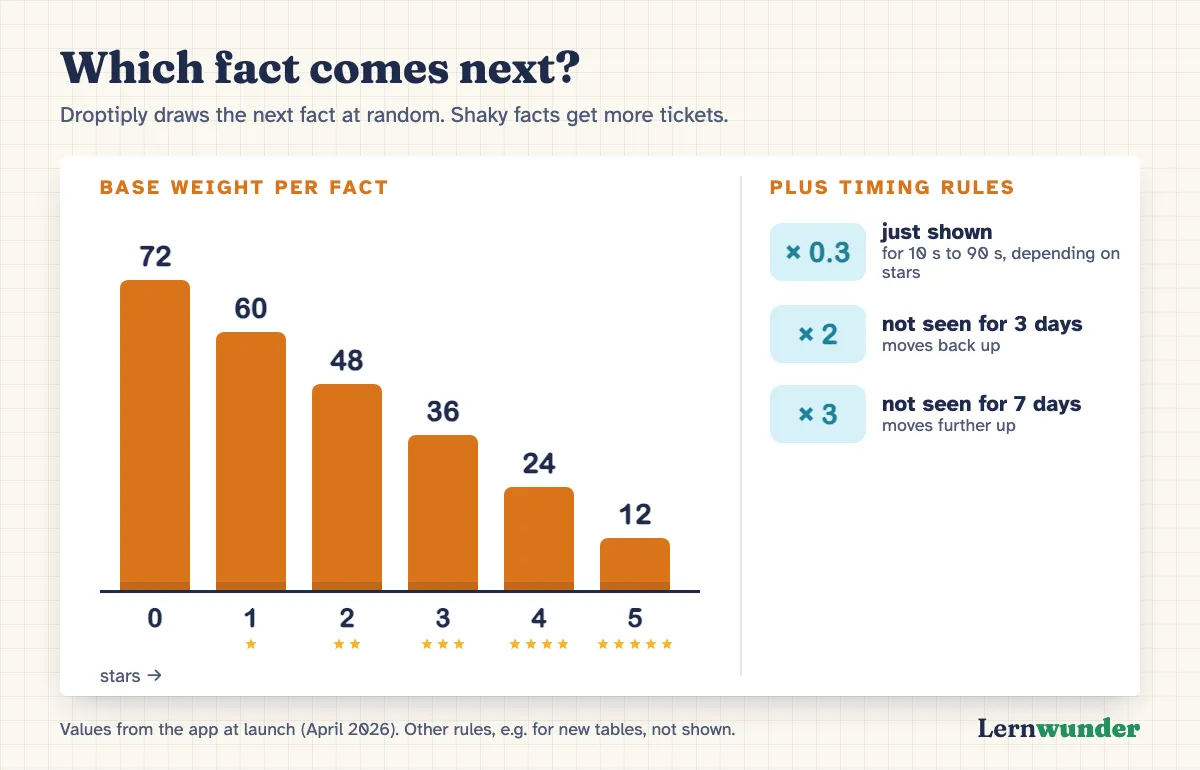
Shaky facts more often, but not only. The next fact is drawn at random, but not evenly. All else being equal, a fact with no stars has six times the weight of a fact with five. Well-known facts never disappear completely; they just come up less often.
Built-in breaks. The last three facts don’t come straight back. After that, a fact that was just shown steps back for a while, and the more stars it has, the longer: from ten seconds up to a minute and a half. It’s spaced practice on a small scale, within a single round.
Spread over days. If a fact hasn’t been practised for three days, its weight doubles; after a week it triples. If it hasn’t come up for two weeks, it loses a star the next time it appears, two after four weeks. So a fact has to keep earning its stars. On the home screen, Droptiply shows up to five facts that haven’t come up for a while under “Facts to review”.
Help when it’s sticky. After the second wrong attempt the correct answer pulses gently; after the third it is shown. If the answer had to be revealed for two facts with the same number, the app slips in an easy fact with that number, such as 2 × 7 when the 7s are causing trouble. After two hard facts in a row comes an easy one. And because Droptiply is also a puzzle, the app mixes in smaller blocks when the board fills up.
Turnaround facts count too. If a child knows 3 × 4, 4 × 3 gets the stars as well, and the app says so: “4 × 3 = 12 too!” That saves practice time and makes visible the link we described in our post on multiplication as a rectangle.
To be honest: the numbers in this system (six times the weight, three and seven days, two and four weeks) are our design decisions. Research says clearly that spaced retrieval helps, and that longer gaps suit longer retention. It doesn’t prescribe an exact schedule for primary school children and times tables.
Frequently asked questions
How often should my child practise times tables? Short and often rather than long and rarely: a few minutes on several days a week. There’s no single best gap; it depends on how long the knowledge needs to last (Cepeda et al., 2006).
Why does a fact my child knows well keep coming back? Because recalling strengthens memory even when a fact is already secure (Karpicke & Roediger, 2008). Secure facts just come up less often.
Why does a fact lose stars in Droptiply? When it hasn’t been practised for two weeks or more. It’s not a telling- off, it’s a reminder. Once it’s answered correctly again, the stars come back quickly.
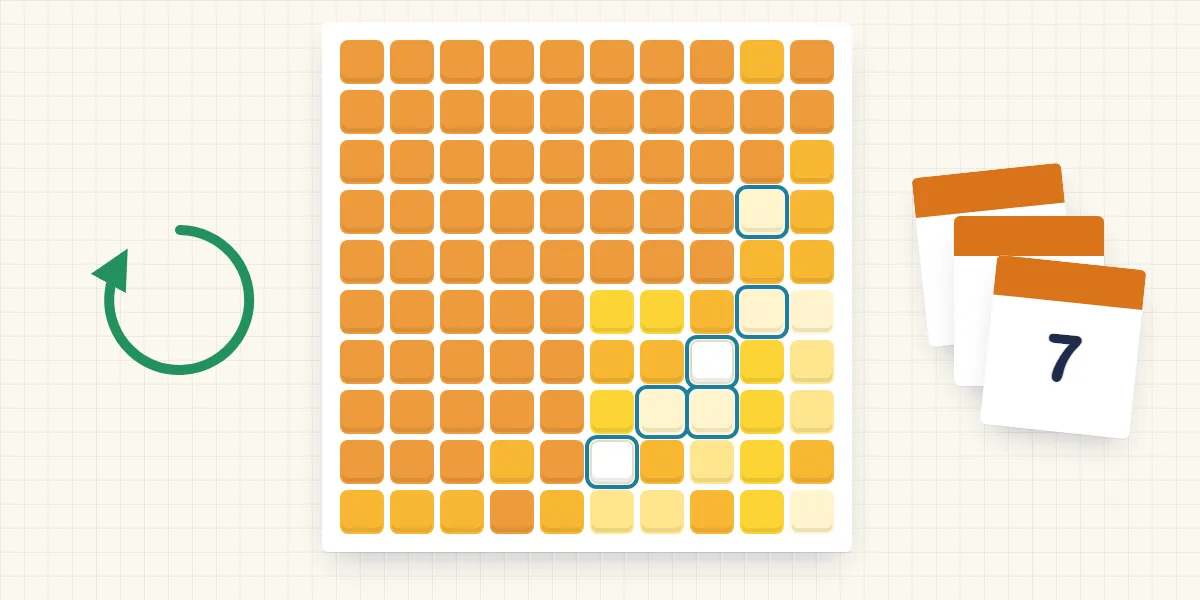
Where can I see which facts are still shaky? In the app’s progress overview: all 100 facts are shown as a 10 × 10 grid, shaded in four levels. The home screen also shows the “Facts to review”.
Find out more on the Droptiply page.
Sources
- Barzagar Nazari, K. & Ebersbach, M. (2019). Distributing mathematical practice of third and seventh graders: Applicability of the spacing effect in the classroom. Applied Cognitive Psychology, 33(2), 288–298. https://doi.org/10.1002/acp.3485
- Cepeda, N. J., Pashler, H., Vul, E., Wixted, J. T. & Rohrer, D. (2006). Distributed practice in verbal recall tasks: A review and quantitative synthesis. Psychological Bulletin, 132(3), 354–380. https://doi.org/10.1037/0033-2909.132.3.354
- Dunlosky, J., Rawson, K. A., Marsh, E. J., Nathan, M. J. & Willingham, D. T. (2013). Improving students’ learning with effective learning techniques: Promising directions from cognitive and educational psychology. Psychological Science in the Public Interest, 14(1), 4–58. https://doi.org/10.1177/1529100612453266
- Kang, S. H. K. (2016). Spaced repetition promotes efficient and effective learning: Policy implications for instruction. Policy Insights from the Behavioral and Brain Sciences, 3(1), 12–19. https://doi.org/10.1177/2372732215624708
- Karpicke, J. D. & Roediger, H. L. (2008). The critical importance of retrieval for learning. Science, 319(5865), 966–968. https://doi.org/10.1126/science.1152408
- Rohrer, D. & Taylor, K. (2007). The shuffling of mathematics problems improves learning. Instructional Science, 35(6), 481–498. https://doi.org/10.1007/s11251-007-9015-8
- Schutte, G. M., Duhon, G. J., Solomon, B. G., Poncy, B. C., Moore, K. & Story, B. (2015). A comparative analysis of massed vs. distributed practice on basic math fact fluency growth rates. Journal of School Psychology, 53(2), 149–159. https://doi.org/10.1016/j.jsp.2014.12.003
- Vlach, H. A. & Sandhofer, C. M. (2012). Distributing learning over time: The spacing effect in children’s acquisition and generalization of science concepts. Child Development, 83(4), 1137–1144. https://doi.org/10.1111/j.1467-8624.2012.01781.x
Lernwunder editorial team · Chaolan Lu