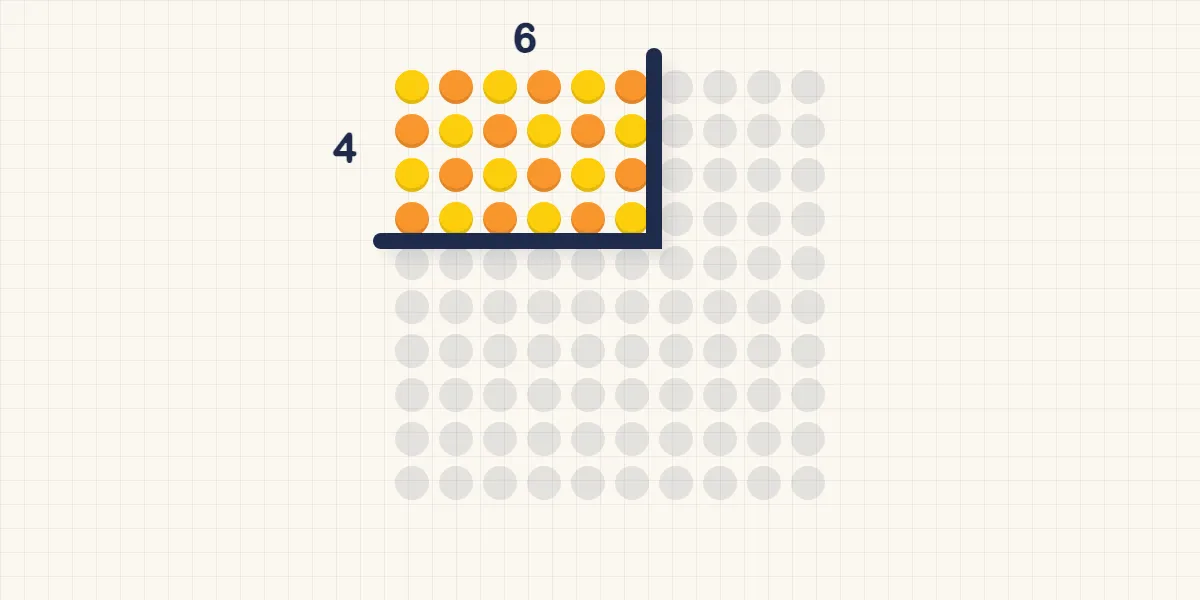
In short: A multiplication array shows a times tables fact as a rectangle: 3 × 4 is 3 rows of 4 dots. From this picture, children can see why 3 × 4 and 4 × 3 are equal and how to split a hard fact into easy ones. But studies also show that many children don’t see the rows and columns on their own. Children who learn to read the rectangle gain a tool for all of their times tables.
A made-up but typical scene at the kitchen table: your child breaks open a bar of chocolate and asks how many pieces there are. They point to each piece and count: one, two, three … eighteen. You say: “Look, three rows, six in each.” Your child looks, nods, and next time counts every piece one by one again.
A chocolate bar is a rectangle made of equal rows, a multiplication fact you can hold. It’s perfectly normal that a child doesn’t see it as 3 × 6 straight away. That’s exactly why the array deserves a closer look.
What is a multiplication array?
An array arranges dots in rows of equal length. 3 × 4 means 3 rows with 4 dots in each. The product, 12, is the number of all the dots. Instead of dots you can use squares on grid paper, interlocking cubes, or the pieces of a chocolate bar. Teachers also call it the area model when the squares fill a rectangle without gaps.
In our post on core facts we showed how children derive hard facts from easy ones. We also looked at the most common mistake when deriving: children see 5 × 8 as a number, not as five rows of eight. The array is the picture that is missing.
What does a rectangle show that a times table doesn’t?
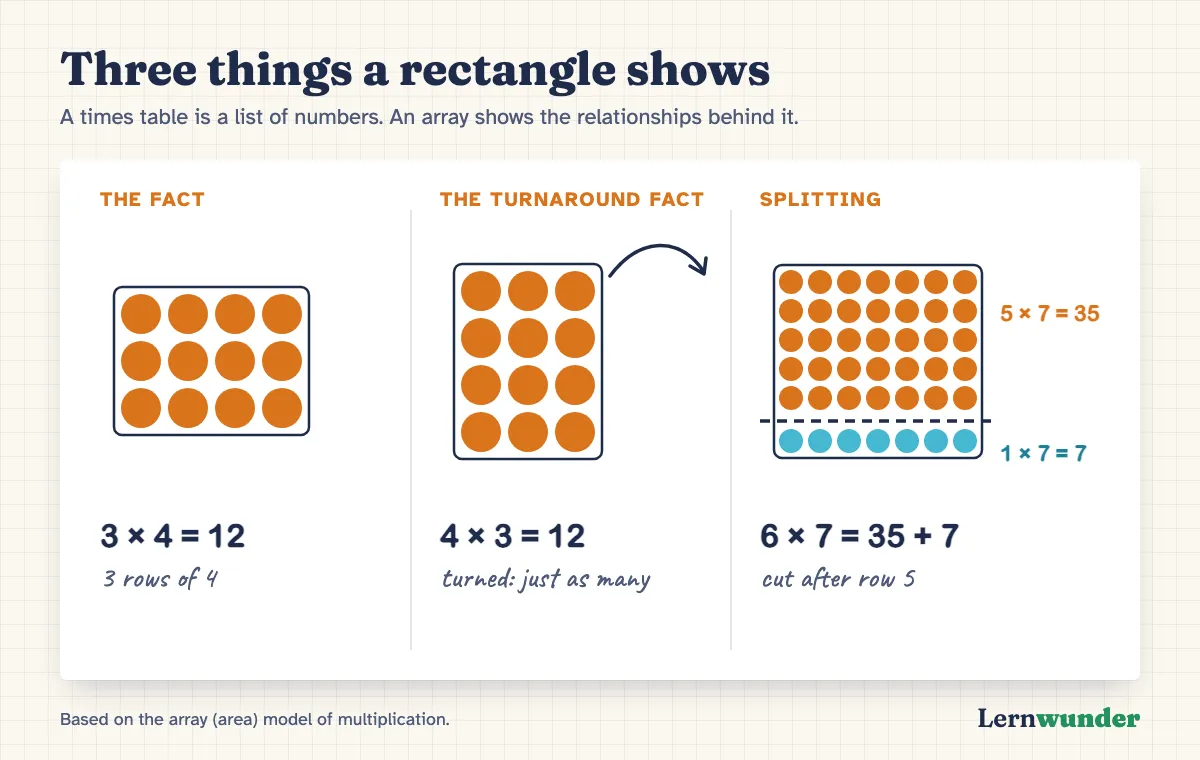
A recited table, “6, 12, 18, 24”, is a sequence of numbers. A rectangle shows three relationships at a glance:
- The fact itself. Rows times columns: 3 rows, 4 columns, 12 dots.
- The turnaround fact. Turn the rectangle by 90 degrees and 3 × 4 becomes 4 × 3. Not a single dot is added or lost.
- Splitting. Cut 6 × 7 after the fifth row and you get 5 × 7 and 1 × 7. One hard fact becomes two easy ones.
Mathematicians call the last two ideas the commutative and distributive properties. Children don’t need the names. But they use these properties with every turnaround fact and every derived fact.
Do children understand turning and splitting equally well?
No. A British study gave 59 children aged 9 and 10 multiplication problems, each with a cue: an already solved problem from which the answer could be worked out by turning it around or by splitting. The children understood turnaround (commutativity) well, but splitting (distributivity) very poorly. A common mistake was to pick a number exactly one more or one less than the answer in the cue, as if a neighbouring fact differed by a single dot rather than a whole row. The authors suggest that children carry rules from addition over to multiplication (Squire, Davies & Bryant, 2004).
This matches the take-away mistake from the core facts post. A neighbouring fact differs not by one, but by a whole row. In a rectangle you can see that. In a list of numbers you can’t.
Do children see the rectangle on their own?
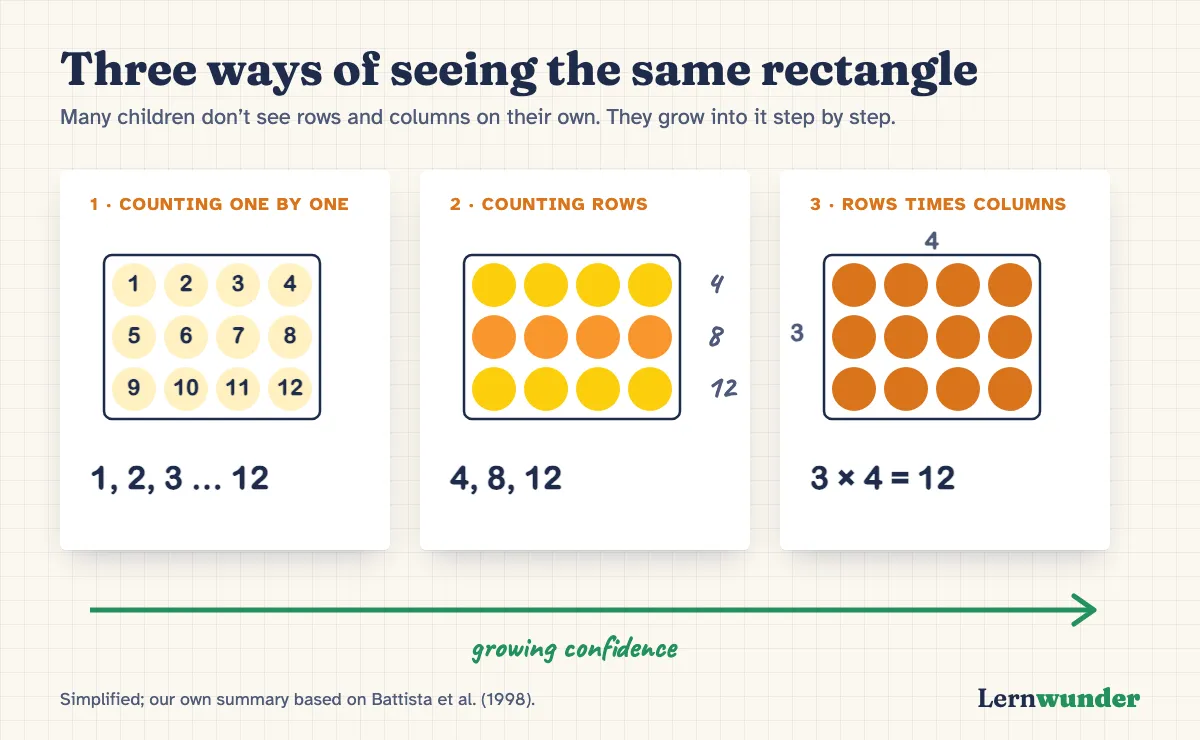
Often not. A US study asked children to count rectangular arrays of squares and observed closely how they went about it. Many children did not see the row-by-column structure. The researchers described several levels at which children organise such an array more and more skilfully, from unstructured counting to thinking in rows and columns (Battista et al., 1998).
It was similar in Australia: 115 children were asked to cover rectangles with tiles before they had been taught to measure area. Their strategies fell into five levels. According to the researchers, what mattered was whether a child saw the link between the size of a tile and the side lengths of the rectangle (Outhred & Mitchelmore, 2000).
Multiplicative thinking itself also grows slowly. In a study of 336 children in grades 1 to 5, 45 per cent of second graders already showed some multiplicative thinking, but only 48 per cent of fifth graders showed it consistently (Clark & Kamii, 1996).
The conclusion is not to drop the rectangle. It is that children need time and guidance to learn to read it. The study we mentioned in our first post on times tables found both: the array helped children reason, and at the same time they struggled with it (Barmby et al., 2009).
Do arrays help children learn their times tables?
A recent study suggests they do. In three third-grade classes, children worked for a school year with short visual prompts known as Quick Looks: a dot image is shown briefly, and the class talks about how many there are and how they can be seen. Compared with classes taught from the regular textbook, these 26 children made greater gains in multiplication fact fluency, used more reasoning strategies instead of counting, and showed deeper understanding of multiplication. The 25 children in the comparison group were more likely to still be counting (Kling, 2023; Kling & Kline, 2025).
The groups were small. But the finding fits what we described in the power of five: children who see structure need to count less.
What you can do
- Hunt for arrays in everyday life. Chocolate bars, egg boxes, muffin tins, windows, tiles. Ask: “How many rows? How many in each row?” Only then: “How many altogether?”
- Play quick looks. Show a dot array (for example 4 × 5) for just two seconds. “How many were there? How did you see them?” Any answer that isn’t counting one by one is progress.
- Turn it. Draw 3 × 5 on squared paper, cut it out and turn it. “Which fact is it now? Has the number changed?”
- Cut it. Draw 7 × 6 and draw a line after the fifth row. “Which two facts can you see now?” Let your child make the cut too: after the second row, after the third.
- One row more, one row less. Build 5 × 4 with cubes. Add a row: “How many did we add? One or four?”
- Picture first, number second. When a fact won’t stick, don’t give the answer straight away. Ask: “What does the rectangle look like?”
What we are working on
One idea won’t let go of us: what if the rectangle weren’t just a picture on paper, but a game piece? A block 3 squares tall and 4 wide would itself be the fact 3 × 4. Turn it, and it becomes 4 × 3, covering the same 12 squares. And a hard fact would have the shape of a big block that can be split into easier parts.
Under the working title Droptiply, we are working on turning this thought into a game. For now it is an idea. We will share how it becomes a game once it holds up.
Frequently asked questions
When is the array a good fit? As soon as children meet multiplication, usually around age 7. Spotting rectangles in everyday life works even earlier.
My child still counts every dot in the array. What can I do? That’s normal (Battista et al., 1998). Cover parts of it, show the array only briefly, or ask about a single row: “How many are in this row? And how many rows are there?”
Is 3 × 4 “3 rows of 4” or “4 rows of 3”? Both make 12. In many classrooms the first number gives the number of rows (“3 groups of 4”). What matters is sticking to one reading while you practise and then turning the rectangle on purpose.
Does the array replace memorising? No. It is the tool children use to find facts they don’t know yet. Fluent recall is still the goal.
Sources
- Barmby, P., Harries, T., Higgins, S. & Suggate, J. (2009). The array representation and primary children’s understanding and reasoning in multiplication. Educational Studies in Mathematics, 70(3), 217–241. https://doi.org/10.1007/s10649-008-9145-1
- Battista, M. T., Clements, D. H., Arnoff, J., Battista, K. & Van Auken Borrow, C. (1998). Students’ spatial structuring of 2D arrays of squares. Journal for Research in Mathematics Education, 29(5), 503–532. https://doi.org/10.2307/749731
- Clark, F. B. & Kamii, C. (1996). Identification of multiplicative thinking in children in grades 1–5. Journal for Research in Mathematics Education, 27(1), 41–51. https://doi.org/10.2307/749196
- Kling, G. (2023). Using visual imagery to develop multiplication fact strategies (Doctoral dissertation). ProQuest LLC, ERIC ED633707. https://eric.ed.gov/?id=ED633707
- Kling, G. & Kline, K. (2025). Visual imagery as a catalyst for multiplication fact fluency and multiplicative understanding. International Journal of Science and Mathematics Education, 23(7), 2255–2278. https://doi.org/10.1007/s10763-025-10541-2
- Outhred, L. N. & Mitchelmore, M. C. (2000). Young children’s intuitive understanding of rectangular area measurement. Journal for Research in Mathematics Education, 31(2), 144–167. https://doi.org/10.2307/749749
- Squire, S., Davies, C. & Bryant, P. (2004). Does the cue help? Children’s understanding of multiplicative concepts in different problem contexts. British Journal of Educational Psychology, 74(4), 515–532. https://doi.org/10.1348/0007099042376364
Lernwunder editorial team · Chaolan Lu