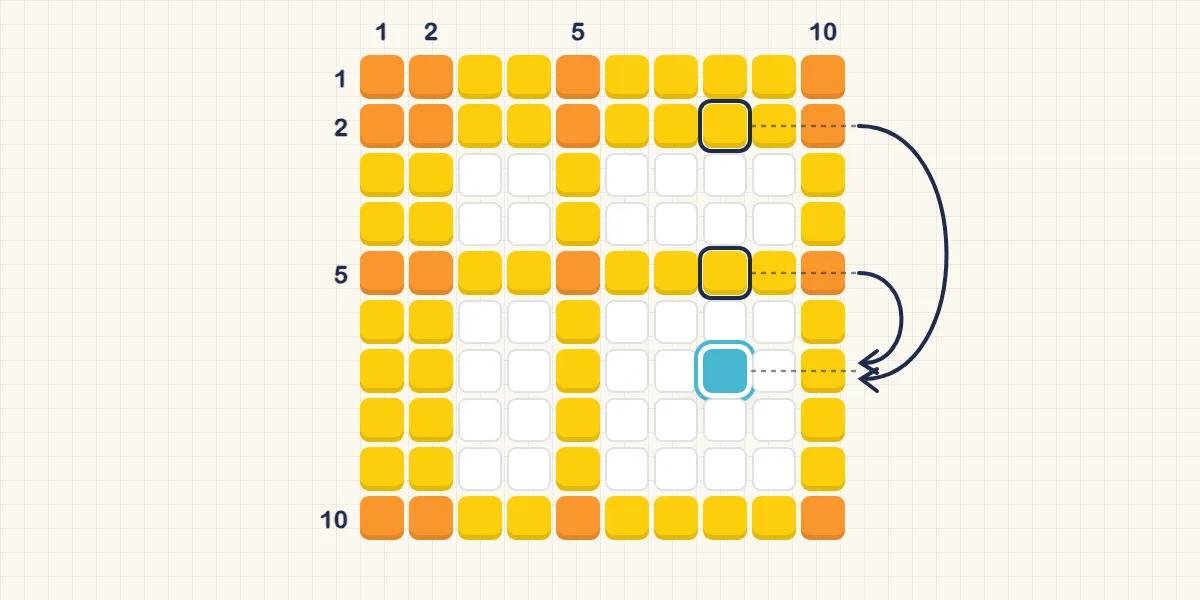
In short: Core facts are the multiplication facts with 1, 2, 5 and 10. Children find them measurably easier, and they already cover 64 of the 100 facts in the times tables up to 10 × 10. Add turnaround facts (commutativity) and only 21 facts need a route of their own, and each of them can be derived from a core fact. In studies, children taught this way ended up solving facts almost entirely by recall or quick derivation, hardly ever by counting.
A made-up but familiar scene: your child is asked for 6 × 8. They think, whisper “8, 16, 24 …” and keep track of the steps on their fingers. Half a minute later, 48 appears on the page. The answer is right. But it took half of the eight times table to solve a single fact.
Another child says: “5 × 8 is 40. One more eight, 48.” They didn’t know the fact by heart. They derived it from a fact they know well. That is what core facts are about.
In our post on learning times tables we introduced core facts briefly. Here we take a closer look: how far do they really get you, what does the research say, and where does deriving go wrong?
What are core multiplication facts?
Core facts (also called anchor facts or foundational facts) are the facts that are especially easy to remember or work out: every fact with 1, 2, 5 or 10 as a factor. Times 1 changes nothing, times 2 is doubling, times 10 adds a zero, and times 5 is half of times 10. Square facts like 3 × 3 or 4 × 4 are often added, because children remember them well.
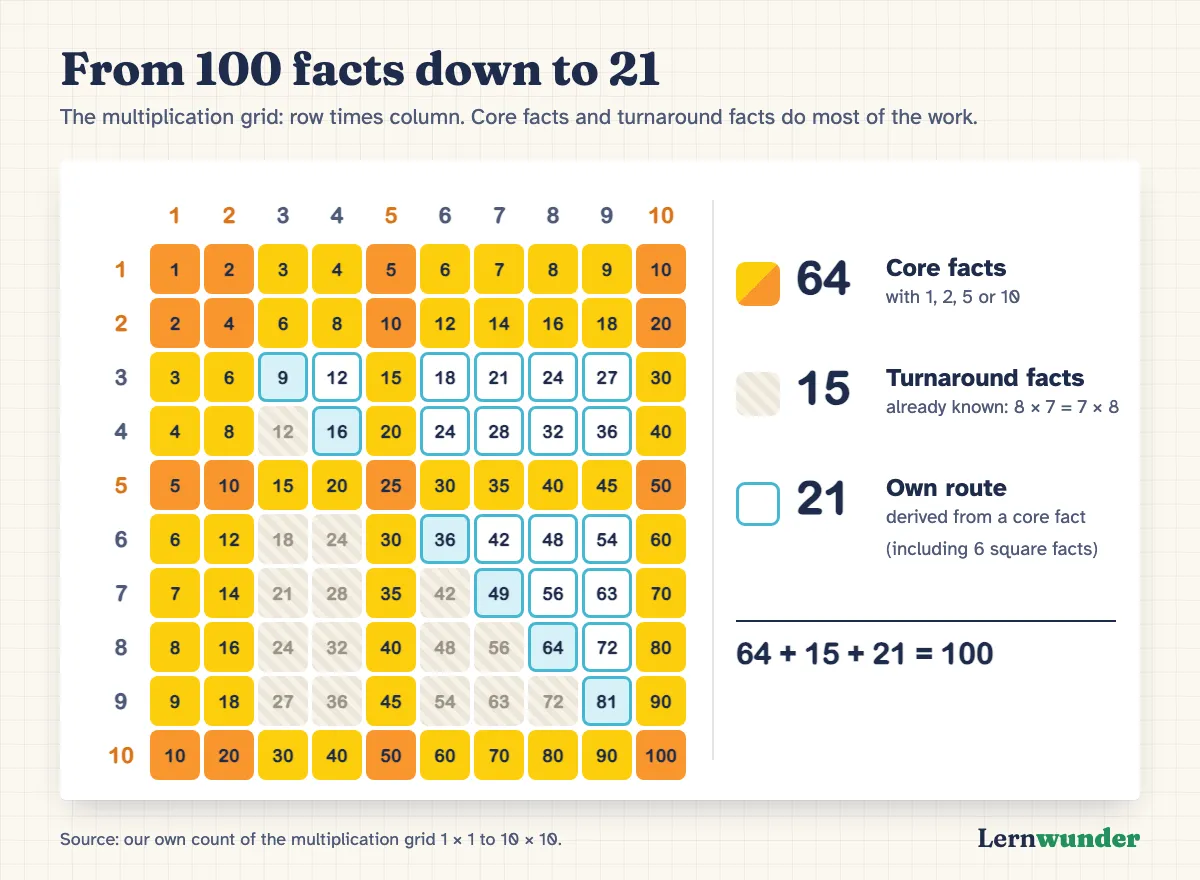
A simple count on the 10 × 10 multiplication grid shows how far these four tables reach:
- 64 facts contain 1, 2, 5 or 10 at least once.
- That leaves 36. Six of them are square facts (3 × 3 to 9 × 9).
- The other 30 form 15 turnaround pairs: if you know 7 × 8, you also know 8 × 7.
What remains are 21 facts that need a route of their own. And for each of them, a core fact sits right next door.
Are core facts really easier?
Yes, large data sets show it. A Dutch study analysed how difficult each multiplication fact was for children practising in an adaptive online maths program. The analysis by grade drew on data from about 26,750 children, and every fact had been answered tens of thousands of times. Facts with 1, 2 and 5 were clearly easier than others, and so were square facts. The larger the numbers, the harder the fact, and the advantage of the core facts grew with problem size. Multi-digit problems with 10 or 100, such as 100 × 25, were even easier than most single-digit ones (van der Ven et al., 2015).
So core facts are not just a teaching idea. They are the facts children master first anyway. It makes sense to build from there.
What does research say about derived facts?
Children use several strategies side by side for a long time. A longitudinal study of French second graders measured how they solved multiplication three times over the school year. At every point, the children used a mix of strategies, retrieved answers most often for the same kinds of problems, and fell back on repeated addition for the hardest ones (Lemaire & Siegler, 1995). The question is not whether a child takes detours, but which ones.
In Austria, researchers looked at what happens when teaching puts derived fact strategies centre stage. 48 children from eight classes were interviewed repeatedly over two school years. By the end of Year 3 (third grade), most children solved the facts either by recall or by quick derivation, and almost none still relied on counting or repeated addition. Even lower-achieving children could explain what a multiplication means and knew ways to derive facts. Where they struggled, it was often the logic of a single step (Gaidoschik, Deweis & Guggenbichler, 2017). More on that below.
A smaller study in grades 3 to 5 compared two routes to fluency over five weeks, 10 to 15 minutes a day: strategies supported by pictures and discussion versus drill alone. The strategy group became more fluent, and more consistently so, than the drill group (Brendefur et al., 2015).
Why does this matter?
Because many children don’t reach the goal. In Baden-Württemberg, Germany, 535 children from 39 classes took the same timed test of multiplication and related division facts at the end of Year 2 and the end of Year 3. At the end of Year 3, only 223 of them (just under 42 per cent) met the curriculum target, and 145 were at the lowest level. The authors suggest moving away from working “table by table”, for example by giving only 6 × 8 and asking which known facts could help (Gleißberg, Eichler & Seibold, 2025).
How do you derive facts from core facts?
Four strategies cover almost all of the 21 harder facts:
| Strategy | Example | Idea |
|---|---|---|
| Add a group | 6 × 7 = 5 × 7 + 7 | one row more than the fives fact |
| Ten minus | 9 × 4 = 10 × 4 − 4 | one row less than the tens fact |
| Double | 8 × 3 = 4 × 3 + 4 × 3 | twice an easier fact |
| Split | 7 × 8 = 5 × 8 + 2 × 8 | 7 = 5 + 2, two core facts together |
The last one rests on the same idea as number decomposition: a number can be split into parts that are easier to work with. And many children already know five as an anchor from the power of five.
Turnaround facts help too. 7 × 9 is tedious if you split the 7. As 9 × 7 = 10 × 7 − 7 it takes a single step (Gaidoschik et al., 2017).

Where does deriving go wrong?
The Austrian study captures a typical mistake precisely. Asked whether 5 × 8 could help with 4 × 8, two children said: “Yes, you have to take away 4.” The right answer is to take away a whole row of eight: 40 − 8 = 32. One child worked out 6 × 4 as 5 × 4 + 5 (Gaidoschik et al., 2017).
This isn’t a slip in calculation but a gap in understanding: the child sees 5 × 8 as a number, not as five rows of eight. This is where a picture helps. With an array of five rows of eight in front of them, a child can see at once that 4 × 8 loses a whole row, not four dots.
So deriving isn’t a trick to memorise. It needs a picture of what multiplication is. How to build that picture is the topic of a post of its own.
What you can do
- Secure the core facts first. Practise times 2, times 10 and times 5 until they are solid. Fives as half of tens: “10 × 6 is 60, half of that is 30, so 5 × 6 = 30.”
- Ask rather than tell. With a hard fact, don’t give the answer. Ask: “Which fact do you know that’s close by?”
- Have them write the route down. 6 × 7 = 5 × 7 + 7 = 35 + 7 = 42. This shows you whether your child is really deriving or guessing.
- Check the take-away mistake with objects. Lay out 5 × 8 with coins or cubes: five rows of eight. Then ask: “What do you need to take away to get 4 × 8?”
- Show turnaround facts as a shortcut. “7 × 9 or 9 × 7, which is easier?” Children soon notice that 10 × 7 − 7 is simpler.
- Speed comes last. Short recall rounds help once your child knows the routes. No pressure and no comparing with others.
Why this matters to us
We are working on a times tables game under the working title Droptiply. One of the questions we keep asking: in what order should facts appear, and what should a child see when a fact is new? The research above suggests starting with the core facts and introducing harder facts not as new things to memorise, but as a route from a fact the child already knows. For now this is a plan; nothing is finished.
Frequently asked questions
My child can recite the tables. Isn’t that enough? Reciting is a good start. But a child who starts at 8 every time they need 6 × 8 takes a long time and easily loses count. Deriving it from 5 × 8 is a single step.
Does my child still need to know them all by heart in the end? Yes. Fluent recall remains the goal. Deriving is the way there and the safety net when a fact slips their mind.
Which facts are hardest? Usually those with large numbers, like 7 × 8 or 6 × 9 (van der Ven et al., 2015). That is exactly where a fixed derivation route pays off.
Is zero a core fact too? Zero is a special case. Anything times 0 is 0. That’s quickly learned but not easy to understand. A picture helps: zero rows contain no dots.
Sources
- Brendefur, J. L., Strother, S., Thiede, K. W. & Appleton, S. (2015). Developing multiplication fact fluency. Advances in Social Sciences Research Journal, 2(8). https://doi.org/10.14738/assrj.28.1396
- Gaidoschik, M., Deweis, K. M. & Guggenbichler, S. (2017). Do lower-achieving children profit from derived facts-based teaching of basic multiplication? Findings from a design research study. In T. Dooley & G. Gueudet (Eds.), Proceedings of CERME10 (pp. 346–353). https://hal.science/hal-01873475
- Gleißberg, S., Eichler, K.-P. & Seibold, M. (2025). Mastering the basic facts of multiplication and division till the end of grade 3 – selected results of a longitudinal study. Proceedings of CERME14, TWG02. https://hal.science/hal-05162091
- Lemaire, P. & Siegler, R. S. (1995). Four aspects of strategic change: Contributions to children’s learning of multiplication. Journal of Experimental Psychology: General, 124(1), 83–97. https://doi.org/10.1037/0096-3445.124.1.83
- van der Ven, S. H. G., Straatemeier, M., Jansen, B. R. J., Klinkenberg, S. & van der Maas, H. L. J. (2015). Learning multiplication: An integrated analysis of the multiplication ability of primary school children and the difficulty of single digit and multidigit multiplication problems. Learning and Individual Differences, 43, 48–62. https://doi.org/10.1016/j.lindif.2015.08.013
Lernwunder editorial team · Chaolan Lu