
In short: Children practise their times tables more willingly and for longer when they can see they are making progress and have a say in how they practise. Time pressure adds little: for anxious children it drags performance down, and it measures speed more than knowledge. What helps is progress that is tied to secure recall, shown in small steps, and doesn’t need a stopwatch.
A made-up example that many families will recognise: on the kitchen table there’s a sheet with 30 multiplication facts and an egg timer next to it. “One minute, go!” The first few go quickly. At 7 × 8 the child stalls, glances at the timer, guesses, rubs it out. At the end there are 19 correct answers on the sheet, and a child who says: “I just can’t do this.”
Yet they can do quite a lot. They just can’t see what they already know, and what they feel most of all is the clock. That’s what this post is about: how do you make progress with times tables visible? And how much pressure does practice really need?
What keeps children going when they practise?
Self-determination theory, one of the most thoroughly studied theories of motivation, names three basic needs: feeling competent, having autonomy, and feeling connected to others. When these are met, motivation from within grows (Ryan & Deci, 2000).
Two findings from this research map straight onto times tables. First, positive feedback on performance increased intrinsic motivation in studies, while negative feedback reduced it, and the effect ran through the sense of being capable. Second, threats, deadlines, pressured evaluations and goals imposed from outside lowered intrinsic motivation, whereas choice strengthened it (Ryan & Deci, 2000).
For practice at home this means: a child needs evidence that they can do something, a bit of say in what happens, and someone who’s interested. We looked at what points and stars can and can’t do in our post on rewards in learning.
Why does it help to make progress visible?
Feedback is one of the most powerful influences on learning. But its effect can be positive or negative, depending on what kind of feedback a child gets and how (Hattie & Timperley, 2007). Feedback that shows how far you’ve come and what comes next is something different from a score written under a test.
A well-known study on coffee loyalty cards shows how strongly visible progress drives effort: the closer customers got to their free coffee, the more often they bought one. And a card with two “free” bonus stamps was completed faster than an equally long card without them (Kivetz et al., 2006). That’s adults, not children doing maths. But it shows how powerful even the impression of progress is, and so how easily it can be misused. For us the lesson is: progress should be real, not gifted.
Tying progress to secure knowledge has been studied for a long time. A meta-analysis of 108 controlled evaluations of mastery learning, where students only move on once they’ve mastered a unit, found positive effects on achievement, especially for weaker students (Kulik et al., 1990). Most of the studies, though, involved older learners, from upper elementary school to college.
And game elements? A meta-analysis found small positive effects of gamification on learning, motivation and behaviour. The effect on learning held up in methodologically rigorous studies; the effect on motivation was less stable (Sailer & Homner, 2020). Play can help, but it isn’t a guarantee.
Do timed tests make children faster, or just more nervous?
The goal with times tables is for children to recall facts rather than count. So speed is part of it. The question is whether pressure is the way to get there.
In people with maths anxiety, performance drops show up mainly on timed tests, for example on simple arithmetic, while ordinary achievement tests show hardly any differences. The anxiety takes up part of working memory, which is then missing for the calculation (Ashcraft, 2002). A review of time pressure, stress and maths anxiety reached a more cautious conclusion: pressure can influence which strategy children choose, but the evidence is thin and clear links have not been established (Caviola et al., 2017).
Our conclusion is a judgement call, not a research finding: speed is the result of secure knowledge, not a good route to it. A ticking timer can’t tell you whether a child doesn’t know 7 × 8 yet or is simply nervous right now. And a child who sees red for every mistake has it twice as hard, as we explain in why mistakes shouldn’t be red.
What you can do
- A times table grid to colour in. A 10 × 10 grid, one square per fact. Each fact that’s secure three days in a row gets coloured in, and its turnaround fact with it. With the 1, 2, 5 and 10 times tables, 64 of the 100 squares are already coloured. A child sees that at a glance.
- Beat yourself, not the clock. Instead of “How fast were you?”, ask “How many did you just know today?” and compare it with last week.
- Name the stages. “The 5 times table this week” is a goal a child can reach and tick off. “Times tables” is too big.
- Let them choose. Which table first, cards, dice or a worksheet, before or after dinner: small choices strengthen motivation.
- Speed only on request. Some children love racing the clock. Fine, but as an offer, and without comparing them with others.
What we’re working on
We’re currently working on a times tables app called Droptiply. In it, every multiplication fact becomes a block whose height and width are the two factors; we’ve described how the game idea came about. For progress, we’ve translated the findings above into a structure. This is our current design; details may still change before release.
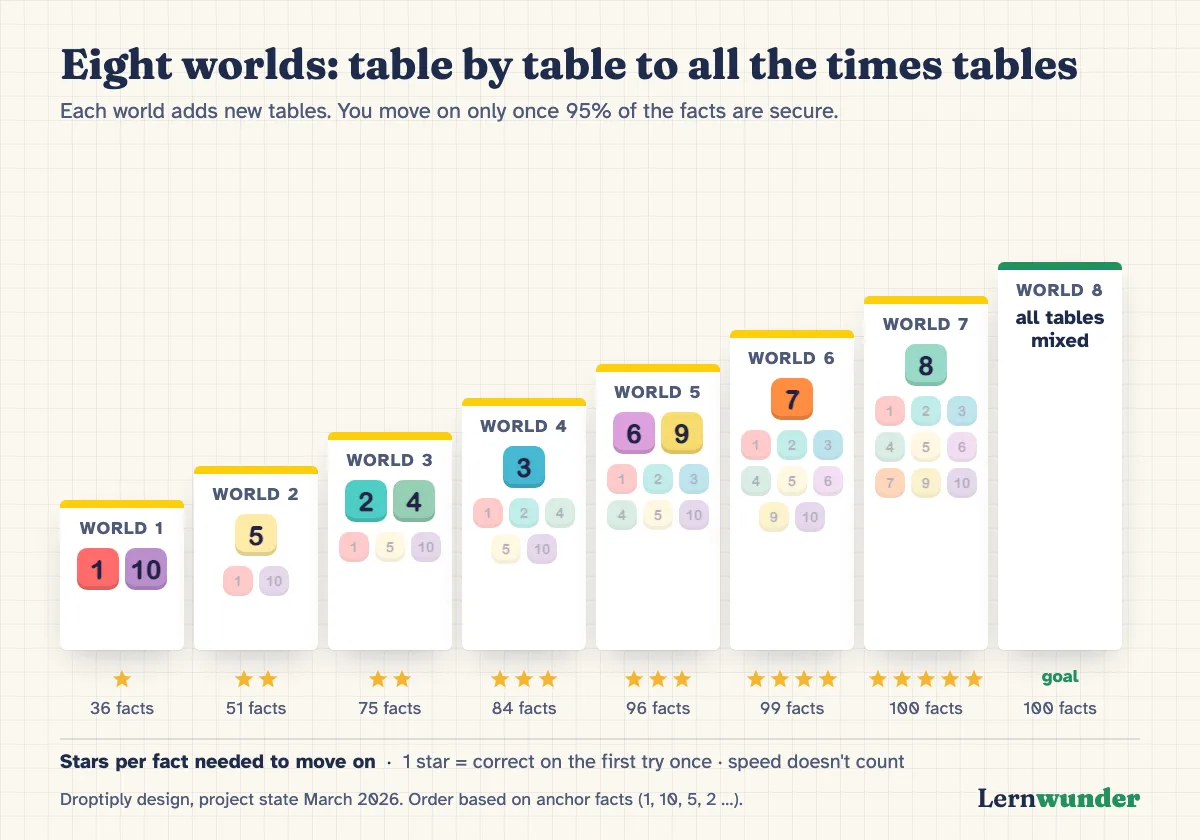
Eight worlds, ordered by anchor facts. The first world starts with the 1 and 10 times tables, followed by 5, then 2 and 4, then 3, then 6 and 9, then 7, and finally 8. The eighth world mixes all tables. The order follows the idea of building times tables from anchor facts: if you know 5 × 8 and 2 × 8, you nearly have 7 × 8.
You move on through security, not speed. A world is complete when 95 percent of its facts are secure. “Secure” means correct on the first try, once in the first world, then two to five times. How fast the answer came doesn’t count. A bar shows how many facts are already secure and how many the next world needs, as a real number.
If you already know it, you don’t have to sit through it. If a child answers several facts in a row correctly and quickly in the early worlds, they can skip a world. The last worlds have to be earned.
The question has no clock. In the normal game the block waits until the child has answered; only then does it fall. In a calm mode nothing falls on its own. A countdown mode is meant as an option for children who like exactly that. It isn’t entirely without tension: if the board fills up, the round ends. The learning progress isn’t affected.
Rewards as feedback, not as a lever. New worlds unlock new colour themes; that’s the visible reward. Extra achievements are meant to be switchable off, for children who find them distracting.
Frequently asked questions
Are timed times tables tests harmful? Not for every child. The evidence is mixed (Caviola et al., 2017). But children with maths anxiety perform worse under time pressure than they actually can (Ashcraft, 2002). A sensible order: accurate first, then fast, and measure speed against the child’s own progress.
Do stars and points help with practice? A little. Game elements show small positive effects, but the effects on motivation aren’t stable (Sailer & Homner, 2020). Rewards work best when they show what a child can do rather than steer them.
In which order should my child learn the tables? It’s well established to start with the tables that other facts can be derived from: 1, 10, 5 and 2. More in our post on anchor facts.
My child insists on playing against the clock. Is that a problem? No. If a child chooses the clock themselves, that’s exactly the kind of choice that strengthens motivation (Ryan & Deci, 2000). It becomes a problem when the clock is imposed and causes anxiety.
Sources
- Ashcraft, M. H. (2002). Math anxiety: Personal, educational, and cognitive consequences. Current Directions in Psychological Science, 11(5), 181–185. https://doi.org/10.1111/1467-8721.00196
- Caviola, S., Carey, E., Mammarella, I. C. & Szucs, D. (2017). Stress, time pressure, strategy selection and math anxiety in mathematics: A review of the literature. Frontiers in Psychology, 8, 1488. https://doi.org/10.3389/fpsyg.2017.01488
- Hattie, J. & Timperley, H. (2007). The power of feedback. Review of Educational Research, 77(1), 81–112. https://doi.org/10.3102/003465430298487
- Kivetz, R., Urminsky, O. & Zheng, Y. (2006). The goal-gradient hypothesis resurrected: Purchase acceleration, illusionary goal progress, and customer retention. Journal of Marketing Research, 43(1), 39–58. https://doi.org/10.1509/jmkr.43.1.39
- Kulik, C.-L. C., Kulik, J. A. & Bangert-Drowns, R. L. (1990). Effectiveness of mastery learning programs: A meta-analysis. Review of Educational Research, 60(2), 265–299. https://doi.org/10.3102/00346543060002265
- Ryan, R. M. & Deci, E. L. (2000). Self-determination theory and the facilitation of intrinsic motivation, social development, and well-being. American Psychologist, 55(1), 68–78. https://doi.org/10.1037/0003-066X.55.1.68
- Sailer, M. & Homner, L. (2020). The gamification of learning: A meta-analysis. Educational Psychology Review, 32(1), 77–112. https://doi.org/10.1007/s10648-019-09498-w
Lernwunder editorial team · Chaolan Lu