In the first part of this series we described why we wanted to build a times-tables app: because fluent times tables aren’t a knowledge problem but a recall problem. Now for the harder question – how do you train recall without boring children or pressuring them?
What flashcards do well – and what they don’t
Flashcards were our starting point, not our enemy. They get a lot right: you decide what to repeat, you get instant feedback, and spaced repetition makes the material stick.
But for the times tables they have two gaps. First: no sense of time. A card draws no distinction between an answer after one second and one after eight. Yet that very difference is what decides a test. Second: a card shows “7×8” on one side and “56” on the other – but never why. It rewards memorising the back of the card, not understanding the relationship.
The idea: the problem is the block
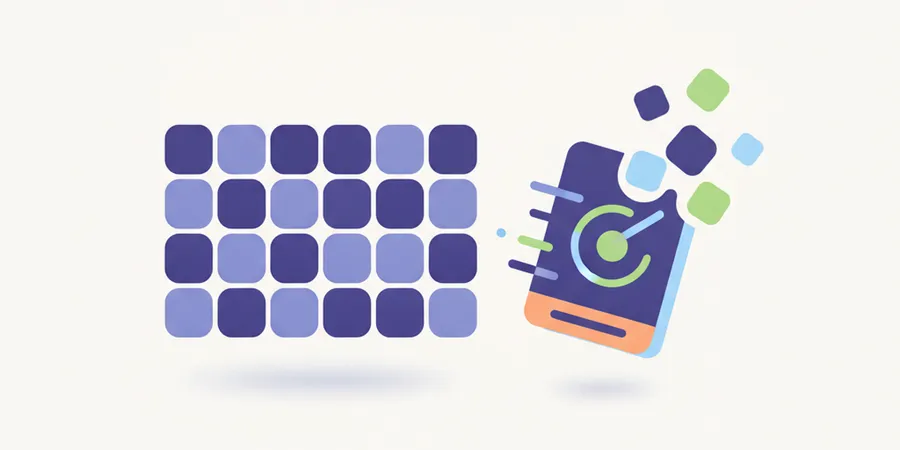
The decisive thought came from didactics, not from game design. Multiplication can be shown as an area – a rectangle of rows and columns. 3×4 isn’t an abstract symbol but a block that is 3 high and 4 wide. This area representation (the array model) is a well-established way in maths education to make multiplication tangible.
And then it clicked: what if that block actually falls? What if the child watches a 3×4 block descend and has to give the answer before it lands?
That closed both gaps of the flashcard:
- The falling block creates real but friendly recall pressure. Not a frightening countdown bar, but a natural movement that invites a pace.
- The block’s dimensions are the factors. The child sees the multiplication instead of just reading it. 7×8 is no longer a string of symbols – it’s a visible quantity.
Why “a little” pressure matters didactically
We hesitated here for a long time, because our apps otherwise follow a clear rule: no countdowns, no stress. With Droptiply, the gentle flow of time is deliberately part of the learning goal. The test, the board, everyday mental arithmetic – they all demand recall under mild pressure. An app that removes that pressure entirely doesn’t train the situation that counts.
The trick is in the dose. The block falls slowly enough that a child who knows the fact answers calmly. It falls fast enough that a still-shaky fact becomes noticeable – as a gentle cue, not a punishment. A wrong or missing answer never triggers red flashing or sad sounds; it simply means that fact will come around again soon.
How the app decides which problem falls next – and why a discovery from 1885 sits behind it – is the subject of the final part of this series.