In short: In your first week on a German ward you do not need a thousand technical terms, but the ones that come up every shift: around the shift and handover, the patient room, care at the bedside, observations, food and medication, hygiene and documentation. We have picked 50 such words, each with its article. The selection is our own, not a frequency list. They are best learned in small portions, out loud, in a sentence and recalled from memory several times.
Monday, first early shift, a made-up scene: the ward manager shows the new nurse the rota, then it is time for handover. “Die Dame in der Sieben hat nachts über Schwindel geklagt, bitte Sturzgefahr beachten, das Bettgitter ist oben.” (The lady in room seven complained of dizziness overnight, please mind the fall risk, the bed rail is up.) The new nurse has years of experience. But which of these words matters most? And which did she never hear in her German course?
We described what makes the first weeks so hard in Arriving on the ward. This article is more practical: a list for the first week and a plan for learning it.
Why not just use a medical dictionary?
Because a dictionary has no order of priority. Research shows how large a vocabulary is needed to understand a language: for English, a well-known analysis estimates 6,000 to 7,000 word families to understand spoken text without help (Nation, 2006). There are no comparable figures for German or for nursing. But the conclusion is clear: if there is that much to learn, start with the words you need most often.
In nursing, this can also be tied to situations. In a survey of 162 Albanian nurses working in Germany, participants named medical terminology, phone calls and documentation as their biggest challenges (Dervishi et al., 2025). That is exactly where the words you hear from day one show up.
How did we choose the 50 words?
We did not find a frequency list for German nursing vocabulary. Our selection is therefore a reasoned list of our own, not a count. We asked three questions:
- Does the word come up in a typical first week? Start of shift, handover, the room, basic care, measuring vital signs, food and medication, hygiene, documentation.
- Do you need it to understand or to act? You have to understand “Sturzgefahr” (fall risk), even if you do not say it yourself yet.
- Is it a noun you can learn with its article? Verbs and phrases matter just as much but deserve their own list.
We deliberately left out abbreviations like RR or BZ. How to learn those is covered in RR, BZ, i.v..
The 50 words
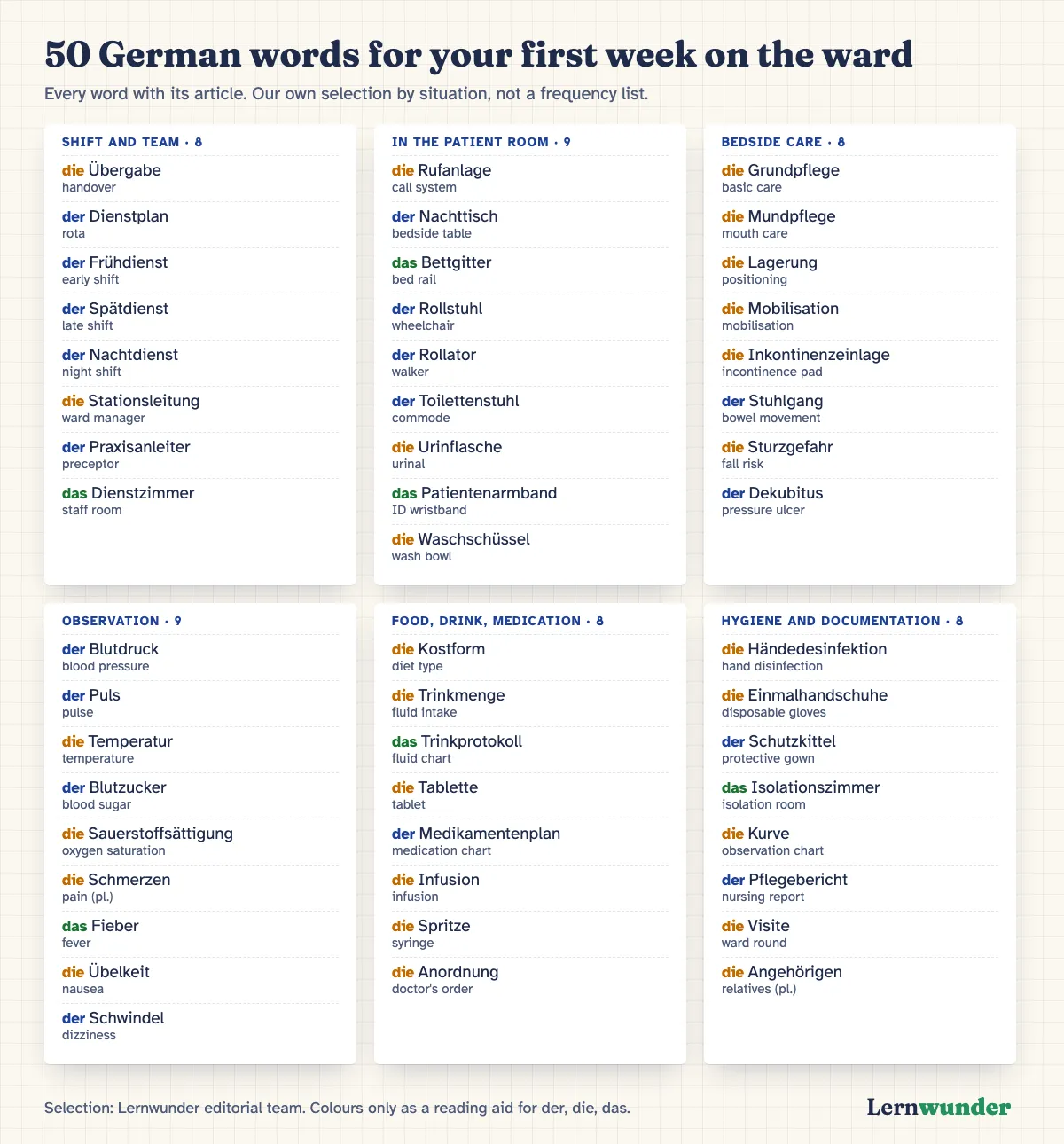
Shift and team (8) die Übergabe (handover) · der Dienstplan (rota) · der Frühdienst (early shift) · der Spätdienst (late shift) · der Nachtdienst (night shift) · die Stationsleitung (ward manager) · der Praxisanleiter / die Praxisanleiterin (preceptor) · das Dienstzimmer (staff room)
In the patient room (9) die Rufanlage (call system) · der Nachttisch (bedside table) · das Bettgitter (bed rail) · der Rollstuhl (wheelchair) · der Rollator (walker) · der Toilettenstuhl (commode) · die Urinflasche (urinal) · das Patientenarmband (ID wristband) · die Waschschüssel (wash bowl)
Bedside care (8) die Grundpflege (basic care) · die Mundpflege (mouth care) · die Lagerung (positioning) · die Mobilisation (mobilisation) · die Inkontinenzeinlage (incontinence pad) · der Stuhlgang (bowel movement) · die Sturzgefahr (fall risk) · der Dekubitus (pressure ulcer)
Observation (9) der Blutdruck (blood pressure) · der Puls (pulse) · die Temperatur (temperature) · der Blutzucker (blood sugar) · die Sauerstoffsättigung (oxygen saturation) · die Schmerzen (pain, plural) · das Fieber (fever) · die Übelkeit (nausea) · der Schwindel (dizziness)
Food, drink, medication (8) die Kostform (diet type) · die Trinkmenge (fluid intake) · das Trinkprotokoll (fluid chart) · die Tablette (tablet) · der Medikamentenplan (medication chart) · die Infusion (infusion) · die Spritze (syringe, injection) · die Anordnung (doctor’s order)
Hygiene and documentation (8) die Händedesinfektion (hand disinfection) · die Einmalhandschuhe (disposable gloves, plural) · der Schutzkittel (protective gown) · das Isolationszimmer (isolation room) · die Kurve (observation chart) · der Pflegebericht (nursing report) · die Visite (ward round) · die Angehörigen (relatives, plural)
Missing a word you hear every day on your ward? Then it belongs on your list. Every ward has its own words.
How do you learn 50 words in a week?
Meet them more often. A meta-analysis of 26 studies on second language vocabulary learning found a medium-sized relationship between the number of encounters with a word and how well it was learned. How strong it was depended, among other things, on whether encounters were spaced and whether there was visual support (Uchihara et al., 2019).
Recall them several times. In one experiment, 98 learners studied word pairs and recalled them one, three, five or seven times in a session. Five and seven retrievals led to better results, even more than two weeks later, than one or three. But every retrieval takes time: when study time was held equal, a single retrieval came out best (Nakata, 2017). In practice: little and often beats long sessions.
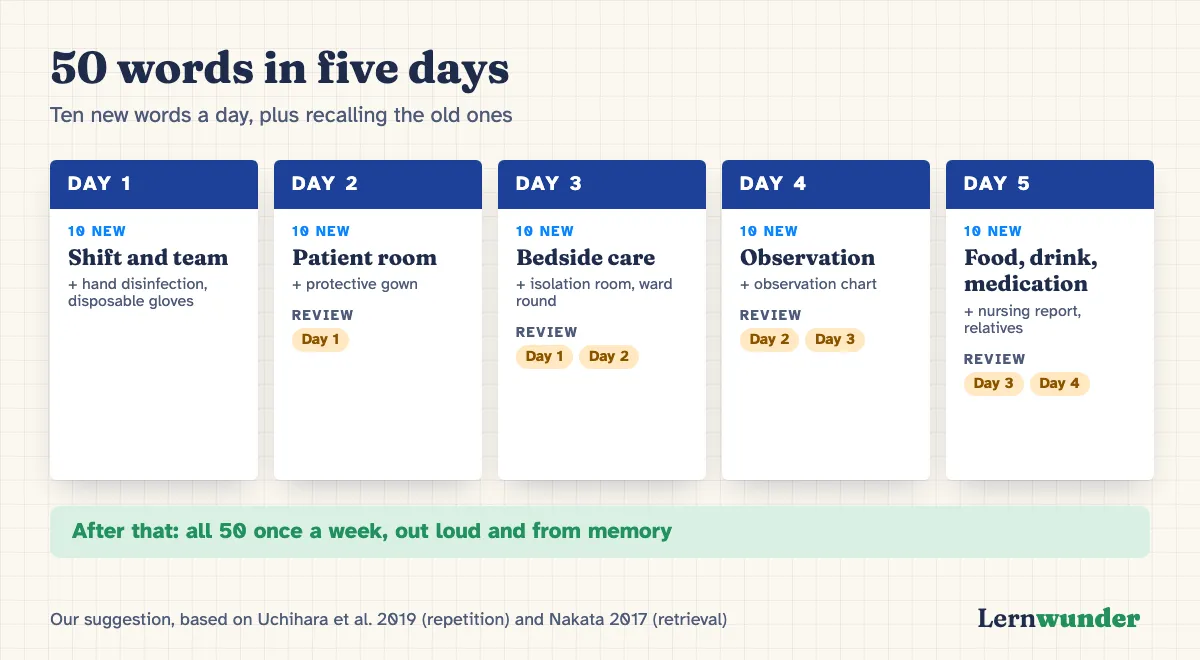
We turned this into a plan. It is our suggestion, not a research standard.
What you can do
- Ten new words a day. No more. Plus yesterday’s words once more from memory.
- Always with the article. “die Kurve”, not just “Kurve”. Why that matters so much is explained in Der, die, das on the ward.
- Say them out loud. Reading silently is not enough. Say each word the way you hear it on the ward.
- One sentence per word. “Ich messe jetzt Ihren Blutdruck.” (I’m going to take your blood pressure now.) That way you learn the word in the situation where you need it.
- Cover and recall. Cover the German column, say the word from memory, then check. It is harder than reading, but it lasts longer.
- Find them on the ward. During a break, point at things and quietly name them: das Bettgitter, der Nachttisch, die Rufanlage.
- Adapt the list. Cross out what never comes up on your ward and add what you hear three times a day.
How PflegeMate can help
PflegeMate is a language learning aid for the German words and sentences of everyday ward work. Of the 50 words on this list, 45 are in the app as their own entry, with a picture, a translation into your language and three example sentences for the patient, a colleague and the doctor. Blood pressure, pulse, temperature and blood sugar appear as tasks (“Blutdruck messen”, to take blood pressure). Only “die Mobilisation” is missing as an entry of its own. Since version 2.1 in August, the app speaks every word with its article and spells out abbreviations the way they are said on the ward.
For the five-day plan, you can mark each day’s words as favourites and listen to them in the evening. The quizzing is up to you, for example by covering the words. PflegeMate is not a medical reference and does not prepare for exams. More on the PflegeMate page.
Frequently asked questions
Why exactly 50 words? Because 50 words fit into five days of ten, even after a shift. The number is a practical size, not a research figure. What matters more than the amount is recalling the words several times.
Should I translate the words into my own language? For the meaning, yes; it helps understanding. But speak and listen in German. More in Your first language as a bridge.
Is it der or die Rollator? Der Rollator. For many nursing words no rule helps, so the article always comes with the word.
What comes after the first week? Verbs and set phrases, especially for handover and the phone. How a handover is built linguistically is explained in Handover in German.
Sources
- Dervishi, A., Jäger, S., Duka, B., Kika, E., Bezhani, V., Lena, A. & Ivziku, D. (2025). Integration of Albanian nurses in Germany: Employment challenges and opportunities – A descriptive study. AIMS Public Health, 12(2), 399–417. https://doi.org/10.3934/publichealth.2025023
- Nakata, T. (2017). Does repeated practice make perfect? The effects of within-session repeated retrieval on second language vocabulary learning. Studies in Second Language Acquisition, 39(4), 653–679. https://doi.org/10.1017/S0272263116000280
- Nation, I. S. P. (2006). How large a vocabulary is needed for reading and listening? The Canadian Modern Language Review, 63(1), 59–82. https://doi.org/10.3138/cmlr.63.1.59
- Uchihara, T., Webb, S. & Yanagisawa, A. (2019). The effects of repetition on incidental vocabulary learning: A meta-analysis of correlational studies. Language Learning, 69(3), 559–599. https://doi.org/10.1111/lang.12343
Lernwunder editorial team · Chaolan Lu