
In short: In many studies, people who learn a new technical word with an explanation in their own language remember it better than with an explanation in the new language only. Your first language is a bridge to meaning, not a substitute for German: speaking, listening and the sentences you need on the ward have to be practised in German. That is exactly how PflegeMate is built.
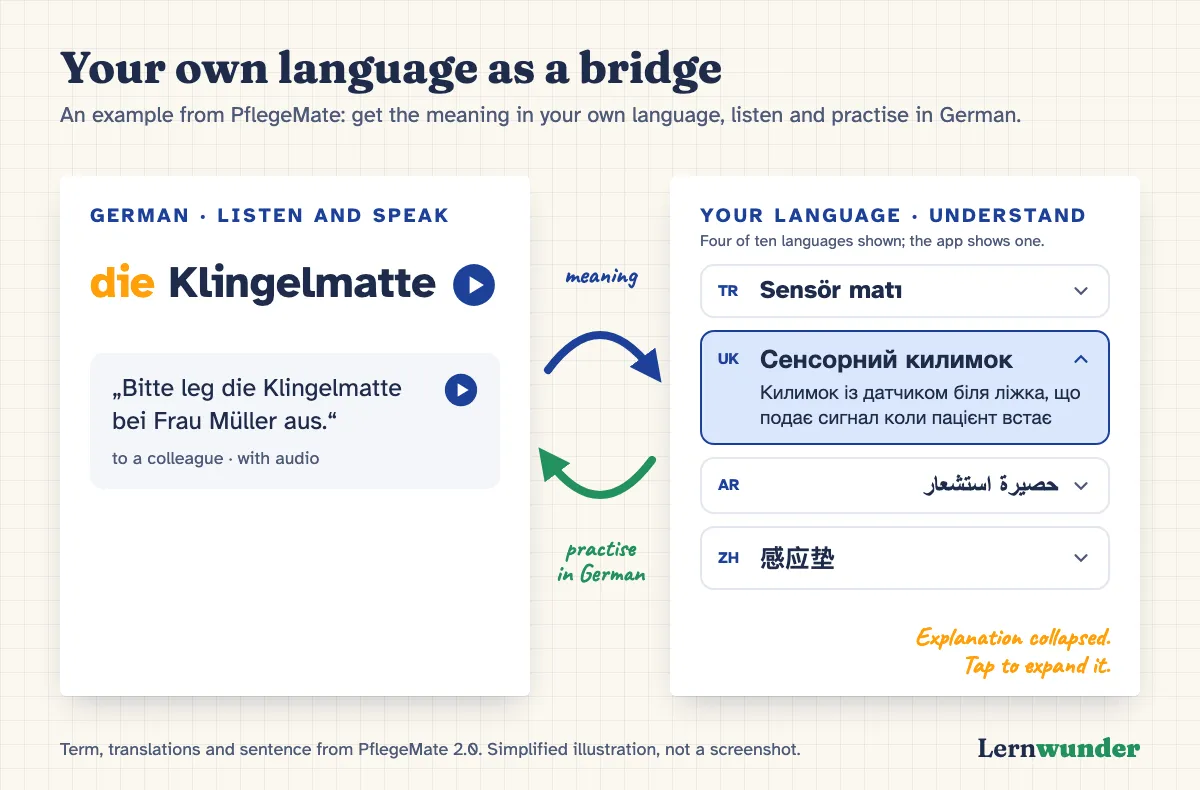
A made-up scene: early shift, second week. A colleague says: “Leg bei Frau Müller bitte die Klingelmatte aus.” Oksana worked as a registered nurse in Kyiv for five years. She knows exactly what fall prevention is. She just doesn’t know the word “Klingelmatte”. A mat that rings? Only when she reads that it’s a floor mat with a sensor that raises an alarm when someone gets up does it click. In Ukrainian she wouldn’t have needed a second.
That’s what this post is about. Internationally educated nurses bring their professional knowledge with them. What’s often missing is just the German form. The question is whether your own language helps you learn it or gets in the way.
Is it OK to use your own language when learning German?
For a long time, the rule in language teaching was: target language only, no translation. A major review shows that this “monolingual assumption” has been increasingly questioned in recent years. Learners’ own languages are used in classrooms around the world, and there are psycholinguistic, learning-theory and social arguments for using them deliberately rather than banning them (Hall & Cook, 2012).
An older, widely cited idea comes from research on bilingual children: what someone can already do in their first language is a foundation for the second (Cummins, 1979). That work is about schoolchildren, not adults at work. But the basic idea fits nursing well: if you know what fall prevention is, you only need to attach the German label to a concept you already have.
What do vocabulary studies show?
Here the picture is fairly clear, with some caveats.
In a study with learners of English, new words were either translated into the learners’ first language or explained in English. The translated words were always remembered better, in the short and the long term (Laufer & Shmueli, 1997).
A study with Chinese-speaking adults compared teachers’ explanations in the first language with English-only explanations, with 50 people per group. With first-language explanations, participants learned more words, both in the immediate and the delayed test (Zhao & Macaro, 2016).
A third study with more than 700 learners in Korea found benefits of the first language for children and for adults at university. The benefit was larger for the children (Lee & Macaro, 2013). For adult nurses that means the first language still helps, but becomes less necessary the better their German already is.
It matters what these studies measure: remembering the meaning of new words. Whether someone can pronounce the word correctly on the ward, use it with the right article and put it in the right place in a sentence is not what they test.
What is translanguaging?
Translanguaging describes how multilingual people actually use their languages: not neatly separated, but as one repertoire they draw on depending on the situation (Li, 2018). For teaching, it means deliberately allowing more than one language.
In hospitals this is everyday reality. In interviews with 78 staff at two bilingual hospitals in Hong Kong, participants described how languages are mixed during handover. The study suggests building this into the handover structure and calls for more research on how to do it safely (Pun, 2021). We described how a handover works in German in Handover in German.
Where are the limits?
A survey of medical students on multilingual learning found benefits for understanding, but also a clear risk: relying too much on one’s own language (Alasmari & Alaqlobi, 2025). That matches our view:
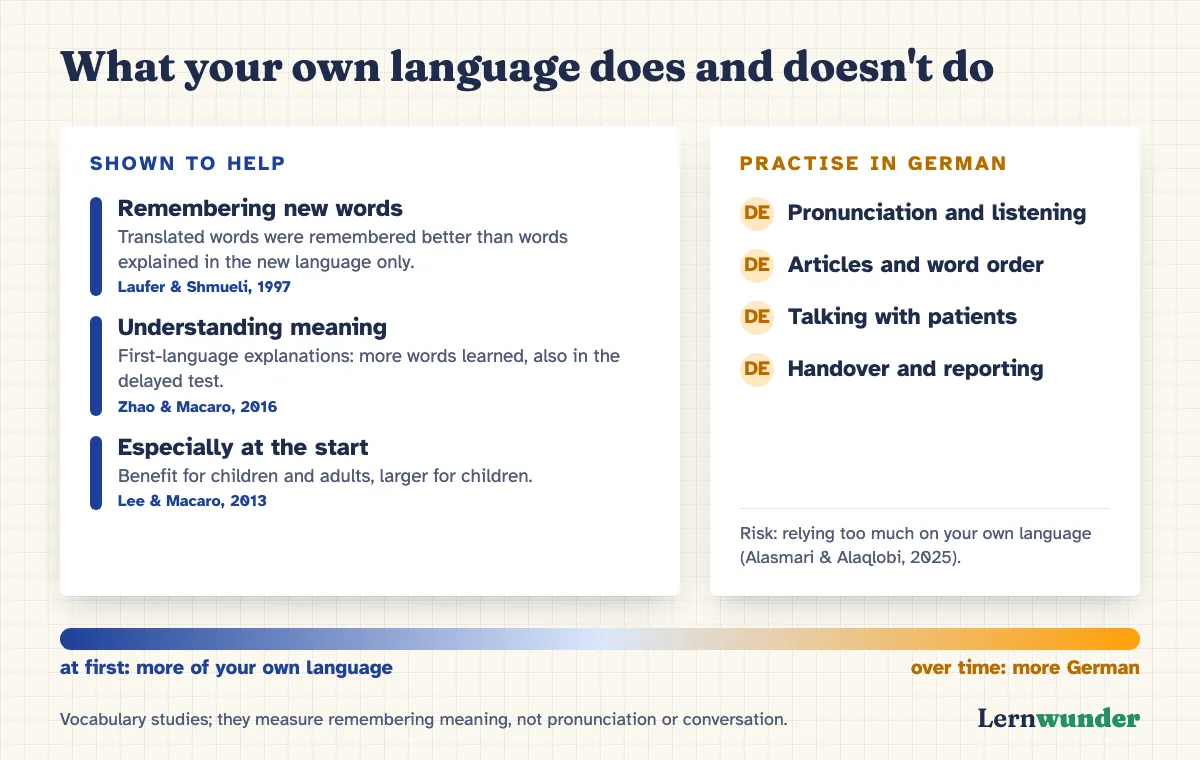
- The bridge leads to meaning, not to the sentence. Reading the translation doesn’t mean you can say the word.
- With patients and the team, the language is German. Your own language helps you learn; it’s not an escape route in conversation.
- Translations are never perfect. Many nursing words have no exact equivalent, and any translation can be off. When in doubt, what your ward says is what counts.
- No word list replaces an interpreter. Consent and diagnoses need professional interpreters or colleagues who speak the language.
What you can do
If you’re learning German for nursing:
- Guess first, then check. Read the German sentence and think about what the word might mean. Only then read the explanation in your language.
- Meaning in your language, form in German. In your notebook, write the German word with its article and a whole sentence on the left, and a keyword in your language on the right. Not the other way round.
- Practise German out loud. Read the translation silently; say the German sentence aloud.
- Check less over time. Once you’ve understood a word three times without the explanation, skip it next time.
If you’re onboarding new colleagues:
- Ask about the concept. “What’s this called in your language?” quickly shows whether only the word is missing or the concept too.
- Use the shared language, then switch. If two colleagues share a language, a tricky point can be explained in it. Then it’s said once more in German.
How we built it into PflegeMate
Since its launch in January, PflegeMate has shown a translation and a short explanation in the learner’s own language for every term. Version 2.0 in March added new terms and categories, and since then every term and its example sentences can be played in German. There are ten languages to choose from: Arabic, Chinese, Croatian/Serbian, English, French, Polish, Romanian, Spanish, Turkish and Ukrainian.
We made three design decisions:
German on top, your language below. The German word with its article comes first and large, next to the listen button. The translation sits below it in smaller type.
The explanation is on demand. The explanation in your own language is collapsed at first. If you need it, tap the translation to expand it. That leaves time to think for yourself, and if you already know a word, it doesn’t distract you.
You only hear German. Each of the three example sentences has its translation directly below, but only the German sentence has a listen button. You don’t need to practise your own language.
You choose your language the first time you open the app and can change it in the settings at any time. The app’s interface itself is in German. And if you don’t know a German word, you can also search for it in your own language.
Translations can contain mistakes. If an explanation seems odd, ask on the ward. PflegeMate is a language learning aid, not a medical reference and not exam preparation.
Frequently asked questions
Will I learn German more slowly if I translate a lot? For remembering new words, your own language helps in many studies. But you only learn to speak and understand by practising German. Use the translation for meaning, then practise the German sentence.
My language isn’t included. Will the app still help? You can choose one of the ten languages you read well, such as English or French. The picture, the German sentence and the pronunciation help either way.
Should I always expand the explanation? Only when you’re unsure. Try without it first.
Find out more on the PflegeMate page.
Sources
- Alasmari, M. & Alaqlobi, O. (2025). A SWOT analysis of translanguaging in healthcare education: Overcoming language barriers for future professionals. BMC Medical Education, 26, 104. https://doi.org/10.1186/s12909-025-08271-8
- Cummins, J. (1979). Linguistic interdependence and the educational development of bilingual children. Review of Educational Research, 49(2), 222–251. https://doi.org/10.3102/00346543049002222
- Hall, G. & Cook, G. (2012). Own-language use in language teaching and learning. Language Teaching, 45(3), 271–308. https://doi.org/10.1017/S0261444812000067
- Laufer, B. & Shmueli, K. (1997). Memorizing new words: Does teaching have anything to do with it? RELC Journal, 28(1), 89–108. https://doi.org/10.1177/003368829702800106
- Lee, J. H. & Macaro, E. (2013). Investigating age in the use of L1 or English-only instruction: Vocabulary acquisition by Korean EFL learners. The Modern Language Journal, 97(4), 887–901. https://doi.org/10.1111/j.1540-4781.2013.12044.x
- Li, W. (2018). Translanguaging as a practical theory of language. Applied Linguistics, 39(1), 9–30. https://doi.org/10.1093/applin/amx039
- Pun, J. (2021). Clinical handover in a bilingual setting: Interpretative phenomenological analysis to exploring translanguaging practices for effective communication among hospital staff. BMJ Open, 11(9), e046494. https://doi.org/10.1136/bmjopen-2020-046494
- Zhao, T. & Macaro, E. (2016). What works better for the learning of concrete and abstract words: Teachers’ L1 use or L2-only explanations? International Journal of Applied Linguistics, 26(1), 75–98. https://doi.org/10.1111/ijal.12080
Lernwunder editorial team · Chaolan Lu